MAX KLEIN BIBLE MINISTRIES
The Seven Baptisms
Written by: Max Klein
Baptism means identification or association:
Introduction:
1. This meaning began in Homer's time. Homer wrote of the one-eyed giant, Cyclops who had trapped Ulysses and his men in a cave and was eating them one at a time. The ingenious Ulysses devised a plan. He had his men sharpen a large log and together they rammed this log into the eye of the one-eyed Cyclops rendering him blind. They identified (baptized) the sharpened log with Cyclops’ eye which changed Cyclops from a seeing giant to a blind giant. Having blinded the Cyclops, they were able to maneuver their way out of the cave. Another example by Homer: Homer's Odyssey, book 9, used baptism for hot metal identified (baptized) with water when a smith dipped a piece of hot iron into water. This is how a blacksmith would temper swords in the ancient world. After this identification, the sword was made stronger and so less likely to bend.
2. Xenophon said that the Spartan military recruits after finishing infantry training would identify (baptize) their spears with pig’s blood. They would run by a barrel of pig’s blood and thrust their spears into this blood. This ritual, identified their spears with killing and the soldier’s readiness for combat with the enemy.
3. Euripides used the word for a ship identified with the bottom of the sea when it sank. Before sinking, the ship was valuable; after sinking it had no value at all.
4. So "baptize" in the classical Greek meant to identify one thing with another so that the characteristics of the original thing were altered. Therefore, the interpretation of the word "baptism" is identification with something that brings about a change.
5. There are a number of cognates related to this Greek word such as bapto, baptizo, baptisma, baptismos, baptistes, and embapto. A few examples follow:
6. John 13:26, “Jesus then answered, ‘That is the one for whom, I shall dip [the future of the Greek word bapto] the morsel and give it to him. So, when he had dipped [the aorist participle of bapto; the sop now takes on a new meaning that of honor] the sop [the morsel], He took and gave it to Judas, the son of Simon Iscariot.”
To give someone a sop [a special bit of food usually a piece of bread or meat with a tasty sauce] was the highest honor of a banquet. At a banquet a special piece of bread or meat was prepared along with a special sauce for the guest of honor who would then honor someone by giving it to that person. Jesus as the guest of honor took this sop and dipped it into a special sauce and gave it to Judas. In this way, the Lord Jesus Christ honored Judas as a member of the family of God, and for his ministry as an apostle to the Lost Sheep of Israel. This honor should have given Judas second thoughts regarding his plan to betray Jesus to the Sanhedrin.
7. Matthew 3:7, “but when he [John the Baptizer] saw many of the Pharisees and Sadducees coming for baptism [identification: the Greek word baptisma], he said to them, “You brood of vipers [poisonous snakes], who warned you to flee from the wrath to come [Baptism of Fire: identification with the fire of Torments and then the Lake of Fire]?”
8. Hebrews 6:1-2, “Therefore, leaving behind the elementary teaching about Christ, let us advance to maturity, not laying again the foundation [of the basics such as]: a change of thinking about dead works [just as an unbeliever must have a change of mind about Christ to obtain salvation, so the believer must have a change of mind about legalism (dead works) in order to obtain the spiritual life], and of faith toward God [Faith-Rest Drill], (2) doctrine of baptisms [the Greek word baptismos; a reference to the seven types of baptism as found in Scripture] as well as the laying on of hands [ritual rebound in the age of Israel], and of resurrection from the dead, and of eternal judgment [the Great White Throne Judgment].
9. Matthew 3:1, “In those days John the Baptizer [the Greek word baptistes; when John baptized someone into the Jordan River, the converts were identified with the plan of God and his kingdom.] came proclaiming [as a herald] in the desert of Judea.”
There are two categories of identification in Scripture namely an actual identification or a real baptism and a representative identification or a ritual baptism which uses water.
The four real or actual identifications with something that has significance.
1. The Baptism of Moses: 1 Corinthians 10:1-2 presents the baptism of Moses, "For I do not want you to be unaware, brethren, that our fathers were all under the cloud and all passed through the sea; (2) and all were baptized [the Greek word baptizo] into Moses in the cloud [the Lord] and in the sea." This was a real identification in which Moses was identified with the Lord and the open path through the Red Sea and the Jews were identified with Moses. By the way, none of the Jews got wet, only Egyptian unbelievers who were immersed in the water as a means of death.
2. The Baptism of the Cross is found in Matthew 20:22, “But Jesus answered [Salome by addressing her sons] and said, “You [plural: a reference to James and John] do not know what you [James and John] ask. Are you [James and John] able to drink of the cup [bear the punishment of all the sins of the world] that I am about to drink of, and to be baptized with the baptism [the sins of the world identified with Christ followed by the Father judging them] that I am baptized with [identified with]?” They [James and John] said to Him, “We are able. [the dumbest statement that James and John ever made]” [I selected the longer text as did Jerome.]
3. The Baptism of the Holy Spirit (Retroactive Positional Truth and Current Positional Truth) occurs at salvation for Church Age believers only.
Colossians 2:12. Having been buried [aorist participle] with Him [Jesus Christ] by means of the baptism [God the Holy Spirit identified us with the burial of Jesus Christ as part of our salvation] by means of which [Baptism] you have been raised up [main verb] with Him [in union with Jesus Christ seated at the right hand of the Father] through faith [at the point of salvation] in the operational power from the source of God who has raised Him [the humanity of Christ was given a resurrection body] out from the dead [physical death].
Romans 6:3-9:
Romans 6:3: Or do you not know that all of us who [a correlative] have been baptized into [identified with] Christ Jesus [Current Positional Sanctification: we are in union with Christ in his life in heaven], have been baptized into His death [Retroactive Positional Truth and so identified with his substitutionary spiritual death on the cross]?
Positionally, (in union with Christ) we share His righteousness, heirship, priesthood, destiny, election, eternal life, royalty, sonship etc. All these making us a new spiritual species in Christ Jesus. The plural correlative hosoi (ὅσοι) means that if we were identified with Christ in heaven and we were, then also we have been identified with Christ in his substitutionary spiritual death in which he removed the power of sin nature. Thus, the sin nature should not have power over our lives.
A few more points will be noted:
1. Note that the baptism of the Holy Spirit at salvation enters the believer into union with Christ at the right hand of God the Father which union is called current positional truth.
2. This verse also mentions identification with Christ in His spiritual death on the cross which identification theologians call retroactive positional truth. Retroactive positional truth also includes identification with Christ in His physical death and burial as well.
3. Identification with Christ in His death, then, has a two-fold connotation namely all personal sins were judged at the cross and since that is the case, God the Father is free to provide in grace, the Recovery Procedure. The second connotation is that good and evil were rejected by Jesus on the cross since good and evil are a part of Satan’s policy and plan. On the cross, Jesus relied on the proto-type spiritual life which operated under the two power options namely God’s power system.
4. So, the old sin nature’s ruling power over the Christian has been broken since all sins were judged on the cross and the Recovery Procedure has been provided. So, Retroactive Positional Truth has destroyed the sovereignty of the old sin nature over the life of the Christian.
5. Also, since Jesus rejected the good and evil policy of Satan so should the believer reject Satan’s policy of good and evil as the believer applies Retroactive Positional Truth.
Romans 6:4: Therefore, we have been buried together with Him through the identification [Baptism of the Spirit] into His death [physical], in order that just as Christ has been raised up from the dead [on Resurrection Sunday], through the glory of the Father [through the Father’s power], [So also we, the dead in Christ, will be raised from the dead by the power of the Father, and those alive at the Rapture, by the power of the Holy Spirit.] in this manner we also might walk in newness of life [Experiential sanctification should reflect our future ultimate sanctification.].
Christ had to die physically “and Jesus having shouted clearly with a loud voice said, Father, into your hands I deposit my [human] spirit, and having said this, he exhaled” (Luke 23:46). This last exhale caused His soul and spirit to depart from his mortal body resulting in physical death. Just as Christ had to die physically in order to obtain his resurrection body, so we must depart from our body of corruption, or mortality in order to receive our eternal body called our resurrection body.
The Newness of Life:
1. The newness of life provided through the baptism of the Spirit includes positional freedom from producing good and evil. Not only are we free from the tyranny of good and evil but we are also free from having to produce good and evil.
2. The believer has no obligation to improve the devil’s world through social action, socialism, welfare state, communism, environmentalism, or any social gospel, social action, getting involved, etc.
3. The human race is protected from Satan’s policy of good and evil through the laws of divine establishment which promote freedom instead of improvement at the cost of freedom.
4. In addition to the Laws of Divine Establishment the believer is insulated from good and evil positionally through the baptism of the Spirit.
5. Divorced from the Old Sin Nature positionally and its useless activity of human good and the function of evil, the life of the believer can be devoted to glorifying the Lord Jesus Christ through maximum knowledge and application of Bible doctrine.
Romans 6:5: For if we have become united with Him [Christ, the new husband] in the likeness of His death [the substitutionary spiritual death of Christ on the cross], and we have, and not only this, but also, we shall be [united in the likeness] of His resurrection [Current Positional Truth: in union with the resurrected Christ].
Romans 6:6: Be knowing this [through Retroactive Positional Truth], that our old man [our former husband, the sin nature dates back to the Garden] has been crucified together [with Him], in order that the [human] body, with reference to its sin nature, [the sin nature located in the body] might be rendered powerless [when we use Recovery Procedure and the two power options], that we should no longer be slaves to the sin nature.
“Our old man has been crucified with Him” meaning that the power of the sin nature has been broken on the cross. Since the power of the sin nature was broken by the work of the cross, we as believers have no excuse for not executing the spiritual life. We will not be able to say to Christ at our evaluation that our sin nature was too powerful for us to execute the spiritual life.
A few points for further clarification:
1. Retroactive positional truth is that phase of the baptism of the Holy Spirit at salvation which identifies the believer with Christ in His spiritual death, physical death and his burial.
2. In the substitutionary spiritual death of Christ on the cross all the personal sins in human history were imputed to Christ, but at the same time the other two trends of the old sin nature were not imputed for judgment.
3. Good and evil is the policy of Satan as the ruler of this world and the function of the old sin nature as the sovereign of human life. In fact, the sin nature functions as the agent of Satan.
4. Good and evil were not imputed for judgment on the cross. Hence, in the spiritual death of Christ on the cross they were rejected to remain an issue in the angelic conflict, rejected to be perpetuated in human history as an issue every believer must face, and either overcome through the intake of doctrine or be entrapped by ignorance of doctrine and therefore lose out in glorifying God in time.
5. We are identified with Christ in His spiritual death, which means that we must understand that our sins have been judged and that good and evil has been rejected.
6. It all adds up to the fact that the sovereignty of the old sin nature over human life has been made powerless through retroactive positional truth.
7. The imputation of all personal sins of the human race to Christ on the cross means that the believer through the rebound technique is instantly forgiven sins, cleansed from all wrong doing which includes Satanic good and evil, restored to fellowship and filled with the Spirit.
Romans 6:7: For we who have died [the Christian is identified with the substitutionary spiritual death of Christ: theologically called Retroactive Positional Truth] have been acquitted [positional deliverance] from [the power of] the sin nature.
A few points for further clarification:
1. A dead person is discharged from the obligations of his former sphere of life. This is why the word “death” is used in this context. It is not a literal, physical death we are discussing but identification with Christ in His death.
2. As unbelievers we were under the authority of Satan as the ruler of this world, and under the authority of the old sin nature as the sovereign of human life.
3. Both the power of Satan and the old sin nature have been abrogated through the baptism of the Holy Spirit at salvation.
4. This passage, then, emphasizes the annulling of the power and the authority of the old sin nature as the sovereign of human life.
5. Positionally, the power of the sin nature has been broken. Experientially, the old sin nature controls to the extent that we fail to understand and utilize the provision and support of logistical grace.
Romans 6:8: Now if we have died with Christ, and we have [retroactive positional truth], we also believe that we shall live in association with Him [the instrumental of association; a reference to Current Positional Truth].
In this verse, the 1st Class conditional sentence shows the relationship between Retroactive Positional Truth with Current Positional Truth. The protasis, the ‘if’ clause states the reality of Retroactive Positional Truth and the apodosis, the concluding clause states the doctrinal inference and the reality of Current Positional Truth. While Retroactive Positional Truth presents positional rejection and separation from good and evil as the policy of Satan and the function of the old sin nature, Current Positional Truth relates the believer to the function of the royal family of God. In other words, they have separate functions.
Romans 6:9: Knowing that because Christ has been raised from the dead [He received a resurrection body], no longer can He die; [physical] death is no longer a master over Him.
Analysis:
1. Retroactive positional truth destroys the sovereign authority of the old sin nature over human life. Current positional truth, on the other hand, destroys the limited authority of physical death in human life.
2. Instead of being ruled by the old sin nature located in the cells of the human body and influencing our souls toward sin, good and evil, we now have a new sovereign, the Lord Jesus Christ. We are identified with Him in His deaths, in His burial, resurrection, ascension and session.
3. Before salvation and the baptism of the Holy Spirit our lives were under the absolute rule of Satan who is the ruler of this world and under the rule of the old sin nature which is the ruler of life, and under the limited rule of physical death. All of that, of course, has been changed since salvation.
4. Now both retroactive and current positional truth have abrogated the authority and power of these former rulers. The power of Satan over our lives has been broken through identification with the rejection of good and evil namely Satan’s policy and plan and through our position in union with Christ. The power of the old sin nature is broken through retroactive positional truth and the power of physical death is broken through current positional truth.
5. Therefore, having studied these things by principle and by implication we are now ready for application, verses 12 & 13 specifically.
6. Having been positionally liberated from the sovereignty of the old sin nature as an absolute ruler, and the authority of physical death, we must recognise and apply doctrine for the experiential victory commanded in verses 11-13.
Galatians 3:25-28, “But now that faith has come, we are no longer under the authority of [have need of] a school bus. (26) For you are all children of God through faith in Christ Jesus. (27) For all of you who were baptized into Christ [identified with Christ through union with Him] have clothed yourselves with Christ. (28) There is neither Jew nor Greek [no racial distinction], there is neither slave nor free man [no social or economic distinction], there is neither male nor female [no gender distinction]; for you are all one in Christ Jesus. [All Christians have the same privileges and opportunities to execute the spiritual life.]”
Current Positional Truth, Elaborated:
In the Church Age, Current Positional Truth establishes our relationship with Christ as opposed to religion. It refers to the Church Age believer in union with Christ and is the key to understanding the Church Age and how the royal family came into being. Therefore, it is the basis for distinguishing between Christianity and religion. Christianity is a relationship with God without merit whereas religion is a system of works to gain the approbation of God. Never shall the twain meet!
The mechanics of Current Positional Truth is the Baptism of the Holy Spirit, whereby the Spirit enters us into union with Christ. 1 Corinthians 12:13, “For also by agency of the one Spirit we are all baptized [identification resulting in becoming a new spiritual species] into one body [in union with Christ], whether Jews or Greeks [racial distinctions are removed], whether slave or free [class and economic distinctions are removed], even all were made to drink [the aorist passive, the voice of grace] the one Spirit [The Holy Spirit did not ask us whether we wanted to be put into union with Christ or not.].” Ephesians 4:5, “One Lord [becomes our Lord positionally at Salvation]), one faith [faith alone in Christ alone; Acts 16:31], one baptism [Baptism of the Holy Spirit takes place at salvation].”
Current Positional truth guarantees that there will be no judgment for believers in eternity, Romans 8:1, “Therefore, there is now no condemnation for those who are in Christ Jesus.” Thus, the condemnation which occurred at the first birth was removed at the 2nd birth. As a result of being born with the sin nature and the imputation of Adam’s Original Sin, we were condemned to the Lake of Fire for all eternity, but now that has been removed. Romans 5:12, “For this reason just as through one man [Adam] the sin [nature] entered into the world [procreation], and so spiritual death through the sin [the imputation of Adam’s Original Sin to the sin nature], and so spiritual death spread to all mankind, because all sinned when Adam sinned [since we were all genetically in Adam when he sinned, we will receive Adam’s Original Sin].” However, at our spiritual birth, the 2nd birth, our pre-salvation sins were all forgiven including Adam’s Original Sin. After which, the Spirit entered us into union with Christ where there is now no condemnation (Romans 8:1).
Current Positional truth qualifies the believer to live with God forever. To live with God forever, the believer must have eternal life and God’s perfect righteousness, 1 John 5:11-12, “And this is the deposition [testimony] that the God [the Father] has given to us, eternal life, and this life is in his son [Since we are in union with Christ, we share this life.]. (12) and he who has the son [a relationship with the Son] has the life [eternal life] and the one who does not have the son of God [relationship with the Son] does not have the life [eternal life].” 2 Corinthians 5:21, “And He [the Father] made Him who knew no sin [perfection] to be a sin offering [imputation of sins on the cross] as a substitute for us so that we might become the righteousness of God in Him [current positional truth].” To live with God forever means you must have His life, and you must be as righteous as He is.
Positional truth guarantees the believer’s eternal security, Romans 8:38-39, “For I am persuaded that neither death [nothing in death] nor life [nothing in life] nor angels nor principalities [ruling angels] nor powers [human organizations] nor things present nor things to come (39) nor height [nothing in heaven] nor depth [nothing in Hades] nor any other creature shall be able to separate us from the love of God which is in Christ Jesus our Lord.” Eternal life in Christ is for all eternity!
Positional truth belongs to all categories of believers whether they be apostate, mature, immature, spiritually adult, or carnal. Since Current Positional Truth occurs at the point of salvation before experience in the Christian life begins, it doesn’t depend on that experience. 1 Corinthians 1:2, “to the church of God which is in Corinth, to those who have been sanctified in Christ Jesus [at salvation], called saints together with all who call upon the person of Our Lord Jesus Christ, their [Lord] and ours.” So, even though you may be carnal or in reversionism, you still have positional truth. Being in union with Christ has nothing to do with what you do [experiential righteousness], or don’t do [failure to execute God’s plan]. Current Positional sanctification is completely the work of God the Holy Spirit and so is not based upon our volition, but on the sovereign decision of God. We make the decision to believe in the Lord Jesus Christ, but we don’t make the decision to enter into union with Christ “all were made to drink the one Spirit” as per 1 Corinthians 12:13. God the Holy Spirit graciously did that for us and so it cannot be undone.
Current Positional truth creates a new spiritual species in Christ as per 2 Corinthians 5:17, “Therefore, if anyone is in Christ and he is, he is a new spiritual species. The old things have lost their power; behold, new things have come to pass.” You become a new spiritual species at salvation by being put into union with Christ. It is what God does for you, and therefore it is grace. It is not what you do after salvation, such as the self-righteous works of legalism. The “old things” have to do with spiritual death and those things related to that death; the “new things” refer to things you receive at salvation such as the 40 assets and the unique spiritual life.
Positional truth should motivate the production of divine good and a pattern of life compatible with royalty as per Ephesians 2:10, “For we are his creation, having been created in Christ Jesus [a new spiritual species with many assets] for the purpose of divine good production [via experiential sanctification] which the God [the Father] has prepared in advance [in eternity past, God the Father provided election and predestination as part of our Portfolio of Invisible Assets], that we in the sphere of them [election and predestination] may pattern our lives.”
Even though a Christian may die the Sin on to Death, he will not lose his position in union with Christ (1 John 5:18-20), and so cannot lose his salvation. In order for a believer to lose his position in Christ, he would have to sin in that status, but since the believer cannot sin in union with Christ, he cannot lose his position in Christ and so cannot lose his salvation. Thus, it is comforting and reassuring to a believer to know that even though a loved one may have died the ‘sin on to death’, he has not lost his salvation.
Because we are in union with Christ, we share His:
1. Eternal life, 1 John 5:11, “And this is the deposition [testimony] that the God [the Father] has given to us, eternal life [At salvation, God the Father imputes this life to the human spirit], and this life is in his son [The Christian also shares the life of Christ through union with Him]. (12) and he who has the son [a relationship with the Son] has the life [eternal life] and the one who does not have the son of God [relationship with the Son] does not have the life [eternal life].”
John 14:6, “Jesus said to him [Thomas], ‘I am the way, the truth and the life [eternal life]; no person [in human history] comes face to face with the Father [having an eternal relationship with the Father] except through Me.’”
2. Perfect righteousness, 2 Corinthians 5:21, “And he (God the Father) made him [Jesus] who knew no sin (perfection) to be a sin offering as a substitute for us so that we might become the righteousness of God in him [positional truth]. Sharing the righteousness of Christ, we become the objects of God the Father’s love as per Romans 8:39.
3. Election, Ephesians 1:4, “just as He [the Father] has elected us for Himself in Him [Jesus Christ] before the creation of the world [in eternity past], that we may be set apart [experiential sanctification] and blameless [ultimate sanctification] in the presence of Him [Father].”
4. Destiny, Ephesians 1:5, “By means of love, He has predestined us for the purpose of adoption as adult sons to Himself through Christ Jesus our Lord according to the grace purpose of His will.”
5. Sonship, Galatians 3:26, “For you are all sons of God through faith in Christ Jesus.”
6. Heirship, Romans 8:16-17, “The Spirit Himself testifies together [bears witness] with our [human] spirit, that we are the children of God. (17) Now, if we are children and we are, also heirs, on the one hand heirs of God [the Father], and joint heirs with Christ. If indeed [if it is true that], we suffer with Him [pass all three stages of undeserved suffering], that also we might be glorified with Christ.”
7. Sanctification, 1 Corinthians 1:2, “to the church of God which is in Corinth, to those who have been sanctified in Christ Jesus, called saints together with all who call upon the person of Our Lord Jesus Christ, their [Lord] and ours.”
8. Priesthood, Hebrews 7:12-19, “For when the priesthood is changed, of necessity there takes place a change in the Law also. (13) For the One [the Lord Jesus Christ] concerning whom these things are spoken belongs to another tribe [the tribe of Judah] from which no one has officiated at the altar. (14) For it is evident that our Lord has descended from Judah, a tribe with reference to which Moses spoke nothing concerning priests, (15) and this is clearer still, if another priest arises similar to Melchizedek, and there has, (16) who has become a priest not on the basis of physical requirement [a reference to the Levitical Priesthood] but on the basis of indestructible life [the Lord’s priesthood is forever]. (17) For this reason, it is witnessed, ‘You are a priest forever similar to the order of Melchizedek.’” [We are in union with Christ. Therefore, we are royalty and priests forever. We represent ourselves before God as royal priests.] (18) For, on the one hand, there is a rescinding of the former commandment [the Mosaic Law that authorized the Levitical priesthood] because of its weakness and uselessness (19) (for the Law brought nothing to completion), but on the other hand, there is the bringing in of a better hope [the second door of hope for the Church Age believer—a personal sense of destiny—by which we enter the adult spiritual life] through which we draw near to God.”
Hebrews 7:26-28, “For it is fitting that we should have such a high priest, impeccable integrity, the One who cannot do evil, undefiled, separated from sinners and exalted above the heavens; (27) Who does not need daily, like those Levitical priests, to offer up sacrifices, first for their own sins, and then for the sins of the people, because this He did once for all when He [Jesus] offered up Himself. (28) For the Law appoints men as high priests who are weak, but the word of His [God the Father’s] oath, which came after the Law, appoints a Son, who has become perfect forever [Jesus Christ is a perfect high priest].”
9. Royalty, 1 Peter 2:9, “ But you and only you are an elect [elect by God the Father] race [as a new spiritual species], a royal priesthood [since Jesus is a king-priest], a holy nation [God’s entity: a nation of priests: every Christian is a priest], a people for God’s own possession [a protected people], so that you may proclaim the excellencies of Him [Christ] who has called [in eternity past] you out of darkness [spiritual death and the Cosmic Systems] into His amazing light [his plan];”
10. New Spiritual Species, 2 Corinthians 5:17, “Therefore, if anyone is in Christ and he is, he is a new spiritual species. The old things have lost their power [Old Covenant]; behold, new things have come to pass [This would include the New Covenant to the Church.].”
Current Positional Truth changes our relationship with Angels.
1. Through current positional truth the believer is higher than angels positionally.
2. Christ is seated at the right hand of the Father, and so superior to all angels. By virtue of being in union with Christ, every believer is now positionally superior to angels.
3. Positional truth has fulfilled the believer’s triumph with Christ in the angelic conflict. We are victorious with Him already.
4. Furthermore, positional truth demands compatibility with experiential righteousness. Therefore, the believer’s walk on this earth must be compatible with positional truth since we have perfect security in Christ, we have the freedom to choose for Jesus Christ, to love Jesus Christ, to respond to His love, and to fulfill our purpose on this earth.
What positional truth is not?
1. It is not an experience, emotions or ecstasies.
2. It is not progressive; it cannot be improved in time or eternity.
3. It is not related to human merit or ability.
4. It cannot be changed by God, man or angels. It is eternal in nature.
5. It is not obtained gradually as you grow in grace, but in toto at salvation.
6. It is not known apart from the metabolization of doctrine.
7. From understanding the doctrine of positional truth, we progress in our spiritual life, but we cannot improve it since it is perfect at salvation.
8. We are not in Christ because of what we do (execution of the spiritual life) or fail to do (fail to execute the spiritual life), but because of what God has done.
A few points of explanation:
1. The conclusion from positional truth, whether retroactive or current, is that the Christian must apply these doctrines to his spiritual life.
2. In Romans 7:1-4 where we have an illustration of a woman whose first husband has died freeing her to marry another. This is what actually happens to us as believers at salvation. The old sin nature is the husband up to the point of salvation, but at the moment we believe in Jesus Christ positionally the sin nature is dead, as it were, the first husband has died and we have a new husband through union with Christ. Retroactive Positional Truth removes our first husband, the sin nature whereas Current Positional Truth enters us into union with Christ, our new husband.
3. The old sin nature-husband is still around, still seeking to regain his control over his former wife, the believer. But union with the second husband, the Lord Jesus Christ, has broken the first husband’s authority over the former wife.
4. The Baptism of Fire:
Matthew 3:11, “On the one hand I [John the Baptizer] baptize you [believers] by means of water because of a change of thinking [about Christ], but the one coming after me is mightier than I whose sandals I am not worthy to lace [loosen, remove]. He himself will baptize by means of the Holy Spirit [a reference to the Baptism of the Holy Spirit in the Church Age] and by means of fire [a reference to the Baptism of Fire at the 2nd Advent].”
Baptism of Fire: The baptism of fire (identification with fire) is defined as the judgment of unbelievers both Jew and gentile at the Second Advent. They will be removed from the earth and placed in fire for 1000 years until the Last Judgment, Luke 3:16-17; Mathew 25:31, 33. The analogy to the Baptism of Fire is found in Matthew 24:36-41. The one left in the field is the mature believer; the one taken is the unbeliever.
Parables of the Baptism of Fire:
1. The wheat and the tares (the unbelievers), Matthew 13:24-30, 36-40.
2. The good and bad fish (unbelievers), Matthew 13:47-50.
3. The ten virgins: five wise, five foolish (the unbelievers), Matthew 25:1-13.
4. The sheep and the goats (the unbelievers), Mathew 25:31-46.
5. The talent test, Matthew 25:14-30. The one talent man represents the unbeliever.
If Jesus Christ had not been rejected by the Jewish people, then the age of Israel would have continued until its completion (the Tribulation completes the age of Israel). (However, they did reject Jesus Christ as Savior and Messiah and so the client nation was destroyed, and the Church age was intercalated that is inserted before the age of Israel was complete.) After the completion of the age of Israel at the end of the Tribulation, comes the wrath of God namely the Baptism of Fire when the Lord removes both Jewish and gentile unbelievers from the earth and identifies them with fire forever. After which, the Millennial reign begins.
The Three Ritual Baptisms. None are extant at the present time. They are representative identifications in which water is used as a training aid to represent some principle of doctrine.
1. The Baptism of John is found in Matthew 3:2-6, “Saying, ‘Change your thinking [regarding Christ] for the kingdom of heaven is near.’ [The future king was already on the earth] (3) For this is what was communicated through Isaiah, the prophet saying, ‘The voice of one [John the Baptizer] proclaiming loudly in the desert [of Judea]. Prepare [the aorist tense is a one time-decision] the way of the Lord [an idiomatic expression for salvation]. Keep on making upright [the use of the Recovery Procedure followed by the development of experiential righteousness] His paths!’ (Isaiah 40:3) (4) Now, John himself kept on having a garment of camel’s hair [very uncomfortable] and a leather belt around his waist, and his food was locusts and wild honey. (5) Then [after John went where God wanted him to be] Jerusalem kept on going out to him [face to face] and all Judea and all the districts around the Jordan. (6) and they were being baptized [identified with the kingdom] by him [under John’s authority] in the Jordan River [where Israel crossed when they entered the land], and they kept on confessing their sins [post-salvation confession of sins].”

MAX KLEIN BIBLE MINISTRIES
First Corinthians Chapter Nine
A verse-by-verse commentary by Max Klein
Let us bow our heads; If we need to use the Recovery Procedure as found in 1 John 1:9, let us do so at this time that we might be in fellowship. (pause) Father, we thank you for the privilege and opportunity to study your word and for the freedom that you have provided for us here in Corpus Christi, Texas, U.S.A.; furthermore, we express our appreciation to God the Holy Spirit who will enlighten us regarding the message this morning. We as priests pray this through the person of our Lord Christ Jesus, our High Priest, Amen.
The Law of Supreme Sacrifice: 1 Corinthians 9:1-15.
Paul’s authority verses 1-2.
1 Corinthians 9:1
Am I not free [under the Law of Liberty]? Yes, I am. Am I not an apostle [He had the gift and the accompanying gifts]? Yes, I am. Have I not seen Jesus our Lord [on the road to Damascus]? Yes, I have. Are you not my work in the Lord [Paul had led them to the Lord either directly or indirectly]? Yes, you are. [All questions in this verse expect a ‘yes’ answer.]
Οὐκ εἰµὶ ἐλεύθερος; οὐκ εἰµὶ ἀπόστολος; οὐχὶ Ἰησοῦν τὸν κύριον ἡµῶν ἑώρακα; οὐ τὸ ἔργον µου ὑµεῖς ἐστε ἐν κυρίῳ;
Law of Liberty:
Freedom to get married;
Freedom to be paid for his services;
Freedom to eat meat and drink wine in the restaurants of a heathen temple;
APOSTLESHIP:
The Greek word, apostolos (apostle) is an Attic Greek word which was already 500 years old when used in the New Testament. First, it was used for the highest ranking-naval admiral in command over the Athenian fleet and the army. These men were chosen by a special council and were given absolute authority in time of war. This would be equivalent to the authority given to the twelve apostles sent to evangelize the unbelievers of Israel and to the twelve apostles commissioned in the Church Age for the primary function of evangelizing, preparing young men for the ministry, establishing local Churches and writing the New Testament Canon. Regarding its secondary meaning, the Athenian government would delegate authority to a person for the purpose of governing an Athenian colony. This new governor of the colony was called an apostolos as well. Paul, for example, delegated authority to many pioneer missionaries that they might have the necessary power to execute their responsibilities. Therefore, both uses of this word are found in the New Testament.
Who were the apostles to the Lost Sheep of Israel?
Jesus had approximately 5000 disciples at one point in his ministry. Out of these disciples only a small number would be promoted to the position of apostleship. Jesus realizing that he needed to promote some of his students to apostleship went up to a mountain and prayed all night regarding this matter. The next morning, he came down with a promotion list. Twelve disciples were promoted to the temporary rank of apostleship. It was temporary since they would hold this position until 30 A.D. when the Church Age would begin. As believers taught by Christ himself, their responsibility was to give the gospel to the “Lost Sheep of the House of Israel”.
“And it was at this time that he went off to the mountain to pray, and he spent the whole night in prayer to God [the Father]. When he returned, he called his disciples (approximately five thousand) to him and chose twelve from among them whom he named his apostles: Simon whom he also named Peter, and Andrew his brother; and James and John; Philip and Bartholomew and Matthew and Thomas; James the son of Alphaeus, Simon who was called the Zealot, Judas the son of James, and Judas Iscariot who became a traitor.” (Luke 6:12-16)
What was their responsibility? Jesus gave these twelve the authority and responsibility to evangelize the unbelievers of Israel (Matthew 10:5, 6) and to announce that the rule of the Messiah was coming nearer (Matthew 10:7). They were given the gifts of healing and miracles to identify themselves as the Lord’s apostles. (Their sensational gifts of healing and miracles were never designed to remove suffering. If so, they would have healed all and performed miracles to benefit all, but they didn’t.) These gifts of healing and miracles were designed to gain an audience and then to give those in the audience the gospel message.
Who were the apostles in the early church?
In the Church Age, in order to become an apostle, one had to see the resurrected Christ. “One of these must become a witness with us of his resurrection” (Acts 1:22). The resurrected Christ appeared to the eleven disciples, and to Paul conferring on them the permanent rank of apostleship in the Church Age.
1 Corinthians 15:5-8, “And that he appeared to Cephas (Peter) then to the twelve (the twelve is a title, actually there were only eleven). After that he appeared to more than five hundred brethren at one time, most of whom remain until now (still alive), but some have fallen asleep (died); Then he appeared to James (Lord’s half-brother), then to all the apostles (the eleven) and last of all, as to one untimely born [miscarriage, as a bastard], he appeared even to me (Paul).”
What was their responsibility? These twelve men had absolute power and authority to teach the spiritual life of the Church Age, to establish churches, to train men for the ministry and to write the New Testament epistles (Also, a few others wrote who were closely associated with apostles). They had rank with absolute power to get the Church Age started.
As the Athenian Commander had absolute power over the Athenian Navy and army so the twelve apostles had absolute power over the Churches. To illustrate their power, Paul had the authority and power to turn a Christian over to Satan for the purpose of being tortured to death (1 Corinthians 5:1, 5).
Others were called apostles in the early church!
The second meaning of the Greek word apostolos was used for pioneer missionaries who were under the authority of the apostles. They had tremendous powers, but they were delegated powers. They were called apostles because apostolos is also used for a Greek who founded and governed a colony as we mentioned in the introduction. They did not possess the spiritual gift of apostleship, but held such gifts as pastor-teacher, evangelist, missionary, etc. Since Barnabas helped Paul on some of his missionary journeys, Paul delegated to him authority to function as a pioneer missionary.
“But when the apostles, Barnabas and Paul heard of it, they tore their robes and rushed out into the crowd, shouting out” (Acts 14:14).
ἀκούσαντες δὲ οἱ ἀπόστολοι Βαρναβᾶς καὶ Παῦλος, διαρρήξαντες τὰ ἱµάτια αὐτῶν ἐξεπήδησαν εἰς τὸν ὄχλον, κράζοντες
Also, Epaphras, Andronicus, Junias, Timothy, Silvanus who functioned as missionaries and pastor-teachers were called apostolos just to mention a few. Philippians 2:25, “But I thought it necessary to send to you Epaphroditus, my brother and fellow worker and fellow soldier, who is also your spiritual ruler (in the Greek: apostolos), a minister to my needs.”
Ἀναγκαῖον δὲ ἡγησάµην Ἐπαφρόδιτον τὸν ἀδελφὸν καὶ συνεργὸν καὶ συστρατιώτην µου, ὑµῶν δὲ ἀπόστολον καὶ λειτουργὸν τῆς χρείας µου, πέµψαι πρὸς ὑµᾶς,
Romans 16:7, “Pay my respects to Andronicus and Junias, my cousins, and fellow prisoners who are prominent among the missionaries (in the Greek: apostolos), who also have been in Christ before me [they were believers before Paul].”
ἀσπάσασθε Ἀνδρόνικον καὶ Ἰουνιᾶν τοὺς συγγενεῖς µου καὶ συναιχµαλώτους µου, οἵτινές εἰσιν ἐπίσηµοι ἐν τοῖς ἀποστόλοις, οἳ καὶ πρὸ ἐµοῦ γέγοναν ἐν Χριστῷ.
1 Thessalonians 2:6, “Nor did we (Paul, Silvanus, Timothy) seek glory from men, either from you or from others, even though as apostles (Paul, Silvanus and Timothy) of Christ, we might have asserted our authority.”
οὔτε ζητοῦντες ἐξ ἀνθρώπων δόξαν, οὔτε ἀφ’ ὑµῶν οὔτε ἀπ’ ἄλλων, δυνάµενοι ἐν βάρει εἶναι ὡς Χριστοῦ ἀπόστολοι.
The Apostle Paul:
1. Paul participated in the martyrdom of Steven in 36 A.D. Acts 7:54-60, “Now when they heard this [Steven’s message], they [the Jewish religious unbelievers] were cut to the quick, and they began gnashing their teeth at him. (55) But being full of the Holy Spirit, he [Steven] gazed intently into heaven and saw the glory of God, and Jesus standing at the right hand of God [the humanity of Christ stood up from his session to honor Steven and to motivate Steven in his martyrdom]; (56) and he said, "Behold, I see the heavens opened up and the Son of Man standing at the right hand of God. (57) But they [these religious Jewish unbelievers] cried out with a loud voice, and covered their ears and rushed at him with one impulse [when unbelievers or believers reject truth, they will come to hate it]. (58) When they had driven him out of the city, they began stoning him; and the witnesses laid aside their robes at the feet of a young man named Saul [His first involvement in murder.]. (59) They went on stoning Stephen as he called on the Lord and said, ‘Lord Jesus, receive my spirit!’ (60) Then falling on his knees, he cried out with a loud voice, ‘Lord, do not hold this sin against them [a demonstration of his impersonal love]!’ Having said this, he fell asleep [died].”
This story continues. Acts 8:1-4, “Saul was in hearty agreement with putting him to death. And on that day, a great persecution began against the church in Jerusalem, and they [the Christians] were all scattered throughout the regions of Judea and Samaria, except the apostles. (2) Some devout men [great believers] buried Stephen, and made loud lamentation over him, (3) but Saul began ravaging the church, entering house after house, and dragging off men and women, he would put them in prison [Paul was merciless]. (4) Therefore, those who had been scattered went about preaching the word.”
2. Paul’s conversion to Christianity in 37 A.D. Acts 9:1-5, “Now Saul, still breathing threats and murder against the disciples of the Lord [Saul murdered many Christians], went to the high priest [in Jerusalem], (2) and asked for letters [giving him the authority] from him to the synagogues at Damascus, so that if he found any belonging to the Way [Christians], both men and women, he might bring them bound to Jerusalem. (3) As he was traveling, it happened that he was approaching Damascus, and suddenly a light from heaven flashed around him; (4) and he fell to the ground and heard a voice saying to him, ‘Saul, Saul, why are you persecuting Me?’ (5) And [seeing Jesus] he said, ‘Who are You, Lord?’ And He said, ‘I am Jesus whom you are persecuting, [This is when Saul believed in Christ.]’”
3. Paul meets Ananias. Acts 9:6-18, “Now, get up [the Lord Jesus] and enter the city, and it will be told you what you must do. (7) The men who traveled with him stood speechless, hearing the voice but seeing no one. (8) Saul got up from the ground, and though his eyes were open, he couldn’t see anything; and leading him by the hand, they brought him into Damascus. (9) And he was three days without sight, and neither ate nor drank [A dramatic change from being a destroyer of Christians to becoming an apostle of Christ. Paul must have been overwhelmed by these events and had much to meditate on!]. (10) Now there was a disciple at Damascus named Ananias [a great believer]; and the Lord said to him in a vision, "Ananias." And he said, "Here I am, Lord. (11) And the Lord said to him, ‘Get up and go to the street called Straight, and inquire at the house of Judas for a man from Tarsus named Saul, for he is praying [Saul is already functioning as a believer], (12) and he has seen in a vision a man named Ananias come in and lay his hands on him, so that he might regain his sight.’ (13) But Ananias answered, ‘Lord, I have heard from many about this man, how much harm he did to Your saints at Jerusalem; (14) and here he has authority from the chief priests to bind all who call on Your name [as if the Lord did not know this].’ (15) But the Lord said to him, ‘Go [an abrupt command], for he is a chosen instrument of Mine, to bear My name before the Gentiles and kings and the sons of Israel; (16) for I will show him how much he must suffer for My name's sake.’ (17) So, Ananias departed and entered the house, and after laying his hands on him said, ‘Brother Saul, the Lord Jesus, who appeared to you on the road by which you were coming, has sent me so that you may regain your sight and be filled with the Holy Spirit [Paul had to be identified with an apostle or a great believer to be filled with the Holy Spirit.].’ (18) And immediately there fell from his eyes something like scales, and he regained his sight, and he got up and was baptized [a reference to water baptism: Paul already understood Retroactive and Current Positional Truth from the answer he had received from the Lord, “I am Jesus whom you are persecuting.”];
4. Paul spends a few days in Damascus, Syria explaining the gospel to the Jews in their synagogue. Acts 9:19-22, “and he took food and was strengthened. Now for several days he was with the disciples who were at Damascus [only stayed for a short time before going to the Arabian desert], (20) and immediately he began to proclaim Jesus in the synagogues, saying, ‘He is the Son of God.’ (21) All those hearing him continued to be amazed, and were saying, ‘Is this not he who in Jerusalem destroyed those who called on this name, and who had come here for the purpose of bringing them bound before the chief priests?’ (22) But Saul kept increasing in strength and confounding the Jews who lived at Damascus by proving that this Jesus is the Christ [At this point they are not hostile toward Paul, but after three years of blackout and scar tissue of the soul, they will be. Though Paul was able to explain the gospel well, he was not equipped to explain the spiritual life. So, he departed for Arabia for his seminary education].
5. Paul goes to Arabia to learn about the spiritual life from the Lord Jesus Christ, 37-40 A.D. Galatians 1:15-18, “And he was pleased [God the Father in eternity past] when he had selected me [in the divine decree for a special job as the greatest apostle], out from my mother’s womb [at birth] and had called [elected in eternity past] me through His grace. (16) to reveal His Son in me [in his soul] that I might proclaim Him among the gentiles [as the apostle to the gentiles], I did not immediately consult with flesh and blood [with people], (17) nor did I go to Jerusalem to those who were apostles before me, but I went away to Arabia [between Acts 9:22 and 23] and returned once more to Damascus [Acts 9:23b-25]. (18) Then, three years later [after his conversion] I went up to Jerusalem [first trip to Jerusalem after his conversion] to become acquainted with Cephas and stayed with him fifteen days.”
6. Paul returns to Damascus and spends some time there, Galatians 1:17b and Acts 9:23-25, “When many days [when a sufficient period of time] had elapsed [after Paul’s three years in the Arabian Desert], the Jews [had become hostile toward the truth] plotted together to do away with him [to kill him], (24) but their plot became known to Saul. They were also watching the gates day and night so that they might put him to death; (25) but his disciples took him by night and let him down through an opening in the wall, lowering him in a large basket.
7. After being forced to leave Damascus, Syria, he went to Jerusalem circa 41 A.D. 2 Corinthians 11:32, 33, “In Damascus the ethnarch under Aretas the king [in order to please the religious Jews of his city] was guarding the city of the Damascenes in order to seize me, (33) and I was let down in a basket through a window in the wall, and so escaped his hands.”
8. There [in Jerusalem, his first trip] he spent 15 days with Cephas that he might be brought up to date regarding the early church. Also, he spent a few days with James, an expert in the Old Testament with whom he discussed certain matters of the Old Testament. Then, Paul began evangelizing the Jews in Jerusalem. Galatians 1:18, 19, “Then, three years later [after his conversion] I went up to Jerusalem to become acquainted with Cephas and stayed with him fifteen days. (19) But I did not see any other of the apostles except James, the Lord’s brother [spent a few days with James].” Acts 9:26-30, “When he came to Jerusalem, he was trying to associate with the disciples [Peter and James]; but they were all afraid of him, not believing that he was a disciple. (27) But Barnabas took hold of him and brought him to the apostles and described to them how he had seen the Lord on the road, and that He had talked to him [Paul], and how at Damascus he had spoken out boldly in the name of Jesus. (28) And he [Paul] was with them, moving about freely in Jerusalem, speaking out boldly in the name of the Lord. (29) And he was talking and arguing with the Hellenistic Jews; but they were attempting to put him to death. (30) But when the brethren learned of it [the assassination attempt], they brought him down to Caesarea and sent him away to Tarsus.” After Paul debarked from the ship at Tarsus, he went back to the cities of Syria, and then returned to Tarsus, Cilicia (Galatians 1:21).
9. Barnabas, needing help at Antioch, Syria, went to Tarsus to seek Paul’s help in circa 43 AD as per Acts 11:25-26, “And he [Barnabas] left for Tarsus to look for Saul; (26) and when he had found him, he brought him to Antioch [Syria]. And for an entire year they met with the church and taught considerable numbers; and the disciples were first called Christians in Antioch.”
10. In 45 AD, Agabus [a prophet] came to Antioch [Syria] announcing that a famine was about to occur all over the world as per Acts 11:28-30, “One of them named Agabus stood up and began to indicate [foretell] by the Spirit [as a prophet, the Holy Spirit provided this information to Agabus.] that there would certainly be a great famine [45-47 A.D.] all over the world. And this took place in the reign of Claudius [41-54 A.D.]. (29) And in the proportion that any of the disciples had means, each of them determined to send a contribution for the relief of the brethren living in Judea. (30) And this they did, sending it in charge of Barnabas and Saul to the elders [to the pastors in Jerusalem: Paul’s 2nd trip to Jerusalem].” Funds were collected from the Antioch Christians to be taken to Christians in need in the land of Judea.
Acts 12:25, “And Barnabas and Saul returned from Jerusalem [from Paul’s 2nd trip to Jerusalem] when they had fulfilled their mission, taking along with them John who was also called Mark.”
11. Paul and Barnabas taking John Mark with them, go on their 1st Missionary Journey circa 47-48 A.D. Acts 13:1-16, “Now there were at Antioch [Syria], in the church that was there, prophets and teachers: Barnabas, and Simeon who was called Niger, and Lucius of Cyrene, and Manaen who had been brought up with Herod the tetrarch [a reference to Herod Antipas, the Fox; Manaen being a foster-brother], and Saul. (2) While they were ministering to the Lord and fasting, the Holy Spirit communicated, ‘Set apart for Me Barnabas and Saul for the work to which I have called them.’ (3) Then, when they had fasted and prayed and laid their hands on them, they sent them away. (4) So, being sent out by the Holy Spirit, they went down to Seleucia [a port city] and from there they sailed to Cyprus. (5) When they reached Salamis [a city of Cyprus], they began to proclaim the word of God in the synagogues of the Jews; and they also had John as their helper. (6) When they had gone through the whole island as far as Paphos, they found a magician, a Jewish false prophet whose name was Bar-Jesus, (7) who was with the proconsul, Sergius Paulus [who would become a believer], a man of intelligence. This man summoned Barnabas and Saul and sought to hear the word of God. (8) But Elymas the magician (for so his name is translated) was opposing them, seeking to turn the proconsul away from the faith, (9) but Saul, who was also known as Paul, filled with the Holy Spirit, fixed his gaze on him, (10) and said, ‘You who are full of all deceit and fraud, you son of the devil, you enemy of all righteousness, will you not cease to make crooked the straight ways of the Lord? (11) Now, behold, the hand of the Lord is upon you, and you will be blind and not see the sun for a time.’ And immediately a mist and a darkness fell upon him, and he went about seeking those who would lead him by the hand. (12) Then the proconsul believed [in the Lord Jesus Christ] when he saw what had happened, being amazed at the teaching of the Lord [the gospel message]. (13) Now Paul and his companions put out to sea from Paphos and came to Perga in Pamphylia [today the shores of Southern Turkey]; but John left them [for fear of losing his life] and returned to Jerusalem. (14) But going on from Perga, they arrived at Pisidian Antioch [a very dangerous route], and on the Sabbath day they went into the synagogue and sat down. (15) After the reading of the Law and the Prophets the synagogue officials sent to them, saying, "Brethren, if you have any word of exhortation for the people, say it.’ (16) Paul stood up, and motioning with his hand said, ‘Men of Israel, and you who fear God, listen:’ Acts 13:42-14:28, “As Paul and Barnabas were going out from [the synagogue in Antioch of Pisidia], the people kept begging that these things might be spoken to them the next Sabbath. (43) Now, when the meeting of the synagogue had broken up, many of the Jews and of the God-fearing proselytes [Gentiles who had joined Judaism] followed Paul and Barnabas, who, speaking to them, were urging them to continue in the grace of God. (44) The next Sabbath nearly the whole city assembled to hear the word of the Lord. (45) But when the Jews [the religious Jewish unbelievers] saw the crowds, they were filled with jealousy and began contradicting the things spoken by Paul, and were blaspheming. (46) Paul and Barnabas spoke out boldly and said, ‘It was necessary that the word of God be spoken to you first; since you repudiate it and judge yourselves unworthy of eternal life, behold, we are turning to the Gentiles. (47) For so the Lord has commanded us, `I have placed you as a light for the gentiles that you may bring salvation to the end of the earth.' (48) When the Gentiles [believers] heard this, they kept on rejoicing [imperfect tense] and praising [imperfect tense] the Word of the Lord, even they had believed [the aorist tense: the point at which they had believed in Christ for their salvation] as many as were assigned to [the perfect passive] eternal life [in the divine decree, the omniscience of God provided assignments; the first assignment was for these Gentiles to believe in Christ]. (49) And the word of the Lord was being spread through the whole region, (50) but the Jews incited the devout [religious] women of prominence and the leading men of the city, and instigated a persecution against Paul and Barnabas, and drove them out of their district. (51) But they shook off the dust of their feet in protest against them and went to Iconium. (52) And the disciples were continually filled with happiness and with the Holy Spirit. (Acts 14:1-28) In Iconium they entered the synagogue of the Jews together, and spoke in such a manner that a large number of people believed, both of Jews and of Greeks, (2) but the Jews who disbelieved stirred up the minds of the Gentiles [unbelieving Gentiles] and embittered them against the brethren [the Christians]. (3) Therefore, they spent a long time there speaking boldly with reliance upon the Lord, who was testifying to the word of His grace, granting that signs [miracles designed for the Jews] and wonders [miracles designed for the Gentiles] be done by their hands, (4) but the people of the city were divided; and some sided with the Jews [the religious unbelieving Jews], and some with the apostles [Paul and Barnabas]. (5) And when an attempt was made by both the Gentiles and the Jews with their rulers, to mistreat and to stone them, (6) they became aware of it and fled to the cities of Lycaonia, Lystra and Derbe, and the surrounding region [remaining there would have been a false application of the Faith-rest-drill]; (7) and there they continued to preach the gospel. (8) At Lystra a man was sitting who had no strength in his feet, lame from his mother's womb, who had never walked. (9) This man was listening to Paul as he spoke [he was very interested in the gospel message], who, when he [Paul] had looked at him intently and had seen that he had the faith to be saved (ὅτι ἔχει πίστιν τοῦ σωθῆναι), (10) said with a loud voice, ‘Stand upright on your feet.’ And he leaped up and began to walk. (11) When the crowds saw what Paul had done, they raised their voice, saying in the Lycaonian language, ‘The gods have become like men and have come down to us.’ (12) And they began calling Barnabas, Zeus, and Paul, Hermes, because he was the chief speaker. (13) The priest of Zeus, whose temple was just outside the city, brought oxen and garlands to the gates, and wanted to offer sacrifice with the crowds, (14) but when the apostles Barnabas and Paul heard of it, they tore their robes and rushed out into the crowd, crying out (15) and saying, ‘Men, why are you doing these things? We are also men of the same nature as you, and preach the gospel to you that you should turn from these vain things to a living God, who made the heaven and the earth and the sea and all that is in them. ‘(16) In the generations gone by He permitted all the nations to go their own ways; (17) and yet He did not leave Himself without witness, in that He did good and gave you rains from heaven and fruitful seasons, satisfying your hearts with food and gladness.’ (18) Even saying these things, with difficulty they restrained the crowds from offering sacrifice to them, (19) but Jews came from Antioch [Pisidia] and Iconium, and having won over the crowds, they stoned Paul and dragged him out of the city, supposing him to be dead. [Though he was dead, he would be resuscitated.] (20) But while the disciples stood around him, he got up and entered the city. The next day he went away with Barnabas to Derbe. (21) After they had preached the gospel to that city and had made many disciples, they returned to Lystra and to Iconium and to Antioch, (22) strengthening the souls of the disciples, encouraging them to continue in the faith, and saying, ‘Through many tribulations we must enter the kingdom of God.’ (23) When they had appointed elders [pastors] for them in every church, having prayed with fasting, they commended them to the Lord in whom they had believed. (24) They passed through Pisidia and came into Pamphylia. (25) When they had spoken the word in Perga, they went down to Attalia [a port city]. (26) From there they sailed to Antioch [Syria], from which they had been commended to the grace of God for the work that they had accomplished. (27) When they had arrived and gathered the church together, they began to report all things that God had done with them and how He had opened a door of faith to the Gentiles. (28) And they spent a long time with the disciples [in Antioch Syria].”

Paul goes to Jerusalem for the third time with Barnabas and Titus [possibly a native of Antioch, Syria] between his first and second missionary journeys to explain to the council in Jerusalem his work with the gentiles as per Galatians 2:1-10, “Then, after an interval of fourteen years [after Paul had left Jerusalem for Damascus in 36 A. D. I went up again to Jerusalem [Paul’s third trip in 50 A.D.] with Barnabas, taking Titus along also. (2) It was because of a revelation that I went up; and I submitted to them the gospel which I preach among the Gentiles, but I did so in private to those who were of reputation, for fear that I might be running, or had run in vain. (3) But not even Titus, who was with me, though he was a Greek, was compelled to be circumcised. (4) But it was because of the false brethren secretly brought in, who had sneaked in to spy out our liberty which we have in Christ Jesus, in order to bring us into bondage [through legalism]. (5) But we did not yield in subjection to them for even an hour, so that the truth of the gospel would remain with you. (6) But from those who were of high reputation (what they were makes no difference to me. God shows no partiality) well, those who were of reputation contributed nothing to me. (7) But on the contrary, seeing that I had been entrusted with the gospel to the uncircumcised, just as Peter had been to the circumcised (8) (for He who effectually worked for Peter in his apostleship to the circumcised effectually worked for me also to the Gentiles), (9) and recognizing the grace that had been given to me, James and Cephas and John, who were reputed to be pillars, gave to me and Barnabas the right hand of fellowship, so that we might go to the Gentiles and they to the circumcised. (10) They only asked us to remember the poor--the very thing I also was eager to do.” At which time, a council at Jerusalem was held in which Paul and Barnabas were given the right hand of fellowship by James, Peter and John. It was also understood at the council that Paul and Barnabas continue to go to the gentiles and the other apostles to the circumcised.
12: Paul’s 2nd and 3rd Missionary Journeys: Paul’s second missionary journey with Silas circa 50 A.D. to the early spring of 53 A.D. During this trip, Paul wrote 1 & 2 Thessalonians from Corinth where he spent his last 18 months of his 2nd missionary journey other than a brief stopover at Ephesus. Paul had a brief stopover in Jerusalem, his 4th Jerusalem visit, at the completion of his 2nd Missionary Journey. Acts 18:22, “When he had landed at Caesarea [at the end of his 2nd Missionary Journey], he went up and greeted the church [in Jerusalem, his 4th trip] and went down to Antioch [Syria].”
On his 3rd missionary journey, he writes from Ephesus to the Galatians in 55 A.D. to the Corinthians in 57 A.D., and to the Romans in 58 A.D. After completing his 3rd missionary journey, Paul goes to Jerusalem [against the will of God] for the 5th and last time.
Paul on his 2nd and 3rd missionary journeys went to Ephesus [on his 2nd for just a short period but on his 3rd for nearly 3 years] which was located three miles from the coast of the Aegean Sea. It was opposite the Island of Samos and had a tremendous harbor at the mouth of the Cayster River. This city with a population of three hundred thousand was connected by roads to all the major cities of the province of Asia Minor.
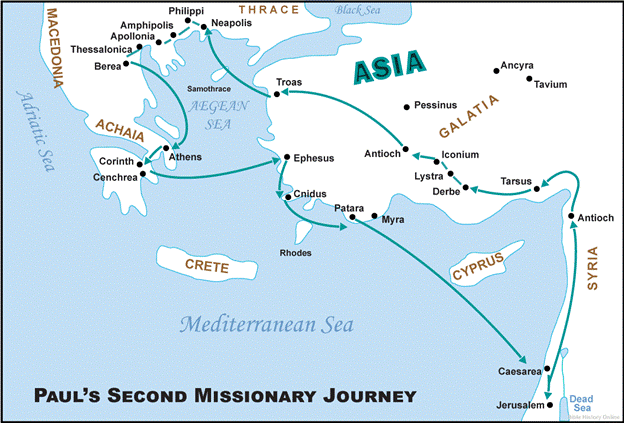
On his 2nd missionary journey, Paul and Silas departed Antioch of Syria, went through Cilicia and Southern Galatia. At Lystra, a city of Galatia, Timothy joined the team. These three then went to Troas and then onto Macedonia where churches were established in Philippi, Thessalonica and Berea. Silas and Timothy were left in Macedonia while Paul having to leave Berea hastily went to Athens. Timothy delivers a report about the Thessalonians to Paul in Athens. From Athens, Timothy is sent back to the Thessalonians to encourage them through his teaching. Paul having left Athens, goes onto Corinth. While in Corinth, Timothy and Silas arrived bringing some funds from the Philippian Church and a report regarding the Thessalonica Church. After hearing the report, Paul wrote 1st Thessalonians circa 52 AD, and 2nd Thessalonians a short while later. After spending about 18 months in Corinth, Paul set sail for Ephesus for a short stop before returning to Antioch, Syria as per Acts 18:18-22, “Paul having remained [in Corinth] many days longer [18 months], took leave of the brethren and put out to sea for [Antioch] Syria, and with him were Priscilla and Aquila. In Cenchrea [the eastern seaport of Corinth], he [Paul] had his hair cut for he was keeping a vow [the Nazarite Vow]. (19) They came to Ephesus, and he left them [Priscilla and Aquila] there. Now, he himself entered the synagogue and reasoned with the Jews. (20) When they asked him to stay for a longer time, he did not consent, (21) but taking leave of them, and saying, ‘I will return to you again if God wills,’ and he set sail from Ephesus. (22) When he had landed at Caesarea, he went up and greeted the church [in Jerusalem], and went down to Antioch [Syria].” This ended officially his 2nd Missionary Journey.”
After spending some time in Antioch, Syria, Paul began his third missionary journey.

Since Paul will spend up to three years in Ephesus on this journey, it behooves us to know something about Ephesus. Ephesus was at the crossroads of the Roman Empire for it linked the orient with the west. Between its harbor and the main city was a boulevard seventy feet wide with beautiful pillars along its sides. Also, the city was famous for an open-air theater carved out of the side of a mountain and seated 25,000 people. The Temple of Artemis with 120 pillars, one of the Seven Wonders of the World was also located in this city. (Each of these pillars, studded with gold, silver and various precious gems, was dedicated by a king or a famous prince and had been engraved with his famous deeds and accomplishments.) (This temple dedicated to Artemis was destroyed in 356 B.C. on the same day Alexander the Great was born.) Ephesus was also the Roman headquarters for the province of Asia. Thus, there was a Roman garrison, a governor and court there, and most importantly, it became the greatest church in the first few centuries of the Church Age. Circa 1200 B.C. Ionians migrated to Ephesus so that by the time Paul had a ministry there, the people spoke primarily Ionic Greek, a very sophisticated form of Greek from which Attic Greek developed. So, an Ionian with a large vocabulary could communicate very well with this sophisticated language. This is just another reason why they became such a successful church. Ionic Greek became the most revolutionary, the most dynamic language of the ancient world.
Emotions are no substitute for thought. Some people will never truly orient to life because they have never done anything to increase their vocabulary. They do not realize that the greater the vocabulary, the greater is the potentiality for thought. And in the day in which we live, emotion has been substituted for increasing one’s vocabulary, and so many want only to feel good at all costs which becomes the basis for alcohol dependance, drug addiction even attendance at churches which emphasize emotions. When you have an entire generation of people who cannot think, then you have a generation of people who live by their feelings, by their emotions and will degenerate to the point of self-destruction.
When Paul arrived in Ephesus, he bumped into an unusual group of believers who had not yet received the assets of the Church Age, the 40 things which the person receives when he believes in the Lord Jesus Christ. (Three of which were specifically mentioned in the “Jewish Pentecost” namely the Indwelling and Filling of the Spirit and the distribution of a spiritual gift.) So, though living in the Church Age, they were operating under the assets of the Old Testament. This situation occurred because they had believed in Christ before the Church Age, and so, in order to receive the experiential spiritual life of the Church Age, they would need to have a Pentecostal experience equivalent to the Jewish Pentecost which occurred in Jerusalem around 30 A.D. and the gentile Pentecost which occurred under the authority of Peter as found in Acts 10:24, “The following day he [Peter] arrived in Caesarea. Cornelius was expecting them and had called together his relatives and close friends.” Then, Acts10:44-48 gives us the rest of the story, “While Peter was still speaking these words, the Holy Spirit came on all who heard the message. (45) The circumcised believers who had come with Peter were astonished that the gift of the Holy Spirit had been poured out even on Gentiles. (46) For they heard them speaking in tongues and praising God. Then Peter said, (47) “Surely no one can stand in the way of their being baptized with water. They have received the Holy Spirit just as we have.” (48) So, he ordered that they be baptized in the name of Jesus Christ. Then they asked Peter to stay with them for a few days.”
Now, for the story of the Pentecost which occurred under the authority of the Apostle Paul in Ephesus during his 3rd missionary journey is found in Acts 19:1-9 which we might call either the mixed Pentecost or the Johnny come late Pentecost, “And it came to pass that while Apollos was at Corinth, Paul [circa 54 AD] having passed through the upper coast [the highlands of northwest Asia Minor] came to Ephesus [from the northeast by following the valley of the Cayster River] and found certain disciples [Old Testament-believers who had believed in Christ under the ministry of John the Baptist]. (2) he [Paul] said to them, “Having believed did you receive the Holy Spirit [the Indwelling and the Filling of the Spirit]?” And they said to him, “We did not so much as hear whether there was [a ministry related to the] a Holy Spirit.” (3) And he said to them, “Therefore, on what basis did you receive [water] baptism?” And they said, “On the basis of John's baptism” [to be distinguished from the pre-canon- baptism of the early church]. (4) Then Paul said, John baptized with a baptism characterized by a change of thinking [John only baptized those who had changed their mind about Christ and had believed], saying to the people that they should believe in the One coming after him [John, the Baptist], that is, in Jesus. (5) And having heard [what Paul had said], they were baptized [by God the Holy Spirit] into the person of the Lord Jesus [Spirit-Baptism: Positional Sanctification before Experiential Sanctification]. (6) And as Paul laid his hands on them, the Holy Spirit came on them [the Filling of the Spirit as the power of Experiential Sanctification], and they spoke with foreign languages [communicated the gospel in some foreign language] and prophesied [about the content of truth and material not yet put into book form: a communicational gift necessary since the Bible had not yet been completed and circulated]. (7) And there were in all about twelve men. (8) And going into the synagogue, he spoke with confidence for about three months, disputing [to argue from the reasonable standpoint of the Word] and persuading [influencing by presenting correct information] the doctrines concerning the kingdom of God [the kingdom of the regenerate]. (9) But when some [Jewish unbelievers in the synagogue] began to be hardened [by rejecting the gospel: the inceptive imperfect] and did not believe [in Christ], speaking evil of the Way [the Lord Jesus Christ as the way of salvation] before the multitude, he departed from them [those who had rejected the gospel] and separated the disciples [those who had accepted the gospel; must separate from apostasy], disputing daily in the school of Tyrannus [Tyrannus was a court physician in Rome who after his retirement founded a medical school in Ephesus].”
The Lord led Paul to Ephesus on his 3rd missionary journey after Apollos had left for Corinth. The Lord used Priscilla and Aquila to help Apollos, not Paul (Acts 18:27-19:1). How was it that Priscilla and Aquila were residing in Ephesus? When Paul left Ephesus at the end of his 2nd missionary journey to return to Antioch, Priscilla and Aquila remained behind (Acts 18:19). A short time later Apollos, a Jewish Alexandrian came to Ephesus and began to teach boldly and eloquently in the synagogue. After hearing him, Priscilla and Aquila realized that Apollos was not up to date on church age doctrines. So, they pulled him aside privately and gave him a briefing regarding these doctrines. It was not necessary for Apollos to meet Paul at this time, but it was very important for him to have met Priscilla and Aquila.
The Holy Spirit led Paul is such a way on his 3rd missionary journey as to avoid the cities of the Lycus Valley. You see, when Paul came back to Ephesus on his 3rd missionary journey, he did not travel on the main highway which ran from Galatia to Ephesus, the most direct route. (This would have taken him through the Lycus Valley in which were three cities: Colossi, Hierapolis and Laodicea. (It was God’s will that his ministry to those in these cities would not be face to face but would be handled through written epistles such as Colossians and Philemon.)) Rather, after departing Galatia he traveled northwest, and so when he was directed by the Lord to go to Ephesus, he merely came down the Cayster Valley from the northeast [likely the road from Sardis to Ephesus] which is described by the phrase in this verse as, “the upper coast.” (The Cayster River flowed southwest into the harbor at Ephesus.)

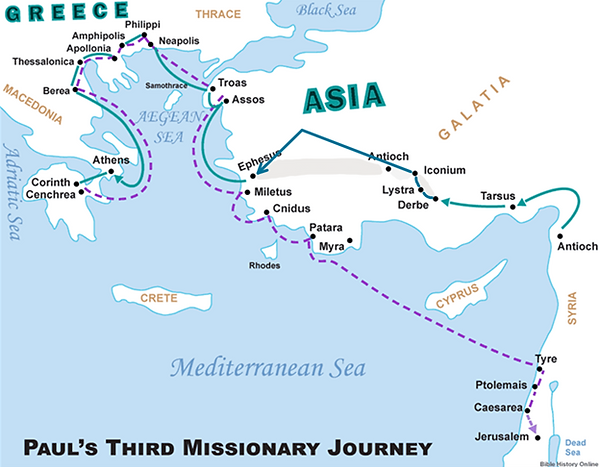
At the end of the 3rd Missionary Journey, Paul makes a short stop at Miletus where he met the pastors of Ephesus for a farewell speech before departing for Jerusalem [for his 5th and final trip to Jerusalem as per Acts 20:17-38].
13. Paul should have gone to the Roman Church at the end of his 3rd missionary journey as per Romans 15:19-24, “By the power of signs [to the Jews] and by miracles [to the Gentiles] in the power of the Holy Spirit, so that from Jerusalem, I Paul, on a circuit as far as Illyricum, have fulfilled the Gospel of the Christ. [Paul had finished his work in both Asia Minor and in Greece as far west as Illyricum.] (20) In fact, my standard operating procedure: I consider it a point of honor to proclaim the Gospel not where Christ has been mentioned [but he does when he decides to go to Jerusalem at the end of his 3rd missionary trip], in order that I might not build on a foundation belonging to another [but he attempted to do this when he decided emotionally to go to Jerusalem rather than to immediately sail for Rome]. (21) And not only this but just as it stands written [a quote from Isaiah 52:15], "They [the Gentiles] shall see, that is, those to whom it was not reported concerning Him [Jesus Christ], and they [gentiles who have not heard] shall understand." (22). For this reason, I also have been hindered many times from coming to you [because he was busy ministering to the gentiles in Asian Minor and Greece], (23) But now, no longer having a place of ministry in those regions [had established local churches with native pastor-teachers in Asian Minor and in Greece], and having a desire to come to you [in Rome] for many years, (24) Whenever I go to Spain for I expect to see you when passing through, and by you be assisted to that place [Spain], if first I am satisfied with you in part [Paul planned on ministering to the Romans before going on his 4th missionary journey to Spain],”
14. Paul makes a sentimentally emotional decision to go to Jerusalem for the Holy Week, Romans 15:25, 26, “But [a change of plans and contrary to what he has just stated in Romans 15:19-24] now I go to Jerusalem to minister to the saints [to bring them the funds collected; a flimsy excuse for violating God’s geographical will for his life], (26) For Macedonia and Achaia have decided with pleasure to make a special offering to the poor ones among the saints who are in Jerusalem.”
15. Paul is warned many times not to go to Jerusalem. As a consequence of his decision to go anyway, Paul will spend 2 year in house arrest in Caesarea, and 2 years in house arrest in Rome. Acts 20:16, 17, “For Paul had decided to sail past Ephesus [at the end of his 3rd missionary journey] so that he would not have to spend time in Asia; for he was hurrying to be in Jerusalem, if possible, on the day of Pentecost. [17] From Miletus he sent to Ephesus and called to him the pastors of the church [around Ephesus]. Acts 20:22, 23, “And now, behold, bound by the Spirit [forbidden: the Holy Spirit was making every effort to restrain Paul], I am on my way to Jerusalem, not knowing what will happen to me there [since Paul was now going contrary to the will of the Lord, he has lost his confidence], (23) except that the Holy Spirit solemnly testifies to me in every city, saying that bonds [chains, fetters] and afflictions [severe punishment] await me [Paul rationalizes away these warnings as if he needs to endure these sufferings for the Lord.].” Acts 21:1-4, “When we had parted from them and had set sail, we ran a straight course to Cos and the next day to Rhodes and from there to Patara; (2) and having found a ship crossing over to Phoenicia, we went aboard and set sail. (3) When we came in sight of Cyprus, leaving it on the left, we kept sailing to Syria and landed at Tyre, for there the ship was to unload its cargo. (4) After looking up the disciples, we stayed there seven days; and they kept telling Paul through the Spirit not to set foot in Jerusalem.” Acts 21:8-14, “On the next day we left and came to Caesarea, and entering the house of Philip the evangelist, who was one of the seven, we stayed with him. (9) Now this man had four virgin daughters who were prophetesses. (10) As we were staying there for some days, a prophet named Agabus came down from Judea. (11) And coming to us, he took Paul's belt and bound his [Agabus’s] own feet and hands, and said, "This is what the Holy Spirit says: `In this way the Jews at Jerusalem will bind the man who owns this belt and deliver him into the hands of the Gentiles [the Romans].' "(12) When we [Luke and others] had heard this, we as well as the local residents began begging him not to go up to Jerusalem. (13) Then Paul answered, "What are you doing, weeping and breaking my heart? For I am ready not only to be bound, but even to die at Jerusalem for the name of the Lord Jesus [but that was not the will of the Lord]." (14) And since he would not be persuaded, we fell silent, remarking, "The will of the Lord be done!"
16. In 58 A.D., Paul was at the peak of his ministry. He had a tremendous response to his evangelism for thousands were being saved. He was establishing with great success many churches in Asia Minor, Macedonia and Achaia. Paul, as a one-man seminary, was teaching and training many pastors. Paul’s writing ministry was phenomenal for he had already written six epistles which would be in the Canon forever. This entire ministry of Paul was removed during his first two years of incarceration in Caesarea except for the opportunity to evangelize a few elites like the governors of Judea namely Felix and Festus and, Herod Agrippa II and Bernice and a few others as well, but there was not one convert during that time. Then, after a rough voyage to Rome and under house arrest in Rome, the Lord permitted him to reestablish his writing ministry namely the Prison Epistles: Ephesians, Philippians, Colossians and Philemon.

17. Paul’s Fourth Missionary Journey:
Upon his acquittal and release in circa 63 A.D., Paul traveled east to Asia Minor by way of Macedonia before embarking on his 4th missionary journey which would take him to Spain. This was a change of plans due to his four years of incarceration for he stated in 58 A.D. that he was going to travel to Rome and then directly to Spain, but now upon his release from Roman house arrest, he first heads back east. Philippians 2:24, “and I trust in the Lord that I myself also will be coming shortly.” Philemon 22, “At the same time also prepare me a lodging, for I hope that through your prayers I will be given to you.”
He apparently went to Philippi first and then to Colossi and finally to Ephesus from where he apparently sailed to Spain and spent approximately two to three years there on his fourth missionary journey.
18. From Spain after completing his 4th missionary journey, he returned to Ephesus where he had left Timothy and then to Macedonia from where he wrote 1 Timothy. 1 Timothy 1:3, “As I urged you upon my departure for Macedonia, remain on at Ephesus so that you may instruct certain men not to teach strange doctrines,” and then onto Nicopolis of Epirus (a province on the western coast of Greece) where he spent the winter and from where he wrote Titus. In the spring of 68 A.D. in Nicopolis, the city of victory founded and named after the Emperor Octavian’s victory at the Battle of Actium, he was arrested and brought to Rome in chains. Then, waiting for his trial, he wrote his last letter to Timothy in the early summer of 68 A.D., and shortly after was executed.

19. The Pauline team of missionaries had been dispersed as Paul states after his 4th Missionary Journey.
Timothy was at Ephesus, 1 Timothy 1:3, “As I urged you upon my departure for Macedonia, remain on at Ephesus so that you may instruct certain men not to teach strange doctrines,”
Titus was at Crete, Titus 1:5, “For this reason I left you in Crete, that you would set in order what remains and appoint elders [pastor-teachers] in every city as I directed you,” After Titus had completed his work in Crete, Paul sent him to Dalmatia. 2 Timothy 4:10, “for Demas, having loved this present world, has deserted me and gone to Thessalonica; Crescens has gone to Galatia, Titus to Dalmatia.” At Nicopolis, a city along the Adriatic Sea, from where Paul writes to Titus and summons him to come to him just before winter. Titus 3:12, “When I send Artemas or Tychicus to you, make every effort to come to me at Nicopolis, for I have decided to spend the winter there.”
Trophimus was left at Miletus and Erastus at Corinth. 2 Timothy 4:20, “Erastus remained at Corinth, but Trophimus I left sick at Miletus.”
Tychicus was in Ephesus, 2 Timothy 4:12, “But Tychicus I have sent to Ephesus.”
20. A brief account of Paul’s trial is given in 2 Timothy 4:6-8, 14-17, “For I am already being poured out as a drink offering, and the time of my departure has come. (7) I have fought the good fight, I have finished the course, I have kept the faith; (8) in the future there is laid up for me the crown of righteousness, which the Lord, the righteous Judge, will award to me on that day [at the Evaluation Platform of Christ]; and not only to me, but also to all who have loved His appearing. (14) Alexander the coppersmith [in Ephesus] did me much harm; the Lord will repay him according to his deeds. (15) Be on guard against him yourself, for he vigorously opposed our teaching. (16) At my first defense [before Nero the Emperor] no one [who could have been there at my trial] supported me, but all deserted me; may it not be counted against them [an expression of Impersonal Love]. (17) But the Lord stood with me [did not desert Paul as did all the others] and strengthened me [the empowering of Paul under pressure], so that through me the proclamation [The summary of all Paul’s writings and a summary of all of his teachings that everyone remembered during his lifetime] might be fully accomplished [Paul was given the time to complete his ministry], and that all the Gentiles might hear and understand [The constative aorist gathers into one entirety the ministry of the apostle Paul to the entire Roman world at that time.]; and I was rescued out of the lion's mouth [Right in the middle of his trial, Nero wanted to send Paul to the lions, but the Lord kept Paul alive to finish his ministry].” Between the trial and execution, Paul wrote 2 Timothy, completing his ministry. His execution took place on Via Ostia, a short way out from the city limits. Less than a year later, Nero was assassinated by the Praetorian Guard, thus ending the Claudio-Julian line. (One cannot murder the greatest Christian and get away with it!)
Jerusalem Trips by Paul:
1st. After being forced to leave Damascus, Syria, he went to Jerusalem circa 41 A.D. 2 Corinthians 11:32, 33, “In Damascus the ethnarch under Aretas, the king was guarding the city of the Damascenes in order to seize me, (33) and I was let down in a basket through a window in the wall, and so escaped his hands.” Galatians 1:18-19, “Then, three years later [after his conversion] I went up to Jerusalem to become acquainted with Cephas and stayed with him fifteen days. (19) But I did not see any other of the apostles except James, the Lord’s brother [spent a few days with James].”
2nd. In 45 A.D., Agabus came to Antioch announcing that a famine was about to occur all over the world as per Acts 11:28-30, “One of them named Agabus stood up and began to indicate [foretell] by the Spirit [as a prophet, the Holy Spirit provided this information to Agabus.] that there would certainly be a great famine [45 to 47 A.D.] all over the inhabited world. And this took place in the reign of Claudius [41-54 A.D.] (29) And in the proportion that any of the disciples had means, each of them determined to send a contribution for the relief of the brethren living in Judea. (30) And this they did, sending it in charge of Barnabas and Saul to the elders [in Jerusalem: Paul’s 2nd trip to Jerusalem].” Funds were collected from the Antioch Christians to be taken to needy Christians in Judea.
3rd. Paul goes to Jerusalem for the third time with Barnabas and Titus [possibly a native of Antioch, Syria] between his first and second missionary journeys to explain to the council in Jerusalem his work with the gentiles as per Galatians 2:1-10, “Then, after an interval of fourteen years [after Paul had left Jerusalem for Damascus in 36 A. D. I went up again to Jerusalem [Paul’s third trip in 50 A.D.] with Barnabas, taking Titus along also. (2) It was because of a revelation that I went up; and I submitted to them the gospel which I preach among the Gentiles, but I did so in private to those who were of reputation, for fear that I might be running, or had run in vain. (3) But not even Titus, who was with me, though he was a Greek, was compelled to be circumcised. (4) But it was because of the false brethren secretly brought in, who had sneaked in to spy out our liberty which we have in Christ Jesus, in order to bring us into bondage [through legalism]. (5) But we did not yield in subjection to them for even an hour, so that the truth of the gospel would remain with you. (6) But from those who were of high reputation (what they were makes no difference to me. God shows no partiality) well, those who were of reputation contributed nothing to me. (7) But on the contrary, seeing that I had been entrusted with the gospel to the uncircumcised, just as Peter had been to the circumcised (8) (for He who effectually worked for Peter in his apostleship to the circumcised effectually worked for me also to the Gentiles), (9) and recognizing the grace that had been given to me, James and Cephas and John, who were reputed to be pillars, gave to me and Barnabas the right hand of fellowship, so that we might go to the Gentiles and they to the circumcised. (10) They only asked us to remember the poor--the very thing I also was eager to do.” At which time, a council at Jerusalem was held in which Paul and Barnabas were given the right hand of fellowship by James, Peter and John. It was also understood at the council that Paul and Barnabas continue to go to the gentiles and the other apostles to the circumcised.
4th. Acts 18:22, “When he had landed at Caesarea [at the end of his 2nd missionary journey], he went up and greeted the church [in Jerusalem], and went down to Antioch [Syria].”
5th. Paul should have gone to the Roman Church at the end of his 3rd missionary journey as per Romans 15:19-24, “By the power of signs [to the Jews] and by miracles [to the Gentiles] in the power of the Holy Spirit, so that from Jerusalem, I Paul, on a circuit as far as Illyricum, have fulfilled the Gospel of the Christ. [Paul had finished his work in both Asia Minor and in Greece as far northwest as Illyricum.] (20) In fact, my standard operating procedure: I consider it a point of honor to proclaim the Gospel not where Christ has been mentioned [but he does when he decides to go to Jerusalem at the end of his 3rd missionary trip], in order that I might not build on a foundation belonging to another [but he attempted to do this when he decided emotionally to go to Jerusalem rather than to immediately sail for Rome]. (21) And not only this but just as it stands written [a quote from Isaiah 52:15], "They [the Gentiles] shall see, that is, those to whom it was not reported concerning Him [Jesus Christ], and they [gentiles who have not heard] shall understand." (22). For this reason, I also have been hindered many times from coming to you [because he was busy ministering to the gentiles in Asian Minor and Greece], (23) But now, no longer having a place of ministry in those regions [had established local churches with native pastor-teachers in Asian Minor and in Greece], and having a desire to come to you [in Rome] for many years, (24) Whenever I go to Spain for I expect to see you when passing through, and by you be assisted to that place [Spain], if first I am satisfied with you in part [Paul planned on ministering to the Romans before going on his 4th missionary journey to Spain],” Paul makes a sentimentally emotional decision to go to Jerusalem for the Holy Week, Romans 15:25, 26, “But [a change of plans and contrary to what he has just stated in Romans 15:19-24] now [58 A.D.] I go to Jerusalem to minister to the saints [to bring them the funds collected; a flimsy excuse for violating God’s geographical will for his life], (26) For Macedonia and Achaia have decided with pleasure to make a special offering to the poor ones [apparently because of persecution] among the saints who are in Jerusalem.” [Earlier he and Barnabas made a trip to bring aid to those who were in need due to the great famine from 45 to 47 A.D.]
Paul’s Conscience:
1 Corinthians 4:4, "For I am conscious [aware] of nothing against myself [So, Paul has a clear conscience regarding his ministry], yet I am not by this [self-evaluation] justified [Paul knows that his ministry is not vindicated by his evaluation]; but the one who keeps evaluating [the periphrastic present: Paul is stating very strongly that only the Lord’s evaluation is meaningful to him] me is the Lord."
οὐδὲν γὰρ ἐµαυτῷ σύνοιδα, ἀλλ’ οὐκ ἐν τούτῳ δεδικαίωµαι, ὁ δὲ ἀνακρίνων µε κύριός ἐστιν.
Paul had a pure conscience regarding his ministry. Conscience is defined as the sense or the consciousness of moral uprightness or blameworthiness of one’s own conduct, intentions, or character together with a sense of obligation to do what is right. So, the conscience is that mental faculty by which one distinguishes between right and wrong, and urges the individual to do what he recognizes to be right and to restrain him from doing that which he recognizes to be wrong.
The conscience is a sense or consciousness in the right lobe related to either moral or spiritual goodness of one's thoughts, motives, decisions, and actions. Therefore, conscience is a faculty, a power, or a principle conceived in the right lobe to determine the quality of one's thoughts, intentions, decisions, and actions. The conscience must be built on a vocabulary that begins with one word: no, or don't. All consciences are started with negative words which forbid doing something. So, the conscience of man is first established by negatives, although eventually there are explanations in both positive and negative terms.
The fifth compartment of the Stream of Consciousness is the Conscience in which is stored norms and standards, and priorities related to the absolutes of Bible doctrine. The Greek word for conscience is suneidesis which means 'to know with an absolute standard.' The English word conscience comes from the Latin, consciari which means "to know with." Conscience is the mental faculty by which one distinguishes between right and wrong and motivates the believer under the Filling of the Spirit to do what is right and not to do what is wrong. Romans 2:15, "in that they show the work of the Law printed in their hearts, their conscience confirming the testimony, and their thoughts alternately accusing or else defending themselves." Accusing and defending oneself is the function of the norms and standards of the conscience of the believer. Acts 23:1, "And Paul, looking intently at the Sanhedrin, said, 'Brethren, I have conducted myself as a citizen with a good conscience before God up to this day.'" Acts 24:16, "In view of this, I [Paul] myself keep on doing my best to maintain always a blameless conscience both before God and before men." 1 Timothy 3:9, "but holding to the mystery doctrine with a clear conscience." We never have true happiness in our soul without a clear conscience. 1 Peter 2:19, "For this is grace, if for the sake of conscience toward God, a man bears-up under sorrows when suffering unjustly." 1 Peter 3:16, "and be having a good conscience, so that in the things in which you are slandered, those who malign your good in Christ will be put to shame." The believer in reversionism destroys his conscience through scar tissue of the soul, 1 Timothy 4:1-2, "But the Spirit explicitly says that in later periods of time [the Church Age, and Tribulation] some [believers] will become apostate from doctrine, paying attention to deceitful spirits [false teachers] and doctrines of demons by means of hypocrisy of liars seared in their own conscience with a branding iron [another word for the destruction of one’s conscience]." The branding iron is scar tissue in the soul from rejection of the truth. Precedence from the humanity of Christ in the dispensation of the hypostatic union is taught in Hebrews 9:14, "How much more will the blood of Christ, who through the eternal Spirit offered Himself without blemish to God, purify your conscience from dead works [false or legalistic standards in the conscience] to serve the living God [you must have a good conscience to serve God]." Metabolized doctrine circulating in the stream of consciousness and its application purifies the conscience from dead works.
2 Corinthians 1:12, "Now this is our boast [esprit de corps], the testimony of our conscience, that we have conducted ourselves in the world and especially in relationship to you, both in holiness [This Greek word is hagioteti based on manuscript evidence and is a reference to the Filling of the Holy Spirit] and honesty [motivation from Bible doctrine], not in fleshly wisdom [human wisdom], but in the grace of God [wisdom learned through God’s grace plan]."
Romans 9:1, “I am telling the truth in Christ [positive affirmation regarding academic integrity], I am not lying [negative affirmation regarding intellectual dishonesty], my conscience bearing me witness [a genitive absolute emphasizing the importance of this joint testimony: everything which Paul says is in agreement with his conscience] by agency of the Holy Spirit.”
1 Corinthians 9:2
If to others [believers who had come into the church who are critical of Paul] I am not an apostle [to them], and I am not [1st Class Conditional Sentence; some do not accept his authority] at least I am to you [the original members of the church]; for you are the seal of my apostleship in the Lord [they had responded to his communication of the gospel message; Paul is their spiritual father].
εἰ ἄλλοις οὐκ εἰµὶ ἀπόστολος, ἀλλά γε ὑµῖν εἰµι· ἡ γὰρ σφραγίς µου τῆς ἀποστολῆς ὑµεῖς ἐστε ἐν κυρίῳ.
1 Corinthians 9:3
My defense to those who judge me is this:
Ἡ ἐµὴ ἀπολογία τοῖς ἐµὲ ἀνακρίνουσίν ἐστιν αὕτη.
Paul is now dealing with those who have become his critics and are attacking his authority. Paul mentions some of the attacks such as his eating habits, why Paul did not seek a wife. They apparently insinuated that there must be something wrong with this guy. Also, why is Paul not demanding a salary from us. This guy is not normal! Paul must deal with these critics since it is having an effect upon his authority in the Corinthian Church.
1 Corinthians 9:4
Do we [Paul and Barnabas] not have the liberty [a right] to eat [meat related to the temple restaurants and stores] and drink [wine also sold at the heathen temple restaurants and stores]? No, emphatically not [not under the type of ministry that Paul and Barnabas had which ministry demanded the maximum function of the Law of Love directed toward believers and the Law of Expediency directed toward the unbeliever. These laws in addition to the Law of Supreme Sacrifice superceded the Law of Liberty]!
µὴ οὐκ ἔχοµεν ἐξουσίαν φαγεῖν καὶ πεῖν; [expects a negative answer emphatically; a denial emphatically]
The double negative with the indicative mood in Greek ‘µὴ οὐκ’ or ‘οὐ µὴ’ states a strong denial or prohibition. Quoting from ‘A Grammar of the Greek New Testament by Dana and Mantey’ page 266, section 242, “With the light that the papyri have thrown upon this doubling of the negatives, we can now say unreservedly that the negatives were doubled for the purpose of stating denials or prohibitions emphatically.”
Since Paul was so well known, if he had gone into the temple restaurant to eat dinner, some weak believer or unbeliever would have seen him and would have been offended. So, Paul denied himself this right, a right he had under the Law of Liberty.
Compare this with the subjunctive of emphatic negation as found in 1 Corinthians 8:13, “Therefore, if food [meat offered to idols; also applies to alcohol] causes my brother [the weak but growing believer] to stumble, I [Paul] will never eat [the Subjunctive of Emphatic Negation] meat again [that is meat sacrificed to idols], so that I will not cause my brother to stumble [spiritually].”
διόπερ εἰ βρῶµα σκανδαλίζει τὸν ἀδελφόν µου, οὐ µὴ φάγω κρέα εἰς τὸν αἰῶνα, ἵνα µὴ τὸν ἀδελφόν µου σκανδαλίσω.
1 Corinthians 9:5
Do we [including Barnabas who had rejoined Paul on this 3rd missionary journey] not have a right [the liberty] to take along a believing wife, even as the rest of the apostles and the brothers of the Lord and Cephas? No, emphatically not [not under the Law of Supreme Sacrifice]!
µὴ οὐκ ἔχοµεν ἐξουσίαν ἀδελφὴν γυναῖκα περιάγειν, ὡς καὶ οἱ λοιποὶ ἀπόστολοι καὶ οἱ ἀδελφοὶ τοῦ κυρίου καὶ Κηφᾶς;
The double negative in Greek ‘µὴ οὐκ’ or ‘οὐκ µὴ’ with the indicative mood states a strong denial or prohibition. If it is used in a question, then the one beginning with ‘µὴ’ expects a negative answer and vice versa.
1 Corinthians 9:6
Or do I alone and Barnabas, do we not have the right to refrain from working, Yes, we do [The Greek negative ‘ou’ expects a ‘yes’ for an answer. They should not have had to work in the tent making business; they should have been receiving a salary for their teaching]?
ἢ µόνος ἐγὼ καὶ Βαρναβᾶς οὐκ ἔχοµεν ἐξουσίαν µὴ ἐργάζεσθαι;
Even though Paul and Barnabas had a right to accept a salary from the Corinthians, they never did so. Thus, even though they had the right not to have had to work physically to make their own living, they didn’t use that right. If they had accepted a salary from the Corinthians, the Corinthians would have accused them of having a false motivation for sure. They did not want to give the Corinthians any excuse for rejecting their teaching.
1 Corinthians 9:7
Who at any time serves as a soldier at his own expense [Paul is a spiritual general]? Who plants a vineyard and does not eat the fruit of it? Or who tends a flock and does not consume the milk from the flock? [All the same, Paul functioning under the Law of Supreme Sacrifice, did not ask to get paid.]
τίς στρατεύεται ἰδίοις ὀψωνίοις ποτέ; τίς φυτεύει ἀµπελῶνα καὶ τὸν καρπὸν αὐτοῦ οὐκ ἐσθίει; ἢ τίς ποιµαίνει ποίµνην καὶ ἐκ τοῦ γάλακτος τῆς ποίµνης οὐκ ἐσθίει;
Paul states the principle of remuneration from the viewpoint of the soldier, the farmer and the shepherd. Paul is operating under the Law of Supreme Sacrifice which is the exception to the principle of remuneration, and not the rule. In each of these cases, remuneration is the basis for human production. If this is true in the realm of human production, Paul points out that much more so in the field of spiritual production. Spiritual production has just as much right, if not more, to receive wages than the illustrations above.
1 Corinthians 9:8
I am not speaking these things according to human judgment, am I [expects a ‘no’ answer]? No, I’m not. Or does not the Law also say these things [expects a ‘yes’ answer]? Yes, it does.
Μὴ κατὰ ἄνθρωπον ταῦτα λαλῶ, ἢ καὶ ὁ νόµος ταῦτα οὐ λέγει;
1 Corinthians 9:9
For it is written in the Law of Moses, ‘You shall not muzzle the ox while he is threshing [The ox should be allowed to eat while he is threshing for his service].’ God is not concerned [impersonal verb: literally: it is not a concern to God regarding oxen, is it? No, of course not] about oxen, is He [expects a ‘no’ answer]? No, of course not. [This means that the issue here is not dealing with an ox as such, but the principle of remuneration for productivity.]
ἐν γὰρ τῷ Μωϋσέως νόµῳ γέγραπται, Οὐ κηµώσεις βοῦν ἀλοῶντα. µὴ τῶν βοῶν µέλει τῷ θεῷ;
This does not mean that God has no concern for the welfare of animals for as we know that God even provides for and protects the sparrow, the least of birds. The point in the verse above is that man has the right of remuneration and the ox was used to illustrate that point. Furthermore, if God takes care of a dumb beast like an ox, then obviously, it is His intention to take care of those who have authority in spiritual things.
1 Corinthians 9:10
Or is He speaking altogether for our sake? Yes, for our sake it was written, because the plowman ought to plow in confidence [of receiving remuneration, a recompense for his work], and the thresher to thresh in confidence of sharing the crops.
ἢ δι’ ἡµᾶς πάντως λέγει; δι’ ἡµᾶς γὰρ ἐγράφη, ὅτι ὀφείλει ἐπí ἐλπίδι ὁ ἀροτριῶν ἀροτριᾶν, καὶ ὁ ἀλοῶν ἐπí ἐλπίδι τοῦ µετέχειν.
1 Corinthians 9:11
If we sowed spiritual things in you [in your souls], and we did, is it too much [to expect] if we reap material things from you [a wage for our hard work]? No, it should not be.
εἰ ἡµεῖς ὑµῖν τὰ πνευµατικὰ ἐσπείραµεν, µέγα εἰ ἡµεῖς ὑµῶν τὰ σαρκικὰ θερίσοµεν;
This says in effect that the congregation shares in the minister’s spiritual things while the minister shares in the congregation’s material things. So, each has something to give the other. Paul has liberty and the right to participate in the law of remuneration on the basis of providing for them an indispensable service.
1 Corinthians 9:12
If others share the right over you [When others provide a service for you, they have the right to expect a recompense for their service or labor], do we not more? Nevertheless, we did not use this right [of requesting payment for our teaching], but we endure all things [Paul and Barnabas had a difficult time working and simultaneously teaching] so that we will cause no hindrance to the gospel of Christ [the gospel message and the good news related to the spiritual life].
εἰ ἄλλοι τῆς ὑµῶν ἐξουσίας µετέχουσιν, οὐ µᾶλλον ἡµεῖς; Ἀλλí οὐκ ἐχρησάµεθα τῇ ἐξουσίᾳ ταύτῃ, ἀλλὰ πάντα στέγοµεν ἵνα µή τινα ἐγκοπὴν δῶµεν τῷ εὐαγγελίῳ τοῦ Χριστοῦ.
Here is the contrast between Paul’s rights under liberty and the reality of the situation which is the Law of Supreme Sacrifice.
1 Corinthians 9:13
Do you not know that those who perform sacred services eat the food of the temple, and those who attend regularly at the sacrificial altar have their share from the altar? Yes, you do.
οὐκ οἴδατε ὅτι οἱ τὰ ἱερὰ ἐργαζόµενοι [τὰ] ἐκ τοῦ ἱεροῦ ἐσθίουσιν, οἱ τῷ θυσιαστηρίῳ παρεδρεύοντες τῷ θυσιαστηρίῳ συµµερίζονται;
Numbers 18:8-24, “Then the Lord spoke to Aaron, "Now behold, I Myself have given you charge of My offerings, even all the holy gifts of the sons of Israel I have given them to you as a portion and to your sons as a perpetual allotment. (9) This shall be yours from the most holy gifts reserved from the fire; every offering of theirs, even every grain offering and every sin offering and every guilt offering, which they shall render to Me, shall be most set apart for you and for your sons. (10) As the most set apart gifts you shall eat it; every male shall eat it. It shall be set apart to you. (11) This also is yours, the offering of their gift, even all the wave offerings of the sons of Israel; I have given them to you and to your sons and daughters with you as a perpetual allotment. Everyone of your household who is clean may eat it. (12) All the best of the fresh oil and all the best of the fresh wine and of the grain, the first fruits of those which they give to the Lord, I give them to you. (13) The first ripe fruits of all that is in their land, which they bring to the Lord, shall be yours; every person of your household who is clean may eat it. (14) Every devoted thing in Israel shall be yours. (15) Every first issue of the womb of all flesh, whether man or animal, which they offer to the Lord, shall be yours; nevertheless, the firstborn of man you shall surely redeem, and the firstborn of unclean animals you shall redeem. (16) As to their redemption price, from a month old you shall redeem them, by your valuation, five shekels in silver, according to the shekel of the sanctuary, which is twenty gerahs. (17) But the firstborn of an ox or the firstborn of a sheep or the firstborn of a goat, you shall not redeem; they are set apart. You shall sprinkle their blood on the altar and shall offer up their fat in smoke as an offering by fire, for a soothing aroma to the Lord. (18) Their meat shall be yours; it shall be yours like the breast of a wave offering and like the right thigh. (19) All the offerings of the set apart gifts, which the sons of Israel offer to the Lord, I have given to you and your sons and your daughters with you, as a perpetual allotment. It is an everlasting covenant of salt before the Lord to you and your descendants with you. (20) Then the Lord said to Aaron, " You shall have no inheritance in their land nor own any portion among them; I am your portion and your inheritance among the sons of Israel. (21) To the sons of Levi, behold, I have given all the tithe in Israel for an inheritance [Ten percent for the maintenance of the Levites] , in return for their service which they perform, the service of the tent of meeting. (22) The sons of Israel shall not come near the tent of meeting again, or they will bear sin and die. (23) "Only the Levites shall perform the service of the tent of meeting, and they shall bear their iniquity; it shall be a perpetual statute throughout your generations, and among the sons of Israel they shall have no inheritance. (24) For the tithe of the sons of Israel, which they offer as an offering to the Lord, I have given to the Levites for an inheritance [Ten percent for the maintenance of the Levites]; therefore, I have said concerning them, ' They shall have no inheritance among the sons of Israel.'”
1 Corinthians 9:14
So, also the Lord directed those who proclaim the gospel to get their living from the gospel [to the apostles to the Lost Sheep of Judah].
οὕτως καὶ ὁ κύριος διέταξεν τοῖς τὸ εὐαγγέλιον καταγγέλλουσιν ἐκ τοῦ εὐαγγελίου ζῆν.
Luke 10:7, “Stay in that house, eating and drinking what they give you; for the laborer is worthy of his wages. Do not keep moving from house to house.”
Matthew 10:9-12, “Do not provide gold nor silver, nor brass in your money belt, (10) nor a bread box for your journey, nor two coats, nor [two pairs of] sandals, nor staffs [for protection from robbers] for the workman is worthy of his food [honorable believers living within the cities will provide for them]. (11) And into whatever city or village you enter, inquire [make a reconnaissance] who within it is worthy [a believer with whom you can associate and be relaxed and can trust]. And there abide until you go away from there [they will sustain you]. (12) And when you come into a house [of believers who have offered lodging and provisions for the apostles], greet it [enjoy the hospitality and the time spent together].”
1 Corinthians 9:15
But I have used none of these things. And I am not writing these things so that it will be done so in my case [to receive a salary from them]; for it would be better for me to die [from lack of the necessities of life] than have any man make my boast [never asked for money] an empty one.”
ἐγὼ δὲ οὐ κέχρηµαι οὐδενὶ τούτων. οὐκ ἔγραψα δὲ ταῦτα ἵνα οὕτως γένηται ἐν ἐµοί, καλὸν γάρ µοι µᾶλλον ἀποθανεῖν ἤ ñ τὸ καύχηµά µου οὐδεὶς κενώσει.
The Law of Expediency deals with what is suitable for achieving a particular end namely the evangelism of the unbeliever. The Law of Love as directed toward the believer. 1 Corinthians 9:16-23:
1 Corinthians 9:16
For if I communicate the good news [maybe I will; maybe I will not], I have nothing to boast about [neither evangelism nor communicating the spiritual life is a basis for boasting], for I am under necessity [I’m just doing what I should be doing; it is my responsibility]; for woe is me if I do not proclaim [at the point of opportunity] the gospel [fail in my responsibility as an ambassador and fail in my responsibility as a communicator of the spiritual life].
ἐὰν γὰρ εὐαγγελίζωµαι, οὐκ ἔστιν µοι καύχηµα· ἀνάγκη γάρ µοι ἐπίκειται· οὐαὶ γάρ µοί ἐστιν ἐὰν µὴ εὐαγγελίσωµαι.
1 Corinthians 9:17
For if I do this willingly [communicate the good news in fellowship], and I do, I have a reward [for witnessing even though the unbeliever may not respond]; but if I unwillingly fulfill a responsibility with which I have been entrusted,
εἰ γὰρ ἑκὼν τοῦτο πράσσω, µισθὸν ἔχω· εἰ δὲ ἄκων, οἰκονοµίαν πεπίστευµαι.
1 Corinthians 9:18
What then is my reward [There is no reward for witnessing or communicating God’s Word unwillingly since the believer is functioning under false motivation]? That, when I proclaim the good news [the gospel to the unbeliever; the spiritual life to the believer], I may offer the good news without charge [Paul never took money from the unbeliever nor did he take funds from the Corinthian believers], so as not to make full use of my right [Paul had the right to receive remuneration from the Corinthian Christians] in the gospel [in presenting the good news].
τίς οὖν µού ἐστιν ὁ µισθός; ἵνα εὐαγγελιζόµενος ἀδάπανον θήσω τὸ εὐαγγέλιον, εἰς τὸ µὴ καταχρήσασθαι τῇ ἐξουσίᾳ µου ἐν τῷ εὐαγγελίῳ.
Four types of false motivation related to the lust pattern:
1. Materialism lust. A person witnesses for money.
2. Approbation lust. A person witnesses for recognition or praise.
3. Power lust. A person witnesses in order to gain ascendancy in some Christian group.
4. Ego lust. Witnessing motivated by competition with other believers. For example, if you witness to five people a day, I’ll witness to six!
1 Corinthians 9:19
For though I am free [the Law of Liberty] from all men, I have made myself a slave to all, so that I may win more [souls for Christ].
Ἐλεύθερος γὰρ ὢν ἐκ πάντων πᾶσιν ἐµαυτὸν ἐδούλωσα, ἵνα τοὺς πλείονας κερδήσω·
1 Corinthians 9:20
To the Jews I became as a Jew [for example abstaining from eating pork] so that I might win Jews; to those who are under the Law, as under the Law though not being under the Law myself [Paul was not under the Mosaic Law], so that I might win those who are under the Mosaic Law [the Jewish unbeliever];
καὶ ἐγενόµην τοῖς Ἰουδαίοις ὡς Ἰουδαῖος, ἵνα Ἰουδαίους κερδήσω· τοῖς ὑπὸ νόµον ὡς ὑπὸ νόµον, µὴ ὢν αὐτὸς ὑπὸ νόµον, ἵνα τοὺς ὑπὸ νόµον κερδήσω·
1 Corinthians 9:21
To those who are without the Law [the Gentile unbeliever], as without law, though [Paul] not being without the Law of God but under the Law of Christ [the Law of the Filling of the Spirit], so that I might win those who are without law.
τοῖς ἀνόµοις ὡς ἄνοµος, µὴ ὢν ἄνοµος θεοῦ ἀλλ’ ἔννοµος Χριστοῦ, ἵνα κερδάνω τοὺς ἀνόµους·
1 Corinthians 9:22
To the weak [Jewish and Gentile unbelievers] I became weak, that I might win the weak [to the Lord]; I have become all things to all men, so that I may by all means save some.
ἐγενόµην τοῖς ἀσθενέσιν ἀσθενής, ἵνα τοὺς ἀσθενεῖς κερδήσω· τοῖς πᾶσιν γέγονα πάντα, ἵνα πάντως τινὰς σώσω.
In matters of doctrine, Paul was adamant and dogmatic, but in matters of expediency Paul was flexible without deceit and without compromise.
1 Corinthians 9:23
I do all things for the sake of the gospel [the gospel-message], so that I may become a fellow partaker of it.
πάντα δὲ ποιῶ διὰ τὸ εὐαγγέλιον, ἵνα συγκοινωνὸς αὐτοῦ γένωµαι.
Summary: 1 Corinthians 10:23, "All things are lawful under the Law of Liberty, but not all things are profitable. All things are lawful, but not all things edify."
Paul introduces in the rest of this chapter some athletic metaphors to help explain the spiritual life as per verses 24-to the end.
1 Corinthians 9:24
Do you not know that those who run in a stadium [race] all run [all Church Age believers], but only one [the winner believer] receives the prize [rewards given by Christ at the Evaluation]? Run in such a way [in the right way] that you may obtain the objectives [two tactical and two strategic objectives resulting in maximum glorification of God].
Οὐκ οἴδατε ὅτι οἱ ἐν σταδίῳ τρέχοντες πάντες µὲν τρέχουσιν, εἷς δὲ λαµβάνει τὸ βραβεῖον; οὕτως τρέχετε ἵνα καταλάβητε.
1 Corinthians 9:25
And everyone who competes in the games, exercises self-discipline [10 months of training under tough authority and strict rules in the gymnasium before the games began] in all things. Therefore, they do it in order that they may receive a perishable wreath, but we, an imperishable one [Escrow Blessings for the winners; so, there will be a vast difference in the eternal state].
πᾶς δὲ ὁ ἀγωνιζόµενος πάντα ἐγκρατεύεται, ἐκεῖνοι µὲν οὖν ἵνα φθαρτὸν στέφανον λάβωσιν, ἡµεῖς δὲ ἄφθαρτον.
In self-discipline, we must take the responsibility for all our decisions, the good ones and the bad ones. These athletes in preparing for the games had to develop tremendous discipline and respect for authority over those ten months of preparation. If they had failed over those ten months of preparation, they were removed in a state of dishonor. However, if they should have completed those ten months of preparation and had gone on to win a crown, they would have been considered a person of honor and honored for the rest their lives.
Rewards and Decorations for the Christians who execute God’s Plan:
1. Eating from the Tree of Life: Revelation 2:7, “He who has an ear [capable of perception, but involves motivation and volition], let him hear what the Spirit communicates to the churches. To him who is a winner [overcomes], I will authorize him [predictive future: I will give him the privilege] to eat from the Tree of Life which is in the Paradise of God [in the New Jerusalem].”
The Tree of Life was associated with perfect happiness in the environment of the Garden, as well as the perpetuation of Adam and his wife’s relationship with God in the Garden, Genesis 2:9, “Out of the ground, the Lord God caused to grow every tree that is pleasing to the sight, and good for food; the Tree of Life also in the midst of the garden, and the Tree of the Knowledge of Good and Evil.” Genesis 3:22, “Then the Lord God said, ‘Behold, the man has become like one of Us, knowing good and evil, and now, he might stretch-out his hand and take from the Tree of [everlasting] Life and eat and live forever.” When man sinned and was driven out of the Garden, he was cut off from the Tree of Life, Genesis 3:24, “So, He drove the man out and at the east of the garden of Eden, He stationed the cherubim and the flaming sword which turned every direction to guard the way to the Tree of Life.” The tree of life is not seen again by man until the eternal state, Revelation 2:7 and in Revelation 22:1, 2, “Then he [the angel] showed me the River of the Water of Life [the first monument of eternal life], bright as crystal, flowing from the throne of God [the Father] and from the throne of the Lamb [the Lord’s throne in the New Jerusalem] (2) in the middle of the street of the city [was the River of the Water of Life]; so, on either side of the river, the Tree of Life [the 2nd monument of eternal life] with its twelve kinds of fruit, yielding its fruit every month; and the leaves of the tree were for the healing of the nations. [a memorial that there is no conflict between nations in the eternal state]” Revelation 22:14, “Happy are those who wash [perfective present: the use of the Recovery Procedure starting at salvation and continuing throughout their lives] their robes in order that they might have the privilege to the Tree of Life and that they may enter the city [of the New Jerusalem] by the gates.”
Paradise:
1. A Persian word describing a garden where the Parsi partied.
2. The king’s garden for magnificent parties associated with great happiness was called paradise.
3. In the New Jerusalem, God will have his own Paradise Club with beautiful gardens for winners only.
At this point, it is important for us to understand why Adam rejected the Tree of Life in the garden for the woman outside of the garden. By creation, man was designed for happiness, and prosperity which was to be perpetuated indefinitely as long as he was positive toward God’s plan. The prohibition to not eat from the fourth tree, the Tree of the Knowledge of Good and Evil was the only test of obedience. Only disobedience to this one command could destroy their happiness and relationship with God. The tree of life, of course, combined capacity for happiness with immortality (perfect happiness and immortality go together) and could only be lost by a negative action on the part of the man and the woman. In other words, the Tree of Life would be useless to man in the status of spiritual death. And since man died spiritually when he ate of the fruit of the forbidden tree, it was absolutely, necessary that the Tree of Life be removed until a future time in eternity.
2. Wreath of Life: Revelation 2:10, "Stop fearing [They were aware of the pending persecution.] that which you are about to suffer. Note that the devil is about to cast some of you into prison in order that you may be tested, and you will have special persecution ten times [ten historical persecutions from 96-305 A.D.]. Keep on being faithful even until death, and I will give you the Wreath of Life."
James 1:12, “Happy is the believer who endures testing [passes the three categories of undeserved suffering] for having become approved [at his evaluation after the Rapture], he shall receive the wreath of life, which He [the Lord] has promised to those who love Him [enduring devotion and respect for the Lord Jesus Christ].”
The greatest happiness comes to the believer who completes the spiritual life, because in doing so he obtains the happiness which God has designed for him. The happiness of spiritual maturity is a system of integrity and thinking, a happiness not dependent upon people or things, but related to loving God the Father, the Lord Jesus Christ, and the Holy Spirit. Since the mature believer has both enduring devotion, respect and reverence for God, he has the power, the inner strength to handle any test or suffering in life. After the believer develops a personal love for Jesus Christ, he will receive his final test in life, then upon passing this test he will be approved by the Lord and receive “The Wreath of Life”. This decoration is awarded to invisible heroes for maximum production of divine good through the execution of the plan of God. Therefore, the wreath (crown) of life is related to the invisible hero's (mature believer’s) production from his spiritual gift, his ambassadorship, and his royal priesthood. The wreath of life is awarded for consistent Filling of the Holy Spirit, consistent perception of doctrine, and consistent use of the Ten Problem-Solving Devices resulting in the completion of the spiritual life.
The Latin ‘Corona’ was the highest decoration in the army and is the exact equivalent of the Greek ‘Stephanos’ (wreath). The Romans had many different crowns as decorations in the military namely, the ‘corona obsidionalis or grammania’, a wreath of golden strands was the highest and rarest decoration. This was given for breaking a blockade or raising (removing) a siege. One example of actions leading to awarding of a grass crown would be a general who broke the blockade around a beleaguered Roman army. The ‘corona civica’ was a crown made of golden oak leaves which was awarded to a soldier who saved the life of another citizen in battle and held the ground where this deed occurred for the rest of the day. The ‘corona navalis’ was the highest decoration in the navy for destroying an enemy fleet or the first marine to board an enemy ship. The ‘corona muralis’ was awarded to the first soldier who scaled the wall of a besieged city. The ‘corona vallaris’ was awarded to the first soldier to scale an enemy rampart. The ‘corona aurea’ was a golden crown for gallantry in battle or any heroic act in battle. The ‘corona triumphalis’ was awarded to a victorious commander. Each crown included a monetary reward, freedom from taxes, children educated at public expense, a statue of the person erected in the public square, and a home wherever you wanted it built. The crown is used by analogy for the greatest honors God can give to believers. There were also decorations worn around the neck, decorations on a baldric worn over the chest, and various spears as rewards.
3. Wreath of Righteousness: When the Christian completes the spiritual life and subsequently receive the fullness of blessing from God, he will wear both the crown (wreath) of life and the crown (wreath) of righteousness. These two wreaths go together. If you have one, you will have the other.
As a result of having obtained maximum capacity righteousness, the Christian will receive the wreath of righteousness as per 2 Timothy 4:7-8, “I have fought that honorable fight [advanced through the stages of spiritual growth], I have finished the course [Paul reached spiritual maturity and had passed Evidence Testing], I have guarded the doctrine [as first priority in the soul]. (8) In the future a wreath of righteousness [escrow blessings for eternity] is reserved for me [on deposit since eternity past], which the Lord, the righteous judge, will award me on that day [at the Evaluation Throne of Christ] and not only to me but to all those who love His appearing [mature believers, whose thorough understanding of doctrine enables them to be occupied with Christ],”
Capacity righteousness is the capacity for true love in the soul. Our spiritual life must have a love based on a righteousness that has capacity from the word of God. True love is always the result of true righteousness in the soul. All capacity for true love is soul capacity-righteousness, not legalism.
This crown (wreath) is used to describe the capacity for the greater blessings in resurrection body that the winner believer receives. God has given special capacity to winner believers to enjoy special blessings forever and ever. 2 Peter 3:13, “But according to His announced promise [Isaiah 65:17; 66:22; Revelation 21:1], we [the believers with doctrine] are anticipating [as wonderful] the new heavens and the new earth [after the Millennium and forever] in which righteousness is at home [the believer in his resurrection body will enjoy perfect righteousness].” This promise means that we are going to be blessed forever and ever and the blessing is going to be so great that we will never recall a bad memory in time. True righteousness and happiness go together.
4. Title of Aristocracy: Revelation 2:17, ‘He who has an ear, must hear what the Spirit says to the churches. To him who overcomes [to the spiritual winner], to him [dative of advantage] I will give [blessing] from the hidden manna [metabolized doctrine hidden in the soul], and I will give him a white pebble, and a new title written on the pebble which no one knows but he who receives it [in time, but in eternity all will know].’
Explanation:
The juries in the ancient world voted privately. They had a box which was passed around in which were black pebbles and white pebbles, and each one selected a pebble and put it on the table. A black pebble was guilty; a white pebble was a vote for acquittal. The white pebble here is the Lord’s vote for acquittal for the believer. There is no condemnation, no lake of fire for the believer in Christ as per Romans 8:1; we are acquitted because we have personally believed in Jesus Christ. The Lord votes with a white stone to adopt the convert into the family of God with the potential of obtaining the highest possible aristocracy. Those who reject Him as their savior get a black pebble; those who accept Him through faith in His person get a white pebble. Either a white pebble with no title (adopted into God’s family with a resurrection body, but not into the elite aristocracy of the eternal state) or a white pebble with a title written on it (a title of eternal aristocracy).
Every aristocratic Roman would adopt a son at age 14 whether it be his own natural son or another young man with great integrity and ability. Once the adoption ceremony was complete, the adopted son was given a new name of aristocracy and had the right of marriage, military service, and had the right to access his father’s fortune. Even the Roman emperors used this system of adoption to guarantee greatness in succession. For example, Emperor Nerva began the golden age of the Roman Empire in 96 A.D. He adopted Trajan, and Trajan adopted Hadrian, and Hadrian adopted Antonius Pius, and Antonius Pius adopted Marcus Aurelius, the last great emperor of the golden age. None of these adoptions involved their own sons.
On this white pebble is the title that Jesus Christ will bestow on the winner-believers at the Evaluation Seat of Christ. This title means that the believer will be part of an elite eternal aristocracy. And to have a white pebble with a new title of aristocracy on it is about as high an honor as one could possibly obtain based upon one’s impact on both human and angelic history, not only an honor, but many wonderful privileges and rewards related to it. (The only higher honor would be the ‘Order of the Morning Star’ to be explained later.)
5. Rule over nations in the Millennium: Revelation 2:26, "He who is victorious [in the spiritual life] and keeps My assignments until the end [of his life], To him I will give authority over the nations, [as a blessing in the Millennium];"
6. The Uniform of Glory: Revelation 3:4, “But you have a few people in Sardis [a group of mature believers] who have not soiled their garments [the uniform of honor worn by the mature believer in time]; in fact, they will walk with Me in whites [the uniform of glory in eternity], because they are worthy [have passed all the undeserved suffering tests].”
7. The Order of the Morning Star: Revelation 2:28, "Furthermore, I will give him [The Order of the] Morning Star."
Explanation: “Furthermore, I will give to him [the mature believer, the winner in time] the order of the morning star,” the highest decoration for life on this earth, the highest decoration for historical impact and for glorification of the Lord Jesus Christ. The uniform of glory worn over the resurrection body as per Revelation 3:4, 5 and the decoration which goes with it, the Order of the Morning Star, means that there will be a presentation in the court of heaven before the Father and his angels for a few believers out of every generation (Revelation 3:5), those who make-up the pivot, those who advance to maturity, and pass Evidence Testing.
But that is only a part of the story, because the person who is making the great contribution to history is the believer who advances to maturity. As goes the believer so goes the client nation to God, and the believer living in the divine power system contributes to the uptrend of the client nation, and the believer living in the cosmic system contributes to the downtrend of history. It is the historical impact of the unknown factor, the unknown factor being as goes the believer so goes the historical trends of any given generation. So, at the 2nd Advent logically there will be a presentation to the entire population of the world of every person who has the Order of the Morning Star and the Uniform of Glory. The authority of this particular decoration is phenomenal because for one thousand years of perfect environment on the earth namely the Millennial reign of our Lord Jesus Christ, the Christians who have the Order of the Morning Star on their Uniforms of Glory will rule nations with a rod of iron (perfect justice). And then in the eternal state as well there will obviously be many unique privileges which will belong to the believer who wears the Order of the Morning Star on his Uniform of Glory.
8. Title of Aristocracy registered in the Book of Life: Revelation 3:5, "Thus, the winner [he who overcomes] will be clothed in white garments [a reference to the translucent uniform of glory worn by those who hold the Order of the Morning Star]; and I will never blot out his title [of aristocracy ] from the Book of eternal Life, in fact I will acknowledge [the presentation of these winners in the court of heaven while the Tribulation is occurring on the earth] his title [of aristocracy] before My Father and before His angels."
At birth, every member of humanity is written in the Book of Eternal Life. However, every unbeliever is blotted out of the Book of Life at his physical death. This we have taught before. So, even though all believers remain in the Book of Eternal Life only a few will have title prefixing their names, a title of aristocracy.
9. Acknowledged before God the Father and his angels: Revelation 3:5, "Thus, the winner [he who overcomes] will be clothed in white garments [a reference to the translucent uniform of glory worn by those who hold the Order of the Morning Star]; and I will never blot out his title [of aristocracy ] from the book of eternal life, in fact I will acknowledge [the presentation of these winners in the court of heaven while the Tribulation is occurring on the earth] his title [of aristocracy] before My Father and before His angels."
10. A Pillar in the Eternal Historical Record Center: titles emblazoned on the Uniform of Glory which allows access to the New Jerusalem: Revelation 3:12, "The winner, I will make him a pillar in the temple of My God [historical record center], furthermore, it [the pillar] will never ever depart outside of the Temple [the Christian’s record of great achievement will never be removed from the Temple of God]; also I will emblazon on him [on his uniform of glory] the title of My God [the Father: indicating the fulfillment of his plan], and the name of the city of My God, the new Jerusalem [the pass to enter into the satellite city of the eternal state], which will descend from heaven from My God, and My new title [is emblazoned on him which title provides access to the New Jerusalem]."
A few points for explanation:
1. While the temple of heaven is the record department of history, the pillars found in the temple are the permanent records of Church Age heroes, the believers in this dispensation who advance to maturity and have maximum impact in history.
2. The Bible must be interpreted in the time in which it was written, so obviously our interpretation of a pillar in the temple must go back to the modus operandi of the ancient world where temple-pillars were chapters in history books.
3. Take, for example, the Temple of Artemis (Diana in Latin) where there was recorded history. This temple in Ephesus was 375 feet long and 180 feet wide, a rather large record-keeping area. Inside of the temple were 127 pillars on which were recorded the deeds of famous kings and other famous people. On these pillars were hung priceless gifts, trophies of the kings involved. There were tablets (inscribed slabs) and records engraved telling of the deeds of these kings and other heroes. In the analogy, the priceless gifts which were on the pillars depict the decorations, the rewards which belong to the mature believer at the Judgment Seat of Christ (Evaluation Platform of Christ). The written biography depicts the eternal history of mankind with emphasis on the true heroes of history.
11. Wreath of Glory: This crown is awarded to pastors who faithfully study and communicate Bible doctrine to their respective congregations. The mature pastor through his personal study and teaching, advances to maturity and leads his congregation there as well. He is a prepared person who emphasizes doctrine and correct theology. He focuses on the message, not his personality.
1 Peter 5:2-4, “Shepherd the flock of God with you, exercising oversight not under compulsion, but voluntarily on the basis of the will of God; and not for sordid gain but with a ready mentality; nor yet as lording it over those allotted to your charge, but proving to be examples to the flock. And when the Chief Shepherd appears [at the Rapture], you will receive the unfading Crown of glory.”
Philippians 4:1 personalizes this concept. “Therefore, my brethren, loved ones [members of the congregation who are respected for their faithfulness], deeply desired ones, my happiness and my crown [of glory], keep on being stabilized [winners of the crown of righteousness and life].”
1 Thessalonians 2:19-20, “For who is our hope or happiness or crown of boasting [glory]? Is it not you in the presence of our Lord Jesus Christ at His coming? For you are our glory and our happiness.” At the judgment seat of Christ (Evaluation Platform of Christ), those who have attained spiritual maturity are the crown of glory for the pastor.
The pastor’s boasting or crown of glory is received because certain members of his congregation do two things by listening to his teaching of the Word. They take the giant step to spiritual self-esteem and then the victory step to spiritual maturity and ultimately pass Evidence Testing.
1 Corinthians 9:26
Therefore, I run in such a way as not without aim [a fixed goal]; I box in such a way as not beating the air, [every punch hits].
ἐγὼ τοίνυν οὕτως τρέχω ὡς οὐκ ἀδήλως, οὕτως πυκτεύω ὡς οὐκ ἀέρα δέρων·
Boxing in the ancient world emphasized not missing a punch, and the leather gloves were usually studded with metal to break open the skin. There were no rounds. So, it would continue until one was knocked-out or acknowledged defeat. One boxer was so battered that he was warned by the referee never to look at his face again, or he would die from the shock of shame.
1 Corinthians 9:27
But I impose strict discipline on my body and make it my slave lest having preached to others, I myself should be disqualified [from Escrow Blessings].
ἀλλὰ ὑπωπιάζω µου τὸ σῶµα καὶ δουλαγωγῶ, µή πως ἄλλοις κηρύξας αὐτὸς ἀδόκιµος γένωµαι.
Each Christian must impose discipline over his body that he might not be disqualified for Escrow Blessings. Each communicator of doctrine is under the mentorship of God the Holy Spirit. In the Church Age, the pastor-teacher has the greatest liability to God that is to study and teach. The responsibility of the members of a congregation is to learn on a daily basis in order that they might grow spiritually and consul themselves under the mentorship of the Spirit.
2nd Timothy 2:4-5, “No soldier when serving on active duty in a military campaign becomes entangled in the functions of civilian life, in order that he may strive to serve and please his commanding officer [The commanding officer in the ancient world was the one who enlisted the recruit; by analogy our commanding officer is the Lord Jesus Christ]. (5) Now, if anyone really competes in the athletic games, he does not receive a winner's crown, unless he competes according to the rules.
There are five ways in which any normal human being can attain an awareness of God. These five ways are called in theology, theistic arguments for the existence of God.
1. The Religious Argument. The religious argument contends that God exists because mankind universally believes in His existence. Creatures do not crave what does not exist, and men seek after God. Even religious instincts indicate the reality of a Supreme Being. The concept of man seeking God is found in Jeremiah 9:13, John 17:17, and Acts 17:27.
2. The Moral or Anthropological Argument. This argument says that to a greater or lesser degree man’s soul possesses both volition and conscience with an urge to choose right over wrong. The structure of human society is based on the recognition of virtue and truth. This phenomena has no explanation apart from the existence and influence of a Supreme Being with perfect and eternal integrity. A material, ungoverned universe can know nothing of moral values apart from the absolute righteousness of a Supreme Being. Acknowledging the existence of virtue and truth eventuates in becoming aware of the source of virtue and truth. Jesus said to him [Thomas], in John 14:6, “I am the way, and the truth and the life; no man comes unto the Father except through Me.”
3. The Ontological Argument. Ontological reasoning says that since the human mind possesses the idea of a perfect and absolute being, such a being must exist. Apart from the religious and moral tendencies, the existence of God is a necessary idea to the human intellect, and beyond the relative which mankind measures there is the absolute which gives value and character to the relative.
4. The Teleological Argument. This argument is the fact that the universe, by its telescopic and microscopic wonders, always form arrangement, purpose, and adaptation, which connotes a designer. Structure in the universe demands a designer. The more we discover about the perfect structure of the universe in science, the more we recognize the need for a designer. The order of the universe can no more be accidental than the shuffling of twenty-six letters of the alphabet into a beautiful poem. The chemical contents of the human body are never accidentally combined to form man.
5. The Cosmological Argument. This reasoning states that the intuitive law of cause and effect demands the existence of God as the initial cause. Order in the universe demands both a creator and a preserver. The universe presents an overwhelming demand for belief in the existence of God. John 1:3, speaking of Jesus Christ as eternal God, says, “All things came into being through Him, and apart from Him nothing came into being that has come into being.”
In closing, if there should be someone here who has not personally believed in the Lord Jesus Christ as his Savior, let me remind him of John 3:36, “He who believes in the Son has eternal life, but he who does not obey the Son [does not believe in Him] will not see life [will not receive eternal life with God], but the wrath of God abides on him [He will be sentenced to the Lake of Fire].” You are free to make a decision for Christ and eternal life with God, likewise, you are free to reject the work of Jesus Christ on the cross, and subsequently spend all eternity in terrible misery. The choice is yours!
Father, we thank you for the message this evening, and we pray that those hearing this message might metabolize it for their continued spiritual advance. In Christ’s name [person], Amen.