MAX KLEIN BIBLE MINISTRIES
The Seven Baptisms
Written by: Max Klein
Baptism means identification or association:
Introduction:
1. This meaning began in Homer's time. Homer wrote of the one-eyed giant, Cyclops who had trapped Ulysses and his men in a cave and was eating them one at a time. The ingenious Ulysses devised a plan. He had his men sharpen a large log and together they rammed this log into the eye of the one-eyed Cyclops rendering him blind. They identified (baptized) the sharpened log with Cyclops’ eye which changed Cyclops from a seeing giant to a blind giant. Having blinded the Cyclops, they were able to maneuver their way out of the cave. Another example by Homer: Homer's Odyssey, book 9, used baptism for hot metal identified (baptized) with water when a smith dipped a piece of hot iron into water. This is how a blacksmith would temper swords in the ancient world. After this identification, the sword was made stronger and so less likely to bend.
2. Xenophon said that the Spartan military recruits after finishing infantry training would identify (baptize) their spears with pig’s blood. They would run by a barrel of pig’s blood and thrust their spears into this blood. This ritual, identified their spears with killing and the soldier’s readiness for combat with the enemy.
3. Euripides used the word for a ship identified with the bottom of the sea when it sank. Before sinking, the ship was valuable; after sinking it had no value at all.
4. So "baptize" in the classical Greek meant to identify one thing with another so that the characteristics of the original thing were altered. Therefore, the interpretation of the word "baptism" is identification with something that brings about a change.
5. There are a number of cognates related to this Greek word such as bapto, baptizo, baptisma, baptismos, baptistes, and embapto. A few examples follow:
6. John 13:26, “Jesus then answered, ‘That is the one for whom, I shall dip [the future of the Greek word bapto] the morsel and give it to him. So, when he had dipped [the aorist participle of bapto; the sop now takes on a new meaning that of honor] the sop [the morsel], He took and gave it to Judas, the son of Simon Iscariot.”
To give someone a sop [a special bit of food usually a piece of bread or meat with a tasty sauce] was the highest honor of a banquet. At a banquet a special piece of bread or meat was prepared along with a special sauce for the guest of honor who would then honor someone by giving it to that person. Jesus as the guest of honor took this sop and dipped it into a special sauce and gave it to Judas. In this way, the Lord Jesus Christ honored Judas as a member of the family of God, and for his ministry as an apostle to the Lost Sheep of Israel. This honor should have given Judas second thoughts regarding his plan to betray Jesus to the Sanhedrin.
7. Matthew 3:7, “but when he [John the Baptizer] saw many of the Pharisees and Sadducees coming for baptism [identification: the Greek word baptisma], he said to them, “You brood of vipers [poisonous snakes], who warned you to flee from the wrath to come [Baptism of Fire: identification with the fire of Torments and then the Lake of Fire]?”
8. Hebrews 6:1-2, “Therefore, leaving behind the elementary teaching about Christ, let us advance to maturity, not laying again the foundation [of the basics such as]: a change of thinking about dead works [just as an unbeliever must have a change of mind about Christ to obtain salvation, so the believer must have a change of mind about legalism (dead works) in order to obtain the spiritual life], and of faith toward God [Faith-Rest Drill], (2) doctrine of baptisms [the Greek word baptismos; a reference to the seven types of baptism as found in Scripture] as well as the laying on of hands [ritual rebound in the age of Israel], and of resurrection from the dead, and of eternal judgment [the Great White Throne Judgment].
9. Matthew 3:1, “In those days John the Baptizer [the Greek word baptistes; when John baptized someone into the Jordan River, the converts were identified with the plan of God and his kingdom.] came proclaiming [as a herald] in the desert of Judea.”
There are two categories of identification in Scripture namely an actual identification or a real baptism and a representative identification or a ritual baptism which uses water.
The four real or actual identifications with something that has significance.
1. The Baptism of Moses: 1 Corinthians 10:1-2 presents the baptism of Moses, "For I do not want you to be unaware, brethren, that our fathers were all under the cloud and all passed through the sea; (2) and all were baptized [the Greek word baptizo] into Moses in the cloud [the Lord] and in the sea." This was a real identification in which Moses was identified with the Lord and the open path through the Red Sea and the Jews were identified with Moses. By the way, none of the Jews got wet, only Egyptian unbelievers who were immersed in the water as a means of death.
2. The Baptism of the Cross is found in Matthew 20:22, “But Jesus answered [Salome by addressing her sons] and said, “You [plural: a reference to James and John] do not know what you [James and John] ask. Are you [James and John] able to drink of the cup [bear the punishment of all the sins of the world] that I am about to drink of, and to be baptized with the baptism [the sins of the world identified with Christ followed by the Father judging them] that I am baptized with [identified with]?” They [James and John] said to Him, “We are able. [the dumbest statement that James and John ever made]” [I selected the longer text as did Jerome.]
3. The Baptism of the Holy Spirit (Retroactive Positional Truth and Current Positional Truth) occurs at salvation for Church Age believers only.
Colossians 2:12. Having been buried [aorist participle] with Him [Jesus Christ] by means of the baptism [God the Holy Spirit identified us with the burial of Jesus Christ as part of our salvation] by means of which [Baptism] you have been raised up [main verb] with Him [in union with Jesus Christ seated at the right hand of the Father] through faith [at the point of salvation] in the operational power from the source of God who has raised Him [the humanity of Christ was given a resurrection body] out from the dead [physical death].
Romans 6:3-9:
Romans 6:3: Or do you not know that all of us who [a correlative] have been baptized into [identified with] Christ Jesus [Current Positional Sanctification: we are in union with Christ in his life in heaven], have been baptized into His death [Retroactive Positional Truth and so identified with his substitutionary spiritual death on the cross]?
Positionally, (in union with Christ) we share His righteousness, heirship, priesthood, destiny, election, eternal life, royalty, sonship etc. All these making us a new spiritual species in Christ Jesus. The plural correlative hosoi (ὅσοι) means that if we were identified with Christ in heaven and we were, then also we have been identified with Christ in his substitutionary spiritual death in which he removed the power of sin nature. Thus, the sin nature should not have power over our lives.
A few more points will be noted:
1. Note that the baptism of the Holy Spirit at salvation enters the believer into union with Christ at the right hand of God the Father which union is called current positional truth.
2. This verse also mentions identification with Christ in His spiritual death on the cross which identification theologians call retroactive positional truth. Retroactive positional truth also includes identification with Christ in His physical death and burial as well.
3. Identification with Christ in His death, then, has a two-fold connotation namely all personal sins were judged at the cross and since that is the case, God the Father is free to provide in grace, the Recovery Procedure. The second connotation is that good and evil were rejected by Jesus on the cross since good and evil are a part of Satan’s policy and plan. On the cross, Jesus relied on the proto-type spiritual life which operated under the two power options namely God’s power system.
4. So, the old sin nature’s ruling power over the Christian has been broken since all sins were judged on the cross and the Recovery Procedure has been provided. So, Retroactive Positional Truth has destroyed the sovereignty of the old sin nature over the life of the Christian.
5. Also, since Jesus rejected the good and evil policy of Satan so should the believer reject Satan’s policy of good and evil as the believer applies Retroactive Positional Truth.
Romans 6:4: Therefore, we have been buried together with Him through the identification [Baptism of the Spirit] into His death [physical], in order that just as Christ has been raised up from the dead [on Resurrection Sunday], through the glory of the Father [through the Father’s power], [So also we, the dead in Christ, will be raised from the dead by the power of the Father, and those alive at the Rapture, by the power of the Holy Spirit.] in this manner we also might walk in newness of life [Experiential sanctification should reflect our future ultimate sanctification.].
Christ had to die physically “and Jesus having shouted clearly with a loud voice said, Father, into your hands I deposit my [human] spirit, and having said this, he exhaled” (Luke 23:46). This last exhale caused His soul and spirit to depart from his mortal body resulting in physical death. Just as Christ had to die physically in order to obtain his resurrection body, so we must depart from our body of corruption, or mortality in order to receive our eternal body called our resurrection body.
The Newness of Life:
1. The newness of life provided through the baptism of the Spirit includes positional freedom from producing good and evil. Not only are we free from the tyranny of good and evil but we are also free from having to produce good and evil.
2. The believer has no obligation to improve the devil’s world through social action, socialism, welfare state, communism, environmentalism, or any social gospel, social action, getting involved, etc.
3. The human race is protected from Satan’s policy of good and evil through the laws of divine establishment which promote freedom instead of improvement at the cost of freedom.
4. In addition to the Laws of Divine Establishment the believer is insulated from good and evil positionally through the baptism of the Spirit.
5. Divorced from the Old Sin Nature positionally and its useless activity of human good and the function of evil, the life of the believer can be devoted to glorifying the Lord Jesus Christ through maximum knowledge and application of Bible doctrine.
Romans 6:5: For if we have become united with Him [Christ, the new husband] in the likeness of His death [the substitutionary spiritual death of Christ on the cross], and we have, and not only this, but also, we shall be [united in the likeness] of His resurrection [Current Positional Truth: in union with the resurrected Christ].
Romans 6:6: Be knowing this [through Retroactive Positional Truth], that our old man [our former husband, the sin nature dates back to the Garden] has been crucified together [with Him], in order that the [human] body, with reference to its sin nature, [the sin nature located in the body] might be rendered powerless [when we use Recovery Procedure and the two power options], that we should no longer be slaves to the sin nature.
“Our old man has been crucified with Him” meaning that the power of the sin nature has been broken on the cross. Since the power of the sin nature was broken by the work of the cross, we as believers have no excuse for not executing the spiritual life. We will not be able to say to Christ at our evaluation that our sin nature was too powerful for us to execute the spiritual life.
A few points for further clarification:
1. Retroactive positional truth is that phase of the baptism of the Holy Spirit at salvation which identifies the believer with Christ in His spiritual death, physical death and his burial.
2. In the substitutionary spiritual death of Christ on the cross all the personal sins in human history were imputed to Christ, but at the same time the other two trends of the old sin nature were not imputed for judgment.
3. Good and evil is the policy of Satan as the ruler of this world and the function of the old sin nature as the sovereign of human life. In fact, the sin nature functions as the agent of Satan.
4. Good and evil were not imputed for judgment on the cross. Hence, in the spiritual death of Christ on the cross they were rejected to remain an issue in the angelic conflict, rejected to be perpetuated in human history as an issue every believer must face, and either overcome through the intake of doctrine or be entrapped by ignorance of doctrine and therefore lose out in glorifying God in time.
5. We are identified with Christ in His spiritual death, which means that we must understand that our sins have been judged and that good and evil has been rejected.
6. It all adds up to the fact that the sovereignty of the old sin nature over human life has been made powerless through retroactive positional truth.
7. The imputation of all personal sins of the human race to Christ on the cross means that the believer through the rebound technique is instantly forgiven sins, cleansed from all wrong doing which includes Satanic good and evil, restored to fellowship and filled with the Spirit.
Romans 6:7: For we who have died [the Christian is identified with the substitutionary spiritual death of Christ: theologically called Retroactive Positional Truth] have been acquitted [positional deliverance] from [the power of] the sin nature.
A few points for further clarification:
1. A dead person is discharged from the obligations of his former sphere of life. This is why the word “death” is used in this context. It is not a literal, physical death we are discussing but identification with Christ in His death.
2. As unbelievers we were under the authority of Satan as the ruler of this world, and under the authority of the old sin nature as the sovereign of human life.
3. Both the power of Satan and the old sin nature have been abrogated through the baptism of the Holy Spirit at salvation.
4. This passage, then, emphasizes the annulling of the power and the authority of the old sin nature as the sovereign of human life.
5. Positionally, the power of the sin nature has been broken. Experientially, the old sin nature controls to the extent that we fail to understand and utilize the provision and support of logistical grace.
Romans 6:8: Now if we have died with Christ, and we have [retroactive positional truth], we also believe that we shall live in association with Him [the instrumental of association; a reference to Current Positional Truth].
In this verse, the 1st Class conditional sentence shows the relationship between Retroactive Positional Truth with Current Positional Truth. The protasis, the ‘if’ clause states the reality of Retroactive Positional Truth and the apodosis, the concluding clause states the doctrinal inference and the reality of Current Positional Truth. While Retroactive Positional Truth presents positional rejection and separation from good and evil as the policy of Satan and the function of the old sin nature, Current Positional Truth relates the believer to the function of the royal family of God. In other words, they have separate functions.
Romans 6:9: Knowing that because Christ has been raised from the dead [He received a resurrection body], no longer can He die; [physical] death is no longer a master over Him.
Analysis:
1. Retroactive positional truth destroys the sovereign authority of the old sin nature over human life. Current positional truth, on the other hand, destroys the limited authority of physical death in human life.
2. Instead of being ruled by the old sin nature located in the cells of the human body and influencing our souls toward sin, good and evil, we now have a new sovereign, the Lord Jesus Christ. We are identified with Him in His deaths, in His burial, resurrection, ascension and session.
3. Before salvation and the baptism of the Holy Spirit our lives were under the absolute rule of Satan who is the ruler of this world and under the rule of the old sin nature which is the ruler of life, and under the limited rule of physical death. All of that, of course, has been changed since salvation.
4. Now both retroactive and current positional truth have abrogated the authority and power of these former rulers. The power of Satan over our lives has been broken through identification with the rejection of good and evil namely Satan’s policy and plan and through our position in union with Christ. The power of the old sin nature is broken through retroactive positional truth and the power of physical death is broken through current positional truth.
5. Therefore, having studied these things by principle and by implication we are now ready for application, verses 12 & 13 specifically.
6. Having been positionally liberated from the sovereignty of the old sin nature as an absolute ruler, and the authority of physical death, we must recognise and apply doctrine for the experiential victory commanded in verses 11-13.
Galatians 3:25-28, “But now that faith has come, we are no longer under the authority of [have need of] a school bus. (26) For you are all children of God through faith in Christ Jesus. (27) For all of you who were baptized into Christ [identified with Christ through union with Him] have clothed yourselves with Christ. (28) There is neither Jew nor Greek [no racial distinction], there is neither slave nor free man [no social or economic distinction], there is neither male nor female [no gender distinction]; for you are all one in Christ Jesus. [All Christians have the same privileges and opportunities to execute the spiritual life.]”
Current Positional Truth, Elaborated:
In the Church Age, Current Positional Truth establishes our relationship with Christ as opposed to religion. It refers to the Church Age believer in union with Christ and is the key to understanding the Church Age and how the royal family came into being. Therefore, it is the basis for distinguishing between Christianity and religion. Christianity is a relationship with God without merit whereas religion is a system of works to gain the approbation of God. Never shall the twain meet!
The mechanics of Current Positional Truth is the Baptism of the Holy Spirit, whereby the Spirit enters us into union with Christ. 1 Corinthians 12:13, “For also by agency of the one Spirit we are all baptized [identification resulting in becoming a new spiritual species] into one body [in union with Christ], whether Jews or Greeks [racial distinctions are removed], whether slave or free [class and economic distinctions are removed], even all were made to drink [the aorist passive, the voice of grace] the one Spirit [The Holy Spirit did not ask us whether we wanted to be put into union with Christ or not.].” Ephesians 4:5, “One Lord [becomes our Lord positionally at Salvation]), one faith [faith alone in Christ alone; Acts 16:31], one baptism [Baptism of the Holy Spirit takes place at salvation].”
Current Positional truth guarantees that there will be no judgment for believers in eternity, Romans 8:1, “Therefore, there is now no condemnation for those who are in Christ Jesus.” Thus, the condemnation which occurred at the first birth was removed at the 2nd birth. As a result of being born with the sin nature and the imputation of Adam’s Original Sin, we were condemned to the Lake of Fire for all eternity, but now that has been removed. Romans 5:12, “For this reason just as through one man [Adam] the sin [nature] entered into the world [procreation], and so spiritual death through the sin [the imputation of Adam’s Original Sin to the sin nature], and so spiritual death spread to all mankind, because all sinned when Adam sinned [since we were all genetically in Adam when he sinned, we will receive Adam’s Original Sin].” However, at our spiritual birth, the 2nd birth, our pre-salvation sins were all forgiven including Adam’s Original Sin. After which, the Spirit entered us into union with Christ where there is now no condemnation (Romans 8:1).
Current Positional truth qualifies the believer to live with God forever. To live with God forever, the believer must have eternal life and God’s perfect righteousness, 1 John 5:11-12, “And this is the deposition [testimony] that the God [the Father] has given to us, eternal life, and this life is in his son [Since we are in union with Christ, we share this life.]. (12) and he who has the son [a relationship with the Son] has the life [eternal life] and the one who does not have the son of God [relationship with the Son] does not have the life [eternal life].” 2 Corinthians 5:21, “And He [the Father] made Him who knew no sin [perfection] to be a sin offering [imputation of sins on the cross] as a substitute for us so that we might become the righteousness of God in Him [current positional truth].” To live with God forever means you must have His life, and you must be as righteous as He is.
Positional truth guarantees the believer’s eternal security, Romans 8:38-39, “For I am persuaded that neither death [nothing in death] nor life [nothing in life] nor angels nor principalities [ruling angels] nor powers [human organizations] nor things present nor things to come (39) nor height [nothing in heaven] nor depth [nothing in Hades] nor any other creature shall be able to separate us from the love of God which is in Christ Jesus our Lord.” Eternal life in Christ is for all eternity!
Positional truth belongs to all categories of believers whether they be apostate, mature, immature, spiritually adult, or carnal. Since Current Positional Truth occurs at the point of salvation before experience in the Christian life begins, it doesn’t depend on that experience. 1 Corinthians 1:2, “to the church of God which is in Corinth, to those who have been sanctified in Christ Jesus [at salvation], called saints together with all who call upon the person of Our Lord Jesus Christ, their [Lord] and ours.” So, even though you may be carnal or in reversionism, you still have positional truth. Being in union with Christ has nothing to do with what you do [experiential righteousness], or don’t do [failure to execute God’s plan]. Current Positional sanctification is completely the work of God the Holy Spirit and so is not based upon our volition, but on the sovereign decision of God. We make the decision to believe in the Lord Jesus Christ, but we don’t make the decision to enter into union with Christ “all were made to drink the one Spirit” as per 1 Corinthians 12:13. God the Holy Spirit graciously did that for us and so it cannot be undone.
Current Positional truth creates a new spiritual species in Christ as per 2 Corinthians 5:17, “Therefore, if anyone is in Christ and he is, he is a new spiritual species. The old things have lost their power; behold, new things have come to pass.” You become a new spiritual species at salvation by being put into union with Christ. It is what God does for you, and therefore it is grace. It is not what you do after salvation, such as the self-righteous works of legalism. The “old things” have to do with spiritual death and those things related to that death; the “new things” refer to things you receive at salvation such as the 40 assets and the unique spiritual life.
Positional truth should motivate the production of divine good and a pattern of life compatible with royalty as per Ephesians 2:10, “For we are his creation, having been created in Christ Jesus [a new spiritual species with many assets] for the purpose of divine good production [via experiential sanctification] which the God [the Father] has prepared in advance [in eternity past, God the Father provided election and predestination as part of our Portfolio of Invisible Assets], that we in the sphere of them [election and predestination] may pattern our lives.”
Even though a Christian may die the Sin on to Death, he will not lose his position in union with Christ (1 John 5:18-20), and so cannot lose his salvation. In order for a believer to lose his position in Christ, he would have to sin in that status, but since the believer cannot sin in union with Christ, he cannot lose his position in Christ and so cannot lose his salvation. Thus, it is comforting and reassuring to a believer to know that even though a loved one may have died the ‘sin on to death’, he has not lost his salvation.
Because we are in union with Christ, we share His:
1. Eternal life, 1 John 5:11, “And this is the deposition [testimony] that the God [the Father] has given to us, eternal life [At salvation, God the Father imputes this life to the human spirit], and this life is in his son [The Christian also shares the life of Christ through union with Him]. (12) and he who has the son [a relationship with the Son] has the life [eternal life] and the one who does not have the son of God [relationship with the Son] does not have the life [eternal life].”
John 14:6, “Jesus said to him [Thomas], ‘I am the way, the truth and the life [eternal life]; no person [in human history] comes face to face with the Father [having an eternal relationship with the Father] except through Me.’”
2. Perfect righteousness, 2 Corinthians 5:21, “And he (God the Father) made him [Jesus] who knew no sin (perfection) to be a sin offering as a substitute for us so that we might become the righteousness of God in him [positional truth]. Sharing the righteousness of Christ, we become the objects of God the Father’s love as per Romans 8:39.
3. Election, Ephesians 1:4, “just as He [the Father] has elected us for Himself in Him [Jesus Christ] before the creation of the world [in eternity past], that we may be set apart [experiential sanctification] and blameless [ultimate sanctification] in the presence of Him [Father].”
4. Destiny, Ephesians 1:5, “By means of love, He has predestined us for the purpose of adoption as adult sons to Himself through Christ Jesus our Lord according to the grace purpose of His will.”
5. Sonship, Galatians 3:26, “For you are all sons of God through faith in Christ Jesus.”
6. Heirship, Romans 8:16-17, “The Spirit Himself testifies together [bears witness] with our [human] spirit, that we are the children of God. (17) Now, if we are children and we are, also heirs, on the one hand heirs of God [the Father], and joint heirs with Christ. If indeed [if it is true that], we suffer with Him [pass all three stages of undeserved suffering], that also we might be glorified with Christ.”
7. Sanctification, 1 Corinthians 1:2, “to the church of God which is in Corinth, to those who have been sanctified in Christ Jesus, called saints together with all who call upon the person of Our Lord Jesus Christ, their [Lord] and ours.”
8. Priesthood, Hebrews 7:12-19, “For when the priesthood is changed, of necessity there takes place a change in the Law also. (13) For the One [the Lord Jesus Christ] concerning whom these things are spoken belongs to another tribe [the tribe of Judah] from which no one has officiated at the altar. (14) For it is evident that our Lord has descended from Judah, a tribe with reference to which Moses spoke nothing concerning priests, (15) and this is clearer still, if another priest arises similar to Melchizedek, and there has, (16) who has become a priest not on the basis of physical requirement [a reference to the Levitical Priesthood] but on the basis of indestructible life [the Lord’s priesthood is forever]. (17) For this reason, it is witnessed, ‘You are a priest forever similar to the order of Melchizedek.’” [We are in union with Christ. Therefore, we are royalty and priests forever. We represent ourselves before God as royal priests.] (18) For, on the one hand, there is a rescinding of the former commandment [the Mosaic Law that authorized the Levitical priesthood] because of its weakness and uselessness (19) (for the Law brought nothing to completion), but on the other hand, there is the bringing in of a better hope [the second door of hope for the Church Age believer—a personal sense of destiny—by which we enter the adult spiritual life] through which we draw near to God.”
Hebrews 7:26-28, “For it is fitting that we should have such a high priest, impeccable integrity, the One who cannot do evil, undefiled, separated from sinners and exalted above the heavens; (27) Who does not need daily, like those Levitical priests, to offer up sacrifices, first for their own sins, and then for the sins of the people, because this He did once for all when He [Jesus] offered up Himself. (28) For the Law appoints men as high priests who are weak, but the word of His [God the Father’s] oath, which came after the Law, appoints a Son, who has become perfect forever [Jesus Christ is a perfect high priest].”
9. Royalty, 1 Peter 2:9, “ But you and only you are an elect [elect by God the Father] race [as a new spiritual species], a royal priesthood [since Jesus is a king-priest], a holy nation [God’s entity: a nation of priests: every Christian is a priest], a people for God’s own possession [a protected people], so that you may proclaim the excellencies of Him [Christ] who has called [in eternity past] you out of darkness [spiritual death and the Cosmic Systems] into His amazing light [his plan];”
10. New Spiritual Species, 2 Corinthians 5:17, “Therefore, if anyone is in Christ and he is, he is a new spiritual species. The old things have lost their power [Old Covenant]; behold, new things have come to pass [This would include the New Covenant to the Church.].”
Current Positional Truth changes our relationship with Angels.
1. Through current positional truth the believer is higher than angels positionally.
2. Christ is seated at the right hand of the Father, and so superior to all angels. By virtue of being in union with Christ, every believer is now positionally superior to angels.
3. Positional truth has fulfilled the believer’s triumph with Christ in the angelic conflict. We are victorious with Him already.
4. Furthermore, positional truth demands compatibility with experiential righteousness. Therefore, the believer’s walk on this earth must be compatible with positional truth since we have perfect security in Christ, we have the freedom to choose for Jesus Christ, to love Jesus Christ, to respond to His love, and to fulfill our purpose on this earth.
What positional truth is not?
1. It is not an experience, emotions or ecstasies.
2. It is not progressive; it cannot be improved in time or eternity.
3. It is not related to human merit or ability.
4. It cannot be changed by God, man or angels. It is eternal in nature.
5. It is not obtained gradually as you grow in grace, but in toto at salvation.
6. It is not known apart from the metabolization of doctrine.
7. From understanding the doctrine of positional truth, we progress in our spiritual life, but we cannot improve it since it is perfect at salvation.
8. We are not in Christ because of what we do (execution of the spiritual life) or fail to do (fail to execute the spiritual life), but because of what God has done.
A few points of explanation:
1. The conclusion from positional truth, whether retroactive or current, is that the Christian must apply these doctrines to his spiritual life.
2. In Romans 7:1-4 where we have an illustration of a woman whose first husband has died freeing her to marry another. This is what actually happens to us as believers at salvation. The old sin nature is the husband up to the point of salvation, but at the moment we believe in Jesus Christ positionally the sin nature is dead, as it were, the first husband has died and we have a new husband through union with Christ. Retroactive Positional Truth removes our first husband, the sin nature whereas Current Positional Truth enters us into union with Christ, our new husband.
3. The old sin nature-husband is still around, still seeking to regain his control over his former wife, the believer. But union with the second husband, the Lord Jesus Christ, has broken the first husband’s authority over the former wife.
4. The Baptism of Fire:
Matthew 3:11, “On the one hand I [John the Baptizer] baptize you [believers] by means of water because of a change of thinking [about Christ], but the one coming after me is mightier than I whose sandals I am not worthy to lace [loosen, remove]. He himself will baptize by means of the Holy Spirit [a reference to the Baptism of the Holy Spirit in the Church Age] and by means of fire [a reference to the Baptism of Fire at the 2nd Advent].”
Baptism of Fire: The baptism of fire (identification with fire) is defined as the judgment of unbelievers both Jew and gentile at the Second Advent. They will be removed from the earth and placed in fire for 1000 years until the Last Judgment, Luke 3:16-17; Mathew 25:31, 33. The analogy to the Baptism of Fire is found in Matthew 24:36-41. The one left in the field is the mature believer; the one taken is the unbeliever.
Parables of the Baptism of Fire:
1. The wheat and the tares (the unbelievers), Matthew 13:24-30, 36-40.
2. The good and bad fish (unbelievers), Matthew 13:47-50.
3. The ten virgins: five wise, five foolish (the unbelievers), Matthew 25:1-13.
4. The sheep and the goats (the unbelievers), Mathew 25:31-46.
5. The talent test, Matthew 25:14-30. The one talent man represents the unbeliever.
If Jesus Christ had not been rejected by the Jewish people, then the age of Israel would have continued until its completion (the Tribulation completes the age of Israel). (However, they did reject Jesus Christ as Savior and Messiah and so the client nation was destroyed, and the Church age was intercalated that is inserted before the age of Israel was complete.) After the completion of the age of Israel at the end of the Tribulation, comes the wrath of God namely the Baptism of Fire when the Lord removes both Jewish and gentile unbelievers from the earth and identifies them with fire forever. After which, the Millennial reign begins.
The Three Ritual Baptisms. None are extant at the present time. They are representative identifications in which water is used as a training aid to represent some principle of doctrine.
1. The Baptism of John is found in Matthew 3:2-6, “Saying, ‘Change your thinking [regarding Christ] for the kingdom of heaven is near.’ [The future king was already on the earth] (3) For this is what was communicated through Isaiah, the prophet saying, ‘The voice of one [John the Baptizer] proclaiming loudly in the desert [of Judea]. Prepare [the aorist tense is a one time-decision] the way of the Lord [an idiomatic expression for salvation]. Keep on making upright [the use of the Recovery Procedure followed by the development of experiential righteousness] His paths!’ (Isaiah 40:3) (4) Now, John himself kept on having a garment of camel’s hair [very uncomfortable] and a leather belt around his waist, and his food was locusts and wild honey. (5) Then [after John went where God wanted him to be] Jerusalem kept on going out to him [face to face] and all Judea and all the districts around the Jordan. (6) and they were being baptized [identified with the kingdom] by him [under John’s authority] in the Jordan River [where Israel crossed when they entered the land], and they kept on confessing their sins [post-salvation confession of sins].”

MAX KLEIN BIBLE MINISTRIES
Second Corinthians Chapter Five
A verse-by-verse commentary by Max Klein
Let us bow our heads; If we need to use the Recovery Procedure as found in 1 John 1:9, let us do so at this time that we might be in fellowship. (pause) Father, we thank you for the privilege and opportunity to study your word and for the freedom that you have provided for us here in Corpus Christi, Texas, U.S.A.; furthermore, we express our appreciation to God the Holy Spirit who will enlighten us regarding the message this evening. We as priests pray this through the person of our Lord Christ Jesus, our High Priest, Amen.
President Reagan’s Address to the Nation on Free and Fair Trade, April 25, 1987
“My fellow Americans, Prime Minister Nakasone of Japan, will be visiting me here at the White House next week. It's an important visit because while I expect to take up our relations with our good friend Japan, which overall remain excellent, recent disagreements between our two countries on the issue of trade will also be high on our agenda. As perhaps you've heard, last week I placed new duties on some Japanese products in response to Japan's inability to enforce their trade agreement with us on electronic devices called semiconductors. Now, imposing such tariffs or trade barriers and restrictions of any kind are steps that I am loathed to take, and in a moment, I'll mention the sound economic reasons for this that over the long run, such trade barriers hurt every American worker and consumer, but the Japanese semiconductors were a special case. We had clear evidence that Japanese companies were engaging in unfair trade practices that violated an agreement between Japan and the United States. We expect our trading partners to live up to their agreements. As I've often said, our commitment to free trade is also a commitment to fair trade. But, you know, in imposing these tariffs, we were just trying to deal with a particular problem, not begin a trade war. So, next week I'll be getting Prime Minister Nakasone this same message. We want to continue to work cooperatively on trade problems and want very much to lift these trade restrictions as soon as evidence permits. We want to do this because we feel both Japan, the United States have an obligation to promote the prosperity and economic development that only free trade can bring. Now, that message of free trade is one I conveyed to Canada's leaders a few weeks ago, and it was warmly received there. Indeed, throughout the world there's a growing realization that the way to prosperity for all nations is rejecting protectionist legislation and promoting fair and free competition. Now, there are some historical reasons for this, but those of us who lived through the Great Depression, the memory of the suffering it caused is deep and searing, and today, many economic analysts and historians argue that high tariff legislation passed back in that period, called the Smooth Hawley Tariff, greatly deepened the Depression and prevented economic recovery. You see, at first, when someone says let's impose tariffs on foreign imports, it looks like they're doing the patriotic thing by protecting American products and jobs, and sometimes for a short while it works, but only for a short time. What eventually occurs is first homegrown industries start relying on government protection in the form of high tariffs. They stop competing and stop making the innovative management and technological changes, they need to succeed in world markets, and then while all this is going on, something even worse occurs. High tariffs inevitably lead to retaliation by foreign countries and the triggering of fierce trade wars. The result is more and more tariffs, higher and higher trade barriers and less and less competition so soon, because the prices made artificially high by tariffs that subsidized inefficiency and poor management, people stop buying. Then, the worst happens; markets shrink and collapse; businesses and industries shut down, and millions of people lose their jobs. The memory of all this, occurring back in the 30s made me determine that when I came to Washington to spare the American people the protectionist legislation that destroys prosperity. Now, it hasn't always been easy. There are those in the Congress, just as there were back in the 30s, who want to go for the quick political advantage, who risk America's prosperity for the sake of a short-term appeal to some special interest group who forget that more than 5 million American jobs are directly tied to the foreign export business and additional millions are tied to imports. Well, I've never forgotten those jobs and on trade issues, by and large we've done well. In certain select cases, like the Japanese semiconductors, we've taken steps to stop unfair practices against American products, but we still maintained our basic long-term commitment to free trade and economic growth. So, with my meeting with Prime Minister Nakasone and the Venice Economic Summit coming up, it's terribly important not to restrict the president's options in such trade dealings with foreign governments. Unfortunately, some in the Congress are trying to do exactly that. I'll keep you informed on this dangerous legislation because it's just another form of protectionism and I may need your help to stop it. Remember, America's jobs and growth are at stake. I’ll see you next week. Thanks for listening and God bless you.”
Beginning 2 Corinthians 5
Verses 1-5, a perspective of death:
2 Corinthians 5:1
For we know [the importance of knowing the Word] that if [introducing a 3rd Class Conditional Sentence: maybe we will die or maybe will be in the resurrection-generation] our earthly tent [made from the minerals of the earth], the tabernacle [appositional genitive; the temporary house for the soul and the human spirit] is loosed [the soul leaving the body at the point of death], we have a building [a permanent building made of marble] from God, not built with human hands [God himself designed and built the resurrection body] an eternal house [the resurrection body] in heaven.
Οἴδαµεν γὰρ ὅτι ἐὰν ἡ ἐπίγειος [masculine or feminine ending] ἡµῶν οἰκία τοῦ σκήνους [genitive singular] καταλυθῇ, οἰκοδοµὴν ἐκ θεοῦ ἔχοµεν οἰκίαν ἀχειροποίητον αἰώνιον ἐν τοῖς οὐρανοῖς.
An introduction to this verse: A promise to believers especially to advanced believers regarding the protection of their mortal bodies:
Job 5:19-27, the discourse of Eliphaz: the concept of grace deliverance
Job 5:19. In six disasters [the cause is not mentioned], he will deliver [rescue: the wall of fire in Logistical Grace] you. Furthermore, in seven disasters [to indicate the whole realm of danger], evil [the things which accompany dying, anything which puts the life in danger] will not touch you [not even brush by you].
בְּשֵׁשׁ צָרוֹת, יַצִּילֶךָּ; וּבְשֶׁבַע, לֹא-יִגַּע בְּךָ רָע
The word for “deliver” is the Hebrew word natsal and it means to rescue or to deliver when you are in a place where you can’t do much for yourself; in other words, a hopeless situation.
Verses 20-21: the areas of deliverance.
Job 5:20. In economic depression [the black horse of economic depression and famine] he will preserve you [until you have had enough time to execute the plan of God] from death [you are preserved from the ashen horse, death from famine], and in battle [the red horse of warfare], he will preserve you from the stroke of the sword [a promise to both the military and the civilians].
בְּרָעָב, פָּדְךָ מִמָּוֶת; וּבְמִלְחָמָה, מִידֵי חָרֶב.
Job 5:21. You will be hidden [protection which comes from God] from the lash [scourge] of the tongue [protection from social degeneration resulting in maligning, judging, gossip, societal ridicule etc.; Job was the object of the scourge of the tongue], and you will not be afraid [the perpetuation of courage in dying grace] of violent death [painful even torture] when it comes.
בְּשׁוֹט לָשׁוֹן, תֵּחָבֵא; וְלֹא-תִירָא מִשֹּׁד, כִּי יָבוֹא.
Job 5:22. You [the prepared believer] will laugh [a relaxed laugh from a sense of humor which will help you think in time of disaster] at death and famine [economic depression], even from the wild animals of the earth [as instruments of violent death], you have nothing to fear.
לְשֹׁד וּלְכָפָן תִּשְׂחָק; וּמֵחַיַּת הָאָרֶץ, אַל-תִּירָא.
In other words, you will be very relaxed in economic depression, and you will also laugh at the wild animals of the earth. What do wild animals represent? It means at certain times in history animals destroy a great deal of life. These animals are analogous to crime, nuclear weapons, conventional weapons, cars, and a lot of other things. However, the believer who is in doctrine is preserved from all of these things.
Job 5:23. For your contract will be with [for you will be secure from] the stones [the ammunition of the ancient world] of the battlefield; and the beast of the field [the wild animals] will be at peace with you [nothing can remove the believer from this life apart from the sovereignty of God].
כִּי עִם-אַבְנֵי הַשָּׂדֶה בְרִיתֶךָ; וְחַיַּת הַשָּׂדֶה, הָשְׁלְמָה-לָּךְ.
None of the instruments of death can remove the believer from this life until God permits. Only the integrity of God can transfer the believer from time to eternity. No believer can be removed until the Lord is ready to take him home to heaven, but once the Lord calls the believer home, nothing can retain him on this earth.
A few points for clarification:
1. No believer can be removed from this life apart from a sovereign, wise and loving God.
2. Until God makes that decision which takes us from living to dying grace, nothing can remove the believer from this life.
3. The divine initiative of Dying Grace is God’s decision. Therefore, in his great love and wisdom, he decides the time, manner and place of our death.
4. Our death is God’s victory which victory he has transferred to the believer by giving him his own death-shadowed valley (intercepting the light of Bible doctrine as found in Psalm 23) so that our dying will be our greatest blessing on this earth.
5. No believer can be removed from this earth until God decides to take him home. Various instruments of death including carelessness, errors, bad judgment or evil people may be used by God to transfer us to heaven through our own death-shadowed valley. So, since the timing, place and manner of our death is the decision of God, no one has the right to question God’s grace, God’s decision or God’s timing in death.
Job 5:24. Therefore, you will know [the importance of knowing doctrine] that your tent [human body, the present home of the soul and human spirit] is in a state of prosperity [tranquility under dying grace], for you will visit your home [in heaven] and you [the mature believer] will not forfeit blessing or reward [he will receive his Escrow Blessings at the Evaluation Platform of Christ].
וְיָדַעְתָּ, כִּי-שָׁלוֹם אָהֳלֶךָ; וּפָקַדְתָּ נָוְךָ, וְלֹא תֶחֱטָא.
Those who are left behind must honor the departure of a loved one by continuing on with living grace, by not entering into self-pity, resentment, bitterness etc. Reaction is not honoring to God, nor to our departed loved ones. So, let your sorrow remind you of God’s grace. Also, remember that in heaven there is no pain, sorrow etc., but only happiness for your departed loved ones.
Those who are left behind must never expect others to share in their great grief, a grief and sorrowful pain that they must bear their entire life. It is a grief that the loved ones left behind must carry without resentment toward others who seem not to care.
Job 5:25. You will know [orientation to the Plan of God is based on knowing the Word of God] that your descendants will be numerous [an idiom for prosperity], and your offspring like the grass of the earth [elaborating on this idiom of prosperity; human life will continue on the earth after your departure; loved ones on the earth must continue living a normal life].
וְיָדַעְתָּ, כִּי-רַב זַרְעֶךָ; וְצֶאֱצָאֶיךָ, כְּעֵשֶׂב הָאָרֶץ.
Not only is there dying grace for you as a mature believer, but also your loved ones will be blessed by association even after you depart. In other words, you will have an impact even beyond your death.
Job 5:26. You will come to the grave in a full age [at the right time and only God’s timing is perfect], like a shock of corn [the farmer removes the corn from its husk; this is analogous to peeling off this mortal body of corruption from the soul] in its season [the farmer as the expert, harvests the corn at the right time so the Lord picks the right time for your departure].
תָּבוֹא בְכֶלַח אֱלֵי-קָבֶר; כַּעֲלוֹת גָּדִישׁ בְּעִתּוֹ.
Job 5:27. Behold this; we have investigated it; this is the gist of it; hear it and apply it to yourself.
הִנֵּה-זֹאת חֲקַרְנוּהָ כֶּן-הִיא; שְׁמָעֶנָּה, וְאַתָּה דַע-לָךְ.
When facing death:
1. The reality of death is the test of the believer’s spiritual condition and true scale of values.
2. In the face of death, the following will not comfort you: money, success, wealth, promotion, and social life just to mention a few things. Dying can be the greatest happiness in life or the greatest misery, and it depends upon the content of Bible doctrine in your soul, not the details of life.
3. If Bible doctrine is not first in your scale of values during the living phase of your life, dying will be a nightmare. If on the other hand, doctrine has first place in one’s scale of values, dying should intensify one’s happiness. So, dying will either intensify suffering or happiness.
4. The ten special persecutions from the Roman emperors, Domitian to Diocletian made death a reality to millions of people who were believers. Believers living in the Cosmic System when facing the threat of torture and death easily renounced their faith in the Lord Jesus Christ. On the other hand, believers having lived their life in God’s power system, when facing the threat of torture and death, were not afraid and did not renounce Christ.
5. Regarding cosmic believers, fear of death becomes fear of life. If you are afraid of death, you are afraid of life. If there is nothing worth living for, there is nothing worth dying for, but only those mature believers in the pivot [the group of mature believers] understands this issue.
Removing Fear from Death:
1. Bible doctrine resident in the soul removes fear of death as well as fear of life.
2. The believer having executed the spiritual life is not afraid of torture and death. That means that martyrdom is never in vain. Martyrdom without renouncing Christ, is one of the greatest rewardable functions in eternity. At the very least, he will receive the Wreath of Life.
3. Before Constantine, the Roman Empire was many times evangelized through dying testimony; after Constantine it was generally evangelized through living testimony. In history it takes both. Dying testimony requires, like living testimony, that Bible doctrine is more real than anything in life. Otherwise, when called upon to live or die for the Lord Jesus Christ, he can’t do it.
4. The success standards of life must be replaced by the success standards of God’s plan. Who will succeed in accomplishing this replacement of standards? The judgment seat of Christ will reveal that many people who have a comparatively humble station in life in the Lord’s eyes were the great heroes and heroines of history.
5. Only through Bible doctrine can God and His plan be more real than people, ambitions, situations, and pleasures. Beware that you do not function in life according to human viewpoint, on the basis of rationalizing doctrine to fit your ambitions and functions in life. The divine viewpoint must override peer pressure, and arrogant ambition must be replaced by doctrinal perception. When that happens and you fulfil the principle of being faithful, even unto death, there will be a special, super reward for you in heaven.
The Rapture, the Resurrection of Church Age Believers:
There are two returns from the dead namely resuscitation and resurrection.
Resuscitation means a person returns from the dead in a body of corruption and eventually dies again. For example, Lazarus was resuscitated by Jesus; Paul resuscitated a boy who fell out of a window; two boys in the Old Testament were resuscitated, and Elijah and Moses will be resuscitated toward the end of the Tribulation. On the other hand, resurrection means to be given an eternal body which does not corrupt or dies. Therefore, resurrection is rising again from the dead in an eternal human body, and never again being subject to death.
Just as the death of the believer is the Lord's victory, so the resurrection of the believer is the Lord's victory. The resurrection of the believer is the wise and sovereign decision of God. This means that the believer's volition, cognition, and individual merit are not factors in the resurrection namely the Rapture of the Church. The resurrection is strictly the Lord's victory. For just as we have no control over the manner or time of our death, so we have no control over the manner or time of our resurrection. This is completely a matter of the wisdom and sovereignty of God.
Your resurrection does not depend in any way on your merit or life. Winners and losers alike receive a resurrection body equally. No distinction is made between winners and losers at the point of receiving resurrection-bodies. The Rapture will never occur by the merit of any Christian. So, resurrection is far greater than we can imagine for in resurrection, God makes no distinction between those who completely fail to execute the Christian way of life and those who succeed in executing the Christian way of life. It has everything to do with who and what the Lord is!
The time, place, and manner of the resurrection of the Church is God's perfect decision based on the completion of the body of Christ, called the royal family of God. Just as the believer has no control over the time, manner, or place of his death, so he has no control over the time, manner, and place of the resurrection. Like the death of the believer, resurrection or the Rapture is the decision of the sovereignty of God. Therefore, it is His victory alone. It is strictly a matter of grace.
1. The Promise of the Rapture:
John 14:1-3. Do not let your heart [the soul] be troubled [addressing future Church age believers]; believe in God, believe also in Me. (2) In My Father’s house are many mansions; if it were not so, I would have told you [future Church Age believers]; for I go to prepare a place for you [the groom prepares a home for his bride]. (3) If I go [His ascension] and prepare a place for you, I will come again [at the Rapture] and receive you [the Church, his bride] to myself [the ceremony: the bride is presented to the groom], that where I am [in heaven], there you may be also.
2. James gives us an admonition.
James 5:7-8. Therefore [if you desire to continue your spiritual growth], have patience, brethren [execute the spiritual life], until the Coming of the Lord [at the Rapture]. Behold, the farmer waits with expectation for the valuable production of the land, and constantly being patient over it [the land] until he has received the early rains [October thru December] and the latter rains [March thru April]. (8) You too be patient and have stability [from knowledge of God’s Word] in your right lobe [the stream of consciousness], because the Coming of the Lord [the Rapture] draws near [every day it gets closer].
3. Three times in Revelation is the phrase, "I am coming soon": Revelation 22:7, 12, 20. Remember that, to the Lord, a day is as a thousand years and a thousand years is as a day. This statement was made in A.D. 96, and this is now A.D. 2025. Therefore, "soon" connotes imminency, not immediacy.
4. How should we be waiting for the Rapture?
Titus 2:13. Waiting with keen anticipation for that blessed hope [Rapture], even the appearance of the glory of our great God and Savior, Christ Jesus.
5. God the Father will participate in the resurrection of Church Age believers.
1 Corinthians 6:14. Now God [the Father] has not only resurrected our Lord, but He will raise us up through His power.
6. The omnipotence of the Holy Spirit restored our Lord's human soul in Hades to His body in the grave and thereby became an agent in the resurrection of the humanity of Jesus Christ.
1 Peter 3:18. For Christ also died as a substitute for our sins once and for all, the righteous as a substitute for the unrighteous so that He might bring us to God, having been put to death in the flesh, but made alive [given a resurrection body] by the Spirit.
Also, the Spirit will be the agent in providing a resurrection body for those in mortal bodies at the Rapture.
Romans 8:11. Now if the Spirit from Him [God the Father] who has raised Jesus from the dead indwells in you and he does, He who raised Christ from the dead will also give life to your mortal bodies [mortality becomes immortality via the resurrection body at the Rapture of the Church] through the agency of his Spirit who indwells in you [those alive at the Rapture will receive their resurrection bodies via the power of the Holy Spirit].
7. There will be two categories of believers at the Rapture.
1 Corinthians 15:53. For this perishable [the interim body of those Christians who will have died before the Rapture] must put on imperishable [an eternal body], and this mortal [the mortal body of those alive at the Rapture] must put on immortality [the eternal body].
8. Our resurrection body will be similar to that of the resurrected Christ.
1 John 3:2-3. Beloved, now we are the children of God, and it has not appeared as yet what we will be. We know that when He appears [at the Rapture], we will be like Him [will have a resurrection body similar to that of Jesus] because we will see Him just as He is. (3) And everyone [the believer with momentum] who keeps having this confidence [from doctrine in the soul] in him purifies himself [by advancing in fellowship and when necessary, the use of the Recovery Procedure] just as that one is pure [the humanity of Christ remained in fellowship with God during the 1st Advent].
9. Explaining the details of the Rapture:
1 Thessalonians 4:13-18. But we do not want you to be ignorant, brethren, about those who are asleep [died] that you may not grieve, as to the rest of the world [of unbelievers] who have no confidence. (14) If we believe that Jesus died and rose again [and we do], even so God [omnipotence of God the Father] will bring with Him those who have fallen asleep [who have died and are in interim bodies]. (15) For this doctrine we communicate to you by the Word of the Lord, that we [Paul identifies with the Rapture generation] who are alive and remain until the coming of the Lord [the Rapture] shall not precede those who have fallen asleep. (16) For the Lord Himself shall descend from heaven with a shout, with the voice of the archangel [for mortality to receive immorality] and with the trumpet of God [the Father’s trumpet command for corruption to become incorruption]; in fact, the dead in Christ shall rise first. (17) Then, we [Paul identifies himself with those who will be alive at the Rapture] who are living who remain on the earth shall be caught up together with them [those who were previously in interim bodies] in the clouds to meet the Lord in the air, and so shall we ever be with the Lord. (18) Therefore, comfort each other with these doctrines.
10. The Lord reminds Martha who was weeping over Lazarus about Resurrection.
John 11:25. Jesus said to Martha, "I am the resurrection and the life. He who believes in Me shall live [in resurrection body] even if He dies [departs from his mortal body]."
11. No one knows when the Rapture will take place for if we don’t know when the 2nd Advent will occur and we don’t, then also we cannot know when the Rapture will take place because they are only seven years apart.
Matthew 24:36. “But concerning that day and hour [of the 2nd Advent] no one knows, not even the [elect] angels of heaven nor the Son [speaking from his humanity], but the Father alone [only the members of the Godhead know].
2 Corinthians 5:2
For indeed, in this mortal body, we groan [the souls located in mortal bodies groan because they suffer anguish, pain, difficulties and mostly because of the Sin Nature] longing to be clothed with our heavenly dwelling [a reference to the Resurrection Body],
καὶ γὰρ ἐν τούτῳ στενάζοµεν, τὸ οἰκητήριον ἡµῶν τὸ ἐξ οὐρανοῦ ἐπενδύσασθαι ἐπιποθοῦντες,
Soul, human:
A few points regarding the human soul:
1. Since God creates the soul, it cannot be eternal, but everlasting namely it has a beginning but no ending.
Genesis 1:27. And God created [the Hebrew bara] man in His own image [a reference to the soul], in the image of God He created [bara] him [mankind]; male and female He created [bara] them [the souls are either male or female].
2. The essence of the soul: mentality, conscience, self-consciousness, and volition. The following definition is taken from the booklet “The Origin of Human Life”, page 6.
Every individual has an identical essence of soul, but each person has a different personality reflecting the combination of the facets in the soul. Let me explain. When negative volition toward the truth impacts mentality and conscience, an unstable, maladjusted personality emerges. When positive volition toward the truth impacts mentality and conscience, a balanced, stable, and well-adjusted personality develops. Heredity [genes] and environment also influence the various aspects of personality, but volition ultimately determines the interaction of the facets of the soul.
The major reason the soul groans in the body is due to the Sin Nature.
The next four paragraphs are taken from the booklet, ‘The Old Sin Nature pages 7-9 by R. B. Thieme Jr.
THE Old Sin Nature
FOR AS LONG AS YOU LIVE the Old Sin Nature and God the Holy Spirit will coexist as permanent residents in your mortal body and will battle continually for control of your soul. When the Holy Spirit controls your soul, you are spiritual. When the Old Sin Nature controls your soul, you are carnal. When you choose to sin, the Old Sin Nature wins the conflict. You do not lose your salvation or your eternal relationship with God, but you do temporarily lose fellowship with Him.
The Sin Nature is the center of man’s rebellion toward God and is variously designated in Scripture as “sin” (a singular noun—Rom. 7:13), “flesh” (Gal. 5:16), and “old man” (Eph. 4:22). The Old Sin Nature was acquired by Adam at his fall and is subsequently transmitted genetically by the male through procreation (Gen. 5:3). With the exception of the perfect humanity of Jesus Christ, it is an integral part of every human being that resides in the cell structure of the body (Rom. 6:6; 7:5, 18). At the moment of physical birth when God imputes soul life, He also imputes Adam’s original sin to the genetically formed Old Sin Nature (Rom. 5:12). Therefore, every person is born physically alive but spiritually dead.
The Sin Nature is sovereign over human life [when allowed to reign] (Rom. 6:12). The Old Sin Nature is composed of an area of weakness, the source of temptation for personal sins (Heb. 12:1); an area of strength, which generates human good (Isa. 64:6; Heb. 6:1); a trend toward legalism, which is self-righteousness (Rom. 7:7), or antinomianism, which is licentiousness (Gal. 5:19–21); and a lust pattern, which is the motivation toward either trend (Eph. 2:3).
Your Old Sin Nature is the source of temptation to sin, but your volition is the source of sin. The Sin Nature cannot make you sin; it can only tempt you to sin. When you choose to succumb to the Sin Nature, you are in carnality and you cannot live the Christian life or glorify God. However, God has placed at your command the means to insure the victory of the Holy Spirit in your life.

The lust pattern determines the trend. The following is taken from R. B. Thieme Jr’s doctrine of lust:
1. There are many categories of lust, all of which relate to the Old Sin Nature.
2. When it comes to lust, all members of the human race are swimming in the same gene pool. None of us are free from lust. If you are human, normal or abnormal, you have lust problems.
3. Because of the different categories of lusts, all believers do not function under the same category.
4. The category of lust related to your modus operandi is directly related to both your personal areas of weakness and your personal areas of strength in your Old Sin Nature.
5. All of us possess an Old Sin Nature in the cell structure of our bodies. Therefore, all of us as humans have areas of strength and weakness. Remember that our areas of strength are very deceiving, and we often build a false self-esteem on our areas of strength. It is quickly broken down by arrogance. The only answer to these things is spiritual self-esteem.
6. This means that one person’s weakness is another person’s strength which is the basis for our arrogance, self-justification, and rationalization about inferiority and superiority. To go through life trying to prove others inferior and yourself superior is the worst concept in life. The majority of people go through life trying to compensate for inferior feelings. They inevitably destroy themselves through their area of weakness and their area of strength.
7. The lust pattern of the Old Sin Nature includes at least seven categories.
a. Power lust is the worst of all, for almost all other lusts are related to this one, especially if you have any inferiority problems. Power lust is the most devastating force for evil in human history. It doesn’t require leadership ability or a prominent position to have power lust. You can be at the lowest echelon, rejected by all, and have a strong power lust. Power lust is one of our greatest enemies. It comes in dozens of different packages and in all flavors.
b. Approbation lust is merely one of the extensions of power lust, and it is separate because some people do want approbation without power. A beautiful woman may not desire power at all, but she, the woman under approbation lust certainly wants someone to tell her she’s beautiful.
c. Stimulation lust has many parts, in which we cater to the nerve centers and functions of our body in the name of pleasure. (1) Sexual lust, or lasciviousness. (2) Drunkenness. (3) Drug addiction. (4) Mental stimulation or intellectual arrogance. 2 Tim 3:4, “lovers of pleasure rather than lovers of God.” Pleasure lust is a destroyer of honor, virtue, and integrity through sin and perpetual carnality. There is nothing wrong with pleasure as long as that pleasure does not involve sinful activity. Pleasure of the moment is not worth the displeasure of God.
d. Killer lust is the problem-solving device of the weak. Inferior people trying to prove they are superior often resort to violence, torture, murder. (Legitimate killing, within the confines of military function, police work, and capital punishment, is not the same as murder.) Murder often occurs within one’s own family, as with Cain. For once this lust comes, it does not discriminate between family, friends, or enemies. Some people live to kill, love to kill and lust to kill.
e. Anger lust or cruelty. Anger does not always but definitely can bring out a cruel streak. Some people are genetically mean and naturally cruel. Some people hide it well and some do not. This lust is the evil desire to hurt others, e.g., the object of one’s love, the object of one’s hatred, or anyone who causes you a problem. Some people cannot stand glitches, and when anyone opposes them, whether it is a loved one or an enemy or someone at work, cruelty lust surfaces. Some people by nature are kind; some people by nature are cruel. It starts as a genetic factor. However, both can also be developed, and can also be overcome by both believers and unbelievers. Variations in cruelty lust depend upon cosmic living.
f. Money lust is called by the Scripture the “root of all kinds of evil.” It expresses itself in all the categories of evil. (1) There is nothing wrong with having and acquiring money; that is not evil or sinful, as communist propaganda says. Marxism says people have no right to wealth; it belongs to the state. (2) The USA was founded not only by Anglo-Saxon culture but also by the Protestant work ethic, which went so far as to say that people who were wealthy were blessed by God or even spiritual. Now with the influence of Marxism, we take the opposite view. Between the two is the truth. (3) God does bless some people with money; God blesses other people in other ways. We must distinguish between the blessing of God in monetary success and the acquiring of money apart from any divine blessing. (4) One index to the soul of every person can be read loud and clear by his attitude toward money. This doesn’t mean that a person who saves is tight or stingy, nor that a big-time spender is necessarily generous. But one’s attitude toward money very clearly delineates one’s overall philosophy of life or one’s spiritual condition or lack of spiritual life. 1 Tim 6:10, “For the love for money is the root of all kinds of evil, and some by lusting for it have wandered away from doctrine and stabbed themselves with many griefs [heartaches].” (5) It is a very definite fact that love for money can distract people from Bible doctrine. Heb 13:5, “Let your life be free from the love for money, and be content [+H] with what you have. For He has said, ‘I will never leave you nor will I ever forsake you.’”
g. Crusader lust, which is Christian activism. Christian activism includes civil disobedience, criminality, paramilitary organizations, vigilante activities, social engineering, anti-Semitism, refusal to pay taxes, terrorism, utopian socialism.
A few more points related to lust:
1. Lust destroys the motivation of the believer to execute the Protocol Plan of God for the Church.
2. Lust is a distraction to the modus vivendi and modus operandi of the Christian way of life.
3. Lust divorces the believer from reality, causing unrealistic expectation which eliminates understanding and using the Problem-solving Devices.
4. Lust destroys spiritual self-esteem and replaces it with inordinate desire related to self-gratification.
Sin Nature and its power!
1. Though the Sin Nature is the source of temptation, human volition is the source of sin.
2. The Sin Nature can tempt in three areas – sin, human good and evil, but it cannot succeed apart from the volition of the soul.
3. The volition of the soul guards the gate of the soul from the Sin Nature’s temptation.
4. Therefore, no one ever sins apart from his own consent or function of his own volition.
5. Whether sins of ignorance or sins of cognizance, the volition is involved in every sin. Therefore, ignorance is no excuse.
6. While the Sin Nature is located in the body, it must persuade the volition of the soul to yield to temptation in order for sin to occur.
7. When theSin Nature’s temptations become sin through human consent the Sin Nature gains control over the soul, and the believer enters into the Cosmic System.
8. The Sin Nature, therefore, is Satan’s inside agent recruiting for the Cosmic System.
9. Therefore, the believer is only pure and free from sin when he is functioning under the two power options.
10. Lawlessness is residence and function in the Cosmic System. When the Christian functions outside of the spiritual life, he is in total violation of God’s authority and laws.
2 Corinthians 5:3
Because when we [a reference to our souls] are clothed [the soul needs to be clothed in a body], we will not be found naked [after death, our body is first clothed in an interim body and then at the Rapture in a resurrection body].
εἴ γε καὶ ἐνδυσάµενοι οὐ γυµνοὶ εὑρεθησόµεθα.
Interim Body, examples of in Scripture:
The Rich Man and Lazarus (Luke 16:19-31)
The account of the rich man and Lazarus as taught by the Lord Jesus Christ is never to be considered as a parable for parables never mention proper names or actual geographical locations. For example, a parable will usually begin by introducing the characters as such: “a certain man had two sons,” or “there was a certain rich man who had a steward.” However, the account of the rich man and Lazarus in Hades is a historical event - a true story, with real people, in a real geographical location.
Luke 16:19. Now there was a certain rich man, and he habitually dressed in purple and fine linen, joyously living every day in luxury [this became a distraction].

Though there is nothing immoral or sinful or even wrong with being wealthy and living in luxury, wealth can lead to distractions, false values, illusions of happiness, and lust. Wealth can distract a person from what is really important, and many wealthy people become so busy managing or spending their money that they just do not take the time to think about eternal matters. Also, many wealthy people have the wrong values in life, placing too much emphasis on achievement, pleasure, power, approbation, social life, physical health etc. Furthermore, to the undiscerning person, money gives the illusion of happiness and security. Many people regardless of whether they are wealthy or poor believe that if they only had enough money, they could overcome all of life’s problems which is not true. Though money can only solve financial problems, it cannot solve the problems of ignorance, love, related to a lack of capacity etc. However, having money is necessary, but lusting for money makes the wealthy person a slave to money. Because of distractions, false values, illusions and lust, many rich people are not mindful of eternal future.
Hebrews 9:27. And in as much as it is appointed for mankind [believer and unbeliever apart from the Rapture generation] to die once [a reference to physical death], but after this [physical] death the act of judgment [the Great White Throne judgment of the unbeliever].
Mark 8:36, 37. What good is it for a man to gain the whole world, yet forfeit his soul? Or what can a man give in exchange for his soul?
Luke 16:20. And a certain poor man named Lazarus who had been thrown at his gate, covered with skin ulcers [Both Job and Lazarus were covered with ulcers].
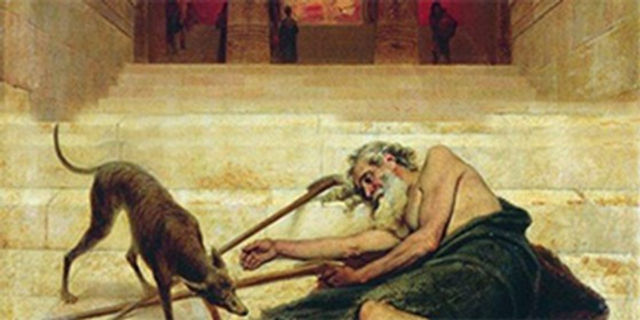
How did Lazarus die? It appears that the ulcerous Lazarus was beaten up and then thrown at the gate possibly by a gang or mob. Principle: Evil people do not discriminate: they despise the rich, poor and the helpless equally. Lazarus was so weak and so maltreated that he was not able to move away from the rich man’s gate, and so there he remained until his death.
After Job had passed his Evidence Testing the Lord eventually restored his health under living grace (God’s grace for the believer in life) whereas Lazarus after successfully passing Evidence Testing departed from this world under Dying Grace (God’s grace for the mature believer in dying). The very fact that the Lord gave the historical account of the dying days of Lazarus is significant as the Lord himself had removed logistical grace-support from Lazarus in order for Lazarus to glorify Him in a special way. Lazarus, as an invisible hero in the angelic conflict, would demonstrate especially to angels how truth in the soul could develop such a strong love for the members of the Godhead that no adversity could destroy it. He also testified to the importance of possessing eternal values over against temporal ones. This testimony of Lazarus under dying grace glorified God to the maximum.
Luke 16:21. And longing to be fed with the crumbs which were falling from the rich man’s table [no one offered food]; but [in contrast to the cruelty of mankind] even the dogs were coming and licking [iterative imperfect] his sores.
Lazarus was normal (not in a state of depression) and therefore had normal physical desires. In normalcy, he in great hunger desired the crumbs which fell from the rich man’s table. If Lazarus had been in a state of depression, he would have had either a loss of appetite or had some abnormal craving.
The only friends Lazarus had, were the wild dogs who demonstrated much more compassion than the rich man and his friends or others who knew of his situation. Lazarus was completely cut off from any human love, compassion, and friendship.
Luke 16:22. Now it came to pass that the poor man died, and he was carried by angels [probably angelic officers, in honor of Lazarus’ status as a winner-believer] to Abraham’s bosom [a technical expression for a location in Paradise for the elite believers]; and the rich man also died and was buried.
The comparison in context indicates that Lazarus was not buried, not even in a potter’s field. Apparently, after his death, he was removed with the garbage and thrown into a garbage heap or burned as was the custom in the ancient world. In the case of Lazarus since he was not under anyone’s care, his body possibly was partially decayed upon discovery of his death, and so being repulsive would not have made it to the potter’s field. He was more than likely thrown into the deep narrow Glen of Gehenna and burned. This glen was used as the garbage heap of Jerusalem located just south of the city.
Later, when the rich man died, he probably had a very unusual and ostentatious funeral in accordance with his wishes, his body being placed in a beautiful coffin which in turn may have been placed into a grand mausoleum. It was all meaningless for the rich man’s soul went straight to Torments in Hades where the soul was placed in an interim body that he might experience the suffering of terrible heat and flames.
If you were to interview Lazarus today about his suffering at the rich man’s gate his reply would surely speak of time on earth being a drop in a bucket compared to eternity, and even tremendous suffering in time is incomparable to the fantastic blessings that he will enjoy for trillions of years.
On the other hand, if you were to interview the rich man regarding the great pleasure, power and influence he had during his lifetime would probably reply: “I regret every second, every minute of my prosperity, worldly pleasures, power and influence. It blinded me to my need for eternal salvation, a relationship with God which I could have had both in time and in eternity. I curse the good times that blinded me to the importance of eternity. The horrors of the eternal state have erased all the pleasures of my lifetime. For over 2000 years I have been tormented in the flames of Hades and the worst is yet to come…”
Luke 16:23. In Hades he [the rich man] lifted up his eyes, being in torment, and saw Abraham far away and Lazarus in a place of honor.
This passage reveals much about the conditions facing a departed unbeliever. In this verse and those following we read that the rich man has eyes, a tongue, and obviously a voice to speak and ears to hear. In other words, the interim body of the unbeliever in Hades functions much like a human body on earth in that it allows the soul placed within that body to perceive the surroundings and communicate with others. It too has some kind of nerve system made of pain receptors that send messages of pain and thirst to the soul – there is no escaping constant torment in the aptly named Torments. We are also taught that Torments is a place of darkness as per Matthew 22:13b, “throw him into the outer darkness where there will be weeping and gnashing of teeth.” So, we may picture the rich man standing on the outer edge of Torments, looking out from darkness across the impassable great gulf fixed and into a beautifully illuminated Paradise, where he can clearly see Lazarus with Abraham.
The unbelievers residing in Torments will be removed from Torments just before the destruction of planet earth and the universe at the completion of the Millennium. Their souls will also be transferred from their interim bodies into permanent resurrection-bodies to face the Great White Throne Judgment (Revelation 20:12) where they will be judged by the Lord Jesus Christ and thrown into the Lake of Fire where they will share the same fate (Revelation 20:15) as Satan himself. (Matthew 25:41; Revelation 20:10).
Since Abraham was the father of the Jewish race and one of the greatest believers of the Old Testament, being in a location with him implies great honor. Thus, the expression “Abraham’s Bosom” indicates that one section of Paradise was the location for mature believers who had died with the highest honors. All Old Testament-believers were taken to the 3rd heaven at the ascension of Christ, but must still wait until the end of the dispensation of Israel, fulfilled at the termination of the seven- year Tribulation, also marking the Second Advent of Christ, before they can receive their eternal resurrection-bodies.
Luke 16:24. And he cried out and said, ‘Father Abraham [indicating that he was a Jew], have mercy on me [something Lazarus never said at the gate of the rich man], and send Lazarus so that he may dip the tip of his finger [Lazarus in his interim body] in water and cool off my tongue [the tongue of the rich man in his interim body], for I am in agony in this flame.’
The rich man showed no mercy in time, but in Torments he begs for mercy. On the other hand, there is no record of Lazarus ever having asked for mercy from the rich man or any other person, nor ever having complained or begged. Evil people show no mercy to others, but when in trouble beg or even demand mercy for themselves, whereas great believers are compassionate and show mercy to others, but do not ask or beg for it from others even when they are in need.
The cry of mercy must occur in time, for in eternity it is too late. Why is this so? Well, one must understand that every decision we make has a time frame. Deciding on what you eat for a dinner usually has consequences lasting no longer than an hour or two. Marriage is a decision of which consequences usually last a maximum of 50 years. However, when we make a decision about Christ and his work on the cross, the time frame is forever.
The longer the time frame related to a decision, the more seriously we should consider it. So, when a young man or woman is considering marriage, one would think that he or she would consider all of the facts very closely since the repercussions of that decision may affect them for quite some time. Yet, how much more so should a person consider the facts regarding Christ and His work upon the cross since this is a decision which affects the person forever.
Luke 16:25. But Abraham said, ‘Child, remember that during your life you received your good things [focused on the temporal], and likewise Lazarus evil things [though under great suffering focused on the eternal]; but now he is being comforted here [given a special place of honor], and you are in agony [because you were distracted from what was really important].
Abraham calls the rich man a child because he is not accepting responsibility for his eternal decision (a decision with eternal repercussions). When he chose to reject the Gospel message, he was literally choosing to suffer first in Torments and then in the Lake of Fire. So, whether he likes it or not, he will take the responsibility for that decision.
Luke 16:26. ‘And besides all this, between us and you a great chasm has been fixed, so that those who wish to come over from here to you will not be able, and that none may cross over from there to us.’
Even if Abraham should have wanted to help, he would not have been able to do so. After death the believers and unbelievers are separated, and so it is in eternity. No one can alter the plan of God the Father.
Luke 16:27-28. And he said, ‘Then, I beg you, father [Abraham is the father of the Jewish race], that you send him to my father’s house [where the rich man and undoubtedly his five brothers saw the starving Lazarus daily] (28) for I have five brothers—in order that he may warn [regarding the rejection of the gospel] them, so that they will not also come to this place of torment.’
It is amazing that in his interim body which lacks the Sin Nature, he expresses some concern for his family members! Though he had rejected the gospel, he did possess some compassion in his soul.
Luke 16:29-30. But Abraham said, ‘They have Moses and the Prophets [an expression for the Old Testament]; let them hear them.’ (30) But he said, ‘No, father Abraham, but if someone goes to them from the dead, they will change their thinking [regarding Christ and believe in Him]!’
In verses 27-30, the rich man in Torments seemed to have understood the Gospel, particularly how salvation is attained by changing one’s thinking and believing in Jesus Christ, for he used the Greek word ‘metanoeo,’a word related to salvation.
Mark 1:15b. Jesus Christ commanded, “Change your thinking [the Greek word ‘metanoeo’] and believe in the gospel.
In Matthew 11:20, Jesus reproached the Jewish negative volition, “Then, He began to reproach the cities in which most of His miracles were done because they did not change their thinking [about Christ; the Greek word ‘metanoeo’ is used; Before anyone believes in Christ, he changes his thinking (mind) about Christ.”
The rich man did not ask for the opportunity to believe in Christ for he knew that it was too late for him to make that decision. (Before death, he had made his eternal decision.)
Luke 16:31. But he [Abraham] replied to him, ‘If they do not listen to Moses and the Prophets [the Gospel message as found in the Old Testament, for example Isaiah 53], they will not be persuaded even if someone should rise from the dead.’
The Word of God (the Old Testament in this verse) is much more powerful than any miracle. Furthermore, Lazarus was the evangelist at their gate. As it were, the gate was his pulpit. If they would not listen to him then, and they didn’t; they would not have listened to him if he had returned. If a person is negative toward the truth, a miracle (i.e. the return of Lazarus) will not change his mind.
John 12:37. But though he had performed so many miraculous signs before them, yet they were not believing in Him.
Matthew 11:20. Then He began to denounce the cities in which most of His miracles were performed because they did not change their thinking [about Him and believe].
Also, Pharaoh Amenhotep II of the Exodus illustrates this point well). If Moses and the Prophets were not able to change their thinking, neither could Lazarus.
A Second example of people in Interim Bodies:
Moses and Elijah in Interim bodies: Revelation 11:7, 11, 12. Now when they [Moses and Elijah] had finished their testimony [ministry], the beast-monster [Abaddon of Revelation 9:11: an evil and powerful fallen angel] who comes up from the abyss [It is obvious from this statement that this powerful demon and his army had to return to the Abyss after their torturing of cosmic individuals for five months] will make battle [fight] against them [Moses and Elijah] and will both overpower and kill them [the Permissive Will of God permits these murders]. (11) And after three and a half days, the breath of life from God entered into them [their original soul and spirit entered into their interim bodies]; then they [Moses and Elijah] stood on their feet; and great fear [but did not change their attitude toward Christ] fell on those who were viewing them. [These people were either viewing them as they walked by or via some media.] (12) And they [Moses and Elijah] heard a loud voice from heaven saying to them, "Come up here." And so, they went up to heaven in a cloud, while their enemies [both believer and unbeliever] observed them [Moses and Elijah were in heaven in interim bodies; then they came to the earth in interim bodies as the Lord’s heralds; upon the completion of their ministries, they were murdered and subsequently resuscitated by God and then commanded to return to heaven in their interim bodies].
Other examples of persons in Interim Bodies:
Matthew 27:52-53. And tombs were opened [by the earthquake], and many bodies of the saints who had fallen asleep [died] were raised-up [raised from Paradise after the resurrection of Jesus Christ as per the next verse]. (53) And coming out of the tombs [Old Testament saints who died and were buried in or around Jerusalem] after His resurrection, they [in their interim bodies] entered into the holy city [Jerusalem] and appeared to many [in their interim bodies possibly to announce the resurrection of Christ for the next forty days and then would have joined the other Old Testament believers in the procession to the 3rd heaven at the ascension of Christ].
1 Peter 3:19. By means of whom [the Holy Spirit] also He [the humanity of Christ] went and made a proclamation [generally a short well-defined declaration apparently in his interim body since he spoke] to the spirits in prison [the fallen angels in Tartarus as a group].
2 Corinthians 5:4
For while we are in this tent [in our human mortal body with itsSin Nature], we groan and are burdened, because we do not wish to be unclothed [the soul will never be without a body] but to be clothed with our heavenly dwelling [ultimately the resurrection body], so that what is mortal may be swallowed up by life [eternal life will function in our resurrection-body].
καὶ γὰρ οἱ ὄντες ἐν τῷ σκήνει στενάζοµεν βαρούµενοι, ἐφí ᾧ οὐ θέλοµεν ἐκδύσασθαι ἀλλí ἐπενδύσασθαι, ἵνα καταποθῇ τὸ θνητὸν ὑπὸ τῆς ζωῆς.
2 Corinthians 5:3-4 tells us that upon death, our souls will be first clothed in an interim body and ultimately in a resurrection body. The exception will be those who are in the Rapture generation.
Resurrection, First and Second:
The First Resurrection:
1. Alpha Company: Jesus Christ received His resurrection body circa April 17, 30 A.D.
2. Bravo Company: Church Age believers will receive their resurrection bodies at the Rapture of the Church.
3. Charlie Company: Old Testament believers will receive their resurrection bodies at the 2nd Advent.
4. Delta Company: Millennial believers will receive their resurrection bodies at the end of the Millennium.
The Second Resurrection:
All unbelievers will receive their resurrection bodies just before the Great White Throne Judgment. After this judgment, they in their resurrected bodies will be cast into the Lake of Fire forever.
Resurrection:
Outline:
1. Resurrection must not be confused with resuscitation:
2. Details leading up to and including His Resurrection:
3. The Power involved in His Resurrection:
4. The Lord’s Resurrection guarantees our Resurrection:
5. Our Resurrection is the Lord's Victory:
6. There are two general resurrections namely the First and the Second:
7. Old Testament applications related to Resurrection:
8. Though the Resurrection of Christ is part of the Gospel-Message, it is not a necessary part:
9. The Importance of Resurrection as it relates to Salvation:
Resurrection must not be confused with resuscitation:
Resuscitation defines a person who has died and then is brought to life in the body in which he died. For example, Lazarus was resuscitated by Jesus [brought back to life in his mortal body and subsequently died]; Paul resuscitated a boy [returned life to his mortal body] who fell out of a window; also, two boys in the Old Testament were resuscitated [life was returned to their mortal bodies], and Elijah and Moses residing in their interim bodies in heaven will return to the earth in the last half of the Tribulation. After their ministries on the earth will have been completed, they will be murdered by Abaddon. However, they will be resuscitated and ascend into heaven with their interim bodies. Then, at the 2nd Advent, the bodies of Moses and Elijah along with all Old Testament believers and those who died during the Tribulation will receive their eternal resurrected bodies: corruption will become incorruption].
Details leading up to and including His Resurrection:
First Fruits occurred on the first Sunday after the Passover.
Leviticus 23:9-12. Then the Lord spoke to Moses, saying, (10) ‘Speak to the sons of Israel and say to them, 'When you enter the land which I am going to give to you and reap its harvest, then you shall bring in the sheaf of the first fruits of your [barley] harvest to the priest [Sunday, 18 Nissan]. (11) 'He shall wave the sheaf [in this case a bundle of barley stalks] before the Lord for you to be accepted [based on resurrection]; on the day after the sabbath [Saturday 17 Nissan] the priest shall wave it. (12) 'Now on the day when you wave the sheaf, you shall offer a male lamb one year old without defect for a burnt offering to the Lord [This feast portrayed the resurrection of our Lord who is the First Fruits, the first member of the human race to receive a resurrection-body].”
After the physical death of Jesus, his body went into the grave, his human spirit went into the presence of God the Father and his soul went to Hades in the care of God the Holy Spirit, and this is why he said to the dying thief in Luke 23:43, "Today you shall be with Me in Paradise," and his human spirit went to God the Father in the 3rd heaven.
1 Peter 3:18-20. For Christ also died [paid the penalty for all the sins of humanity] for sins once and for all, the righteous one as a substitute for the unrighteous ones [we are all sinners with Sin Natures], so that He might bring us to the God [the Father via reconciliation], having been put to death in the flesh [in his human body], but made alive by means of the Spirit [the omnipotence of the Holy Spirit participated in the resurrection of Christ]; (19) By means of whom [the Holy Spirit] also He [the Lord Jesus Christ most likely in an interim body] went and made a proclamation [a short well defined declaration] to the spirits in prison [the fallen angels in Tartarus as per Jude 6; 2 Peter 2:4]. (20) who [the fallen angels in Tartarus] once were disobedient [by cohabitating with human females and so producing the Nephilim, the half angel and half human as per Genesis 6:1-11], when the patience of God kept waiting in the days of Noah [God waited 120 years for these half human, half angels to believe in Jesus Christ before the flood], during the construction of the ark, in which a few, that is, eight souls [emphasis is placed on the soul since it is the soul that is saved], were brought safely through the water.
When the work of salvation was finished, our Lord said to the Father, in Luke 23:46, "Father, into Your hands I dismiss My spirit," and so his human spirit traveled billions of light years of space into the presence of God the Father. After three days, the omnipotence of the Father sent our Lord's human spirit through billions and billions of light years of space back to His body in the tomb. Simultaneously, the omnipotence of the Holy Spirit returned His human soul from Hades to His body. Now rejoined in the resurrection body, our Lord walked through the stone. Later on, an angel rolled away the stone so that the world could see and verify the resurrection. In summary, the power that resurrected Christ was made possible by means of the omnipotence of God the Father and the omnipotence of the Holy Spirit.
Additional documentation:
Acts 2:27. Because you will not abandon my soul to Hades [the Holy Spirit will return his soul to his body in the grave], nor allow your holy one to undergo decay [the body of Jesus did not suffer decay in the tomb, a quote from Psalm 16:10].
Acts 2:31 clarifies this statement, "He [David] looking ahead spoke of the resurrection of Christ, that He was neither abandoned in Hades nor did His flesh see decay."
Ephesians 4:8-10, “Therefore, it says [in Psalm 68:18] when He ascended into the third heaven up on high, He led a host of captives [to exhibit prisoners in a triumphal procession; however in this context, it is not prisoners but the Old Testament saints who were transferred from Abraham’s Bosom to the third heaven] in triumphal procession [an analogy to the Roman Triumphal Procession] from a state of captivity [by analogy, a reference to Abraham’s Bosom in Hades] and He [Christ] gave spiritual gifts to men [to Church Age believers in celebration of his triumph that is his strategic victory over Satan on the cross; this would be analogous to a Roman Imperator or a triumphal general who would give gifts to his soldiers as part of his triumphal celebration]. (9) (Now, this doctrine that He ascended, what does it imply except that He [His soul most likely in an interim body] went down [descended] into the lower regions [Hades] of the earth? (10) Jesus who descended is the same one also that ascended up higher than all the heavens, that He might bring to completion all things.
Matthew 28:1-2. Now, after the Sabbath [the normal Saturday Sabbath], as it began to dawn into the first day of the week [Sunday, the Feast of the First Fruits also a Sabbath], Mary Magdalene and the other Mary [the wife of Clopas, the mother of Joseph and James the Lesser and others not mentioned here] came to see the sepulcher [they traveled at sunrise]. (2) And behold, a great earthquake occurred [to alert people that the resurrection had occurred]! For an angel from the Lord had descended from Heaven and came [after Jesus had passed through the boulder] and rolled back the stone [in order that others may look in] and sat on it [while waiting for the ladies].

Matthew 28:3-8. His countenance [the angel who rolled back the stone] was like lightning, and his clothing white as snow. [Angels possibly are constructed out of something similar to light, but can travel much faster than the speed of light.] (4) And the guards shook from fear of him [the angel] and became like dead [passed out]. (5) And the angel answered and said to the women [Mary Magdalene, Mary, the wife of Clopas and the other women], ‘You yourselves, stop fearing [stop looking confounded, astonished and afraid: a normal response since they were facing something beyond their frame of reference], for I know that you seek Jesus who was crucified. (6) He is not here, for He has risen, just as He said. Come, see the place where He was lying. (7) And go quickly and tell His disciples that He has risen from the dead. And, behold, He goes before you into Galilee. There you shall see Him. Lo, I have told you [The angel has followed his orders from God].’ (8) And having departed quickly from the tomb with awe [occupied with Christ] and with great joy [sharing the happiness of God], they [Mary Magdalene, the wife of Clopas, Joanna, and others] ran [in good condition] to announce [the resurrection] to His disciples [Luke 24:9].
The first appearance of the resurrected Christ was to Mary Magdalene and then to other Jewish ladies.
John 20:1-18. Now on the first day of the week [Sunday] Mary Magdalene [along with Mary, the wife of Clopas and other women] came early to the tomb, while it was still dark [early Sunday morning], and saw the stone already taken away from the tomb. (2) So, she [Mary Magdalene is singled-out since she will be the first one to see the resurrected Jesus] ran and came to Simon Peter and to the other disciple whom Jesus loved [John], and said to them [these two were considered the two spiritual leaders], ‘They have taken away the Lord out of the tomb, and we [Mary Magdalene and Mary the wife of Clopas and other women] do not know where they have laid Him [his body].’ (3) So [after hearing this message from the ladies], Peter and the other disciple went forth, and they were going to the tomb. (4) The two were running together [followed by Mary Magdalene who still desired to locate the body]; and the other disciple [John] ran ahead faster than Peter and came to the tomb first; (5) and stooping and looking in, he saw the linen wrappings lying there; but he did not go in. (6) And so, Simon Peter also came, following him [John], and entered the tomb [Peter was very aggressive]; and he saw the linen wrappings lying there [but no angels], (7) and the face-cloth which had been on His head, not lying with the linen wrappings, but rolled up in a place by itself [the angel was very neat]. (8) So, the other disciple [John] who had first come to the tomb then also entered, and he [John] saw and believed [in the resurrection; the first one to do so]. (9) For as yet they did not understand the Scripture, that He must rise again from the dead. (10) So, the disciples [Peter and John] went away again to their own homes [but Mary Magdalene remained behind]. (11) And Mary [Magdalene] was standing outside the tomb weeping [because of her love for the Lord Jesus Christ]; and so, as she wept, she stooped and looked into the tomb; (12) and she saw two angels in white sitting, one at the head and one at the feet [protocol], where the body of Jesus had been lying. (13) And they [the two angels] said to her, “Woman, why are you weeping?” She said to them, “Because they have taken away my Lord, and I do not know where they have laid Him [His body]. (14) When she had said this, she turned around and saw Jesus standing there, and did not know that it was Jesus. (15) Jesus said to her, “Woman, why are you weeping? Whom are you seeking?” Supposing Him to be the gardener, she said to Him, “Sir, if you have carried Him away, tell me where you have laid Him, and I will take Him away [His body away for a proper burial]. (16) Jesus said to her, “Mary!” She turned and said to Him in Hebrew, “Rabboni!” (which means Teacher). (17) Jesus said to her, “Stop clinging to Me [in her tremendous love response], for I have not yet ascended to the Father; but go to My brethren [all the believers known to her] and say to them, ‘I ascend to My Father and your Father, and My God [the Father] and your God.’” (18) Mary Magdalene came announcing to the disciples, “I have seen the resurrected Lord and that He had said these things to her.
Matthew 28:9-10. And behold, Jesus met them [the ladies minus Mary Magdalene; this would be His 2nd resurrection-appearance], saying, “Hail [greetings]! And they [Mary the wife of Clopas, Joanna etc.] came and held Him by the feet and worshiped Him. (10) Then, Jesus said to them, “Do not remain in this state of awe; go tell My brethren [the eleven disciples that you have seen the resurrected Jesus] that they should go into Galilee, and there, they will see Me [first these women along with Mary Magdalene reported to the disciples regarding the empty tomb; now these ladies minus Mary Magdalene are to report that they have seen the resurrected Christ and to repeat the instructions to meet the Lord in Galilee].
Luke 24:1-12. On the first day of the week [Sunday], very early in the morning, the women took the spices they had prepared and went to the tomb. (2) They found the stone rolled away from the tomb, (3) but when they entered, they did not find the body of the Lord Jesus. (4) While they were wondering about this, suddenly two men [two angels who reiterated the message of the angel who had rolled back the stone as per Mark 16:7] in clothes that gleamed like lightning stood beside them. (5) In their fright the women bowed down with their faces to the ground, but the men [the two angels] said to them, "Why do you look for the living among the dead? (6) He is not here; he has risen! Remember how he told you, while he was still with you in Galilee, (7) saying that the Son of Man must be delivered over to the hands of sinners, be crucified and on the third day be raised again. (8) Then, they remembered his words. (9) When they [Mary Magdalene, Mary the wife of Clopas, Joanna and others] came back from the tomb, they told all these things to the Eleven and to all the others. (10) It was Mary Magdalene, Joanna, Mary the mother of James, and the others with them who told this to the apostles. (11) But they [a reference to “to all the others”] did not believe the women, because their words seemed to them like nonsense. (12) Peter, [and John and Mary Magdalene who followed after these two for she still desired to locate the body] however, got up and ran to the tomb. Bending over, he saw the strips of linen lying by themselves, and he went away, wondering to himself what had happened [Peter still was not able to relate this to the resurrection of the humanity of Christ].
Mark 16:1-8. When the Sabbath was over [a reference to the Passover which occurred on Wednesday], Mary Magdalene, Mary the mother of James, and Salome bought spices [during Thursday and Friday] so that they might go to anoint Jesus' body [This intention was never fulfilled]. (2) Very early on the first day of the week [Sunday], just after sunrise, they were on their way to the tomb (3) and they asked each other, "Who will roll the stone away from the entrance of the tomb?" (4) But when they looked up, they saw that the stone, which was very large, had been rolled away. (5) As they entered the tomb, they saw a young man [an angel] dressed in a white robe sitting on the right side [apparently the angel who had rolled away the stone], and they were alarmed. (6) "Don't be alarmed," he said. "You are looking for Jesus the Nazarene, who was crucified. He has risen! He is not here. See the place where they laid him. (7) But go, tell his disciples and Peter, 'He is going ahead of you into Galilee. There you will see him, just as he told you.' " (8) Trembling and bewildered, the women went out and fled from the tomb. They said nothing to anyone, because they were afraid [apparently this is why this command had to be reiterated in Matthew 28:7].
The Power involved in His Resurrection:
Jesus had the authority to lay down his life and to take it up again.
John 10:18. No one has taken it [my life] away from Me, but I lay it down on My own initiative [“Father, into your hands, I commit My spirit”]. I have authority to lay it down [to bring to an end, his physical life], and I have authority to take it up again. This commandment I received from My Father.
Although Jesus Christ Himself had the power to bring Himself back from the dead, he relied upon the omnipotence of God the Father and of God the Holy Spirit. Therefore, during the period of His physical death, the three days in the grave, Jesus Christ in conformity to the concept of Kenosis, did not exercise His omnipotence to benefit Himself, to provide for Himself, to raise Himself from the dead, or to glorify Himself in any way.
This authority or power came from the omnipotence of God the Father, who restored our Lord's human spirit to His body, and from the omnipotence of the Holy Spirit, who restored our Lord's human soul to His body. At that moment, the human spirit and soul of our Lord rejoined His undecayed body in the grave: mortal became immortal in resurrected body via the agency of both the omnipotence of God the Father and of God the Holy Spirit.
1 Corinthians 6:14. Now God [the Father] has not only resurrected our Lord, but He will raise us up through His power [He will provide resurrection bodies for all those Christians who will have died before the Rapture of the Church. Furthermore, he will raise the Rapture generation through God the Holy Spirit].
Romans 8:11. Now if the Spirit from Him [God the Father] who raised Jesus from the dead indwells you [and He does], He [God the Father] who raised Jesus Christ from the dead will also give life to your mortal bodies through His Spirit who indwells you [God the Holy Spirit will provide resurrection bodies for all those who will be alive at the Rapture].
1 Peter 3:18. For Christ also died as a substitute for our sins once and for all, the righteous for the unrighteous so that He might bring us to God [the Father], having been put to death in the flesh [his physical death], but made alive [given a resurrection body] by the Spirit.
The identical omnipotence of God the Father and the omnipotence of the Holy Spirit that raised Christ from the dead is the same power that has been provided for us in our spiritual lives. The omnipotence of God the Father is available to you in the mechanics of the Protocol Plan of God and in the promises and guarantees in our Portfolio of Invisible Assets. The power of the Holy Spirit is understood through Common and Efficacious Grace, Baptism of the Spirit, Regeneration, Indwelling, the giving of spiritual gifts, Sealing and the phenomenal enabling power of the Filling of the Spirit. Furthermore, the omnipotence of Jesus Christ is available to you as well for He not only holds the universe together but at the same time controls and perpetuates human history one day at the time. Never before in history has so much divine omnipotence been available to so many believers for the glorification of God through the execution of His will, His plan, and His purpose.
1 Peter 1:3-8. Worthy of praise and glorification [because of his character, plan and function] is the God even the Father of our Lord Jesus Christ, who on the basis of his mercy has caused us to be born again to a living confidence [based on our spiritual life taken directly from our Lord’s spiritual life and the confidence based upon resurrection] through the resurrection of Jesus Christ out from the dead [the power that raised Christ has been given to us], (4). resulting in an inheritance [a reference to Escrow Blessings] which is imperishable [eternal] and undefiled [not stained by theSin Nature] and will not fade away, reserved in heaven for you (5) who are guarded [in a garrison on this earth] by the power of God [the wall of fire; guardian angels; spiritual life] through faith [we walk by faith and not by sight] resulting in deliverance [via the Faith-rest Drill explained in the next verse] ready to be revealed [the bride is unveiled at the 2nd Advent] in the last time [at the 2nd Advent]. (6) In this [inheritance] you greatly rejoice, even though now for a little while, if necessary, you have distresses from various testing [undeserved sufferings] (7) that [purpose clause] the testing [for approval] of your faith [Faith-rest Drill], of greater value [the testing of faith under suffering] than gold which is perishable [spiritual assets do not perish], even though tested through fire [the tests associated with the levels of spiritual growth] may be found [having passed the tests] to result in commendation and glory and honor [rewards] at the revelation of Jesus Christ [the Rapture], (8) and though you have not seen Him, you love Him [occupation with Christ], and though you do not see Him now, but believe [Faith Perception to maintain their love], you greatly rejoice with joy inexpressible having received glory [from the execution of the spiritual life].
Paul not only wanted to understand the divine power related to the resurrection of the humanity of Christ, but also Christ’s sufferings and death. Since both God the Father and Holy Spirit used their power in providing the resurrection-body for Christ, it was this power to which Paul was referring. He wanted to understand the Father’s power as it relates to His plan and the power of God the Holy Spirit especially his enabling power; Furthermore, he wanted to experience undeserved suffering in his spiritual life as Christ experienced undeserved suffering but of course not at the same degree. Christ was victorious in his death; Paul wanted to be victorious in his death.
Philippians 3:10. That I [Paul] may come to know Him, and the inherent power of His resurrection, and the fellowship of His suffering, being conformed to His death.
The Lord’s Resurrection guarantees our Resurrection:
1 Thessalonians 4:13. But we do not want you to be ignorant, brethren, about those who are asleep [the body sleeps as it were until the believer’s body resurrects, gets up from its sleep], that you may not grieve as do the rest [the unbelievers] who have no confidence.
Ignorance is the greatest problem with Christianity today, and it is not an easy problem to solve especially since most Christians do not think that learning the Word of God is important.
1 Thessalonians 4:14-16. For if we believe that Jesus died and rose again, and we do. So, in the same manner, the God [the omnipotence of God the Father] will bring with Him those [in interim bodies] who have fallen asleep [died] by [the will of] Jesus (15) for this we communicate to you by the word of the Lord, that we [Paul identifies himself with the Rapture generation] who are alive and remain until the coming of the Lord [at the Rapture], will not precede [in meeting the Lord in the air at the Rapture of the Church age believers] those who have fallen asleep [died]. (16) because the Lord Himself will descend from heaven with a command [will give a command through Gabriel], with the voice of the archangel [for mortality to receive immortality, a reference to those alive at the Rapture] and with the trumpet of God [the Father’s trumpet command for the corruption of the interim body to become the incorruption of an eternal body], in fact, the dead in Christ [those having died before the Rapture] will rise first [in their resurrection bodies].
Notice that at the resurrection there are two commands. The voice command of the Lord via the archangel is for the resurrection of Christians alive on the earth, mortal becoming immortal, from having a mortal body to having a resurrection body. There is also a trumpet command of God the Father which command is blown for the resurrection of those believers who will have died before the Rapture: the corruption of the interim body will be transformed into the incorruption of the Resurrection body.
Since both God the Father and God the Holy Spirit provided the humanity of Christ with his resurrection body so will they provide the resurrection bodies of Church Age believers at the Rapture of the Church. The Father will use his power in providing the resurrection bodies of those who have already died, whereas God the Holy Spirit will provide the resurrection bodies of those who will be alive at the Rapture.
1 Corinthians 15:50-54. Now this I affirm, brethren, that flesh and blood [the mortal body] cannot inherit the kingdom of God [the mortal body was not designed for the eternal state], nor does corruption [the interim body] inherit incorruption [also the interim body was not designed for the eternal state]. (51) Behold, I teach you a mystery [the resurrection of Church Age-believers about which there is no prophecy in the Old Testament]: we shall not all sleep [In this analogy, sleep applies only to the physical body, not to the soul. The body “sleeps” because the soul and spirit are absent from that body in an interim body waiting for the resurrection.], but we shall be changed [receive a resurrection-body], (52) in a moment, in the winking of an eye, at the last trumpet; for the trumpet will sound, and the dead [those in interim bodies] will be raised incorruptible [these interim bodies will be metamorphosed into an eternal resurrected body], and we [Church Age believers alive at Rapture] shall be changed [mortality becomes immortality that is the mortal body will be metamorphosed into an eternal resurrected body]. (53) For this perishable [the interim body of those Christians who died before the Rapture] must put on imperishable [an eternal body], and this mortal [the mortal body of those alive at the Rapture] must put on immortality [eternal body]. (54). But when this perishable [the believer in his interim body] shall have put on the imperishable [a resurrection-body], and this mortal [the believer alive at the Rapture] shall have put on immortality [resurrection body], then will come about the saying that is written, “Death is swallowed up in [as a result of] victory [All Christians both the evil and the great will receive a resurrection-body and live with God in happiness for all eternity].
1 Thessalonians 4:17-18. Then, we [Paul identifies himself with those who will be alive at the Rapture] who are alive and remain will be caught up together with them in the clouds to meet the Lord in the air, and so we shall always be with the Lord. (18) Therefore, comfort one another with these words.
These doctrines are a source of comfort when you have lost Christian loved ones since the separation is only temporary. They are in heaven in their interim bodies waiting for the Rapture just as you. These doctrines are a source of blessing as you face the adversities of life and realize that there is something far beyond this life, and that God will provide for you an eternal body to be enjoyed in both the Millennium and in the eternal state, a permanent body that will never experience pain or deterioration in any possible way.
The Promise of the Rapture:
John 14:1-3. Do not let your heart [the mentality of the soul] be troubled [addressing future Church age believers]; believe in God, believe also in Me. (2) In My Father’s house are many mansions; if it were not so, I would have told you [the apostles but applies to future Church Age believers]; for I go to prepare a place for you [the groom prepares a home for his bride]. (3) If I go [ascension] and prepare a place for you, I will come again [Rapture] and receive you [the Church, his bride] to myself [the ceremony: the bride is presented to the groom], that where I am, there you may be also.
1 John 3:2-3. Beloved, now we are the children of God, and it has not appeared as yet what we will be. We know that when He appears [at the Rapture], we will be like Him [a resurrection body similar to that of Jesus] because we will see Him just as He is. (3) And everyone [the believer with momentum] who keeps having this confidence [from doctrine in the soul] in him purifies himself [by advancing in fellowship] just as that one is pure [the humanity of Christ remained in fellowship with God during the 1st Advent].
James gives us an admonition.
James 5:7-8. Therefore [if you desire to continue your spiritual growth], have patience, brethren [execute the spiritual life], until the Coming of the Lord [at the Rapture]. Behold, the farmer waits with expectation for the valuable production of the land, and constantly being patient over it [the land] until he has received the early rains [October thru December] and the latter rains [March thru April]. (8) You too be patient and have stability [from knowledge of God’s Word] in your right lobe [the stream of consciousness], because the Coming of the Lord [the Rapture] draws near [every day it gets closer].
Titus 2:13. Waiting with keen anticipation for that blessed hope [Rapture], even the appearance of the glory of our great God and Savior, Christ Jesus.
Three times in Revelation is the phrase, "I am coming soon": Revelation 22:7, 12, 20. Remember that, to the Lord, a day is as a thousand years and a thousand years is as a day. This statement was made in A.D. 96, and this is now A.D. 2025. Therefore, "soon" connotes imminency, not immediacy. God the Father has not made known to us when the Rapture is to take place. However, if we should know when the 2nd Advent should occur, but we don’t, we could merely subtract seven years and so ascertain the date of the Rapture.
Matthew 24:36. But concerning that day and hour [of the 2nd Advent] no one knows, not even the [elect] angels of heaven nor the Son [speaking of his humanity], but the Father alone [only the members of the Trinity know].
The Significance of Resurrection as the Lord's Victory:
John 11:25. Jesus said to Martha, "I am the resurrection and the life. He who believes in Me shall live [in resurrection-bodies forever] even if He dies [So, there is no need for your unwarranted concern for the death of Lazarus!]."
Just as the death of the believer is the Lord's victory, so the resurrection of the believer is the Lord's victory. The resurrection of the believer is the wise and sovereign decision of God. This means that the believer's volition, cognition, and individual merit are not factors in the resurrection of the Church. Winners and losers alike will receive a resurrection body equally. So, resurrection is strictly the Lord's victory. For just as we have no control over the manner or time of our death, so we have no control over the manner or time of our resurrection. This is completely a matter of the wisdom and sovereignty of God.
There are two general resurrections namely the First and the Second:
The Resurrection of Christ is the Pattern for the First Resurrection which is pictured as a battalion pass-in-review, and therefore, is divided into four echelons, Alpha Company, the resurrection of Christ at the end of the great power experiment of the Hypostatic Union. Secondly, Bravo Company, the resurrection of the royal family of God at the end of the great power experiment of the Church Age. Third, Charlie Company, the resurrection of the Old Testament believers and martyrs of the Tribulation at the Second Advent. Finally, Delta Company, the resurrection of the millennial saints at the end of the Millennium. The Second Resurrection is for unbelievers only. They will be resurrected to face the Great White Throne Judgment. After which, they will be cast into the Lake of Fire forever.
Old Testament applications related to Resurrection:
Though those in the Old Testament did not know about the Church Age and its culmination at the Rapture, the doctrine of resurrection was well known by the greats of the Old Testament. As examples, we will use Daniel, Job and Joseph although there are many others that we could have cited.
Daniel 12:2. And many of those who sleep [who have died] in the dust of the ground will awake [analogous to receiving a resurrection body], those to everlasting life [at the 2nd Advent], and that is the First Resurrection, but others to disgrace and everlasting shame [to those who reject the gospel message].
Job made application to the doctrine of resurrection in the time of his suffering.
Job 19:25-26. And as for me, I know that my Redeemer lives [resurrection after the redemptive work on the cross], and at last, He will take His stand on the earth [2nd Advent]. (26) Even after my skin is destroyed [for that is all that is left], yet out from my flesh, I [in my resurrection body] shall see God.
Joseph ordered, while he was dying, that his bones (body) be taken to the land promised by the Lord.
Hebrews 11:22. By faith, Joseph, when he was dying, made mention of the exodus to the sons of Israel and gave orders concerning his bones.
Genesis 50:24-26. And Joseph said to his brothers, “I am about to die, but God will surely take care of you, so that He will take you up from this land [Egypt] to the land which He promised on oath to Abraham, to Isaac and to Jacob. (25) Then, Joseph made the sons of Israel take an oath, saying, ‘God is going to deliver you. Therefore, you will carry my bones up from this place.’ (26) So, Joseph died at the age of one hundred and ten years; and he was embalmed and placed in a coffin in Egypt.
His coffin remained above ground for over four hundred years as a testimony that he knew he would be resurrected and so wanted to be resurrected from the Promised Land. In Exodus 13:19, we see that Joseph’s coffin went with the Jews as they left Egypt. For forty years it marched through the desert as a testimony of the faithfulness of God and the certainty of resurrection.
Joshuah 24:32. Now they buried the bones of Joseph, which the sons of Israel brought up from Egypt, at Shechem, in the piece of ground which Jacob had bought from the sons of Hamor the father of Shechem for one hundred pieces of money, and they became the inheritance of Joseph’s sons.
Though the Resurrection of Christ is part of the Gospel-Message, it is not a necessary part:
1 Corinthians 15:3-4. For I delivered to you as of first importance what I also received, that Christ died [a Substitutionary Spiritual Death] for our sins [propitiation, reconciliation and redemption] according to the Scriptures, (4) and that He was buried, and that He was raised on the third day according to the Scriptures [Even though the Corinthians had rejected the entire concept of resurrection, they were saved. So, after salvation as Christians, Paul had to teach them this important doctrine.],
Most unbelievers know very little about propitiation, reconciliation, redemption and in most cases nothing about the resurrection of Christ when they express faith in Christ. All the same, they are saved. Some unbelievers hear only the story about Nicodemus and believe in Christ and are eternally saved; others are told only that Jesus bore the punishment of their sins on the cross and so believe in Him. They do so and are eternally saved. So, although the unbeliever needs some information, it does not take much information for the Holy Spirit to convince the unbeliever to make a decision. Of course, the more information one gives to the unbeliever, the better.
John 16:8. And when that one comes, he will convince the world concerning sin [the sin of rejecting Christ as savior; sometimes understanding Christ’s resurrection will help to prevent this rejection] and concerning righteousness [to live with God, one needs perfect righteousness] and concerning judgment [if you should not respond to the good news, you will share in the devil’s judgment].
There are two major points in John 16 namely the need to believe in Christ and the need for God’s righteousness. James the half-brother of Christ obviously heard the gospel clearly presented, but it was not until he saw the resurrected Christ that he believed in Christ as his savior.
The Importance of Resurrection as it relates to Salvation:
1 Corinthians 15:12-14. Now, if Christ is proclaimed that He has been raised from the dead, how do some among you say that there is no resurrection out from the dead? (13) But if there is no resurrection of the dead, not even Christ has been raised, (14) and if Christ has not been raised, then our communication is in vain, your faith also is in vain.
Feasts of Israel:
There are seven feasts which the Jews celebrated as a Client Nation to God. There were the feasts regarding the First Advent, four of them, and there are the feasts of the Second Advent, three of them. Regarding the 1st Advent, the Passover represents the work of our Lord Jesus Christ on the cross which was generally celebrated around 14 April according to the Judean Calendar. Next came the Feast of Unleavened Bread which was a seven-day feast, 15-21 April. It represents the use of the Recovery Procedure and the advance to maturity. Within that week, there was the Feast of the First Fruits occurring on 18 April, the first Sunday after the Passover. This feast portrays the resurrection of our Lord Jesus Christ, and the importance of having an eternal relationship with Lord Jesus Christ. Then, in the first week of June, there was the Feast of Pentecost which is fifty days after the Feast of the First Fruits. It represents the setting aside of Israel as a client nation to God through the administration of the fifth cycle of discipline. After these four feasts, there occurred a great gap, between Pentecost, approximately from June 3rd to September-October. This gap represents the time when the Church Age, the dispensation of the royal family of God, is inserted. Then, came the feasts of the Second Advent, three of them: the Feast of the Trumpets signaling the termination of the fifth cycle of discipline and the restoration of Israel as a Client Nation. This was followed by Feast of the Atonement, Yom Kippur, which is the fulfilment of the unconditional covenants to Israel [the Abrahamic, Palestinian or Land Covenant, Davidic and the New Covenant]. The final feast is the Feast of the Tabernacles which depicts the Millennial reign of Christ.
The Feast Days and what they represented. As we will see, these feasts have to do with the ritual function of the Age of Israel; the Jews in the Age of Israel looked forward to the cross, the resurrection of Jesus, and their future via Pentecost, Trumpets, Atonement and Tabernacles. The word ‘feast’ is derived from the word chag which has a root meaning to dance, to be joyous. The feasts were designed to celebrate the happiness in the souls of Jewish believers in the Age of Israel. None of these feast days have anything to do with the modus operandi of the Church Age.
1. Passover and Unleavened Bread: This is taken from ‘Thieme’s Bible Doctrine Dictionary’ page 206 by R. B. Thieme Jr.
“Passover The divinely directed event that marked the Jews’ deliverance from Egyptian slavery and depicted the person and work of their Deliverer (Ex. 12:1–13). “Passover” also designates the annual ritual instituted to memorialize that initial event of 1441 B.C.
The young male lamb without blemish was the center of what God named “the Lord’s Passover” (Ex. 12:5, 11b). Per God’s instructions to Moses and Aaron, the yearling was killed before twilight [about sunset] on the appointed day and its blood painted on the doorposts and lintels of the houses (Ex. 12:6–7, 21–22). The Jews, dressed and ready for departure, then ate the roasted lamb with unleavened bread (Ex. 12:8–11). Later that evening, the angel of the Lord struck down the firstborn of every Egyptian household, while He “passed over” and spared from judgment the houses with bloodstained doorways (Ex. 12:12– 13, 23, 27). Finally overwhelmed by the God of Israel, the Egyptians begged the Jews to exit their country (Ex. 12:33).
Even more than securing the Jews’ freedom from Egypt, the Passover vividly prophesied the One who would be sacrificed for their spiritual freedom and redemption. The unblemished lamb represented the impeccable, innocent humanity of Jesus Christ. The blood of the animal painted on the crossbeams of the doorways symbolized Christ’s saving work on the cross, His Substitutionary Spiritual Death and judgment (1 Pet. 1:19). Finally, eating the lamb was a picture of non-meritorious faith in God’s salvation gift.
The Jews were also instructed that “this night is for the Lord, to be observed by all the sons of Israel throughout their generations” (Ex. 12:42, cf. 14). As a memorial to His grace, God instituted an annual Passover. Ceremonies involving the lamb, all of which depicted salvation, were to be immediately followed by a weeklong ritual involving unleavened bread, which depicted fellowship with God (Ex. 12:15–19).
Christ, our Passover. When the promised Savior, Jesus Christ, finally arrived in person, those who had heeded the Passover lessons recognized “the Lamb of God who takes away the sin of the world” (John 1:29, 36; 1 Pet. 1:19; cf. Isa. 53:7b). The disciples celebrated the last official Passover feast watching the Lamb Himself use bread as the sign of His spotless nature and the cup as the sign of His impending substitutionary death (Matt. 26:18, 26–28). Before twilight on the day of Passover, Jesus Christ was sacrificed for all humanity, fulfilling the reality behind the Old Testament shadow rituals (John 19:14; 1 Cor. 5:7). Now believers look back at the cross in memorial to God’s saving grace. The Eucharist, the new ritual instituted for the Church, replaces the ancient Passover feast and ceremonies.
For many Jews who through the years memorialized the first Passover but forgot about the necessity of the cross, ritual replaced reality. The true Lamb of God was unrecognizable. To this day, Judaism keeps the Passover and Feast of Unleavened Bread, not as the Lord’s Passover but as “the Passover, the feast of the Jews” (John 6:4; Acts 12:4).”
2. More on the Feast of Unleavened Bread: This feast lasted for seven days from April 15-21, and it occurred immediately after the Passover. Unleavened bread represents fellowship with God and everything God provides to keep you alive in Satan’s world.
1 Corinthians 5:8. Therefore, let us observe the Feast [of Unleavened Bread: after the Passover, there followed this Feast representing fellowship with God], not with old leaven [cannot celebrate this feast out of fellowship through unconfessed sin], nor with the leaven of malice and wicked deeds, but with unleavened bread held up to the sun [Biblical truth] to show its purity and truth [The believer knows he is in fellowship with God only through his understanding of God’s Word. So, the Word must be the absolute criterion for evaluating everything in the believer’s life].
3. The Feast of the First Fruits: The First Fruits occurred on the first Sunday after the Passover. It fell on the third day of the Feast of Unleavened Bread. This feast portrayed the resurrection of our Lord who is the first fruits. This feast indicated that only those who were regenerate in Israel would live in the future to receive the unconditional covenants.
Leviticus 23:9-11. Then the Lord spoke to Moses, saying, (10) ‘Speak to the sons of Israel and say to them, when you enter the land which I am going to give to you and reap its harvest, then you shall bring in the sheaf of the first fruits of your harvest to the priest. (11) He shall wave the sheaf before the Lord for you to be accepted; on the day after the sabbath the priest shall wave it.
1 Corinthians 15:20-23. But now Christ has been raised from the dead, the first fruits [the first person to receive a resurrection body] of those who are asleep [who have died]. (21) For since by a man [Adam] came death, by a man [Jesus] also came the resurrection of the dead. (22) For as in Adam all die [spiritually], so also in Christ all will be made alive [in union with Christ, we share his eternal life]. (23) But each in his own order: Christ the first fruits, after that those who are Christ's at His coming [a reference to the Rapture of the Church],”
4. Pentecost was a one-day feast in the first week in June. This feast occurred exactly fifty days after the Resurrection of Christ. Understand that the Feast of Unleavened Bread is sometime called the Passover in which the Feast of the First Fruits occurred.
Leviticus 23:15-16. You shall also count for yourselves from the day after the sabbath, from the day when you brought in the sheaf of the wave offering [representing resurrection]; there shall be seven complete sabbaths. (16) You shall count fifty days to the day after the seventh sabbath; then you shall present a new grain offering to the Lord.
Hence, it occurred sometime during the first week in June. It represented the beginning of the fifth cycle of discipline for the Jews and their dispersion. Simultaneously, it represented the beginning of the Church Age in 30 A.D. and the times of the Gentiles in 70 A.D. when Client Judea went out under the 5th cycle of discipline. After the resurrected Jesus spent forty-days on the earth, he ascended and ten days after that the Church Age began on the Day of Pentecost, signified by the Baptism of the Spirit which forms the royal family of God. The Day of Pentecost is followed by an approximate four-month gap. This time gap represents the 5th Cycle Discipline to Israel and simultaneously the intercalation of the Church Age.
5. The Feast of Trumpets: This feast represented the termination of the fifth cycle of discipline to Israel followed by the regathering of Israel to establish Israel as the client nation during the Millennial reign of Christ.
Leviticus 23:23-25. Again, the Lord spoke to Moses, saying, (24) ‘Speak to the sons of Israel, saying, ' In the seventh month [Jewish Tishri, September-October] on the first of the month you shall have a rest, a reminder by blowing of trumpets [shofar], a holy convocation. (25) 'You shall not do any laborious work, but you shall present an offering by fire to the Lord.'”
Isaiah 11:11-13. In that day the Lord will reach out his hand a second time to reclaim the remnant that is left of his people from Assyria, from Lower Egypt, from Upper Egypt, from Cush, from Elam, from Babylonia, from Hamath and from the islands of the sea. (12) He will raise a banner for the nations and gather the exiles of Israel; he will assemble the scattered people of Judah from the four quarters of the earth. (13) Ephraim's jealousy will vanish, and Judah's enemies will be cut off; Ephraim will not be jealous of Judah, nor Judah hostile toward Ephraim.
6. The Feast of Atonement: This feast was celebrated in the Age of Israel and will be celebrated at the 2nd Advent to represent their cleansing of sins related to their 5th Cycle of Discipline before entering the land to make-up the last Client Nation in history. The cleansing of sins is one side of the coin, the other side is the issuing-in of the Unconditional Covenants.
Leviticus 23:26-31. The Lord spoke to Moses, saying, (27) On exactly the tenth day of this seventh month [Jewish Tishri, September-October] is the day of atonement; it shall be a holy convocation for you, and you shall humble your souls [be in fellowship] and present an offering by fire to the Lord. (28) You shall not do any work on this same day, for it is a day of atonement, to make atonement on your behalf before the Lord your God. (29) If there is any person who will not humble himself on this same day, he shall be cut off from his people [executed by the Jewish judicial system]. (30) As for any person who does any work on this same day, that person I will destroy from among his people [the Lord will execute]. (31) You shall do no work at all. It is to be a perpetual statute throughout your generations in all your dwelling places.
Romans 3:25. Whom God [the Father] publicly displayed as a mercy seat [propitiation] by his blood [propitiation, reconciliation, and redemption] through faith in Christ to demonstrate His [Father's] righteousness, because of the passing over of previously committed sins.
The pouring of blood over the Mercy Seat on the Day of Atonement was a ritual which taught the judgment which would take place on the cross with the result that the sins of the High Priest and his family along with the sins of all the Jews of Israel were forgiven. In the future, this Feast of Atonement will commemorate the Lord’s forgiveness of the sins of Israel just before installing it as the last Client Nation in history.
7. The Feast of Tabernacles (booths):
This feast lasted seven days and represented the perfect environment of the Millennial rule of Christ.
Leviticus 23:33-35. Again, the Lord spoke to Moses, saying, (34) Speak to the sons of Israel, saying, 'On the fifteenth of this seventh month [Jewish Tishri, September-October] is the Feast of Booths [Tabernacles representing the Millennial reign of Christ] for seven days to the Lord. (35) 'On the first day is a holy convocation; you shall do no laborious work of any kind.
Other festivals:
The New Moon: When the Moon is “new,” it's located between the Earth and the Sun. In other words, the Moon is in line with the Sun, and the Sun and Earth are on opposite sides of the Moon. (Note that when the Moon is perfectly aligned in front of the Sun, it blocks out the Sun, giving us a solar eclipse.) The New Moon is essentially the opposite of a Full Moon which occurs when the Moon is on the opposite side of Earth from the Sun. The New Moon was a feast, a special worship day at the beginning of each month in which the Jews offered a burnt offering and other offerings which emphasized consecration to Lord and love for Him.
Numbers 10:10. Also in the day of your gladness and in your appointed feasts, and on the first days of your months, you shall blow the trumpets over your burnt offerings, and over the sacrifices of your reconciliation-offerings; and they shall be as a reminder of you before your God. I am the Lord your God.
Numbers 28:11. Then, at the beginning of each of your months you shall present a burnt offering to the Lord: two bulls and one ram, seven male lambs one year old without defect;
It was observed by the blowing of the trumpets, by sacrifices, by feasting, by the teaching of Bible doctrine. In many ways, the feast was comparable to what we have today in the monthly communion table which is a test of one’s Biblical content and occupation with Christ. The new moon was a ritual, a shadow and is now replaced by the reality found in the completed canon of Scripture. Thus, the New Moon festival in the Church Age has no spiritual meaning or purpose.
A Second definition with pictures:
For astronomers, a new Moon means no Moon to look at. For many cultures, however, the new Moon carries special meaning. So, what exactly is a new Moon?
What Is a New Moon?
A new Moon is essentially the opposite of a full Moon. During a full Moon, we see the side of the Moon that is being illuminated by the Sun, giving the Moon its bright, glowing appearance. During a new Moon, however, we see the side of the Moon that is not being illuminated by the Sun, which makes the Moon blend in with the dark night sky.
When the Moon is “new,” it’s located between the Earth and the Sun. In other words, the Moon is in line with the Sun, and the Sun and Earth are on opposite sides of the Moon. (Note that when the Moon is perfectly aligned in front of the Sun, it blocks out the Sun, giving us a solar eclipse.)
The new Moon marks the beginning of a lunar cycle. This means that there’s a new Moon about once a month, because the Moon takes about a month (29.5 days) to orbit Earth.
In fact, the word “moon” shares its origins with the Latin word metri, which means “to measure,” and mensis, which means “month.” The Moon is called the Moon because it is used to measure the months.
By: Bob Berman
New Moon: This occurs when the moon is between the sun and the earth. This occurs simultaneously with a solar eclipse.


Full Moon: A full moon occurs when the moon has moved in its orbit so that earth is “between” the moon and the sun.

Hanukkah: A little historical information is needed: Antiochus Epiphanes of the Seleucid Dynasty stormed Jerusalem in 167 B. C. and took military control over Judea. After which, he installed an altar of Zeus Olympias and a statue of himself at whose feet pig-sacrifices were made. This brought about the Hasmonean Revolt led by Judas Maccabeus. After years of fighting, on December 25 of 164 B. C., the Jews regained their freedom. Their regained freedom from tyranny is celebrated by the Feast of Hanukkah, the Feast of Lights from December 25 to January 1st.
Feast of Purim: The joyous holiday commemorating Queen Esther’s triumph in saving the Jews of ancient Persia from annihilation.
Summary regarding the feast days:
There is no spiritual growth which can be attached to observing these feasts today. We learn many things from studying them in the Scriptures, but they are not to be incorporated into our spiritual lives. In the Church Age, the feasts are to be studied but not to be observed.
Colossians 2:17. Which [the seven feasts, new moon festivals, and sabbaths] keep on being a shadow of things about to come; but the reality is from the source of the Christ [substance and reality in contrast to shadows].
Christ is the substance, and once the substance or the reality has come then the shadows must go. Otherwise, we have ritual without reality. You cannot have a shadow without light somewhere. Shadows are formed by light. Once the reality, Christ the light of the world comes, the continuation of the shadows means legalism without any meaning, without any purpose. This is taught in Hebrews 8:5; 10:1. There are no shadows in the Church Age for we now have the substance and therefore, anytime in the Church Age when you have the infiltration of shadows and rituals, this becomes legalism, pseudo righteousness, and a form of pseudo spirituality.
Summary:
1. The feasts, new moon festivals, and Sabbaths were shadows pointing to the reality, Jesus Christ.
2. Therefore, they were bona fide means of communicating doctrine before the incarnation.
3. However, Christ is the reality or the substance which the holy days anticipated. So, once Christ came, the shadows were replaced by the reality.
4. The substance of this reality is found in the gospels, Acts and the New Testament Epistles.
5. To continue with the shadows is an empty expression of legalism. So, ritual cannot replace doctrine in the believer’s soul. Ritual does not feed the soul rather doctrine feeds the soul.
The 17 resurrection-appearances of the Lord:
1. The first appearance of the resurrected Christ was to Mary Magdalene.
John 20:11-17. But Mary was standing outside the tomb weeping; and so, as she wept, she stooped and looked into the tomb; (12) and she saw two angels in white sitting, one at the head and one at the feet, where the body of Jesus had been lying. (13) And they said to her, “Woman, why are you weeping?” She said to them, “Because they have taken away my Lord, and I do not know where they have laid Him. (14) When she had said this, she turned around and saw Jesus standing there, and did not know that it was Jesus. (15) Jesus said to her, “Woman, why are you weeping? Whom are you seeking?” Supposing Him to be the gardener, she said to Him, “Sir, if you have carried Him away, tell me where you have laid Him, and I will take Him away. (16) Jesus said to her, “Mary!” She turned and said to Him in Hebrew, “Rabboni!” (which means, Teacher). (17) Jesus said to her, “Stop clinging to Me, for I have not yet ascended to the Father; but go to My brethren and say to them, ‘I ascend to My Father and your Father, and My God and your God.’”
2. The second appearance was to the other women.
Matthew 28:5-9. And the angel answered and said to the women, “Stop fearing, for I know that you seek Jesus [His humanity] who was crucified. (6) He is not here, for He has risen, as He said. Come, see the place where the Lord lay. (7) And go quickly and tell His disciples that He has risen from the dead, and behold, He goes before you into Galilee. There you shall see Him. Lo, I have told you [I have followed my orders]. (8). And they quickly departed from the tomb with awe [occupied with Christ] and great joy [sharing God’s happiness] and ran [in good condition] to report it to His disciples [which they did]. (9) And behold, Jesus also met them [the women on their way home apart from Mary Magdalene who had returned to the Sepulcher: this would be the 2nd resurrection-appearance], saying, “Hail [greetings]! And they came and held Him by the feet and worshiped Him.
3. The third appearance was to Peter. He appeared on Sunday afternoon, according to Luke.
Luke 24:34. saying, ‘The Lord has really risen and has appeared to Simon.’
1 Corinthians 15:5. And that He appeared to Cephas, then to the twelve [the group was called the “twelve” though it now excluded Judas Iscariot as per John 20:26].
4. The fourth appearance was to the two disciples on the road to Emmaus.
Luke 24:13-31. Now that same day two of them were going to a village called Emmaus, about seven miles from Jerusalem. (14) They were talking with each other about everything that had happened. (15) As they talked and discussed these things with each other, Jesus himself came up and walked along with them; (16) but they were kept from recognizing him. (17) He asked them, “What are you discussing together as you walk along?” They stood still; their faces downcast. (18) One of them, named Cleopas, asked him, “Are you the only one visiting Jerusalem who does not know the things that have happened there in these days?” (19) “What things?” he asked. “About Jesus of Nazareth,” they replied. “He was a prophet, powerful in word and deed before God and all the people. (20) The chief priests and our rulers handed him over to be sentenced to death, and they crucified him; (21) but we had hoped that he was the one who was going to redeem Israel. And what is more, it is the third day since all this took place. (22) In addition, some of our women amazed us. They went to the tomb early this morning (23) but didn’t find his body. They came and told us that they had seen a vision of angels, who said he was alive. (24) Then some of our companions went to the tomb and found it just as the women had said, but they did not see Jesus. (25) He said to them, “How foolish you are, and how slow to believe all that the prophets have spoken! (26) Did not the Messiah have to suffer these things and then enter his glory? (27) And beginning with Moses and all the Prophets, he explained to them what was said in all the Scriptures concerning himself. (28) As they approached the village to which they were going, Jesus continued on as if he were going farther. (29) But they urged him strongly, “Stay with us, for it is nearly evening; the day is almost over.” So, he went in to stay with them. (30) When he was at the table with them, he took bread, gave thanks, broke it and began to give it to them. (31) Then, their eyes were opened, and they recognized him, and he disappeared from their sight.
5. The fifth appearance was to the ten disciples (Thomas was not there, nor Judas Iscariot).
John 20:19, 24. So when it was evening on that day [on resurrection day], the first day of the week, and when the doors were shut where the disciples were, for fear of the Jews, Jesus came and stood in their midst and said to them, “Prosperity be with you.” (24) But Thomas, one of the twelve, called Didymus, was not with them when Jesus came [Also found in Mark 16:14 and Luke 24:36-43. In summary, there were five appearances on Resurrection-day.].
6. The sixth appearance was to the eleven disciples including Thomas who acquired the name ‘Doubting Thomas’.
John 20:25-26. So, the other disciples told him, “We have seen the Lord!” But he said to them, “Unless I see the nail marks in his hands and put my finger where the nails were, and put my hand into his side, I will not believe. (26) After eight days [the 26th of Nissan], His disciples were again inside, and Thomas with them. Jesus came, the doors having been shut, and stood in their midst and said, “Prosperity be with you.
7. The seventh appearance was to the seven disciples by the Sea of Galilee, John 21:1-23.
8. The eighth appearance was to more than five hundred believers.
1 Corinthians 15:6. After that, He appeared to more than five hundred at one time, most of whom remain until now, but some have fallen asleep.
9. The ninth appearance was to James, his half-brother.
1 Corinthians 15:7. Then He appeared to James, then to all the apostles.
10. The tenth appearance was again to the eleven disciples on the Mountain in Galilee.
Matthew 28:16-17. And the eleven disciples went into Galilee, to the mountain where Jesus had assigned to them [before his death] (17) And when they saw Him, they [the eleven disciples] worshiped Him, but some doubted [other Jewish people in Jerusalem believed the report of the guards].
11. The eleventh appearance had great historical and doctrinal significance. This appearance was followed by His ascension.
Acts 1:9. And after He had said these things, He was lifted up while they were looking on, and a cloud received Him out of their sight.
The rest of the resurrection appearances were post-ascension where our Lord would leave the right hand of the Father and make an appearance under special conditions. All these appearances ceased after the completion of the book of Revelation.
12. The twelfth appearance was to Stephen, the first and most famous of the martyrs.
Acts 7:55. But being full of the Holy Spirit, he gazed intently into heaven and saw the glory of God [the Father] and Jesus standing at the right hand of God [the Father].
13. The thirteenth appearance had great significance, the appearance to Paul on the road to Damascus, the basis for his conversion. This story is told in three different passages in Acts namely Acts 9:3-6; 22:6-11; 26:13-18.
14. The fourteenth appearance of the resurrected Christ was to Paul in Arabia for the purpose of teaching him the spiritual life of the Church Age.
Galatians 1:12,17. For I neither received it [the spiritual life] from man, nor was I taught it [the spiritual life] from man, but I received it through a revelation of Jesus Christ [in Arabia]. (17) nor did I go up to Jerusalem to those who were apostles before me [for an explanation regarding the spiritual life], but I went straight away to Arabia [to be taught by Christ] and returned once more to Damascus.
15. The fifteenth appearance was to Paul in the Temple in Jerusalem.
Acts 22:17-18. It happened when I returned to Jerusalem [circa 41 A.D.] and was praying in the temple that I fell into a trance, (18) and I saw Him saying to me, ‘Make haste and get out of Jerusalem quickly because they will not accept your testimony about Me.
16. The sixteenth appearance was to Paul in the Roman barracks.
Acts 23:11. But on the night following [a Jewish mob trying to kill Paul], the Lord stood at his [Paul’s] side and said, ‘Take courage for as you have solemnly witnessed to My cause at Jerusalem so you must witness at Rome also.
17. The seventeenth and final one was the appearance to John on the Island of Patmos, Revelation 1:12-20.
2 Corinthians 5:5
Now, it is God [the Father] who has made us [what God has provided for us at salvation] for this very purpose [the soul in the resurrection body will never groan in heaven] and has given us, a deposit [as a down payment guaranteeing what is to come] even the Spirit [the appositional genitive presenting the indwelling at salvation].
ὁ δὲ κατεργασάµενος ἡµᾶς εἰς αὐτὸ τοῦτο θεός, ὁ δοὺς ἡµῖν τὸν ἀρραβῶνα τοῦ πνεύµατος.
The Indwelling of God the Holy Spirit.
The purpose of the indwelling of the Holy Spirit is to provide a temple in the body of every Church Age believer for the indwelling of Jesus Christ as the Shekinah Glory and the indwelling of God the Father. No believer in the Old Testament was ever indwelt by the Spirit nor will any believer in the Tribulation or in the Millennium be indwelt by the Holy Spirit.
1 Corinthians 3:16. Do you not know that you are the temple of God and that the Spirit of God dwells in you?
Both the Sin Nature and the Holy Spirit reside in the body of the believer and wage battle against one another for control of the soul.
Galatians 5:17. For the Flesh [the Sin Nature] desires what is contrary to the Spirit, and the Spirit is against [totally opposed to] the Sin Nature for these [two] are constantly battling against each other [for control of the soul] [and you have subordinated yourselves to the Sin Nature] so that you are not doing the things which you might wish to do [Even though most wished to execute God’s will, they were failing].
This is expressed through a 3rd Class Conditional Clause. Either the soul of the Christian is controlled by God the Holy Spirit under the concept of Filling or the Sin Nature will control the soul.
2 Corinthians 5:6
Therefore, we are always confident [courageous] and knowing that while we are at home [at present] in this body, we are absent from the Lord.
Θαρροῦντες οὖν πάντοτε καὶ εἰδότες ὅτι ἐνδηµοῦντες ἐν τῷ σώµατι ἐκδηµοῦµεν ἀπὸ τοῦ κυρίου,
Confidence in the love of God and in one’s love for God:
Confidence is always related to knowledge. No one has confidence when he is in a state of ignorance. No one has confidence in a person unless he knows that person very well. First comes knowledge, second comes confidence.
Romans 5:5. And confidence does not disappoint, because the love for God has been poured out [the Greek word ekcheo] in our hearts [our streams of consciousness] by the personal agency of the Holy Spirit who was given to us for our benefit.
In this verse, confidence is based on our understanding of God’s eternal love for us. As the believer learns about God’s love and responds, he develops a love for God. In this way, he gradually gains a confidence in God and in God’s plan.
As the believer advances in the spiritual life, he must advance with two columns. The first column is formed from his understanding of the principles and categories of doctrine found in Scripture. The second column is formed from his love (appreciation, respect, obedience, devotion) for God. There must be the simultaneously advance of two columns namely doctrine and love for they support and protect each other namely doctrine is the basis for love and love is the motivation to learn more doctrine.
Some Christians learn many doctrines of Scripture and may even learn of God’s love, but they never develop a love for God; they never walk by faith, appreciate God’s grace, develop divine standards and values, or try to please God in their motivation, thinking, decisions and actions. These Christians will eventually give-up under the pressures of punishment or testing. Only love for God with emphasis on the primary components namely knowledge, integrity and the appreciation of grace and the functioning under it provides the necessary motivation to carry one through the difficult times of punishment or testing.
Other Christians appreciate their salvation and eternal security, the seeds of love, but they do not learn consistently from a prepared pastor. Thus, eventually their desire to love dissipates and is replaced by emotion or legalism. It takes two columns to advance spiritually. If the Christian attempts to advance with only one column, he will fail.
2 Corinthians 5:7
For you see [introducing an explanation], we walk [the perfective present] by faith [the use of the Faith-rest Drill indicating that they have reaches spiritual self-esteem], not by means of sight [human viewpoint].
διὰ πίστεως γὰρ περιπατοῦµεν οὐ διὰ εἴδους
Faith-rest Drill:
Living by Faith, a Drill producing Tranquility:
Walking by faith is a drill which must be practiced. This drill of applying God’s word to one’s difficulties and pressures produces tranquility in the soul. When the believer lives by faith, he applies Biblical promises, principles and doctrines by faith to his experience. Living by faith is trusting in God’s thinking, not one’s own false thinking. If the believer is able to trust God regarding all matters in his life, his soul will be in a state of tranquility, namely a soul free of mental agitation caused by mental and emotional sins.
For example, God is perfect justice and as such he can only be perfectly fair to all of his creatures. Moreover, he is perfectly fair to them all the time. If this is true and it is, then God is perfectly fair to you every second of every day. If that is the case, then why do you say, in your self-pity, "People and life are unfair to me?" Don't you realize that if a person treats you unfairly, God can discipline that person and provide extra blessing for you?
When the believer applies God's word to his problems and pressures, he will possess tranquility in his soul. Tranquility means two things: complete confidence in God and freedom from mental agitation caused by emotional and mental sins. When the believer is controlled by such sins as fear, worry, anger, hatred, jealousy, bitterness, self-pity etc., he will have stress in his soul. For example, if he worries about his family problems, stress will occur (problems + emotional or mental sins = stress). Stress produces an agitation in the soul, whereas living one’s life by faith produces a phenomenal tranquility in the soul (problems + walking by faith = tranquility).
Living by Faith has always been a part of the believer's spiritual life. Abraham was promised a great progeny by God through his wife, Sarah who was at the time barren. At first, Abraham did not have the spiritual strength to believe this promise and in discouragement assumed that his progeny would come through Eliezer (Gen. 15:2, 3). Even when Abraham was 86 years old, he still did not believe that God could manufacture a progeny through his wife, Sarah (Genesis 16:1-3, 16). The Lord certainly would not have encouraged Abraham to produce his progeny through adultery (Gen. 12:2; 13:16).
This promise was initially given to Abraham when he was still residing in his hometown, the 3rd Dynasty of Ur (Ur of the Chaldees).
Genesis 12:1-2 states, “Now, the Lord said to Abram, ‘Go forth from your country [the 3rd Dynasty of Ur], and from your relatives, and from your father’s house to the land which I will show you, (2) and I will make you a great nation [obviously through his wife since God does not condone adultery], and I will bless you.”
Then, though he was commanded to go to a new land in Canaan he went instead to Haran, a city to the east of Carchemish on the Euphrates. After his father died [a forced separation], he at age 75 departed Haran (a city his father Terah had named after his son, Haran who had died in the 3rd Dynasty of Ur) for the new land which God had promised him. (Genesis 12:4). After arriving in the new land, it still took Abraham more than 24 years in the Levant, in Canaan to accumulate enough Bible doctrine in his soul to believe that he would have a son through Sarah.

Romans 4:19-21. And so not becoming weak in that faith, he completely understood his own body which had become [sexually] dead when he was approximately one hundred years old likewise, he completely understood the deadness of Sarah's womb [had passed the menopause]. (20) He [Abraham] staggered not at the promises of God through unbelief, but was strong in faith giving glory to God (21) and being fully persuaded that what God had promised [a son through Sarah], God is able also to perform.
You see, as Abraham learned more and more about God, his confidence in God increased.
Romans 10:17. So, faith comes from hearing, and hearing by the word of Christ.
The believer listens to the Word of God today, and a little faith is developed. Then he listens tomorrow, and a little more faith is developed, and then the following day, and he continues to do so for his entire life. In this way his faith becomes stronger and stronger.
This stage-by-stage development of faith is illustrated by one of the Hebrew words for faith, “Qawah.” Qawah is a strong rope that does not break even under great pressure and is used to illustrate the strong faith of the mature believer waiting on the Lord (Isaiah 40:31). In order to make this strong unbreakable rope, one begins with a single strand of rope which would easily breaks under pressure. However, when this single strand is twisted around a second strand and then around another and another until it becomes thick, a strong rope is developed. The principle is as follows: as more and more strands are twisted together, the stronger the rope becomes. This process involved in making a strong rope depicts how faith is developed in stages. The first strand of faith is extremely weak. However, as the believer twists more and more strands of faith together, he will eventually have a strong faith. As baby believers, our faith is like a single fine thread. It has no strength at all. However, as the believer learns more and more doctrine, he develops a strong ropelike faith. At that point he can walk by faith and not by sight (2 Corinthians 5:7).
Before the Church Age, the spiritual life of the believer emphasized living by faith. For example, the Jews of the Exodus generation were taught how to walk by faith while they were still in Egypt. They were all taught about the promise which God had made to Abraham namely that God would give the Jewish people a country of their own, a prosperous land, “a land flowing with milk and honey.” Before Joseph died, He made the Jews promise to take his bones out of Egypt and bury them in the promised land. So, when Joseph died, he was embalmed and placed in a vault above ground. So, every time a Jewish family living in Egypt would pass by the vault of Joseph, the Jewish Father would relate this story to his children. The story of how God had promised the Jews a promised land. In this way they learned to trust in the Lord. They were taught that their spiritual life was to trust in the promises and doctrines of God just as Joseph believed the promises and doctrines of God.
When God gives a spiritual life to the believer, he is going to test him regarding that life. Therefore, the Jews were tested regarding their spiritual lives as they were leaving Egypt at the Red Sea. As the pillar of fire by night and the cloud by day, God the Son, the only manifest person of the Trinity, led them deliberately into a trap. He led them into a cul-de-sac at the Red Sea. There were mountains to the north and south and the Sea was to their front. Suddenly, behind this great multitude of Jews, arose a great cloud of dust. Pharaoh Amenhotep II was leading the greatest military force in the world at that time. Facing this great military force were over a million untrained Jewish slaves. The only Jewish people with any military training were Moses and possibly Joshua and Caleb. This was a hopeless situation from the human viewpoint. However, nothing is impossible with God (Luke 1:37). All the Jews had to do was to believe what God had promised them.
God’s promise of a land of their own:
Exodus 3:7-10. Then the Lord said, "I have seen the affliction of my people who are in Egypt, and have heard their cry because of their taskmasters; I know their sufferings, (8) and I have come down to deliver them out of the hand of the Egyptians, and to bring them up out of that land to a good and spacious land, a land flowing with milk and honey, to the place of the Canaanites, the Hittites, the Amorites, the Perizzites, the Hivites, and the Jebusites. (9) And now, behold, the cry of the people of Israel has come to me, and I have seen the oppression with which the Egyptians oppress them. (10) Come, I will send you [Moses] to Pharaoh that you may bring forth my people, the sons of Israel, out of Egypt.
God also promised the Jews of the Exodus that they would worship him at Mount Sinai (Mount Horeb).
Exodus 3:1. Now Moses was pasturing the flock of Jethro, his father-in-law, the priest of Midian; and he led the flock to the west side of the desert, and came to Horeb, the mountain of God.
Exodus 3:12. And he said, certainly I [God] will be with you [Moses], and this shall be the sign to you that it is I who have sent you: when you have brought the people out of Egypt, you shall worship God at this mountain [Mount Horeb, Mount Sinai].
How did the Jews of the Exodus respond to these promises stated above?
Exodus14:9-12. The Egyptians pursued them, all Pharaoh's horses and chariots and his horsemen and his army and overtook them [the Jews] encamped at the sea, by Pi-ha-hi'roth, in front of Ba'al-ze'phon. (10) When Pharaoh drew near, the people of Israel lifted up their eyes, and behold, the Egyptians were marching after [pursuing] them; and they were in great fear. And the people of Israel cried out to the Lord [help, help]; (11) and they said to Moses, "Is it because there are no graves in Egypt [apparently they were cremated as slaves] that you have taken us away to die in the desert? What have you done to us, in bringing us out of Egypt? (12) Is not this what we said to you in Egypt, 'Let us alone and let us serve the Egyptians'? For it would have been better for us to serve the Egyptians than to die in the desert.
Although there were more than one million Jewish adults, only Moses and possibly Joshua and Caleb had the spiritual strength to apply the promises of God to this hopeless situation. While the majority of Jews were immersed in fear and screaming about dying [no faith application of the promises of God],
Exodus 14:13. Moses said, "Do not fear. Stand still [in your souls] and watch the deliverance of the Lord. The Lord will fight for you today.
The Jews should have passed this test, but they kept concentrating on the problem namely the advancing Egyptian military, rather than the solution, trusting in God’s promises. Initially, Moses concentrated on the advancing Egyptians in order to understand the situation, but when he realized that their situation was militarily hopeless, he concentrated on a divine solution, a solution based on his confidence in God and the promises which God had given him. So, he walked by faith and remained very calm in this tense situation.
Now, after God had delivered the Jews from the Pharaoh, they sang beautifully praising him for their deliverance (Exodus 15:1-18) but singing does not imply spiritual strength. These believers were not praising and singing because they respected and loved God. They were expressing their appreciation to God for having delivered them. Their appreciation was based on their emotional relief from being delivered, not on their appreciation for the Lord. To these Jews the most important priority in their life was their safety, not a harmonious relationship with God. Praising God and singing hymns has meaning if one has a close relationship with God based on knowledge. However, if the believer is ignorant of God and God’s plan, his relationship with God will be related to emotion. An emotional relationship has no strength!
One can relate to a hymn cognitively or emotionally or both since a hymn contains both lyrics and melody. The purpose of the lyrics is to stimulate thought whereas the purpose of the melody is to stimulate one’s emotions pleasurably. If the believer understands and appreciates the lyrics of a hymn only then can he benefit from his singing and at the same time enjoy the melody. However, if the believer does not understand and appreciate the lyrics of a good hymn, his singing becomes a meaningless emotional activity related only to the melody as the following few verses will illustrate. The following is the singing of the Jews on the far side of the Red Sea.
Exodus 15:2. The Lord is my strength and song, and he has become my deliverance. This is my God, and I will praise him. My father's God; I will extol him.
Exodus 15:15. The chiefs of Edom were dismayed; the leaders of Moab, trembling grips them; all the inhabitants of Canaan have melted away.
Exodus 15:22-24. Then Moses led Israel from the Red Sea, and they went into the Desert of Shur. For three days they traveled in the desert without finding water. When they came to Marah, they could not drink its water because it was bitter. [That is why the place is called Marah.] So, the people grumbled against Moses, saying, ‘What are we to drink?’
Three days after the Jews sang “the Lord is my strength,” they demonstrated that they had no spiritual strength at all for they immediately began complaining under this simple pressure. Then, one year later after singing how brave they would be in combat, and how fearful the Edomites, Moabites and the inhabitants of Canaan would be of them, the Jewish army refused to enter the land and wept all night in their fear of the Canaanites. So, the Edomites, Moabites and the inhabitants of Canaan didn't need to worry about that generation of Jews for those men were too cowardly to fight their way into the land (Numbers 14:1-11). You see, a believer can sing and praise God until he passes out from exhaustion, but all of this is meaningless unless that believer has strength in his soul from knowledge of God and rapport with God through his understanding and appreciation of God’s plan.
These Jews produced sinful emotion on one side of the Red Sea and non-sinful emotion on the other side of the Sea. They swung from one end of the emotional spectrum (fear) to the other end (relief from being delivered). Only Moses and possibly Joshua and Caleb had divine thought in their souls and true capacity for life. So, when they sang, it had meaning.
During their first year in the Sinai Peninsula, every time they had a pressure situation, they would worry and fear about their safety and never even once considered God’s provision and plan for their lives. So, they continued to complain and complain until they died in the desert for the majority of these Jews never learned to apply the Word of God by faith to their experience.
Hebrews 4:2, 3. For we also have been evangelized as they had been [evangelized with result that they had believed: the Jews of the Exodus generation were believers], but the word they heard [after salvation] did not profit them, because those who heard it [God’s word taught by Moses and others] did not mix it [knowledge of the Word] with faith [no faith perception due to their carnality]. For we who have believed [in the promises, principles and doctrines of God’s word] enter into the rest [of contentment and tranquility from trusting in God].
The Jews used faith in salvation; now they needed to apply God’s promises by faith to this pressure situation at the Red Sea. If one does not use faith for salvation, it is hopeless, so also if one does not use faith in the spiritual life, it is hopeless.
Colossians 2:6. Therefore, as you have received Christ Jesus your Lord [a metaphor for believing in Jesus Christ as one’s savior], so be walking in him [the spiritual life after salvation which involves both faith-perception and faith-application].
We used faith for salvation, now we must use faith for the spiritual life. The only difference is the object of faith. In salvation, the object of faith is the Lord Jesus Christ. In the spiritual life, the object of faith is the thinking of Jesus Christ.
To the Exodus generation, security was more important than applying Bible doctrine. As a result of their false priority, they became involved in the emotional sin of fear. Fear is not only an irrational state of emotion, but it is also a destructive sin. God does not answer prayer when the believer is out of fellowship and controlled by hisSin Nature. The Jews should not have prayed the prayer of “help, help.” Rather, they should have prayed to the Father thanking him for this opportunity to watch the Lord’s power in delivering them at the Red Sea. Fear however destroyed their perspective of the situation.
Principles related to fear:
1. It is possible to learn a lot of doctrine and yet fall apart in a sudden pressure situation.
2. Sudden disaster often places the believer in a panic situation resulting in a failure to apply doctrine to that situation.
3. The difference between fear and courage is important in a crisis situation. The courageous person is able to think under great pressure, whereas the person with fear is not able to think rationally under pressure. The difference is the ability to concentrate under pressure. Now, if you have a problem concentrating in normal situations, you will surely have a problem concentrating under pressure in an abnormal situation.
4. A coward is a person who cannot think under pressure, whereas a courageous person can think under pressure.
5. Concentration is not only required in learning Bible doctrine, but even to a much greater extent in applying Bible doctrine. This is especially true when historical disaster occurs, because in historical disaster one has two categories of pressure namely personal and national and sometimes even international.
6. Adversity and great pressure can easily cause stress when the believer fails to apply to that situation. When a believer is under stress, he is not able to think objectively.
7. Many disasters come suddenly and with great intensity. So, these disasters can easily hinder the believer from concentrating on the promises and doctrines of the Word of God.
Now back to Exodus and quoting again Exodus 14:11a, “They said to Moses, “Was it because there were no graves in Egypt that you brought us to the desert to die?” Now keep in mind that these Jews did not have to leave Egypt. Moses did not force them to leave. Arrogant people never take responsibility for their decisions. Furthermore, Moses was only God's agent. It wasn't his idea to bring the Jews out of Egypt; it was the command of God. God was going to remove the Jews from Egyptian slavery in order to make them a special nation (client nation) in history, a tremendous privilege and honor. (Exodus 3:6-8)
A coward dies many times, but a brave man dies only once. Under fear emotion controls the soul. When emotion is in control, the believer becomes irrational. In a state of irrationality, he assumes that he is already dead. This was true of the Exodus generation. In a state of irrationality, they possessed a false view of their situation. Their false viewpoint was that they were already dead. The true view was that God would deliver them.
Exodus 14:12. Is this not the word which we spoke to you in Egypt? Let us alone that we may be slaves to the Egyptians because it is better for us to be slaves to the Egyptians than to die in the desert.
Initially, when the Jews heard that God was going to remove them from slavery, they welcomed the idea.
Exodus 4:31. And when they heard that the Lord was concerned about them and had seen their misery, they bowed down and worshiped.
However, once the Egyptians started to give them a hard time, they changed their minds about going.
Exodus 5:21. And they said, may the Lord look upon you and judge you [Moses and Aaron]! You have made us a stench to Pharaoh and his officials [through the Plagues] and have put a sword in their hand to kill us.
Exodus 6:8, 9. And I will bring you to the land I swore with uplifted hand to give to Abraham, to Isaac and to Jacob. I will give it to you as a possession. I am the Lord. Moses reported this to the Israelites, but they did not listen to him because of their discouragement [from lack of Biblical application] and cruel bondage.
PRINCIPLES OF STRESS:
1. Adversity is outside pressure of life; stress is inside pressure of the soul.
2. Stress is caused by oneself; adversity is caused by self, by others or circumstances.
3. Adversity is inevitable; stress is optional.
4. Stress destroys the spiritual life of the believer. Therefore, the believer must name his sins to God the Father as soon as possible.
5. There is a definite relationship between stress and cognition, namely stress lowers cognition.
6. Stress makes a person forgetful and impairs the memory. Therefore, stress impairs the ability to learn.
7. Stress affects a person's perception of reality. At the Red Sea, the Jews with stress in their souls considered themselves already dead.
8. If a person remains in a stress-situation too long, all of his cognitive ability will be destroyed, and he will enter into a psychotic state.
People controlled by emotion and possessing false priorities easily succumb to fear when pressure occurs. Only the stable Christian with doctrine in his soul is able to handle the pressures of life. If the Faith-rest Drill or some other Problem-solving Device is not used when the believer faces a difficult problem or pressure, he will easily enter into a state of fear. In a state of fear and stress, he cannot solve his problems rationally.
2 Corinthians 5:8
We are of good courage I say [in the mortality stage] and prefer rather to be absent from the body [the mortal body] and to be at home face to face with the Lord [interim stage residing in an interim body].
θαρροῦµεν δὲ καὶ εὐδοκοῦµεν µᾶλλον ἐκδηµῆσαι ἐκ τοῦ σώµατος καὶ ἐνδηµῆσαι πρὸς τὸν κύριον.
Philippians 1:21-24. As far as I am concerned, living is Christ [occupation with Christ] and dying is profit, (22) but if to live in the flesh [of the mortal body] means productive labor for me; really, I do not know what I myself prefer. (23) In fact, I am hard pressed to choose between the two alternatives [of life or death], because I have a desire to weigh anchor [depart] and so keep on being together with Christ [in heaven], for this alternative is better by far. (24) Yet, on the other hand, to remain on in the human body is more necessary for your sake.
The Interim life on earth, not to be confused with the interim body in heaven:
1. The interim life is that period of Christian experience between salvation and maturity.
2. This interim life can only be executed by those believers who are positive toward doctrine and advancing toward the objective of maturity.
3. The reversionistic believer namely the apostate who is negative toward doctrine and rejects the function of the Recovery Procedure is not able to live the interim life. Instead, he lives his life under divine discipline, the disciplinary life. So, attitude toward doctrine determines whether you live the interim life on earth or the disciplinary life.
4. In other words, the interim life is the status of those believers who are adjusting to the integrity of God. Either you adjust to the integrity of God or the integrity of God will adjust to you.
5. In the interim life, the believer is adjusting to the integrity of God through the Filling of the Spirit and consistent intake of doctrine.
2 Corinthians 5:9
So, we make it our goal to please him [the Lord Jesus Christ], whether we are at home in the body [on the earth] or away from it [in heaven in an interim body].
διὸ καὶ φιλοτιµούµεθα, εἴτε ἐνδηµοῦντες εἴτε ἐκδηµοῦντες, εὐάρεστοι αὐτῷ εἶναι.
Occupation with Christ:
Introduction and development:
1. Occupation with Christ is personal love for our Lord Jesus Christ through maximum metabolized doctrine circulating in the stream of consciousness (the pre-frontal right lobe of the soul) by means of the Filling of the Holy Spirit. The result is maximum metabolized doctrine in the right lobe of the soul and freedom from garbage in the subconscious.
1 Peter 1:8. And even though you have not seen Him [the recipients of this epistle had never seen the humanity of Christ], you love Him [occupation with Christ]; and though you do not see Him now but believe [faith perception to maintain love], you greatly rejoice with inexpressible happiness [sharing the happiness of God] and having received glory [from the execution of the spiritual life resulting in receiving one’s Escrow Blessings].
2. Capacity to love someone who is invisible requires a tremendous amount of information in the right lobe of the soul. Those who love Christ have made a role model out of the humanity of Christ. These are the believers with true happiness, and are spiritually self-sustaining (they never lean on counseling). This happiness and love for Jesus Christ is dependent upon the accumulation of Bible doctrine in the stream of consciousness of the right lobe of the soul and having zero garbage in the subconscious of the soul.
3. The mystery doctrine of the Church Age is described as the thinking or the mind of Christ.
1 Corinthians 2:16. For who has known the thinking of the Lord [no one knows the thinking of God] that he should instruct Him [many attempts to instruct God in prayer]? But we [Church Age believers with the mystery doctrines deposited in their souls] have the thinking of Christ [as found in the Scriptures].
The “thinking of Christ” is a specific reference to the mystery doctrines of the Church Age. You cannot love Jesus Christ until you know how He thinks, for He is invisible. Perception and metabolization of the mystery doctrines of the Church Age is how we come to personally love Jesus Christ. Having the thinking of Christ results in occupation with Christ in contrast to preoccupation with people.
4. There are two divine mandates with regard to occupation with Christ. The first is in Hebrews, the second mandate is in 1st Peter.
Hebrews 12:2. Be concentrating [unfortunately today most cannot concentrate well] on Jesus, the one establishing the precedence and perfecter of our doctrine [He tested and proved the Prototype Spiritual Life], who because of His exhibited happiness [while he was being judged for the sins of the world], He endured the Cross and disregarded [through the use of the Problem-Solving Devices] the shame [imputation of our sins], and He sat down at the right hand of God [the place of honor and glorification].
1 Peter 3:15. But sanctify [set apart as more important than anything else] the Lord Christ in your hearts [in your stream of consciousnesses of your souls].
God makes a direct positive demand on your will and volition to be occupied with Christ, which is a mandate to be consistent in the metabolization of doctrine.
5. The fellowship with the Holy Spirit is necessary for the execution of these mandates.
2 Corinthians 13:14. The grace of our Lord Jesus Christ and the love of God [the Father] and the fellowship of the Holy Spirit be with all of you.
The fellowship of the Holy Spirit is another way of describing the Filling of the Holy Spirit, which is required for occupation with Christ.
Philippians 2:1-2, 5. Therefore, if there is any encouragement in Christ [in union with Christ], and there is, if there is any comfort from the love [of God the Father] and there is, if there is any fellowship with the Spirit and there is, and if there is any tender affections and merciful compassions and there are, (2) Bring to completion my happiness that you might be thinking the same things [in harmony with the thinking of Christ], having that same love, united in soul intent on one objective [maximum glorification of God via taking Evidence Testing]. (5) Keep on thinking this in you which was also in Christ Jesus [Occupation with Christ].
6. People seek encouragement from many people for many reasons, but we are to seek encouragement from Christ. Encouragement from Christ comes from the mystery doctrines of the Church Age. At spiritual maturity, your dependence on people ceases; rather your dependence is on God. Furthermore, you have made a role model out of Jesus Christ. Occupation with Christ doesn’t depend upon any emotionalism or any other human work. Occupation with Christ is structured entirely upon your perception of Bible doctrine from which the believer extrapolates the Problem-Solving Devices. When you have suffering, disaster, shocks, pressures, it is the Problem-Solving Devices that handle these problems and your understanding of the thinking of Christ and your position in Christ become an encouragement.
7. Once you attain occupation with Christ, simultaneously you share the happiness of God, so that you are prepared to meet and face any and every circumstance. Occupation with Christ is often mentioned with sharing the happiness of God in Scripture.
James 1:12. Happy is the believer [literally the honorable person] who endures testing [passes the three categories of undeserved suffering] for having become approved [at his evaluation immediately after the Rapture], he shall receive the wreath of life, which he [the Lord] has promised to those who love Him [enduring devotion and love for the Lord Jesus Christ].
8. You are to think the same things as Jesus thought for thought is the basis for happiness, love, and virtue. Thinking the same things is thinking Bible doctrine; thinking the same things that the humanity of Christ thought during the Incarnation. Having the thinking of Christ results in preoccupation with Christ rather than preoccupation with people. Occupation with Christ results in God emphasis taking precedence over people emphasis. Fellowship with God is infinitely more important than fellowship with people. God must come first in your life in order for you to execute God’s plan for your life. This is only done by learning doctrine on a daily basis. You cannot grow spiritually and execute the Protocol Plan of God unless you have the mystery doctrines of the Church Age metabolized in your stream of consciousness.
9. The attainment of Occupation with Christ is the ultimate.
Ephesians 3:17, 19. So that Christ may be at home in your right lobes through doctrine [as a friend would be relaxed around you] when you have been rooted and established in love [personal love for Christ]… (19) And to come to know the love of [and for] Christ [this is both a subjective genitive namely Christ’s love for us and objective genitive namely our love for Christ], which goes beyond gnosis [academic knowledge in the staging area of the faculty of thinking (the mind)] that you may be filled with all the fullness of [blessing] from God.
Problem-solving device number ten is Occupation with Christ, the priority solution, and ultimately the answer to any adversity in life as well as the basis for having capacity for happiness and prosperity when it comes.
1 Corinthians 13:13. And now abides faith [the Faith-rest Drill functions in childhood and beyond], confident expectation [reached at Spiritual Self-Esteem/Personal Sense of Destiny], and love, these three; but the greatest of these is love [the adult spiritual life represented by personal love for God the Father, impersonal love, sharing the happiness of God and finally the ultimate, occupation with the Lord Jesus Christ].
10. Occupation with Christ provides the greatest motivation in life. At first, your motivation is from using the Faith-rest Drill, in learning the basic doctrines, and in understanding and using the basic Problem-Solving Devices. As you begin to grow spiritually, you not only have a stronger motivation in relationship to the Lord, but you change subtly from dependence on people to dependence on the Lord. (This principle does not refer to the necessary dependence we all have on other people in life, such as team members who must depend on each other in athletics or the military.) In the spiritual life, we don’t need to depend on anyone else but God.
11. Occupation with Christ is the true and the greatest motivator in life. False motivation leads to false doctrine, wrong priorities, and produces garbage in the subconscious, which produces false experience. Occupation with Christ is structured completely from metabolized doctrine.
2 Corinthians 5:14-15. For the love for Christ keeps on motivating us, and we have reached the conclusion that One [Jesus Christ] died as a substitute for all; therefore, all [members of the human race] have died [real spiritual death at birth]. (15) Furthermore, He [Jesus Christ] died a substitute for all [unlimited atonement], in order that those who live [believers functioning under the Protocol Plan] should no longer live for themselves, but for Him who died [physically] and was resurrected.
12. Occupation with Christ eliminates the human viewpoint of life. Human viewpoint makes you miserable and so you argue with others about everything in life. Human viewpoint holds an opinion about everything in life and is intolerant of anyone else’s opinion. You cannot hold opinions to the point of agitation and execute God’s plan for your life. The other side of the coin is to complain about everything. Occupation with Christ eliminates all human viewpoint. Occupation with Christ is the ultimate motivator in life.
13. The higher the motivation in your life, the greater your happiness and the greater your enthusiasm, your awareness, and your spiritual life. The greater your motivation, the greater your perspective of reality and the greater your divine viewpoint. The greater your motivation in life the greater your capacity for life, love, and happiness, and therefore, the greater you are as a person.
14. Occupation with Christ results in God emphasis taking precedence over people emphasis. God emphasis must take priority over people emphasis in the function and execution of the Protocol Plan of God for the Church Age. Fellowship with God is infinitely more important than fellowship with people, but you will never discover this until you learn some doctrine. Fellowship with God is part of God’s Protocol Plan, but fellowship with people at best is a mere result; at worst a disaster. True Christian fellowship is fellowship with God the Father, the Filling of the Holy Spirit, and Occupation with Christ. Therefore, the importance of our motivation from personal love for the Lord Jesus Christ.
15. The key to the Protocol Plan is that we no longer live for ourselves but for Christ. The only way you can ever have a marvelous life is to no longer live for yourself. Once you have occupation with Christ, you are living for Christ and you are happier than you ever were when you lived for yourself.
16. Believers after salvation must develop a love for Christ based on cognizance. As unbelievers, we were ignorant of Jesus Christ and did not love Him. We used His name in profanity or blasphemy or in erroneous concepts. Therefore, we knew Him only from the human viewpoint, but now with cognitive self-confidence in spiritual self-esteem, cognitive independence in spiritual autonomy, and cognitive invincibility in spiritual maturity, we no longer regard Christ from the human viewpoint of ignorance and non-love.
17. A new spiritual species is qualified to have fellowship with God and so must give priority to Bible doctrine so that personal love for God the Father and occupation with Christ results.
2 Corinthians 5:17. Therefore, if anyone is in Christ, he is a new spiritual species. Old things have lost their power [people priority, cupidity etc.]; behold, new things have come [the Ten Unique Features of the Church Age, the Ten Problem-Solving Devices, Escrow Blessings etc.].
1 Corinthians 1:9. God [Father] is faithful, through whom you have been called into fellowship with His Son, Jesus Christ our Lord.
18. Since you were called into fellowship with God’s Son, Occupation with Christ should be your number one priority in life, but this priority cannot be fulfilled without making Bible doctrine the number one priority from the start of your spiritual life.
The Need for Occupation with Christ:
1. Very few people, including Christians, are loved the way they want to be loved, or treated the way they want to be treated. This comes from unrealistic expectations. Without Bible doctrine and the Problem-Solving Devices, it is inevitable that this will result in terrible frustration and great instability.
2. Because people are not treated or loved the way they want to be treated and loved by other people, they develop an ingrained frustration. In a church where doctrine is taught, this frustration leads to a false move to another church based on a false application. This frustration is based on their emphasizing fellowship with people over fellowship with God. Such people never stop searching; they’re always looking for that one individual or group or job or social life or church where they will be treated the way they want to be treated.
3. The doctrine of Occupation with Christ addresses this problem of people emphasis over God emphasis. It makes the necessary correction of priorities in the Christian way of life. So, Occupation with Christ is the only way a believer can handle the problems of marriage, romance, friendship, business, profession, or job, and the problems of constantly bumping into people in these various situations since God emphasis provides the capacity for interactions with people.
4. From sharing the Happiness of God and Occupation with Christ, you learn to avoid the three great hazards in the Christian life caused by unrealistic expectations. Eyes or focus on self, eyes or focus on others and finally eyes or focus on things. Occupation with Christ provides a new focus in life away from eyes on self, on people, and on things. How you are treated and loved by people is no longer an issue once you have reached spiritual self-esteem and have cognitive self-confidence. It is your fellowship with God that counts. Perfect God can only treat you perfectly, maybe not in the way you want to be treated, but in the way you should be treated, which means a combination of blessing and testing along the way. So, how you are treated and loved by people is no longer an issue. Instead, you have moved into the three categories of love. You have personal love for God the Father as a motivational solution in life. You have impersonal love for all mankind as the functional virtue. Therefore, you have the capacity to be friends with people who are not perfect as you are not perfect. Furthermore, you have occupation with Christ as the priority solution, the greatest of all three.
5. Occupation with Christ changes your mental attitude about yourself, so that you can change your mental attitude about other people who do not love you the way you want to be loved or treat you the way you want to be treated. There is no way you can make an issue out of yourself and advance in your spiritual life! Functioning under Occupation with Christ, impersonal love for all mankind and the use of the Recovery Procedure gives you the ability to conquer hurt, frustration, anger, hatred, or antagonism toward others who are not treating you and loving you the way you think you should be treated and loved.
6. Personal love for God and Grace Orientation combine with Impersonal Love and Occupation with Christ to create a gracious attitude toward people with whom you are involved, whether friends or strangers, husband or wife, etc. Whatever the relationship, you have a completely new attitude.
7. If you take refuge in the Lord, you are not expecting anything from people. It is your fellowship with God that counts, not your fellowship with people, but your fellowship with people can be wonderful when you bring into your relationships all the Problem-Solving Devices.
Psalm 118:9. It is better to take refuge in the Lord than to trust in man.
Occupation with Christ versus Preoccupation with People:
1. The problem is stated in Jeremiah 17:5, “Thus says the Lord, ‘Cursed is the man who puts his trust in mankind, who depends on people for his strength, and whose right lobe turns away from the Lord.’” You may put your trust in man in many different relationships, whether social, professional, romantic, marriage, or Christian fellowship. There’s nothing wrong with having relationships with people; that’s not the issue. The issue is whether they are your number one priority. We were designed from creation to put our trust in God, not in people. People have OldSin Natures and varying moments of instability. People are always trying to change you instead of changing themselves so that you will conform to their unrealistic expectations. To depend on people for your strength means that you are getting your encouragement from fellowship with other Christians, from being told how wonderful you are. If that is the case, you are in trouble. You are depending on people for strength instead of depending on the Lord for strength. There is a special curse on the person who depends on man for his strength and encouragement as found in our passage above.
2. Comparing a believer as a failure with a believer who is great.
Jeremiah 17:6-7. For he [the believer without capacity] will be like a tumbleweed in the desert; he will not see prosperity when it comes [all believer will receive some prosperity from Logistical Grace], but he will live in parched places of the desert [no intake of doctrine], a land of salt where no one lives [he will have no capacity for life]. (7) but happy is the man [a believer who shares the happiness of God] who trusts in the Lord, whose confidence is in Him [occupation with Christ].
A tumbleweed has no roots and blows wherever the wind carries it. God provides some prosperity even to losers under logistical grace, but they don’t recognize it. If prosperity came and knocked on their door and declared, “I am prosperity,” they still wouldn’t recognize it. They cannot enjoy prosperity any more than adversity because they do not have capacity for either. They are a dried-up with no capacity for life.
Paul’s Testimony and lessons to be learned regarding Occupation with Christ:
Philippians 1:20-21. On the basis of my confident expectation that I shall not be put to shame in anything, but with all confidence [courage, boldness, fearlessness], Christ shall even now as always be exalted in my body, whether by life or by death. (21) As far as I am concerned, living is Christ [Occupation with Christ]; dying is gain.
1.The ultimate in Occupation with Christ is when He is exalted in your body, whether you are in a state of living or in a state of dying.
2. Notice the advance. First, Christ is formed in your soul as you grow spiritually, Galatians 4:19. Then, He is at home in your right lobe as an adult believer, Ephesians 3:17. Finally, He moves from your soul to your life where Christ is exalted in your body, meaning in all your functions in which, the body is being controlled by the soul, not the soul by the body. No longer are you a slave to your body and its every lust. The soul controls your body through occupation with Christ.
3. Bible doctrine as the written Word becomes the means of causing Jesus Christ, the living Word, to become number one priority in your life. At this point, you have a dual priority: Bible doctrine and Jesus Christ, the written Word and the living Word.
4. Therefore, you now have the ability to concentrate on what is important in the midst of the greatest pressures in life. You are now qualified to pass Evidence Testing, which requires the ultimate in concentration on Christ through doctrine.
5. You organize your life around this dual priority so that you continue to learn doctrine from your right pastor. This is necessary to pass Evidence Testing. Evidence Testing and even Momentum Testing create a lot of confusion in the Christian life. Though all kinds of things are falling apart, you must concentrate through that confusion. This requires not only an organized life, but you also have to be organized in your thinking.
6. Therefore, you organize your thinking so that Occupation with Christ becomes the basis for passing Evidence Testing as the function of an invisible hero. You must concentrate on Jesus Christ through metabolized doctrine so that occupation with the person of Christ in the midst of Evidence Testing becomes both the motivation and the focus of your life.
7. Summary of Occupation with Christ in Spiritual Adulthood: Occupation with Christ occurs in three stages. As a result of cognitive self-confidence or spiritual self-esteem, occupation with Christ is being developed “Christ being formed in you” as found in Galatians 4:19. Jesus Christ becomes a role model. As a result of cognitive independence in spiritual autonomy and qualified to take Momentum Testing, occupation with Christ is classified as “Christ being at home in your right lobes through doctrine” as per Ephesians 3:17. You come to realize that Jesus Christ is your best friend. As a result of cognitive invincibility in spiritual maturity and now qualified to take Evidence Testing, Occupation with Christ is classified as “Christ exalted in my body, whether by life or by death” in Philippians 1:20. You become an invisible hero, having taken Evidence Testing in the sphere of Occupation with Christ. So, Occupation with Christ is the ultimate function and perspective of the Christian way of life.
2 Corinthians 5:10
We must all appear before the Evaluation Throne of Christ that each of us may be rewarded for his accomplishments in the body on the basis of what he has done whether good [divine production in fellowship with God] or worthless [good produced in the Cosmic System].
τοὺς γὰρ πάντας ἡµᾶς φανερωθῆναι δεῖ ἔµπροσθεν τοῦ βήµατος τοῦ Χριστοῦ, ἵνα κοµίσηται ἕκαστος τὰ διὰ τοῦ σώµατος πρὸς ἃ ἔπραξεν, εἴτε ἀγαθὸν εἴτε φαῦλον.
Evaluation Platform of Christ (Judgment Seat of Christ):
The Purpose of the Judgment Seat of Christ.
2 Corinthians 5:10. For we must all appear before the Judgment Seat of Christ [the Evaluation Platform of Christ], that each one of us [royal family of God] may receive what is due him for the things accomplished while in the body, whether good [of intrinsic value produced in fellowship with God] or worthless [produced out of fellowship with God].
This is the evaluation of the believer’s performance in the Protocol Plan of God during his time on earth. Under the computer assets, each believer has equal privilege and equal opportunity under both election and predestination to execute the Protocol Plan of God. If the believer lives his life in the Cosmic System, his production will be worthless or evil. If on the other hand, he lives his spiritual life under the two power options, God’s power system, he will receive his Escrow Blessings for eternity.
1 Corinthians 3:11-15. For no man can lay a foundation other than [except] the one which is laid which is Jesus Christ [there is only one way of salvation]. (12) Now if any man builds on the foundation with gold, silver, precious gems [through the execution of the spiritual life], wood, hay, straw [through life in Satan’s Cosmic System]. (13) Each man’s production will become manifest; for the day will show it, because it is to be revealed by fire. In fact, the fire itself will test what quality each one’s production is. (14) If any one’s production, which he has built on the foundation [salvation] remains [gold, silver and precious gems], he shall receive a reward. (15) If anyone’s production is burned up [because it is wood, hay and stubble], he shall suffer loss [of reward]. But he himself shall be delivered yet so as through fire [does not lose his salvation].
There will be great inequality in heaven based on the function of one’s free will in time. What you sow in life when you are Filled with the Spirit will produce a harvest which last forever in the eternal state. The Christian sows in time and reaps rewards at the Evaluation Throne of Christ (the Judgment Seat of Christ). It is impossible to be Filled with the Spirit apart from the use of the Recovery Procedure; it is impossible to produce apart from being Filled with the Spirit; when you produce under the Filling of the Spirit you have that which will last forever in the eternal state.
The Evaluation Platform of Christ after the Rapture, the only evaluation that counts:
Romans 14:10. You there, why do you [the weak believer] judge your fellow believer? Or you also, why do you [the strong believer] regard your fellow believer with contempt? For we shall all stand before the Evaluation Platform of God [the Judgment Seat of the Lord Jesus Christ].
1 Corinthians 4:5. Therefore, do not go on passing judgment before the time [the Rapture of the Church followed by the Evaluation Platform of Christ], but wait until the Lord comes [the Rapture of the Church] who will both bring to light the things hidden in the darkness [the tremendous repercussions of learning and applying the Word] and disclose the motives of men's hearts [souls]; and then each man's praise will come to him from God.
A few points regarding our future Evaluation:
1. Every believer is a royal priest and represents himself before God. After the Rapture of the Church, he will have to give an account to the Lord Jesus Christ.
2. Each one of us must stand before the Judgment Seat [Evaluation Platform] of Christ alone. Just as we have to learn how to live our own lives and how to die alone, so we will stand alone in resurrection body before the Lord Jesus Christ and give an account of ourselves to Him.
3. You are responsible for your own decisions whether they are made in cognizance or in ignorance. You must give an account for your own thoughts, motives, actions, and decisions. You cannot blame anyone else at the Judgment Seat of Christ for you yourself will be evaluated by Jesus Christ whose evaluation of the believer will be perfect. So, why should any believer judge another when that judgment is imperfect.
4. Do not try to evaluate the work or life or function of another believer. This is the prerogative of Jesus Christ both now and at the Evaluation Platform of Christ which will take place after the Rapture.
5. Each believer must live his own life as to the Lord and avoid meddling in the affairs of another believer.
6. The life of every believer will be evaluated by the Lord Jesus Christ for the purpose of destroying human good and rewarding the advance to maturity.
7. The Judgment Seat (Evaluation Platform) of Christ never implies loss of salvation but only evaluation of your life after salvation.
Revelation 22:12. Behold, I am coming soon, and My reward is with Me to decorate each winner according to his accomplishments.
This verse says that the winners will receive their escrow blessings for eternity at the Judgment Seat of Christ [the Evaluation Platform of Christ].
1. The main purpose of this evaluation is to decorate the mature believers “My reward is with Me”.
2. Sin is neither mentioned at the Great White Throne Judgment for unbelievers nor at the Evaluation Platform of Christ for believers. The issue at the Evaluation Platform of Christ will be whether you will receive your Escrow Blessings or not.
3. The issue at the Evaluation Platform of Christ will be the quality of your production. Will you have gold, silver and precious gems or will it be wood, hay and stubble!
2 Corinthians 5:11
Since, therefore, we know what it is to fear the Lord [Paul and his team have great respect for the integrity of the Lord and for His exercise of authority and power at the future Evaluation Platform of Christ.], we reassure men [with gospel information, with the free gift of salvation]. What we are is plain to God [God knows our motivation, and thinking in giving out the gospel message], and I have confidence that it also has been made plain to your conscience.
Εἰδότες οὖν τὸν φόβον τοῦ κυρίου ἀνθρώπους πείθοµεν, θεῷ δὲ πεφανερώµεθα· ἐλπίζω δὲ καὶ ἐν ταῖς συνειδήσεσιν ὑµῶν πεφανερῶσθαι.
Your conscience should be a ruler in your soul. If you are taking-in doctrine, you are going to develop doctrinal norms and standards in your conscience which are designed so that you can have some ruler by which to function. These norms and standards then will be reflected in your Christian service and production.
2 Corinthians 5:12
We [Paul and his team] are not trying to commend ourselves to you again [their commendation occurred through their past teaching of the spiritual life], but are giving you an opportunity to take pride in us [Paul and his team, taught truth from their souls], so that you can answer those [false teachers] who take pride in what is seen [Corinthian believers pushing a pseudo spiritual life based on externals. It isn’t what people see outside, it is what God sees in the soul.] rather than what is in the stream of consciousness [the real person is the functioning of his soul].
οὐ πάλιν ἑαυτοὺς συνιστάνοµεν ὑµῖν, ἀλλὰ ἀφορµὴν διδόντες ὑµῖν καυχήµατος ὑπὲρ ἡµῶν, ἵνα ἔχητε πρὸς τοὺς ἐν προσώπῳ καυχωµένους καὶ µὴ ἐν καρδίᾳ.
The Stream of Consciousness:
1. The Frame of Reference is the first compartment which is defined as the conceptual structure where concepts, principles and doctrines like pieces of a puzzle, are placed in their proper places to form the spiritual life of the Church Age. The frame of reference is where you have the giant computer system that puts new information into its proper area and correlates it with information, principles and doctrines you have previously learned.
2. From the Frame of Reference, the Holy Spirit then sends all this data to the second compartment namely the memory center. Whereas the frame of reference is the area of retention for metabolization of doctrine, the memory center is the area for recall. The memory center is also the mechanism for circulating doctrine into the other compartments of the stream of consciousness. The memory center is an index to your rate of learning Bible doctrine. (Principle: the rate of learning must always exceed the rate of forgetting. When the rate of learning is greater than the rate of forgetting, the total quantity of metabolized doctrine increases both in your frame of reference and in your memory center. When the rate of forgetting is greater than the rate of learning, then the total quantity of metabolized doctrine decreases both in the frame of reference, memory center, and in circulation throughout the rest of your stream of consciousness.) Recall is necessary for the execution of the spiritual life so that in an instant of time you can come up with the right principle, the right answer to make the right moves. In summary, the memory center is the circulating link between the frame of reference and the other five compartments of the stream of consciousness.
Lamentations 3:20-23. Surely my soul remembers and is humbled within me. This I [Jeremiah] recall in my thinking. Therefore, I have confidence. The unfailing love of the Lord indeed never ceases, for His compassions never come to an end. They are new every morning; great is Your faithfulness.
Psalm 119:16. In your doctrines I will delight; I will not forget Your doctrine.
1 Corinthians 11:24. And when He had given thanks, He broke it, and said, 'This represents My body, which is a substitute for you; keep on doing this in remembrance of Me.'
3. The third compartment is the Vocabulary Storage. You can never think beyond your remembered vocabulary, and you can never develop a system of knowledge without technical words etc. So, Vocabulary Storage is the location of all technical theological nomenclature, biblical metaphors, teaching acronyms through which Bible doctrine is classified and categorized. You must learn such vocabulary as the Recovery Procedure, Faith-rest, dispensations, hypostatic union, Protocol Plan of God, Portfolio of Invisible Assets, Substitutionary Spiritual Death, Common and Efficacious Grace, Election and Predestination, reciprocity, the indwelling of God the Father, God the Holy Spirit and God the Son, the Baptism of the Holy Spirit just to name a few. After salvation, the believer as a spiritual baby must learn a vocabulary by which to think, express, apply, and utilize Bible doctrine. You cannot think without vocabulary.
Jeremiah 15:16. Your words were found and I ate them [positive volition], and Your words became for me a source of superabundance of happiness and a delight to my heart [Jeremiah’s soul], because Your person was engraved in my soul, O Lord God of the Armies.
Moses made it clear that Bible doctrines are composed of words.
Deuteronomy 8:3. And He humbled you and let you be hungry, then He fed you with manna which you did not know, nor did your ancestors know, that He might cause you to know that mankind does not live by food alone, but man lives by every word that proceeds from the mouth of the Lord.
4. The fourth compartment is Categorical Storage where Biblical information is organized into its subject matter. By comparison of Scripture to Scripture, biblical subjects emerge and are brought together into divisions of doctrine, formed for the purpose of classification and utilization. Vocabulary and categorical storage are essential for understanding the mechanics of the spiritual life and causing spiritual advance. Can you imagine not understanding well the following doctrines such as dispensations, salvation, hypostatic union, logistical grace, and the angelic conflict just to mention a few doctrinal categories.
5. The fifth compartment is Conscience in which is stored norms and standards, and priorities related to the absolutes of Bible doctrine. The Greek word for conscience is suneidesis which means 'to know with an absolute standard.' The English word conscience comes from the Latin, consciari which means "to know with." Conscience is the mental faculty by which one distinguishes between right and wrong and motivates the believer under the Filling of the Spirit to do what is right and not to do what is wrong. Accusing and defending oneself is the function of the norms and standards of the conscience of the believer.
Romans 2:15. in that they show the work of the Law printed in their hearts, their conscience confirming the testimony, and their thoughts alternately accusing or else defending themselves.
Acts 23:1. And Paul, looking intently at the Sanhedrin, said, 'Brethren, I have conducted myself as a citizen with a good conscience before God up to this day.'
Acts 24:16. In view of this, I myself keep on doing my best to maintain always a blameless conscience both before God and before men.
1 Timothy 3:9. But holding to the mystery doctrine with a clear conscience.
1 Peter 2:19. For this is grace, if for the sake of conscience toward God a man bears up under sorrows when suffering unjustly.
1 Peter 3:16. And be having a good conscience, so that in the things in which you are slandered, those who malign your good in Christ will be put to shame.
The believer in reversionism destroys his conscience through scar tissue of the soul.
1 Timothy 4:1-2. But the Spirit explicitly says that in later periods of time [the hypostatic union, Church Age, and Tribulation] some [believers] will become apostate from doctrine, paying attention to deceitful spirits [false teachers] and doctrines of demons by means of hypocrisy of liars seared in their own conscience with a branding iron.
The branding iron is scar tissue in the soul from rejection of the truth. Precedence from the humanity of Christ in the dispensation of the hypostatic union.
Hebrews 9:14. How much more will the blood of Christ, who through the eternal Spirit offered Himself without blemish to God, purify your conscience from dead works to serve the living God.
Metabolized doctrine circulating in the stream of consciousness and its application purifies the conscience from dead works.
6. Momentum is the 6th compartment of the stream of consciousness which results in the execution of the unique spiritual life. Momentum comes from achieving the four objectives in the spiritual life; two are tactical and two are strategic. The first tactical objective is a personal sense of destiny which is tantamount to spiritual self-esteem. The first strategic objective is spiritual maturity which then becomes a tactical base from which the second strategic objective is taken namely maximum glorification of God from passing Evidence Testing. When Paul wrote 2 Timothy in 67 A.D., he had parlayed spiritual maturity into maximum glorification of God. In other words, through his phenomenal momentum, he had taken all his tactical and strategic objectives.
2 Timothy 4:7. I have fought the good fight; I have finished the course; I have kept the doctrine.
An analogy to spiritual momentum is found in 1 Peter.
1 Peter 2:2. Like newborn babies eagerly desire the unadulterated milk of the word, that by means of it you may grow as a result of salvation.
2 Peter 3:18. but keep on growing in the sphere of grace and the knowledge about our Lord and Savior Jesus Christ. To Him be the glory, both now and to the day of eternity. Amen.
The major Greek verb in the momentum department is auxano which means "to grow". The minister communicates the truth as a part of the function of momentum.
Ephesians 4:15. But communicating the truth associated with love, we may cause them to grow up with reference to the all things with reference to Him, who is the head, Christ.
2 Thessalonians 1:3. We ought always to give thanks to God concerning you, brethren, as is fitting, because your faith has fantastic growth, and the love of each one of you toward one another keeps on growing ever greater.
7. The Seventh or last compartment of the stream of consciousness is wisdom. Wisdom is the sphere for the application of metabolized doctrine to your experiences after salvation. Therefore, the wisdom compartment is directly connected to the execution of the unique spiritual life of the Church Age. The Hebrew word for wisdom is chakmah, the Greek is sophia.
Proverbs 2:2. Make your ear to concentrate on wisdom, apply your heart to understanding.
Proverbs 2:10. For wisdom will enter your heart [the stream of consciousness of the soul], and knowledge of doctrine will be pleasant to your soul.
Proverbs 18:15. The heart [the stream of consciousness] of the wise acquires knowledge, and the ear of the wise seeks knowledge.
Ephesians 1:7-8. By whom we have redemption through His blood [propitiation, reconciliation and redemption], resulting in the forgiveness of our trespasses, on the basis of the riches of His grace, which He lavished upon us by means of all wisdom and a way of thinking,
The wealth of God is measured in terms of doctrine and wisdom in the soul.
Colossians 1:9. For this reason also, since the day we heard, we do not cease to pray for you and to ask that you may be filled up with knowledge of His will in all wisdom and spiritual understanding.
2 Corinthians 5:13
If we express emotional appreciation, and we do [appreciation based on doctrine with emotion], it is toward God; if we have a stabilized mentality, and we do [a relaxed mental attitude with good control over one’s emotion], it is toward you.
εἴτε γὰρ ἐξέστηµεν, θεῷ· εἴτε σωφρονοῦµεν, ὑµῖν.
When in private prayer, the Christian in expressing his appreciation, may become emotional. It won’t gain you any points, but it is quite okay and quite natural. You are beautifully combining your understanding with your emotions. With God it is quite okay, but with people, it is generally not a good idea.
2 Corinthians 5:14
For the love for Christ keeps on motivating us, having reached this conclusion namely that one died [Christ paid the penalty for all the sins of humanity] as a substitute for everyone [the genitive of advantage]. Therefore, all died [real spiritual death at birth is implied].
ἡ γὰρ ἀγάπη τοῦ Χριστοῦ συνέχει ἡµᾶς, κρίναντας τοῦτο, ὅτι εἷς ὑπὲρ πάντων ἀπέθανεν· ἄρα οἱ πάντες ἀπέθανον·
The Greek expression “he agape tou Christou” can be translated two different ways namely either as the “love of Christ” or the “love for Christ.” In the expression “love of Christ” Christ is the one producing the love namely it is his love for us. In the expression “love for Christ” it is the Christian’s love for Christ; This context suggests that we translate it as “love for Christ” since the highest motivation is to be occupied with the Lord Jesus Christ.
The Greek word “sunecho” means to hold together, to sustain, and to devote oneself completely to something, to be occupied with, to be motivated, and to urge on someone to a course of action. Here it is a reference to the motivation of the mature believer. It is a gnomic present which is a timeless fact. In every generation of history, some believers learn the Word and reach occupation with the Lord Jesus Christ.
The Greek word “krino” has two meanings. It originally meant to judge and also acquired the meaning to conclude for it was used by a judge to judge a case in a courtroom, also to conclude or summarize a case in condemning or acquitting a person.
Substitutionary Spiritual Death:
The Substitutionary Spiritual Death of Christ on the Cross:
1. Why was there a need for a Substitutionary Spiritual Death? To answer this question, we must go back to the Garden. In the Garden, Adam and his wife suffered a real spiritual death when they ate from the Tree of the Knowledge of Good and Evil. This involved the loss of their human spirit and acquisition of a Sin Nature located in each cell. Hence, since the Sin Nature is part of the makeup of cellular genetics, all Adam’s descendance are born with the Sin Nature within their cells and with the imputation of Adam’s Original Sin imputed by God to that Sin Nature at birth. This means that all of mankind excluding the humanity of Christ is helplessly located in the slave market of sin. This required someone namely the humanity of Christ who was born outside of the slave market of sin to provide a ransom to free mankind. Thus, the need for an impeccable human being in hypostatic union to pay the penalty of every sin of mankind. This we call the substitutionary work of Christ on the cross.
2. He, Jesus was born in trichotomy (body, soul and human spirit) without a Sin Nature and so no need for the imputation of Adam’s Original sin. Furthermore, since He never committed a personal sin, he retained his human spirit. Thus, the humanity of Jesus arrived at the cross in a state of impeccability and trichotomy. In that state, his humanity was qualified to bear the punishment of all the sins of humanity. Even on the cross, Jesus Christ remained in the status of trichotomy as proven by his unique death namely his human spirit went into the care of God the Father, his soul went with God the Holy Spirit to Hades and his body remained in the grave.
3. Jesus lived under the Proto-type Spiritual Life which used the Two Power Options. This he gave to all the Church Age believers for their operational function. During the lifetime of the humanity of Christ, he was never forsaken by God the Holy Spirit whether it be before the cross or on the cross. The Holy Spirit always provided the enabling power for Jesus to execute the Father’s will during his entire life on this earth. So, from His birth to His physical death on the cross, He always had available and used the two power options namely the metabolized doctrine in his soul and the enabling power of the Spirit. In this way, Jesus Christ demonstrated the power of the Proto-type Spiritual Life. Having tested and proven this Proto-type, he gave it to the Church as its Operational Type Spiritual Life.
4. Before going to the cross, Jesus agreed to accept the punishment of all the sins of the human race.
Matthew 26:39b. My Father if it is possible and it is [Jesus had to be willing to go to the cross], let this cup [of the sins of the human race] pass from me [this prayer reveals his tremendous pressure], yet not as I will [He was not living his life to please himself], but as you will [that was the will of the humanity of Christ as He related to the Father’s plan].
5. Jesus personally never died a spiritual death, rather he bore the burden of mankind’s spiritual death on the cross namely He was punished for the penalty of the sins of all mankind. In other words, Jesus died a Substitutionary Spiritual Death while forsaken by the Father during the judgment. On the other hand, Adam suffered a real spiritual death as also his progeny at birth.
6. So, Jesus’ Substitutionary Spiritual Death means that He died as a substitute for the sins related to our spiritual death namely the billions of sins which were committed in addition to Adam’s original sin. In other words, he paid the penalty for our sins in toto.
7. Jesus Christ was portrayed as a male lamb unblemished and spotless (no Sin Nature and no personal sins).
1 Peter 1:18-19, “knowing that you were not redeemed with perishable things like silver or gold from your futile way of life inherited from your forefathers, (19) but with precious blood, as of a lamb [a lamb sacrificed representing propitiation, reconciliation and redemption] unblemished and spotless.
Jesus remained impeccable while being judged for the sins of the world.
2 Corinthians 5:21. And he [God the Father] made him who knew no sin [remained impeccable both before the cross and on the cross] to become a sin offering [The Greek word, hamartia can be translated sin offering: meaning in this verse that he accepted and received the responsibility for and the judgment of all the sins of the world] as a substitute for us so that we might become the righteousness of God [the Father] by Him [by the work of Christ on the cross].
8. All the while Jesus was on the cross, he was functioning under the two power options namely the Filling of the Holy Spirit and metabolized doctrine in his human soul; not once was He out of fellowship. In this way, Jesus Christ demonstrated the power of the Proto-type Spiritual Life.
9. Judgment means a break in fellowship! On the cross, from noon to 3 p.m., God the Father punished Jesus for the penalty of every sin of the entire human race (Unlimited atonement). How was this accomplished? The omniscience of God the Father imputed all the sins of mankind to Jesus during the last three hours on the cross while the Justice of the Father using his omnipotence then judged the humanity of Christ on the cross, while the deity of Christ was sustaining the universe. While bearing the penalty of the sins of the world namely His Substitutionary Spiritual Death, Jesus had no fellowship with the Father, separation from fellowship with the Father until the work was accomplished on the cross. Death implies separation!
10. Jesus Christ was not a curse, but became a curse.
Galatians 3:13. Christ redeemed us from the curse of the Law having become a curse for us, for it is written ‘Cursed is everyone who hangs on a tree.’
11. The Staying Power of Jesus on the Cross:
Hebrews 12:2. Be concentrating on Jesus, the founder [the one having established the precedence for our spiritual life] and perfecter of our doctrine [the Church Age doctrines], who because of the happiness that was set before him endured the cross, despising the shame [from being identified with all these despicable sins], and is seated at the right hand of the throne of God.
Just as Jesus endured under great pressure, not reacting in bitterness, hatred, and self-pity, so we must endure under great pressure in order to achieve and preserve happiness. There is no happiness without the ability to endure under pressure (staying power).
12. Judgment not forgiveness: On the cross, there was only judgment, not forgiveness. Forgiveness is the result of the judgment of the cross. Forgiveness occurs for the first time, when a person believes in Jesus Christ. At that time, God the Father forgives that person’s pre-salvation sins as part of the salvation package. After salvation, when the Christian sins, he must use the Recovery Procedure as explained in 1 John 1:9.
13. The Christian is identified with His Substitutionary Spiritual Death.
Romans 6:2, 7, 10. Emphatically not [Paul’s abhorrence to a falsely drawn conclusion]! We who have died to the Sin Nature [Retroactive Positional Truth], how shall we still live in it [the power of the Sin Nature]? (7) For we who have died [the Christian is identified with the Substitutionary Spiritual Death of Christ theologically called Retroactive Positional Truth] have been acquitted [positional deliverance] from [the power of] the Sin Nature [sin was judged; human good and evil were rejected; thus, the power of the Sin Nature was neutralized]. (10) For the death [Substitutionary Spiritual Death] which He has died, He has died once and for all with reference to the Sin Nature; but the resurrection-life which He lives, He lives with reference to the God [the Father].
14. The omnipotence of the Father imputed all the sins of mankind to Jesus during the last three hours on the cross, and the Justice of the Father using his omnipotence then judged the humanity of Christ on the cross, while the deity of Christ was sustaining the universe.
Matthew 27:46. And about the ninth hour [3 P.M.] Jesus cried out with a loud voice, saying, “Eli, Eli, Lama Sabachthani?” translated [from the Aramaic into Greek], “My God, my God [addressing God the Father], why have you [in the singular, and so only referring to God the Father] forsaken [abandoned] me?”
David prophesizes the shout in Psalm 22:1a, “My God, My God why have you forsaken Me far from helping Me.” This was answered in Psalm 22:3a, “because you [Father] are holy [righteous and just].” The Father had to judge Jesus for every sin of mankind. Judgment implies abandonment and forsaking. There was no help nor fellowship during this judgment on the cross. So, this shout was prophesied in Hebrew (Psalm 22); shouted out in Aramaic and translated in Greek (Matthew 27:46).
Jesus understood why he had to be forsaken by God the Father but shouted out this rhetorical question for our benefit. It was a rhetorical question which had already been answered in Scripture as per Psalm 22:3a namely because the integrity of God demanded the punishment of all sins of mankind via a perfect sacrifice.
R. B. Thieme Jr. first taught this doctrine in its final form in 1986 during the teaching of the Ephesian series, a doctrine which has been buried for over 1500 years and is still unknown by most Christians since it is not known and subsequently not taught by any professor in any major theological seminary today.
All Unbelievers are Spiritually dead suffering from Real Spiritual Death:
Introduction to this subject: Death is an existence, a status quo. This emphasizes that death is never a state of non-existence. However, death is a state or existence involving a change or separation. For example, the physical death of the believer is the separation of the soul and spirit from the human body and a change of residence to heaven. He is “absent from the body and face to face with the Lord,” in a place of “no more sorrow, no more tears, no more pain, no more death; the old things have passed away;” The physical death of the unbeliever is the separation of the soul from the body, and a change of residence to Torments, a compartment of Hades and then after the Great White Throne Judgment to the Lake of Fire. In certain categories, death may also be classified as inability and helplessness, as is true with sexual death and real spiritual death. This introduces our subject.
Real Spiritual Death
Real Spiritual Death describes man’s total separation from God. Adam, the first man, was created spiritually alive namely body, soul, and human spirit, but he lost his human spirit and became spiritually dead when he chose to sin in the Garden.
Genesis 2:16-17. The Lord God commanded the man, saying, "From any tree of the garden you may eat freely; (17) but from the tree of the knowledge of good and evil you shall not eat, for in the day that you eat from it, dying, [real spiritual death] you will die [physical death].
Adam’s original sin brought condemnation to all mankind.
Romans 5:12. For this reason just as through one man [Adam] the Sin Nature entered into the world, and so spiritual death through the Sin Nature [Adam’s Original Sin imputed to the Sin Nature at birth], and so spiritual death spread to all mankind, because all sinned when Adam sinned [Adam as the federal head of the human race, made a decision which involves all his posterity. This occurs since we were seminally in Adam when he sinned, and so we inherit the Sin Nature through his seed at conception and consequently at birth receive the imputation of Adam’s Original Sin].
Every human being, with the exception of Jesus Christ, is born physically alive but spiritually dead, no human spirit, unable to have a relationship with God or understand His truths.
1 Corinthians 2:14. But the soulish man [the unbeliever without a human spirit] does not acquire [receive] the things [the spiritual truths] from the Spirit [Holy Spirit] of God for they [spiritual truths] are absurd [senselessness] to him, and he is not able to acquire knowledge [the spiritual truths] because they [the spiritual truths] are discerned in a spiritual manner [the Holy Spirit takes the pastors accurate teaching and makes it understandable to the human spirit of believers].
The only solution to man’s spiritual death is regeneration, to be “born again” into eternal life.
John 3:6–7. That which is born out from flesh [parents] is flesh [a person with human life], and that which is born from the Spirit [the Holy Spirit provides a human spirit for the person at salvation] is spirit [a believer with a human spirit]. (7) Do not be astonished [Nicodemus’ mouth was hanging open] that I said to you [Nicodemus], ‘You must be born again [at the first birth one receives human life; at the second birth one receives eternal life].
Romans 6:23. Certainly, the subsistence payments [in the plural] from the Sin Nature is death [Real Spiritual Death at birth followed by the Second Death at the Great White Throne Judgment], but the grace benefit from the God [the Father] is eternal life in Christ Jesus, our Lord.
1 Corinthians 15:22. For as in Adam all die [receive real spiritual death], so also in Christ all will be made alive [through obtaining a resurrection body in which eternal life will reside].
A few points for elaboration:
1. Regardless of environment, the entire human race is both sinful and spiritually dead. Some have the environment of heathenism, and some have the environment of the perfect Mosaic Law, but all are spiritually dead.
2. Nevertheless, with or without the Mosaic Law all people have an Old Sin Nature, have Adam’s imputed sin and commit personal sins. (1 John 1:8, 10).
3. With the Law, then, there is a tendency to distort it and develop self-righteousness and from that to accumulate maximum human good for the purpose of impressing God.
4. Not only does the Mosaic Law set up a standard to determine sinfulness and define hamartiology, but the Mosaic Law also reflects the absolute standard of God’s eternal, infinite, perfect righteousness. In other words, the Mosaic Law reveals the integrity of God.
5. To adjust to the righteousness of God at salvation, man therefore must discard illusions about self. He must discard self-righteousness for divine righteousness. This can only be accomplished by personal faith in Jesus Christ, which is known as instant adjustment to the integrity of God.
6. The more intensified the effort to be saved by keeping the Law, the more human good and self-righteousness is accumulated and the greater becomes his debt.
Romans 4:4. Now, to him who works for salvation, his wage [compensation] is not imputed on the basis of grace, but on the basis of debt [The more one works for salvation, the deeper one goes into debt].
7. Therefore, the self-righteous unbeliever is just as much under condemnation as the immoral or heathenistic unbeliever without the Law.
8. The integrity of God is impartial. It condemns the self-righteous type just as quickly as the immoral type without the Law. So, both Jew and Gentile unbeliever are equally maladjusted to the integrity of God and equally guilty before the judgment throne of God.
9. You cannot build your righteousness on the principle of snobbery which is arrogance plus self-righteousness.
10. Having the Mosaic Law made snobs out of the Jews. Illustration: the rich young ruler as per Matthew 19:16ff.
11. Distorting the Law into a system of legalism and self-righteousness led the Jews to substitute snobbery for integrity.
12.You cannot build your righteousness on someone else’s unrighteousness; neither can you build your righteousness on snobbery.
A few more points:
1. The principle stated in Romans 2:11-12 was quite a shock to the self-righteous Jew especially to the Jew under the Law.
Romans 2:11-12. For there is never partiality before God. (12) For as many as without the Law [the gentiles] have sinned, without the Law [without Christology and Soteriology] will also perish; and as many as under the Law [the Jew] have sinned through the Law [distorted the Law into a system of salvation] will be judged [at the Great White Throne Judgment].
2. To discover that he, the Jew was as guilty as the immoral Gentile unbeliever before the integrity of God is unpalatable, totally foreign to his thinking. It was a shock to him to realize that the integrity of God regards him with his self-righteousness based on the distortion of the Mosaic Law in the same way as the gentile without the Mosaic Law.
3. To the Jew under the Law, the standards of the Law were distorted into a check list by which he could keep track of his self-righteousness and count his human good.
4. Such self-righteousness feeds pride, inflates the ego and gives momentum to arrogance and inevitably it leads to evil.
5. So, we have the student and the doers. Both are using the Law and distorting the Law, and both groups are rejected.
6. The hard-core self-righteous type contends that being taught the Mosaic Law, being a student of the Law is not enough; one must be a doer of the Law to gain God’s approbation.
7. Romans 14-15 demonstrates that Gentiles who are neither students of the Law nor doers of the Law can produce an equivalent righteousness.
8. If apart from the Law, the Gentile can produce an equivalent moral self-righteousness then obviously the self-righteousness of the Jew under the Law is neutralized as far as adjustment to the integrity of God. So, this removes the Law as an instrument of justification.
9. Totally apart from the Law the Gentiles produce an equivalent righteousness. A certain number of Gentiles in each generation achieve the same standards of morality and righteousness as do the Jews with the Law. The Gentiles apart from the Law achieved what the Jews achieved with the Law.
10. Both Jew and Gentile are equally guilty before the Supreme Court of Heaven when they pervert morality into a system for obtaining salvation.
The works of the Gentiles produced apart from the Law and the works of the Jews produced by the Law cannot attain salvation adjustment to the integrity of God.
2 Corinthians 5:15
And He [Christ] died as a substitute for all in order that they who live might no longer live for themselves, but for Him who died and was resurrected [rose again] on their behalf.
καὶ ὑπὲρ πάντων ἀπέθανεν ἵνα οἱ ζῶντες µηκέτι ἑαυτοῖς ζῶσιν ἀλλὰ τῷ ὑπὲρ αὐτῶν ἀποθανόντι καὶ ἐγερθέντι.
This is a general explanation why believers never execute the spiritual life. They are living for themselves, and what they can get out of life by way of entertainment and stimulation. This selfishness prevents the believer from ever loving God.
2 Corinthians 5:16
Therefore, in the future we regard no one from the human viewpoint [according to the flesh]; even though we have known Christ from the human viewpoint [from the typical viewpoint that we had before we were saved], but now [with cognitive self-confidence and beyond] we know Him in this way no longer.
Ὥστε ἡµεῖς ἀπὸ τοῦ νῦν οὐδένα οἴδαµεν κατὰ σάρκα· εἰ καὶ ἐγνώκαµεν κατὰ σάρκα Χριστόν, ἀλλὰ νῦν οὐκέτι γινώσκοµεν.
2 Corinthians 5:17
Therefore, if anyone is in Christ, and he is, he is a new spiritual species; the old things have passed away [lost their power over you like people emphasis over God emphasis]; behold, new things have come [the ten unique features of the Church Age; the ten Problem Solving-devices; the distribution of Escrow Blessings for time and the anticipation of the distribution of Escrow Blessing for the eternal state].
ὥστε εἴ τις ἐν Χριστῷ, καινὴ κτίσις· τὰ ἀρχαῖα παρῆλθεν, ἰδοὺ γέγονεν καινά·
Retroactive and Current Positional Truth: Romans 6:3-12
Romans 6:3: Or do you not know that all of us who [a correlative] have been baptized into [identified with] Christ Jesus [Current Positional Sanctification: we are in union with Christ in his life in heaven], have been baptized into His death [Retroactive Positional Truth and so identified with his Substitutionary Spiritual Death on the cross]?
Positionally, (in union with Christ) we share His righteousness, heirship, priesthood, destiny, election, eternal life, royalty, sonship etc. All these making us a new spiritual species in Christ Jesus. The plural correlative hosoi (ὅσοι) means that if we were identified with Christ in heaven and we were, then also we have been identified with Christ in his Substitutionary Spiritual Death in which he removed the power of the Sin Nature. Thus, the Sin Nature should not have power over our lives.
A few more points will be noted:
1. Note that the Baptism of the Holy Spirit at salvation enters the believer into union with Christ at the right hand of God the Father which union is called Current Positional Truth.
2. This verse also mentions identification with Christ in His spiritual death on the cross which identification, theologians call Retroactive Positional Truth. Retroactive Positional Truth also includes identification with Christ in His physical death and burial as well.
3. Identification with Christ in His Substitutionary Spiritual Death, then, has a two-fold connotation namely all personal sins were judged at the cross and since that is the case, God the Father is free to provide in grace, the Recovery Procedure. The second connotation is that good and evil were rejected by Jesus on the cross since good and evil are a part of Satan’s policy and plan. On the cross, Jesus relied on the Proto-type Spiritual Life which operated under the two power options namely God’s power system.
4. So, the Old Sin Nature’s ruling power over the Christian has been broken since all sins were judged on the cross and the Recovery Procedure has been provided. So, Retroactive Positional Truth has destroyed the sovereignty and the power of the Old Sin Nature over the life of the Christian.
5. Also, since Jesus rejected the good and evil policy of Satan so should the believer reject Satan’s policy of good and evil as the believer applies Retroactive Positional Truth.
Romans 6:4: Therefore, we have been buried together with Him through the identification [Baptism of the Spirit] into His death [physical], in order that just as Christ has been raised up from the dead [on Resurrection Sunday], through the glory of the Father [through the Father’s power], [So also we, the dead in Christ, will be raised from the dead by the power of the Father, and those alive at the Rapture, by the power of the Holy Spirit.] in this manner we also might walk in newness of life [Experiential Sanctification should reflect our future Ultimate Sanctification.].
Christ had to die physically “and Jesus having shouted clearly with a loud voice said, Father, into your hands I deposit my [human] spirit, and having said this, he exhaled” (Luke 23:46). This last exhale caused His soul and spirit to depart from his mortal body resulting in physical death. Just as Christ had to die physically in order to obtain his resurrection body, so we must depart from our body of corruption, or mortality in order to receive our eternal body called our resurrection body.
The Newness of Life:
1. The newness of life provided through the Baptism of the Spirit includes positional freedom from producing good and evil. Not only are we free from the tyranny of good and evil, but we are also free from having to produce good and evil.
2. The believer has no obligation to improve the devil’s world through social action, socialism, welfare state, communism, environmentalism, or any social gospel, social action, getting involved, etc.
3. The human race is protected from Satan’s policy of good and evil through the Laws of Divine Establishment which promote freedom instead of improvement at the cost of freedom.
4. In addition to the Laws of Divine Establishment, the believer is insulated from good and evil positionally through the Baptism of the Spirit.
5. Divorced from the Old Sin Nature positionally and its useless activity of human good and the function of evil, the life of the believer can be devoted to glorifying the Lord Jesus Christ through maximum knowledge and application of Bible doctrine.
Romans 6:5: For if we have become united with Him [Christ, the new husband] in the likeness of His death [the Substitutionary Spiritual Death of Christ on the cross], and we have, and not only this, but also, we shall be [united in the likeness] of His resurrection [Current Positional Truth: in union with the resurrected Christ].
Romans 6:6: Be knowing this [through Retroactive Positional Truth], that our old man [our former husband, the Sin Nature dates back to the Garden] has been crucified together [with Him], in order that the [human] body, with reference to its Sin Nature, [the Sin Nature located in the body] might be rendered powerless [when we use Recovery Procedure and the two power options], that we should no longer be slaves to the Sin Nature.
“Our old man has been crucified with Him” meaning that the power of the Sin Nature has been broken on the cross. Since the power of the Sin Nature was broken by the work of the cross, we as believers have no excuse for not executing the spiritual life. We will not be able to say to Christ at our evaluation that our Sin Nature was too powerful for us to execute the spiritual life.
A few points for further clarification:
1.Retroactive Positional Truth is that phase of the Baptism of the Holy Spirit at salvation which identifies the believer with Christ in His spiritual death, physical death and his burial.
2. In the Substitutionary Spiritual Death of Christ on the cross all the personal sins in human history were imputed to Christ, but at the same time the other two trends of the Old Sin Nature were not imputed for judgment.
3. Good and evil is the policy of Satan as the ruler of this world and the function of the Old Sin Nature as the sovereign of human life. In fact, the Sin Nature functions as the agent of Satan.
4. Good and evil were not imputed for judgment on the cross. Hence, in the spiritual death of Christ on the cross, they were rejected to remain an issue in the angelic conflict, rejected to be perpetuated in human history as an issue every believer must face, and either overcome through the intake of doctrine or be entrapped by ignorance of doctrine and therefore lose out in glorifying God in time.
5. We are identified with Christ in His spiritual death, which means that we must understand that our sins have been judged and that good and evil has been rejected.
6. It all adds up to the fact that the sovereignty of the Old Sin Nature over human life has been made powerless through Retroactive Positional Truth.
7. The imputation of all personal sins of the human race to Christ on the cross means that the believer through the Rebound Technique is instantly forgiven sins, cleansed from all wrong doing which includes Satanic good and evil, restored to fellowship and Filled with the Spirit.
Romans 6:7: For we who have died [the Christian is identified with the Substitutionary Spiritual Death of Christ: theologically called Retroactive Positional Truth] have been acquitted [positional deliverance] from [the power of] the Sin Nature.
A few points for further clarification:
1. A dead person is discharged from the obligations of his former sphere of life. This is why the word “death” is used in this context. It is not a literal, physical death we are discussing but identification with Christ in His death.
2. As unbelievers we were under the authority of Satan as the ruler of this world, and under the authority of the Old Sin Nature as the sovereign of human life.
3. Both the power of Satan and the Old Sin Nature have been abrogated through the Baptism of the Holy Spirit at salvation.
4. This passage, then, emphasizes the annulling of the power and the authority of the Old Sin Nature as the sovereign of human life.
5. Positionally, the power of the Sin Nature has been broken. Experientially, the Old Sin Nature controls to the extent that we fail to understand and utilize the provision and support of Logistical Grace.
Romans 6:8: Now, if we have died with Christ, and we have [Retroactive Positional Truth], we also believe that we shall live in association with Him [the instrumental of association; a reference to Current Positional Truth].
In this verse, the 1st Class conditional sentence shows the relationship between Retroactive Positional Truth with Current Positional Truth. The protasis, the ‘if’ clause states the reality of Retroactive Positional Truth and the apodosis, the concluding clause states the doctrinal inference and the reality of Current Positional Truth. While Retroactive Positional Truth presents positional rejection and separation from good and evil as the policy of Satan and the function of the Old Sin Nature, Current Positional Truth relates the believer to the function of the royal family of God. In other words, they have separate functions.
Romans 6:9: Knowing that because Christ has been raised from the dead [He received a resurrection body], no longer can He die; physical death is no longer a master over Him.
Analysis:
1. Retroactive Positional Truth destroys the sovereign authority of the Old Sin Nature over human life. Current Positional Truth, on the other hand, motivates the Christian to live up to his new status as a new spiritual species.
2. Instead of being ruled by the Old Sin Nature located in the cells of the human body and influencing our souls toward sin, good and evil, we now have a new sovereign, the Lord Jesus Christ. We are identified with Him in His deaths, in His burial, resurrection, ascension and session.
3. Before salvation and the Baptism of the Holy Spirit, our lives were under the absolute rule of Satan who is the ruler of this world and under the rule of the Old Sin Nature which is the ruler of life. All of that, of course, has been changed since salvation.
4. Now, both Retroactive and Current Positional Truth have abrogated the authority and power of these former rulers. The power of Satan over our lives has been broken through identification with Christ on the cross and the rejection of good and evil namely Satan’s policy and plan and through our position in union with Christ.
Romans 6:10: For the death [Substitutionary Spiritual Death] which He has died, He has died once for all with reference to the Sin Nature; but the resurrection-life which He lives, He lives with reference to the God [the Father].
Romans 6:11: So also, on the one hand, all of you yourselves conclude yourselves to be dead with reference to the Sin Nature but, on the other hand, living with reference to God in Christ Jesus.
The Greek verb logizomai meaning in this context ‘to conclude’: The present middle imperative of the verb logizomai means to calculate, to take into account, to evaluate, to estimate, to think, consider, ponder, have in mind, to be of the opinion. In the Attic Greek, logizomai connoted thought regulated by strict logical rules, and therefore meant to deliberate or to conclude or apply information non-emotionally. Plato used this verb for ‘non-emotional thinking’.
Emotion may result from thinking, but emotion must never be allowed to destroy thinking. The imperative mood is an entreaty rather than a command, an entreaty which does not convey the finality of a command but has the force of urgency. It is urgent that we must begin to think in terms of doctrine, and when we have a conflict in our soul between how we feel and what the Word of God says we must always go with what the Word of God says, rather than how we feel. Emotion must never destroy our ability to reason and to think. Our highest form of emotion must come from the stimulation of thought, rather than the destruction of thought.
A few points of explanation:
1. The conclusion from positional truth, whether retroactive or current, is that the Christian must apply these doctrines to his spiritual life.
2. In Romans 7:1-4, we have an illustration of a woman whose first husband has died freeing her to marry another. This is what actually happens to us as believers at salvation. The Old Sin Nature is the husband up to the point of salvation, but at the moment we believe in Jesus Christ, positionally the Sin Nature is dead, as it were, the first husband has died, and we have a new husband through union with Christ. Retroactive Positional Truth removes our first husband, the Sin Nature whereas Current Positional Truth enters us into union with Christ, our new husband.
3. The Old Sin Nature-husband is still around, still seeking to regain his control over his former wife, the believer, but union with the second husband, the Lord Jesus Christ, has broken the first husband’s authority over the former wife.
Romans 6:12. Therefore, stop permitting the Sin Nature to rule in your mortal body, that you should obey [the same Sin Nature] with its lusts.
Complete abrogation must occur. If we are going to live our lives to please the Lord, our new husband, then the rulership of the Old Sin Nature must not only be abrogated positionally but also experientially. (We can abrogate the rulership of the Sin Nature, but not the Sin Nature itself.) The Lord Jesus Christ is not necessarily experientially your sovereign for there is a vast difference between positional victory over the Old Sin Nature and experiential victory.
The command to stop permitting etc. indicates that we have some control over the matter, that our volition is very definitely involved. Though we may be tempted to sin via some lust from the Sin Nature, our volition does not need to give consent. Lust + consent = sin!
A few points for clarification:
1. Notice that this is a negative command. This is something that has to be shut down, turned off. This negative command of prohibition indicates that the believer has an option after salvation regarding the rulership of the Old Sin Nature.
2. As a result of the Baptism of the Spirit at salvation and resultant Retroactive and Current Positional Truth the sovereignty and the authority of the Old Sin Nature as the ruler of life has been broken positionally. This is true for every believer. The fact of the abrogation of the Old Sin Nature’s power means that experientially there can be and should be a change.
3. The option, then, is the issue. How and where do we exercise our options? The option is related to experiential Christianity, not positional Christianity. Positional Christianity gives us the opportunity to exercise our options, but the option is exercised in the field of Christian experience.
4. We have two opportunities to exercise an option, both are continuous. One of them has to do with the use of the Recovery Procedure throughout our Christian experience, the other option is to daily grow in grace and in the knowledge of our Lord and saviour Jesus Christ.
The Mystery-Doctrines:
Vocabulary based on the Ancient Cults:
The Greek word musterion is a reference to the secrets of the ancient cults. Only those who were initiated into the fraternities and sororities of these cults knew the mystery doctrines or their secrets. The mystery cults of the ancient world were all demonic. Some of the famous mystery cults included: The mystery cult of Eleusis related to the goddess Demeter (Ceres) adopted by Athens, the mystery cult of Isis, the cult of Egypt, the mystery sorority of Dionysus for women whose rites included heavy drinking, drugs, ritual shouting, ecstasies, wild frenzied dancing, lesbian homosexual perversions, and human sacrifice, also there was the mystery cult of Mithras which was for men only, worshippers of Cybele who often castrated themselves in the madness of the rites, and the Orphic mystery cult centered around the singer Orpheus. Though these cults were said to be famous, infamous would be a better word to use.
Therefore, a vocabulary was developed in the Attic Greek for these cultic functions. The Greek word museo means to be initiated into the mysteries of the fraternity or sorority. This initiation was comprised of learning through inculcation, the secrets and doctrines of the fraternity (sorority) which secret doctrines were never to be revealed to outsiders. The Greek word muste referred to those who were initiated, to those who persevered until they actually learned all the fraternity (sorority) doctrines which doctrines were called mystery (musterion in the Greek).
Paul borrows the Greek word, musterion of the ancient cults to explain the Church Age and its unique doctrines:
The word musterion came down into the Koine of the New Testament. Musterion referred to the content of the doctrine, the actual principles and points that had to be learned to understand the spiritual life of the Church Age. The apostle Paul who used this word twenty-three times in the New Testament, took this noun away from the Greek fraternities (sororities) and gave it, under the ministry of the Holy Spirit, a Biblical definition which stands in the Word of God forever.
The meaning of Mystery (musterion in the Greek) in the Church Age:
The word “mystery” (musterion in the Greek) refers to Church Age doctrines that were never revealed in Old Testament times. In the Old Testament, the Church Age with its unique spiritual assets was completely blacked-out. None of the following unique doctrines were known to the Old Testament writers of Scripture such as:
1. The assets provided by the Holy Spirit at salvation namely the Baptism of the Spirit, Indwelling of the Spirit, a spiritual gift, Sealing of the Spirit, and the Filling of the Holy Spirit though Regeneration and Efficacious Grace are provided as well, they are not unique to the Church Age.
2. The new spiritual species of the royal family of God,
3. The unique Protocol Plan of God with its precisely correct procedure,
4. The equal privilege and equal opportunity of every Church Age believer to execute the Protocol Plan of God,
5. The Portfolio of Invisible Assets,
6. The unique royal commissions of the royal priesthood and the royal ambassadorship,
7. The indwelling of each member of the Trinity in the body of every Church Age believer,
8. The 100% availability of divine power (the omnipotence of the Father, Son, and Spirit),
9. The dispensation of invisible heroes having personal, national, international, and angelic impact.
10. Marriage in the Church Age which may need a little elaboration is also part of the Mystery doctrine. No unbeliever could fulfill the phrase “as unto the Lord” as found in Ephesians 5:22 and the clause, “just as the Lord loved the Church and gave himself as a substitute for her” Ephesians 5:25. As a matter of fact, only mature believers have the ability to obey these commands; growing believers should be challenged to advance to spiritual maturity in order to fulfill these mandates. Furthermore, these commands found only in Ephesians were never given to any Old Testament believer. Moses, for example was never given the command found in Ephesians 5:25 since to execute these commands requires the power of the ‘mystery doctrines’ as found in the New Testament Epistles and the power of the Filling of the Holy Spirit. So, this passage was designed for Church Age believers only. In the Old Testament both unbeliever-marriage and believer-marriage were under the Laws of Divine Establishment whereas in the Church Age, the Christian marriage is not only under the Laws of Establishment, but is related to the spiritual life as well. Thus, the standard of believer-marriage in the Church Age was raised to the highest possible level. This makes Christian marriage in the Church Age unique and a part of the mystery doctrines.
Ephesians 5:32. This mystery [Christian marriage as related to the spiritual life of the Church Age with the highest possible mandates in order to defeat Satan’s argument against marriage] is great; I am speaking with reference to Christ [Christian marriage is related to one’s relationship with Christ] and with reference to the Church [Christian marriage as part of the mystery doctrines only occurs in the Church Age].
The divine institution of marriage during the Church Age is far more important and has greater repercussions than any other period of human history.
The Church Age and the Mystery Doctrines are not mentioned in the Old Testament; the Church Age and these doctrines are skipped-over:
There are a number of Old Testament passages which could have mentioned the Church Age but passed over it. Between the following passages, the Church Age occurred and so could have been revealed, but it was passed over in silence:
Daniel 2:40-42. Then, there will be a fourth kingdom as strong as iron [the Roman Empire]; inasmuch as iron crushes and shatters all things, so like iron that breaks in pieces, it [the Roman Empire] will crush and break all these in pieces. [between verse 40 and 41 we have the Church Age] (41) And in that you saw the feet and toes, partly of potter’s clay and partly of iron, it will be a divided kingdom; but it will have in it the toughness of iron, inasmuch as you saw the iron mixed with common clay [the consolidation of the Revived Roman Empire in the Tribulation]. (42) And as the toes of the feet were partly of iron and partly of pottery, so some of the kingdom will be strong and part of it will be brittle.
Daniel 7:23-24. Therefore, he said [the interpretation from the angel], ‘The fourth beast shall be a fourth empire upon earth [the historical Roman Empire], which shall be diverse from all the kingdoms [for it was the first Gentile Client Nation], and shall devour the whole earth, and shall tread it down, and crush it. [After speaking about the Roman Empire, Daniel skips over the Church Age and proceeds to the Tribulation.] (24) And as for the ten horns [the Revived Roman Empire], out of this kingdom shall ten kings arise: and another [a little horn, the dictator of the Revived Roman Empire] shall arise after them; and he shall be different from the previous ones [the ten in that he is Satan’s chosen servant] and he shall conquer three kings.
Hosea 5:15-6:1. I will go away and return to My place [Jesus Christ departs Israel and ascends into heaven; ten days later, the Church Age begins, but is not mentioned in this passage], until they [historical Israel in the Old Testament] acknowledge their national guilt [of the 5th Cycle of Discipline] and seek My face; In their affliction [a reference to the Tribulation] they will earnestly seek Me. (6:1) Come, let us return to the Lord. For He has torn us [under the 5th Cycle of Discipline], but He will heal us; He has wounded us [under the 5th Cycle of Discipline], but He will bandage us [restore Israel at the 2nd Advent].
Jesus prophesized in part regarding the Mystery-Doctrines:
John 14:20. In that day [Pentecost] you will know [they did not understand it when Jesus taught it] that I am in My Father [identification of Jesus Christ with the essence of God], and you in Me [Baptism of the Spirit], and I in you [Indwelling of Christ in every Church Age believer].
Acts 1:5-8. For John truly baptized with water, but you shall be baptized by the Holy Spirit [identification with Christ in heaven] not many days from now. (6) Then, indeed, these coming together, they asked Him, saying, Lord, are You at this time going to restore the kingdom to Israel [His millennial kingdom]? (7) And He said to them, ‘It is not for you to know the times or the seasons, which the Father has put under His own authority. (8) But you shall receive power, the Holy Spirit coming upon you [the Filling of the Holy Spirit]. And you shall be witnesses [both to unbelievers of the human race and to angels with regard to the Angelic Appeal Trial] to Me both in Jerusalem and in all Judea, and in Samaria, and to the end of the earth.
The Mystery-doctrines for the Church Age as taught by Paul:
These mystery doctrines are now revealed.
Romans 16:25-26. Now to Him who is able to establish [stabilize] you [through the spiritual life] according to my good news and the preaching of Jesus Christ, on the basis of the revelation of the mystery which has been kept secret [concealed] for long ages past [past dispensations]. (26) But now [in the Church Age] has been revealed through the prophetic Scriptures [of the New Testament] by the decree of the eternal God, having been made known to all the Gentiles, for the purpose of obedience [to the plan of God] from doctrine.
Ephesians 3:2-6. Inasmuch as you have heard about the dispensation of the grace of God which was given to me for your benefit, (3) that through revelation, the mystery doctrine was made known to me just as I have already written briefly. (4) By reading this, you ought to be able to understand my technical knowledge about the mystery of Christ (5) which was not made known to mankind in other ages [other dispensations], so that it has now been revealed to His holy apostles, even the prophets, by the Spirit; (6) that Gentiles are fellow-heirs and members together of the same body and sharers together of the same promises in Christ Jesus through the Gospel.
Never before in human history has the grace policy of God promised so much for the ordinary believer, no matter how insignificant his life may be.
Pastors are mandated to teach the Mystery-doctrines:
1 Corinthians 4:1. Let a person regard us [communicators of God’s Word] as servants of Christ and stewards of the mysteries of God.
1 Corinthians 2:7. But we communicate God’s wisdom in a mystery, the hidden assets which God predestined before the ages for the purpose of our glory.
These doctrines of the Church Age will manufacture invisible heroes when Christians are willing to learn them from having correct Biblical priorities.
1 Timothy 3:9. With a pure conscience, keep holding the mystery, even the Church Age doctrine.
Colossians 1:25-26. Concerning which [body which is the Church] I have become a minister with reference to the dispensation from God having been given to me for my benefit [it is to the advantage of the communicator to be oriented to dispensations] for the purpose of [communicating it to] you to fulfill [every time the communicator teaches] the Word of God [Bible doctrine must be taught to the congregation in the framework of dispensations.] (26) That is, the mystery which has been hidden from past dispensations and generations [within those dispensations], but now has been revealed to the saints [the Royal Family of God].
Since this mystery is now revealed, there is no excuse for ignorance. So, it is the pastor’s job to inculcate the mystery-doctrines, to inculcate through repetition.
Ephesians 3:9. and to make perspicuous to all [church age believers] what is the dispensation of the mystery which has been concealed [hidden] from the ages [past dispensations] in the God [God the Son, the location of concealment] who has created [culminative aorist indicates also that he preserves them] all things.
There is a link between the great power experiment of the Hypostatic Union and the great power experiment of the Church Age.
Colossians 2:2. That their right lobes may be encouraged, having been held together by means of love [meaning all the components of love], and resulting in all the riches from the full assurance of technical knowledge [providing insight] resulting in metabolized knowledge of the mystery of the God, that is, Christ [who utilized the Prototype Spiritual Life].
Note the linkage between the great power experiment of the Hypostatic Union and the great power experiment of the Church Age. The humanity of Christ pioneered maximum utilization of divine omnipotence inside the Prototype Spiritual Life. We have the Operational Type Spiritual Life for the utilization of that same power.
1 Timothy 3:16. And by consent of all, great is the mystery of the spiritual life: the unique One [Jesus Christ] who appeared in a human body was vindicated by means of the Holy Spirit [His spiritual life and work on the cross]; He was observed by angels [both fallen and elect]; He was proclaimed among the nations; He was the object of faith in the world; He was taken up into glory [ascension and session].
Our Lord’s humanity resided inside the Prototype Spiritual Life where He depended entirely upon the omnipotence of the Holy Spirit and metabolized doctrine. Today, we have exactly what the humanity of Christ had. He functioned in the prototype; we have the operational-type. The strategic victory of our Lord during the great power experiment of the Hypostatic Union resulted in a second Christocentric dispensation: the great power experiment of the Church Age [the first time so much was given]. The great power experiment of the Church Age derives its precedence from the great power experiment of the Hypostatic Union. So, the dispensation of the Hypostatic Union has two applications. First, it serves as a permanent line of demarcation between the dispensation of Israel in the Old Testament and the dispensation of the Church in the New Testament. Secondly, it also serves as a precedence for the unique spiritual life of the Church Age with its mystery doctrines.
Distinguishing between the Age of Israel and the Church:
The modus operandi of Israel is based on being a new racial species. The modus operandi of the Church is based on being a new spiritual species. Therefore, Israel did not have the 100% availability of divine power as we have nor did Israel have the indwelling of all three persons of the Trinity, the baptism of the Holy Spirit, the universal priesthood of the believer, the universal royal family of God composed of all believers, the equal privilege and equal opportunity of both Jews and Gentiles, the modus operandi of the Protocol Plan of God, and the extremely high mandates required in Christian marriage.
Using the Mosaic Law for the spiritual life of the Church Age instead of the Mystery-Doctrines:
Throughout the Church Age, there has been the prevalence of using the Mosaic Law for the Christian way of life. The Mosaic Law became the center of attention for explaining the Christian way of life, and self-determined morality became the order of the day instead of Spirit-filled virtue. The result of morality combined with arrogance related to Sabbath observance, tithing, ritual muttering of the alleged Lord’s Prayer. All these things are not the Christian way of life. For the Protocol Plan of God for the Church Age, derives its precedence from the great power experiment of the Hypostatic Union, not from the Old Testament and not from the Mosaic Law.
In conclusion, the dispensation of Israel provides no precedence for the Church Age. All precedence for the Protocol Plan of God is taken from the great power experiment of the Hypostatic Union.
2 Corinthians 5:18
Now, all these things are from God, who reconciled us to Himself through Christ and gave us [His ambassadors] the ministry of reconciliation,
τὰ δὲ πάντα ἐκ τοῦ θεοῦ τοῦ καταλλάξαντος ἡµᾶς ἑαυτῷ διὰ Χριστοῦ καὶ δόντος ἡµῖν τὴν διακονίαν τῆς καταλλαγῆς,
Reconciliation:
The doctrine of reconciliation is defined as that category of soteriology (the biblical doctrine of salvation) which explains the removal of the barrier between God and mankind through the salvation work of our Lord Jesus Christ on the Cross. In this definition, mankind is reconciled to God, not vice versa. God is never said to be reconciled to mankind. Although the work of reconciliation took place on the cross, it must be appropriated (or ratified) through faith in Jesus Christ.
2 Corinthians 5:18-21. Now all these things are from God who has reconciled us to Himself through Christ, and has given to us the ministry of reconciliation [the responsibility to evangelize the unbeliever]. (19) Namely, that God [Father] by means of Christ [through His work on the cross] was reconciling the world to Himself [God the Father] by not imputing their sins to them [the members of the human race], having deposited in us the doctrine of reconciliation [this deposit is the understanding of the doctrine of reconciliation in the Christian’s soul]. (20) Therefore, we are ambassadors for Christ, as though God were making His appeal through us. We invite you on behalf of Christ to become reconciled to God [by believing in Jesus Christ]. (21) He [God the Father] caused Him [the humanity of Christ] who knew no sin to be made a sin offering as a substitute for us so that we might become the righteousness of God in him [Positional Truth].
Ephesians 2:14-17. For He himself is our reconciliation [welfare, benefit, harmony, and blessing], the One having made both [Jews and Gentiles] one [through union with Christ], and has abolished the dividing wall of the barrier; (15) Having canceled in His flesh [He bore our sins on his body] the barrier, the Law of the Commandments [the Decalogue and all other moral commandments] by means of the ordinances [priesthood, tabernacle and sacrifices: a complete Christology and Soteriology] so that He might create in himself the two [Jews & Gentiles], resulting in one new species [in union with Christ], causing harmony and blessing; (16) And that He might reconcile unto God the both [Jew & Gentile] in one body [the Church] through the cross, by it having put to death the enmity [by removing the barrier]. (17) Also, having come, He [Jesus Christ] communicated reconciliation to you [how to be reconciled with God], the far away ones [the Gentiles], and to them, near [the Jews].

Other passages dealing with Reconciliation:
Acts 10:34-36. Then Peter opened his mouth and said, `I most certainly understand that God is not one to show partiality, (35) but in every nation the person who reveres Him and accomplishes the purpose of imputed righteousness is acceptable to Him. (36) The doctrine which He sent to the sons of Israel, preaching peace [reconciliation] through Jesus Christ: He is Lord of all.
Reconciliation teaches the removal of the enmity between man and God through the agency of Jesus Christ. Furthermore, this reconciliation is appropriated or ratified by personal faith in Christ.
Colossians 1:19-20. Because in him [Christ] he [God the Father] has determined with pleasure that all the fullness [of blessing] should have permanent residence [in Jesus Christ as the Escrow Officer]. (20) And through Him [Christ] to reconcile the all things to Himself [God the Father], having made reconciliation through the blood of His Cross [propitiation, reconciliation and redemption] through Him [Jesus Christ] whether things on earth [believers alive] or things in heaven [believers who have died].
Ephesians 4:3. Be diligent [consistent exertion, pursue assiduously with constant, unremitting perseverance to accomplish the divine objective; for the positive believer the Durative Present; for the negative believer the Tendential Present] to guard [preserve, maintain: the iterative present to designate action repeated at various intervals] the unity [the common characteristics of the Royal Family of God] from the Holy Spirit [the Filling of the Spirit], by means of the bond [the bonding agent is the Spirit via the Baptism of the Spirit which Baptism joins the believer to Jesus Christ] of reconciliation [all believers have been reconciled to God the Father through Christ who is the bonding agent; reconciliation at salvation is the means of establishing unity in the Royal Family; when Christians understand this, it helps to unify them experientially].
Ephesians 6:15. After you have put combat boots on your feet [prepared to communicate the gospel message], with the readiness to communicate the Gospel of reconciliation.
Romans 5:8-11. But God demonstrates His love [impersonal love] toward us in that while we were still sinners, Christ died on behalf of us [the substitutionary spiritual death]. (9) much more then, having been justified by His blood [His work on the cross with emphasis on reconciliation], we shall be delivered from wrath through Him. (10) For if, while we were enemies we were reconciled to God by the death of His Son, and we were, much more, having been reconciled, we shall be delivered by His life. (11) And not only this, but also, we glory in God through our Lord Jesus Christ through whom we have received reconciliation.
Greek words dealing with Reconciliation:
1. The Greek verb katallasso means to change someone from a state of hostility into a state of tranquility and peace, from enmity to reconciliation. The Greek noun katallege means reconciliation.
2. The Greek compound verb apokatallasso, an intensified form of the verb, is found in Ephesians 2:16 and Colossians 1:22. It means to transfer from a certain status (real spiritual death) to another quite different status (eternal salvation).
3. The Greek noun eirene is translated "peace." It is a synonym for reconciliation, emphasizing the saving work of Jesus Christ on the Cross as removing the enmity between man and God, the removal of the barrier between man and God.
The Peace Offering of the Levitical sacrifices portrayed the doctrine of reconciliation.
Leviticus 3:3. From the sacrifice of the peace [reconciliation] offerings he shall present an offering by fire to the Lord [God the Father], the fat that covers the entrails and all the fat that is on the entrails [the fat representing the perfect righteousness of Christ],
Reconciliation was prophesied.
Isaiah 57:17-21. Because of the iniquity of his unjust gain [function of evil in Judah], I was angry [anthropopathism to express the divine attitude toward evil in that client nation]; I struck him [anthropomorphism to express divine judgment toward evil]; I hid My face [anthropomorphism to express divine rejection of evil]; therefore, I was angry, but he went on turning away [continual apostasy] in the way of the right lobe [mental attitude of black-out of soul, life in the Cosmic System]. (18) I have seen his ways [his evil ways], but I will heal him [reconciliation]. I will lead him and restore comfort to him and to his mourners [perpetuation of the pivot in Judah], (19) creating the praise of his lips. Peace [reconciliation] to him who is far off [gospel to Gentiles through Israel as missionaries] and peace to him who is near [evangelism in Israel], says the Lord. `Therefore I will heal him [remove the barrier as a result of positive response], (20) but the unrighteous [adikos in the Greek: the ones without imputed righteousness] are like the tossing sea, for it cannot be quiet, and its waters toss up refuse and mud. (21) There is no peace [reconciliation],’ says my God, "for the godless [asebes in the Greek: the unbeliever].
Jesus Christ as a Mediator provided the work of Reconciliation:
1 Timothy 2:3-6. This is good and acceptable in the sight of our Savior, the God (4) who [God the Son is the antecedent of this relative in the Greek] desires all mankind to be saved and to come to a metabolized knowledge of the truth (5) for God is one [in essence] and the one [person of the Godhead] even is a mediator between God and mankind, the man Christ Jesus (6) who gave himself a redeemer [as a ransom having paid the price to free us from the slave market of sin], a substitute for all, [resulting in] the testimony [of the gospel message] given at the proper time [the unbeliever receives the gospel at the right time in his life].
The Greek word mesites has both a general meaning and a technical meaning. The general meaning refers to anyone who arbitrates, one who gives advice. The technical meaning refers to Jesus Christ in hypostatic union as a mediator between God and fallen mankind.
Moses, not Jesus was the arbiter of the Mosaic Covenant. Jesus Christ could not function as mediator of this Covenant since He was not yet in hypostatic union. Jesus Christ first became a mediator at his birth but did not function in that capacity until the cross at which time He provided the work of reconciliation. Since the Mosaic Law was given to Israel in 1441 B.C., Moses functioned as the umpire, the arbiter of the Mosaic Covenant between God and the people of Israel.
Unconditional covenants do not require an arbiter. On the other hand, conditional covenants require an arbiter (a mediator in the general sense), and since the Mosaic Law was conditional, Moses was made the umpire. Whereas the unconditional covenants such as the Abrahamic, Land and Davidic required neither an arbiter nor a mediator. In the Mosaic Law there was no equivalency. Another words, Moses was not equal with God and man. Therefore, there was no mediator in the technical theological sense, but in the general sense of an arbitrator. Moses was the arbiter, the umpire of the Mosaic Law.
In its technical sense, a mediator must be equal with both parties regarding integrity. Jesus Christ as God has perfect divine integrity and so has equivalency with both God the Father and God the Holy Spirit, and Jesus Christ in His birth had equivalency with Adam as he was created perfect. Furthermore, Jesus remained impeccable during His entire life and so exceeded the integrity of the 1st Adam. Jesus on the cross as a mediator reconciled mankind to God.
2 Corinthians 5:19
Namely that God [the Father] was by means of Christ reconciling the world to himself [the principle of unlimited atonement] not counting their trespasses against them, and he committed to us, the doctrine of reconciliation.
ὡς ὅτι θεὸς ἦν ἐν Χριστῷ κόσµον καταλλάσσων ἑαυτῷ, µὴ λογιζόµενος αὐτοῖς τὰ παραπτώµατα αὐτῶν, καὶ θέµενος ἐν ἡµῖν τὸν λόγον τῆς καταλλαγῆς.
2 Corinthians 5:20
Therefore, we are ambassadors for Christ as though God were making His appeal through us. We [as ambassadors] invite you [through the gospel message] on behalf of Christ become reconciled to God.
ὑπὲρ Χριστοῦ οὖν πρεσβεύοµεν ὡς τοῦ θεοῦ παρακαλοῦντος διí ἡµῶν· δεόµεθα ὑπὲρ Χριστοῦ, καταλλάγητε τῷ θεῷ.
2 Corinthians 5:21
And he [God the Father] made him [Jesus] who knew no sin [impeccability of Christ] to be a sin offering [Jesus Christ, the high priest offered himself as a sacrifice for the penalty of our sins] as a substitute for us so that we might become the righteousness of God in him [Positional Truth].
τὸν µὴ γνόντα ἁµαρτίαν ὑπὲρ ἡµῶν ἁµαρτίαν ἐποίησεν, ἵνα ἡµεῖς γενώµεθα δικαιοσύνη θεοῦ ἐν αὐτῷ.
Ambassadorship, royal:
An ambassador is a high ranking-minister of state or royalty sent to another state to represent his sovereign or country. By analogy, we are spiritual aristocracy as members of the royal family of God, and Christ is the King who has sent us into a foreign country, the cosmic world. At salvation, every believer enters the royal family of God through the Baptism of the Holy Spirit, and at the same time, he becomes a representative of the Lord Jesus Christ on earth. Ambassadorship stems from being in union with Christ via the Baptism of the Spirit.
The Profile of the Ambassador.
1. An ambassador does not appoint himself for he is appointed by God Himself at the moment he believes in Jesus Christ. As the Christian grows spiritually, he acquires the capacity to handle this responsibility.
2. The ambassador does not support himself, and so it is with the Church Age believer who is provided for by Logistical Grace and augmented at spiritual maturity by Escrow Blessings.
3. The ambassador's instructions are always in written form so he has no doubt as to what he should do. We have the policies, the Problem-Solving Devices, instructions, principles, doctrines, and concepts in written form in the Scripture.
4. The royal ambassador does not belong to the country to which he is sent. His citizenship is in heaven though he is also a citizens of a particular nation.
5. The royal ambassador does not live in the foreign country for his own personal interest, but lives on earth solely to serve the interest of his Lord. Therefore, he should subordinate all personal interest to the function of his ambassadorship which includes the Filling of the Spirit, cognition of Bible doctrine, and execution of the Protocol Plan of God. The more a person advances spiritually, the better he will fulfill his responsibilities as an ambassador.
6. The ambassador does not treat any insult as personal for he realizes that any insult received in the proper function of his ambassadorship is an insult against the Lord. This also means that the Christian ambassador tolerates others and holds no grudges. When he is insulted, treated unfairly, or ridiculed, he maintains his poise and dignity by the use of the spiritual life given to him. He leaves the responsibility of retaliation etc. in the Lord's hands.
7. When an ambassador is recalled, his recall is tantamount to a declaration of war. His recall is analogous to the Rapture of the Church. The Tribulation is analogous to that period of war.
The Royal Ambassadorship is Specialized and Intensified in the Gift of Pastor-Teacher.
1. All communicative gifts (evangelists, apostles, pastor-teachers) become critical and specialized in the functions of the royal ambassadorship because they communicate spiritual truth. This is why Paul said the following:
Ephesians 6:20. On behalf of which [gospel] I am an ambassador in chains, that in this [proclaiming of the mystery doctrine], I might communicate with confidence as I ought to speak.
2. There is a special need for those who communicate doctrine to do so with confidence. That confidence cannot exist apart from their understanding of the spiritual life in detail, and have the ability to study and teach the Word from the original languages. Furthermore, in order to handle the difficulties, the indifference, the communicator must be a spiritual adult otherwise he will not be able to do his job as unto the Lord.
The Royal Ambassadorship Related to Evangelism.
Knowledge of salvation is necessary for witnessing. You cannot witness for Christ unless you know the gospel.
2 Corinthians 5:18-21. All this is from God, who reconciled us to himself through Christ and gave us [as ambassadors] the ministry of reconciliation: (19) Namely that God [the Father] was by means of Christ reconciling the world to himself [the principle of unlimited atonement] not counting their trespasses against them [the penalty of our personal sins were imputed directly to Christ on the cross], and he committed to us, the doctrine of reconciliation. (20) Therefore, we are ambassadors for Christ as though God were making His appeal through us. We [as ambassadors] invite you [through the gospel message] on behalf of Christ become reconciled to God. (21) And he [God the Father] made him [Jesus] who knew no sin [impeccability of Christ] to be a sin offering [Jesus Christ, the high priest offered himself as a sacrifice for the penalty of our sins] as a substitute for us so that we might become the righteousness of God in him [positional truth].
This is the function of every believer who witnesses and is the special function of the believer with the gift of evangelism. We are not only to witness through our life, but also to witness through verbal communication of the Gospel.
The Royal Ambassadorship Mandates the Function of Spiritual Self-esteem and Impersonal Love.
Philemon 8-10. Therefore, although I have much confidence [in my authority] in Christ to command you to do what is right [protocol], rather because of your love [for Jesus Christ] I encourage you, being such a one as Paul, an ambassador, and also now a prisoner of Christ Jesus. I appeal to you on behalf of my son, whom I have fathered in my chains, Onesimus [Paul’s spiritual son].
1. When the spiritual momentum of the royal ambassador takes him to the point of personal love for God, he then has maximum spiritual self-esteem which enables him to apply impersonal love toward all mankind.
2. While personal love for God is the function of one’s royal priesthood, spiritual self-esteem and impersonal love for man are the functions of his ambassadorship.
3. Everything the believer does in life becomes a part of his modus operandi as a royal ambassador. Every believer, therefore, makes a pulpit out of his circumstances in every area of life.
4. Your ambassadorship is basically made up of two factors: how you live and what you say as a result of what you think. In private, you function under your priesthood; in public, you function under your ambassadorship.
The Royal Ambassadorship is Related to the Angelic Conflict.
1. The Church Age believer is not only an ambassador to human creatures, but to angels as well. You are being watched right now just as the angels observed our Lord.
1 Timothy 3:16. And by common acknowledgement, great is the mystery of the spiritual life [proto-type and the operational type]. He who was revealed in the flesh [the Hypostatic Union]: He was vindicated by the Spirit [Filled at birth and remained under that ministry during His 33 years]; He was seen by angels [because it was the crossroad of history]; He was proclaimed among the nations; He was believed on in the world; He was taken up into glory [resurrection, ascension and session].
2. Elect angels observe and rejoice over the conversion of one person.
Luke 15:7-10. I tell you that in the same way, there will be more joy in heaven over one sinner [an unbeliever] who changes his thinking [regarding Christ and believes and therefore, becomes a royal priest and ambassador] than over ninety-nine righteous persons [believers with imputed righteousness] who have no need of a change of thinking [toward Christ]. (8) Or what woman, if she has ten silver coins and loses one coin, does not light a lamp and sweep the house and search carefully until she finds it? (9) When she has found it, she calls together her friends and neighbors, saying, ‘Rejoice with me, for I have found the coin which I had lost!’ (10) In the same way, I tell you, there is happiness in the presence of the angels of God over one sinner [unbeliever] who changes his thinking [regarding Christ and believes].
3. Fallen angels are organized to resist and oppose your ambassadorship and your growth in grace.
Ephesians 6:12. Because our warfare [as royal priests and ambassadors in spiritual combat] is not against blood and flesh [human beings], but against the rulers [demon generals and commanders such as Abaddon, and Apollyon], against the authorities [demon commissioned officers], against the world rulers of this darkness [demon possessed ambassadors and rulers of the world], against the spiritual forces of evil [rank and file demons] in the heavenly places [in the atmosphere around the earth].
4. The fact that angels are watching you as an ambassador.
1 Corinthians 4:9. For I think God has exhibited us, apostles last of all as men condemned to death [last ones into the Colosseum], for we have become an amphitheater to the world, both to angels and to men.
Ephesians 3:10. In order that the manifold wisdom of God might be made known through the church to rulers and authorities in the heavenlies [angels learn from Church Age believers].
1 Timothy 5:21. I solemnly charge you in the presence of God and of Christ Jesus and of His elect angels [elect angels constantly watch Church Age believers] to maintain these doctrines without bias; do nothing on the basis of partisan strife.”
The Concept of the Believer-Ambassador.
1. While the priesthood of the believer emphasizes the daily intake and application of God’s word and advance to spiritual maturity, the ambassadorship of the believer emphasizes the production of the Christian way of life.
2. This ambassador’s service can be a function of one's spiritual gift or obedience to a command related to service as taught in the Word.
3. Since maximum production involves spiritual maturity, it is obvious that the attainment of spiritual maturity results in maximum effectiveness in the area of your royal ambassadorship.
4. The Filling of the Spirit is an absolute necessity in the function of the ambassador. Any Christian service or works apart from the Filling of the Spirit is wood, hay and stubble, a good to be burned at the Judgment Seat of Christ.
5. Everything the believer does in life becomes a part of his ambassadorship, for in effect, the believer makes a pulpit out of his circumstances.
6. The Lord uses ambassadors in business, professions, homes, academic life, and in local churches. Your circumstances are your full-time Christian service whether you work in the military, in labor, or in management etc. In the Roman Empire, many believers fulfilled their ambassadorship as slaves.
The Concept of the Weeping Ambassador.
The weeping ambassador expresses the regrets of wrong thinking and the failure of the believer or unbeliever to orient to history. Disorientation to history means distraction from the Christian way of life.
Isaiah 33:6-7. And He [the Lord Jesus Christ] will be the stability of your times, a wealth of deliverance, wisdom, and knowledge. The fear of [respect for] the Lord is his treasure [in 721 B.C. there was no knowledge or respect for the Lord in the Northern Kingdom] (7) Behold their brave men [the army of the Northern Kingdom of Israel] cry [from patriotism over the loss of their fellow soldiers, their freedom and over the destruction of their nation] in the streets, the ambassadors of peace [the liberal politicians] weep bitterly.
The faithful ambassador in contrast to the weeping ambassador:
Proverbs 13:16-17. Every wise believer acts with knowledge of doctrine, but a fool [a believer who rejects the spiritual life] spreads foolishness. An evil messenger falls into adversity [from the Law of Volitional Responsibility], but a faithful envoy brings healing [is an effective witness for Christ].
