MAX KLEIN BIBLE MINISTRIES
The Seven Baptisms
Written by: Max Klein
Baptism means identification or association:
Introduction:
1. This meaning began in Homer's time. Homer wrote of the one-eyed giant, Cyclops who had trapped Ulysses and his men in a cave and was eating them one at a time. The ingenious Ulysses devised a plan. He had his men sharpen a large log and together they rammed this log into the eye of the one-eyed Cyclops rendering him blind. They identified (baptized) the sharpened log with Cyclops’ eye which changed Cyclops from a seeing giant to a blind giant. Having blinded the Cyclops, they were able to maneuver their way out of the cave. Another example by Homer: Homer's Odyssey, book 9, used baptism for hot metal identified (baptized) with water when a smith dipped a piece of hot iron into water. This is how a blacksmith would temper swords in the ancient world. After this identification, the sword was made stronger and so less likely to bend.
2. Xenophon said that the Spartan military recruits after finishing infantry training would identify (baptize) their spears with pig’s blood. They would run by a barrel of pig’s blood and thrust their spears into this blood. This ritual, identified their spears with killing and the soldier’s readiness for combat with the enemy.
3. Euripides used the word for a ship identified with the bottom of the sea when it sank. Before sinking, the ship was valuable; after sinking it had no value at all.
4. So "baptize" in the classical Greek meant to identify one thing with another so that the characteristics of the original thing were altered. Therefore, the interpretation of the word "baptism" is identification with something that brings about a change.
5. There are a number of cognates related to this Greek word such as bapto, baptizo, baptisma, baptismos, baptistes, and embapto. A few examples follow:
6. John 13:26, “Jesus then answered, ‘That is the one for whom, I shall dip [the future of the Greek word bapto] the morsel and give it to him. So, when he had dipped [the aorist participle of bapto; the sop now takes on a new meaning that of honor] the sop [the morsel], He took and gave it to Judas, the son of Simon Iscariot.”
To give someone a sop [a special bit of food usually a piece of bread or meat with a tasty sauce] was the highest honor of a banquet. At a banquet a special piece of bread or meat was prepared along with a special sauce for the guest of honor who would then honor someone by giving it to that person. Jesus as the guest of honor took this sop and dipped it into a special sauce and gave it to Judas. In this way, the Lord Jesus Christ honored Judas as a member of the family of God, and for his ministry as an apostle to the Lost Sheep of Israel. This honor should have given Judas second thoughts regarding his plan to betray Jesus to the Sanhedrin.
7. Matthew 3:7, “but when he [John the Baptizer] saw many of the Pharisees and Sadducees coming for baptism [identification: the Greek word baptisma], he said to them, “You brood of vipers [poisonous snakes], who warned you to flee from the wrath to come [Baptism of Fire: identification with the fire of Torments and then the Lake of Fire]?”
8. Hebrews 6:1-2, “Therefore, leaving behind the elementary teaching about Christ, let us advance to maturity, not laying again the foundation [of the basics such as]: a change of thinking about dead works [just as an unbeliever must have a change of mind about Christ to obtain salvation, so the believer must have a change of mind about legalism (dead works) in order to obtain the spiritual life], and of faith toward God [Faith-Rest Drill], (2) doctrine of baptisms [the Greek word baptismos; a reference to the seven types of baptism as found in Scripture] as well as the laying on of hands [ritual rebound in the age of Israel], and of resurrection from the dead, and of eternal judgment [the Great White Throne Judgment].
9. Matthew 3:1, “In those days John the Baptizer [the Greek word baptistes; when John baptized someone into the Jordan River, the converts were identified with the plan of God and his kingdom.] came proclaiming [as a herald] in the desert of Judea.”
There are two categories of identification in Scripture namely an actual identification or a real baptism and a representative identification or a ritual baptism which uses water.
The four real or actual identifications with something that has significance.
1. The Baptism of Moses: 1 Corinthians 10:1-2 presents the baptism of Moses, "For I do not want you to be unaware, brethren, that our fathers were all under the cloud and all passed through the sea; (2) and all were baptized [the Greek word baptizo] into Moses in the cloud [the Lord] and in the sea." This was a real identification in which Moses was identified with the Lord and the open path through the Red Sea and the Jews were identified with Moses. By the way, none of the Jews got wet, only Egyptian unbelievers who were immersed in the water as a means of death.
2. The Baptism of the Cross is found in Matthew 20:22, “But Jesus answered [Salome by addressing her sons] and said, “You [plural: a reference to James and John] do not know what you [James and John] ask. Are you [James and John] able to drink of the cup [bear the punishment of all the sins of the world] that I am about to drink of, and to be baptized with the baptism [the sins of the world identified with Christ followed by the Father judging them] that I am baptized with [identified with]?” They [James and John] said to Him, “We are able. [the dumbest statement that James and John ever made]” [I selected the longer text as did Jerome.]
3. The Baptism of the Holy Spirit (Retroactive Positional Truth and Current Positional Truth) occurs at salvation for Church Age believers only.
Colossians 2:12. Having been buried [aorist participle] with Him [Jesus Christ] by means of the baptism [God the Holy Spirit identified us with the burial of Jesus Christ as part of our salvation] by means of which [Baptism] you have been raised up [main verb] with Him [in union with Jesus Christ seated at the right hand of the Father] through faith [at the point of salvation] in the operational power from the source of God who has raised Him [the humanity of Christ was given a resurrection body] out from the dead [physical death].
Romans 6:3-9:
Romans 6:3: Or do you not know that all of us who [a correlative] have been baptized into [identified with] Christ Jesus [Current Positional Sanctification: we are in union with Christ in his life in heaven], have been baptized into His death [Retroactive Positional Truth and so identified with his substitutionary spiritual death on the cross]?
Positionally, (in union with Christ) we share His righteousness, heirship, priesthood, destiny, election, eternal life, royalty, sonship etc. All these making us a new spiritual species in Christ Jesus. The plural correlative hosoi (ὅσοι) means that if we were identified with Christ in heaven and we were, then also we have been identified with Christ in his substitutionary spiritual death in which he removed the power of sin nature. Thus, the sin nature should not have power over our lives.
A few more points will be noted:
1. Note that the baptism of the Holy Spirit at salvation enters the believer into union with Christ at the right hand of God the Father which union is called current positional truth.
2. This verse also mentions identification with Christ in His spiritual death on the cross which identification theologians call retroactive positional truth. Retroactive positional truth also includes identification with Christ in His physical death and burial as well.
3. Identification with Christ in His death, then, has a two-fold connotation namely all personal sins were judged at the cross and since that is the case, God the Father is free to provide in grace, the Recovery Procedure. The second connotation is that good and evil were rejected by Jesus on the cross since good and evil are a part of Satan’s policy and plan. On the cross, Jesus relied on the proto-type spiritual life which operated under the two power options namely God’s power system.
4. So, the old sin nature’s ruling power over the Christian has been broken since all sins were judged on the cross and the Recovery Procedure has been provided. So, Retroactive Positional Truth has destroyed the sovereignty of the old sin nature over the life of the Christian.
5. Also, since Jesus rejected the good and evil policy of Satan so should the believer reject Satan’s policy of good and evil as the believer applies Retroactive Positional Truth.
Romans 6:4: Therefore, we have been buried together with Him through the identification [Baptism of the Spirit] into His death [physical], in order that just as Christ has been raised up from the dead [on Resurrection Sunday], through the glory of the Father [through the Father’s power], [So also we, the dead in Christ, will be raised from the dead by the power of the Father, and those alive at the Rapture, by the power of the Holy Spirit.] in this manner we also might walk in newness of life [Experiential sanctification should reflect our future ultimate sanctification.].
Christ had to die physically “and Jesus having shouted clearly with a loud voice said, Father, into your hands I deposit my [human] spirit, and having said this, he exhaled” (Luke 23:46). This last exhale caused His soul and spirit to depart from his mortal body resulting in physical death. Just as Christ had to die physically in order to obtain his resurrection body, so we must depart from our body of corruption, or mortality in order to receive our eternal body called our resurrection body.
The Newness of Life:
1. The newness of life provided through the baptism of the Spirit includes positional freedom from producing good and evil. Not only are we free from the tyranny of good and evil but we are also free from having to produce good and evil.
2. The believer has no obligation to improve the devil’s world through social action, socialism, welfare state, communism, environmentalism, or any social gospel, social action, getting involved, etc.
3. The human race is protected from Satan’s policy of good and evil through the laws of divine establishment which promote freedom instead of improvement at the cost of freedom.
4. In addition to the Laws of Divine Establishment the believer is insulated from good and evil positionally through the baptism of the Spirit.
5. Divorced from the Old Sin Nature positionally and its useless activity of human good and the function of evil, the life of the believer can be devoted to glorifying the Lord Jesus Christ through maximum knowledge and application of Bible doctrine.
Romans 6:5: For if we have become united with Him [Christ, the new husband] in the likeness of His death [the substitutionary spiritual death of Christ on the cross], and we have, and not only this, but also, we shall be [united in the likeness] of His resurrection [Current Positional Truth: in union with the resurrected Christ].
Romans 6:6: Be knowing this [through Retroactive Positional Truth], that our old man [our former husband, the sin nature dates back to the Garden] has been crucified together [with Him], in order that the [human] body, with reference to its sin nature, [the sin nature located in the body] might be rendered powerless [when we use Recovery Procedure and the two power options], that we should no longer be slaves to the sin nature.
“Our old man has been crucified with Him” meaning that the power of the sin nature has been broken on the cross. Since the power of the sin nature was broken by the work of the cross, we as believers have no excuse for not executing the spiritual life. We will not be able to say to Christ at our evaluation that our sin nature was too powerful for us to execute the spiritual life.
A few points for further clarification:
1. Retroactive positional truth is that phase of the baptism of the Holy Spirit at salvation which identifies the believer with Christ in His spiritual death, physical death and his burial.
2. In the substitutionary spiritual death of Christ on the cross all the personal sins in human history were imputed to Christ, but at the same time the other two trends of the old sin nature were not imputed for judgment.
3. Good and evil is the policy of Satan as the ruler of this world and the function of the old sin nature as the sovereign of human life. In fact, the sin nature functions as the agent of Satan.
4. Good and evil were not imputed for judgment on the cross. Hence, in the spiritual death of Christ on the cross they were rejected to remain an issue in the angelic conflict, rejected to be perpetuated in human history as an issue every believer must face, and either overcome through the intake of doctrine or be entrapped by ignorance of doctrine and therefore lose out in glorifying God in time.
5. We are identified with Christ in His spiritual death, which means that we must understand that our sins have been judged and that good and evil has been rejected.
6. It all adds up to the fact that the sovereignty of the old sin nature over human life has been made powerless through retroactive positional truth.
7. The imputation of all personal sins of the human race to Christ on the cross means that the believer through the rebound technique is instantly forgiven sins, cleansed from all wrong doing which includes Satanic good and evil, restored to fellowship and filled with the Spirit.
Romans 6:7: For we who have died [the Christian is identified with the substitutionary spiritual death of Christ: theologically called Retroactive Positional Truth] have been acquitted [positional deliverance] from [the power of] the sin nature.
A few points for further clarification:
1. A dead person is discharged from the obligations of his former sphere of life. This is why the word “death” is used in this context. It is not a literal, physical death we are discussing but identification with Christ in His death.
2. As unbelievers we were under the authority of Satan as the ruler of this world, and under the authority of the old sin nature as the sovereign of human life.
3. Both the power of Satan and the old sin nature have been abrogated through the baptism of the Holy Spirit at salvation.
4. This passage, then, emphasizes the annulling of the power and the authority of the old sin nature as the sovereign of human life.
5. Positionally, the power of the sin nature has been broken. Experientially, the old sin nature controls to the extent that we fail to understand and utilize the provision and support of logistical grace.
Romans 6:8: Now if we have died with Christ, and we have [retroactive positional truth], we also believe that we shall live in association with Him [the instrumental of association; a reference to Current Positional Truth].
In this verse, the 1st Class conditional sentence shows the relationship between Retroactive Positional Truth with Current Positional Truth. The protasis, the ‘if’ clause states the reality of Retroactive Positional Truth and the apodosis, the concluding clause states the doctrinal inference and the reality of Current Positional Truth. While Retroactive Positional Truth presents positional rejection and separation from good and evil as the policy of Satan and the function of the old sin nature, Current Positional Truth relates the believer to the function of the royal family of God. In other words, they have separate functions.
Romans 6:9: Knowing that because Christ has been raised from the dead [He received a resurrection body], no longer can He die; [physical] death is no longer a master over Him.
Analysis:
1. Retroactive positional truth destroys the sovereign authority of the old sin nature over human life. Current positional truth, on the other hand, destroys the limited authority of physical death in human life.
2. Instead of being ruled by the old sin nature located in the cells of the human body and influencing our souls toward sin, good and evil, we now have a new sovereign, the Lord Jesus Christ. We are identified with Him in His deaths, in His burial, resurrection, ascension and session.
3. Before salvation and the baptism of the Holy Spirit our lives were under the absolute rule of Satan who is the ruler of this world and under the rule of the old sin nature which is the ruler of life, and under the limited rule of physical death. All of that, of course, has been changed since salvation.
4. Now both retroactive and current positional truth have abrogated the authority and power of these former rulers. The power of Satan over our lives has been broken through identification with the rejection of good and evil namely Satan’s policy and plan and through our position in union with Christ. The power of the old sin nature is broken through retroactive positional truth and the power of physical death is broken through current positional truth.
5. Therefore, having studied these things by principle and by implication we are now ready for application, verses 12 & 13 specifically.
6. Having been positionally liberated from the sovereignty of the old sin nature as an absolute ruler, and the authority of physical death, we must recognise and apply doctrine for the experiential victory commanded in verses 11-13.
Galatians 3:25-28, “But now that faith has come, we are no longer under the authority of [have need of] a school bus. (26) For you are all children of God through faith in Christ Jesus. (27) For all of you who were baptized into Christ [identified with Christ through union with Him] have clothed yourselves with Christ. (28) There is neither Jew nor Greek [no racial distinction], there is neither slave nor free man [no social or economic distinction], there is neither male nor female [no gender distinction]; for you are all one in Christ Jesus. [All Christians have the same privileges and opportunities to execute the spiritual life.]”
Current Positional Truth, Elaborated:
In the Church Age, Current Positional Truth establishes our relationship with Christ as opposed to religion. It refers to the Church Age believer in union with Christ and is the key to understanding the Church Age and how the royal family came into being. Therefore, it is the basis for distinguishing between Christianity and religion. Christianity is a relationship with God without merit whereas religion is a system of works to gain the approbation of God. Never shall the twain meet!
The mechanics of Current Positional Truth is the Baptism of the Holy Spirit, whereby the Spirit enters us into union with Christ. 1 Corinthians 12:13, “For also by agency of the one Spirit we are all baptized [identification resulting in becoming a new spiritual species] into one body [in union with Christ], whether Jews or Greeks [racial distinctions are removed], whether slave or free [class and economic distinctions are removed], even all were made to drink [the aorist passive, the voice of grace] the one Spirit [The Holy Spirit did not ask us whether we wanted to be put into union with Christ or not.].” Ephesians 4:5, “One Lord [becomes our Lord positionally at Salvation]), one faith [faith alone in Christ alone; Acts 16:31], one baptism [Baptism of the Holy Spirit takes place at salvation].”
Current Positional truth guarantees that there will be no judgment for believers in eternity, Romans 8:1, “Therefore, there is now no condemnation for those who are in Christ Jesus.” Thus, the condemnation which occurred at the first birth was removed at the 2nd birth. As a result of being born with the sin nature and the imputation of Adam’s Original Sin, we were condemned to the Lake of Fire for all eternity, but now that has been removed. Romans 5:12, “For this reason just as through one man [Adam] the sin [nature] entered into the world [procreation], and so spiritual death through the sin [the imputation of Adam’s Original Sin to the sin nature], and so spiritual death spread to all mankind, because all sinned when Adam sinned [since we were all genetically in Adam when he sinned, we will receive Adam’s Original Sin].” However, at our spiritual birth, the 2nd birth, our pre-salvation sins were all forgiven including Adam’s Original Sin. After which, the Spirit entered us into union with Christ where there is now no condemnation (Romans 8:1).
Current Positional truth qualifies the believer to live with God forever. To live with God forever, the believer must have eternal life and God’s perfect righteousness, 1 John 5:11-12, “And this is the deposition [testimony] that the God [the Father] has given to us, eternal life, and this life is in his son [Since we are in union with Christ, we share this life.]. (12) and he who has the son [a relationship with the Son] has the life [eternal life] and the one who does not have the son of God [relationship with the Son] does not have the life [eternal life].” 2 Corinthians 5:21, “And He [the Father] made Him who knew no sin [perfection] to be a sin offering [imputation of sins on the cross] as a substitute for us so that we might become the righteousness of God in Him [current positional truth].” To live with God forever means you must have His life, and you must be as righteous as He is.
Positional truth guarantees the believer’s eternal security, Romans 8:38-39, “For I am persuaded that neither death [nothing in death] nor life [nothing in life] nor angels nor principalities [ruling angels] nor powers [human organizations] nor things present nor things to come (39) nor height [nothing in heaven] nor depth [nothing in Hades] nor any other creature shall be able to separate us from the love of God which is in Christ Jesus our Lord.” Eternal life in Christ is for all eternity!
Positional truth belongs to all categories of believers whether they be apostate, mature, immature, spiritually adult, or carnal. Since Current Positional Truth occurs at the point of salvation before experience in the Christian life begins, it doesn’t depend on that experience. 1 Corinthians 1:2, “to the church of God which is in Corinth, to those who have been sanctified in Christ Jesus [at salvation], called saints together with all who call upon the person of Our Lord Jesus Christ, their [Lord] and ours.” So, even though you may be carnal or in reversionism, you still have positional truth. Being in union with Christ has nothing to do with what you do [experiential righteousness], or don’t do [failure to execute God’s plan]. Current Positional sanctification is completely the work of God the Holy Spirit and so is not based upon our volition, but on the sovereign decision of God. We make the decision to believe in the Lord Jesus Christ, but we don’t make the decision to enter into union with Christ “all were made to drink the one Spirit” as per 1 Corinthians 12:13. God the Holy Spirit graciously did that for us and so it cannot be undone.
Current Positional truth creates a new spiritual species in Christ as per 2 Corinthians 5:17, “Therefore, if anyone is in Christ and he is, he is a new spiritual species. The old things have lost their power; behold, new things have come to pass.” You become a new spiritual species at salvation by being put into union with Christ. It is what God does for you, and therefore it is grace. It is not what you do after salvation, such as the self-righteous works of legalism. The “old things” have to do with spiritual death and those things related to that death; the “new things” refer to things you receive at salvation such as the 40 assets and the unique spiritual life.
Positional truth should motivate the production of divine good and a pattern of life compatible with royalty as per Ephesians 2:10, “For we are his creation, having been created in Christ Jesus [a new spiritual species with many assets] for the purpose of divine good production [via experiential sanctification] which the God [the Father] has prepared in advance [in eternity past, God the Father provided election and predestination as part of our Portfolio of Invisible Assets], that we in the sphere of them [election and predestination] may pattern our lives.”
Even though a Christian may die the Sin on to Death, he will not lose his position in union with Christ (1 John 5:18-20), and so cannot lose his salvation. In order for a believer to lose his position in Christ, he would have to sin in that status, but since the believer cannot sin in union with Christ, he cannot lose his position in Christ and so cannot lose his salvation. Thus, it is comforting and reassuring to a believer to know that even though a loved one may have died the ‘sin on to death’, he has not lost his salvation.
Because we are in union with Christ, we share His:
1. Eternal life, 1 John 5:11, “And this is the deposition [testimony] that the God [the Father] has given to us, eternal life [At salvation, God the Father imputes this life to the human spirit], and this life is in his son [The Christian also shares the life of Christ through union with Him]. (12) and he who has the son [a relationship with the Son] has the life [eternal life] and the one who does not have the son of God [relationship with the Son] does not have the life [eternal life].”
John 14:6, “Jesus said to him [Thomas], ‘I am the way, the truth and the life [eternal life]; no person [in human history] comes face to face with the Father [having an eternal relationship with the Father] except through Me.’”
2. Perfect righteousness, 2 Corinthians 5:21, “And he (God the Father) made him [Jesus] who knew no sin (perfection) to be a sin offering as a substitute for us so that we might become the righteousness of God in him [positional truth]. Sharing the righteousness of Christ, we become the objects of God the Father’s love as per Romans 8:39.
3. Election, Ephesians 1:4, “just as He [the Father] has elected us for Himself in Him [Jesus Christ] before the creation of the world [in eternity past], that we may be set apart [experiential sanctification] and blameless [ultimate sanctification] in the presence of Him [Father].”
4. Destiny, Ephesians 1:5, “By means of love, He has predestined us for the purpose of adoption as adult sons to Himself through Christ Jesus our Lord according to the grace purpose of His will.”
5. Sonship, Galatians 3:26, “For you are all sons of God through faith in Christ Jesus.”
6. Heirship, Romans 8:16-17, “The Spirit Himself testifies together [bears witness] with our [human] spirit, that we are the children of God. (17) Now, if we are children and we are, also heirs, on the one hand heirs of God [the Father], and joint heirs with Christ. If indeed [if it is true that], we suffer with Him [pass all three stages of undeserved suffering], that also we might be glorified with Christ.”
7. Sanctification, 1 Corinthians 1:2, “to the church of God which is in Corinth, to those who have been sanctified in Christ Jesus, called saints together with all who call upon the person of Our Lord Jesus Christ, their [Lord] and ours.”
8. Priesthood, Hebrews 7:12-19, “For when the priesthood is changed, of necessity there takes place a change in the Law also. (13) For the One [the Lord Jesus Christ] concerning whom these things are spoken belongs to another tribe [the tribe of Judah] from which no one has officiated at the altar. (14) For it is evident that our Lord has descended from Judah, a tribe with reference to which Moses spoke nothing concerning priests, (15) and this is clearer still, if another priest arises similar to Melchizedek, and there has, (16) who has become a priest not on the basis of physical requirement [a reference to the Levitical Priesthood] but on the basis of indestructible life [the Lord’s priesthood is forever]. (17) For this reason, it is witnessed, ‘You are a priest forever similar to the order of Melchizedek.’” [We are in union with Christ. Therefore, we are royalty and priests forever. We represent ourselves before God as royal priests.] (18) For, on the one hand, there is a rescinding of the former commandment [the Mosaic Law that authorized the Levitical priesthood] because of its weakness and uselessness (19) (for the Law brought nothing to completion), but on the other hand, there is the bringing in of a better hope [the second door of hope for the Church Age believer—a personal sense of destiny—by which we enter the adult spiritual life] through which we draw near to God.”
Hebrews 7:26-28, “For it is fitting that we should have such a high priest, impeccable integrity, the One who cannot do evil, undefiled, separated from sinners and exalted above the heavens; (27) Who does not need daily, like those Levitical priests, to offer up sacrifices, first for their own sins, and then for the sins of the people, because this He did once for all when He [Jesus] offered up Himself. (28) For the Law appoints men as high priests who are weak, but the word of His [God the Father’s] oath, which came after the Law, appoints a Son, who has become perfect forever [Jesus Christ is a perfect high priest].”
9. Royalty, 1 Peter 2:9, “ But you and only you are an elect [elect by God the Father] race [as a new spiritual species], a royal priesthood [since Jesus is a king-priest], a holy nation [God’s entity: a nation of priests: every Christian is a priest], a people for God’s own possession [a protected people], so that you may proclaim the excellencies of Him [Christ] who has called [in eternity past] you out of darkness [spiritual death and the Cosmic Systems] into His amazing light [his plan];”
10. New Spiritual Species, 2 Corinthians 5:17, “Therefore, if anyone is in Christ and he is, he is a new spiritual species. The old things have lost their power [Old Covenant]; behold, new things have come to pass [This would include the New Covenant to the Church.].”
Current Positional Truth changes our relationship with Angels.
1. Through current positional truth the believer is higher than angels positionally.
2. Christ is seated at the right hand of the Father, and so superior to all angels. By virtue of being in union with Christ, every believer is now positionally superior to angels.
3. Positional truth has fulfilled the believer’s triumph with Christ in the angelic conflict. We are victorious with Him already.
4. Furthermore, positional truth demands compatibility with experiential righteousness. Therefore, the believer’s walk on this earth must be compatible with positional truth since we have perfect security in Christ, we have the freedom to choose for Jesus Christ, to love Jesus Christ, to respond to His love, and to fulfill our purpose on this earth.
What positional truth is not?
1. It is not an experience, emotions or ecstasies.
2. It is not progressive; it cannot be improved in time or eternity.
3. It is not related to human merit or ability.
4. It cannot be changed by God, man or angels. It is eternal in nature.
5. It is not obtained gradually as you grow in grace, but in toto at salvation.
6. It is not known apart from the metabolization of doctrine.
7. From understanding the doctrine of positional truth, we progress in our spiritual life, but we cannot improve it since it is perfect at salvation.
8. We are not in Christ because of what we do (execution of the spiritual life) or fail to do (fail to execute the spiritual life), but because of what God has done.
A few points of explanation:
1. The conclusion from positional truth, whether retroactive or current, is that the Christian must apply these doctrines to his spiritual life.
2. In Romans 7:1-4 where we have an illustration of a woman whose first husband has died freeing her to marry another. This is what actually happens to us as believers at salvation. The old sin nature is the husband up to the point of salvation, but at the moment we believe in Jesus Christ positionally the sin nature is dead, as it were, the first husband has died and we have a new husband through union with Christ. Retroactive Positional Truth removes our first husband, the sin nature whereas Current Positional Truth enters us into union with Christ, our new husband.
3. The old sin nature-husband is still around, still seeking to regain his control over his former wife, the believer. But union with the second husband, the Lord Jesus Christ, has broken the first husband’s authority over the former wife.
4. The Baptism of Fire:
Matthew 3:11, “On the one hand I [John the Baptizer] baptize you [believers] by means of water because of a change of thinking [about Christ], but the one coming after me is mightier than I whose sandals I am not worthy to lace [loosen, remove]. He himself will baptize by means of the Holy Spirit [a reference to the Baptism of the Holy Spirit in the Church Age] and by means of fire [a reference to the Baptism of Fire at the 2nd Advent].”
Baptism of Fire: The baptism of fire (identification with fire) is defined as the judgment of unbelievers both Jew and gentile at the Second Advent. They will be removed from the earth and placed in fire for 1000 years until the Last Judgment, Luke 3:16-17; Mathew 25:31, 33. The analogy to the Baptism of Fire is found in Matthew 24:36-41. The one left in the field is the mature believer; the one taken is the unbeliever.
Parables of the Baptism of Fire:
1. The wheat and the tares (the unbelievers), Matthew 13:24-30, 36-40.
2. The good and bad fish (unbelievers), Matthew 13:47-50.
3. The ten virgins: five wise, five foolish (the unbelievers), Matthew 25:1-13.
4. The sheep and the goats (the unbelievers), Mathew 25:31-46.
5. The talent test, Matthew 25:14-30. The one talent man represents the unbeliever.
If Jesus Christ had not been rejected by the Jewish people, then the age of Israel would have continued until its completion (the Tribulation completes the age of Israel). (However, they did reject Jesus Christ as Savior and Messiah and so the client nation was destroyed, and the Church age was intercalated that is inserted before the age of Israel was complete.) After the completion of the age of Israel at the end of the Tribulation, comes the wrath of God namely the Baptism of Fire when the Lord removes both Jewish and gentile unbelievers from the earth and identifies them with fire forever. After which, the Millennial reign begins.
The Three Ritual Baptisms. None are extant at the present time. They are representative identifications in which water is used as a training aid to represent some principle of doctrine.
1. The Baptism of John is found in Matthew 3:2-6, “Saying, ‘Change your thinking [regarding Christ] for the kingdom of heaven is near.’ [The future king was already on the earth] (3) For this is what was communicated through Isaiah, the prophet saying, ‘The voice of one [John the Baptizer] proclaiming loudly in the desert [of Judea]. Prepare [the aorist tense is a one time-decision] the way of the Lord [an idiomatic expression for salvation]. Keep on making upright [the use of the Recovery Procedure followed by the development of experiential righteousness] His paths!’ (Isaiah 40:3) (4) Now, John himself kept on having a garment of camel’s hair [very uncomfortable] and a leather belt around his waist, and his food was locusts and wild honey. (5) Then [after John went where God wanted him to be] Jerusalem kept on going out to him [face to face] and all Judea and all the districts around the Jordan. (6) and they were being baptized [identified with the kingdom] by him [under John’s authority] in the Jordan River [where Israel crossed when they entered the land], and they kept on confessing their sins [post-salvation confession of sins].”

MAX KLEIN BIBLE MINISTRIES
First Corinthians Chapter Fifteen
A verse-by-verse commentary by Max Klein
Let us bow our heads; If we need to use the Recovery Procedure as found in 1 John 1:9, let us do so at this time that we might be in fellowship. (pause) Father, we thank you for the privilege and opportunity to study your word and for the freedom that you have provided for us here in Corpus Christi, Texas, U.S.A.; furthermore, we express our appreciation to God the Holy Spirit who will enlighten us regarding the message this evening. We as priests pray this through the person of our Lord Christ Jesus, our High Priest, Amen.
Memorial Day:
May 27th is Memorial Day in the United States. On which day, patriotic Americans remember and honor those who have fallen in defense of our country. There are many heroic stories which could be told of men dying for freedom and for the love of the country. Today, we will hear about the oldest man who died at the Alamo, and his young ten-year old daughter and her many brave acts.

Outline:
Verses 1-4, the Boundaries of the Gospel
Verse 5-20, the Fact of Resurrection.
Verses 21-25, the Angelic Conflict and Resurrection.
Verses 26-34, the Results of Resurrection.
Verse 35-58, some Questions regarding Resurrection.
1 Corinthians 15:1
Now, I make known to you, brethren, the gospel which I proclaimed to you, which also you received [they received salvation and all that goes with it including a future resurrection body], in which also you stand [they cannot change what God has provided for them as believers. So, whether they like it or not, they will receive a resurrection body in the future].
Γνωρίζω δὲ ὑµῖν, ἀδελφοί, τὸ εὐαγγέλιον ὃ εὐηγγελισάµην ὑµῖν, ὃ καὶ παρελάβετε, ἐν ᾧ καὶ ἑστήκατε,
If the unbeliever at God-Consciousness expresses a desire to learn more, God is responsible to bring to him the gospel message.
God-Consciousness:
Romans 2:7, "To those, on the one hand [positive at God Consciousness], by the expectation [the time between God-Consciousness and gospel hearing] of a good work [the work of Jesus Christ on the cross] are seeking [Acts 17:27a, “that they should seek God; if perhaps they might grope for him, and find him”] eternal life [their response to the gospel], there is glory [at spiritual maturity the believer brings glory to the Trinity and receives glory as well], honor [for those who advance spiritually] and immortality [resurrection body],"
Actually, when one discovers that there is a God through the function of the soul via the Theistic Arguments, then, if he is positive at God-consciousness, there is a seeking for God, a thinking about God, a looking into the sky and wondering about God; the person wants to know about God and have a relationship with Him. So, he will keep seeking until he is provided with gospel-information.
A few points regarding this subject:
1. In this phase of the angelic conflict, human volition is tested at two points: God-consciousness and gospel hearing.
2. At God-consciousness man becomes aware of the existence and the power of God through the function of his own mentality and human perspicacity according to Romans 1:20, 21.
3. There are two exceptions to reaching God-consciousness namely a person who doesn’t have the mental capability to perceive God and therefore, is unable to come to God-awareness or a person who dies before reaching accountability. These exceptions are always automatically saved as per 2 Samuel 12:23.
4. When a member of the human race arrives at God-consciousness, he is accountable to the integrity of God.
5. The age of accountability varies with culture, language, historical circumstance, environment, and civilization or lack of it.
6. If any member of the human race, regardless of geographical isolation or linguistic barrier, desires relationship with God after reaching God-consciousness then God will provide necessary gospel information by which that person can make instant adjustment to the integrity of God through faith in Jesus Christ. (Acts 17:27)
7. At gospel hearing, man understands the gospel through the convincing ministry of God the Holy Spirit as per John 16:8-11.
8. So “the expectation of a good work” as per Romans 2:7 is the anticipation of gospel information or communication of the work of Christ on the cross by which a further decision is made namely faith in Christ.
God-consciousness, also termed the age of accountability, is the point in time when an individual is capable of recognizing the existence of a Supreme Being (Romans 1:19–20), is able to understand the Gospel (1 Corinthians. 15:3–4) and becomes responsible for his own positive or negative volition toward God. God-consciousness is the result of thought and reasoning—the mentality of the individual comprehending facts and drawing conclusions upon which to act. The specific age in which this occurs varies among individuals and depends on several factors including IQ, geographical location, and education. In some cases, the point of God-consciousness might not be reached until the late teens or early twenties. Also, what about those people who die before reaching God-consciousness? What about babies, young children, or the mentally handicapped who cannot comprehend facts or draw conclusions to make a decision about Christ? To hold them accountable for their decisions when they lack the mental faculties to reach God-consciousness would be unfair. However, God is always just. Since every member of the human race is condemned at birth, and Jesus Christ died as a substitute for the entire human race, the love of God is free to secure in heaven the eternal future of those who never reach God-consciousness (2 Samuel 12:15, 23). In other words, any member of the human race who dies before reaching accountability is automatically saved.
The Mechanics of God-Consciousness: There are three basic systems of perception by which the human mind acquires information.
1. Empiricism determines reality through observation or experience, especially of the senses.
2. Rationalism determines reality through reason which is the supreme authority in matters of opinion, belief, or conduct.
3. Faith determines reality through confidence in the authority or veracity of another. Although during your life you rely on all three systems to determine facts and gain knowledge, faith is a fundamental means of comprehension. For example, in learning geography your teacher may have said, “There is a land called England.” You had neither been there nor seen the country. Yet, you believed England existed because you trusted the authority and veracity of your teacher. You could have refused to believe her, but you did not. You accepted the fact on faith. Perception by faith is a normal means through which you assimilate information even though you may eventually verify these facts through empiricism or rationalism.
There are a number of rational approaches whereby the human mind can come to the point of God-consciousness. These are theistic arguments which move past the range of human experience and beyond the sphere of material knowledge to consider the infinite. While these arguments contribute a theoretical basis for the existence of God, they are no substitute for faith in the self-revelation of God in Scripture.
1. The Religious Argument. God exists because men universally believe in Him. Among all people and tribes on earth there is a concept of the divine which manifests itself in some form of worship. Man’s religious instincts indicate the reality of a Supreme Being.
2. The Moral or Anthropological Argument. The soul of man contains both volition and conscience, and has the ability to distinguish right from wrong. The very existence of man’s moral nature suggests the need of a Higher Being who has set the standards for right and wrong. Indeed, the structure of human society is based on the recognition of virtue, truth, and morality. A material, ungoverned universe can know nothing of moral values and distinctions apart from the absolute righteousness of a Supreme Being.
3. The Ontological Argument. Since the human mind possesses the idea of a perfect and absolute Being, such a Being must exist. Apart from the religious and moral tendencies previously considered, the existence of God is a necessary idea to the human mind. Beyond the relative which man measures, there is the absolute that gives character or value to the relative. (Obviously, God put that idea in the soul when he created it.)
4. The Teleological Argument. The observation of the structure of the universe indicates the need for a designer. Both microscopic and telescopic phenomena, from the structure of an atom to the configuration of galaxies, display order, design, arrangement, purpose, and adaptation that demand both a Creator and a Preserver (Colossians 1:16–17). The probability that an orderly universe emerged from primordial chaos, even over a period of billions of years, is about the same as a Shakespearean sonnet appearing in a can of alphabet soup!
5. The Cosmological Argument. The intuitive law of cause and effect demands the existence of God as the initial cause. Every new thing or change must have a cause. In no sense can the universe be its own cause. The universe presents an overwhelming demand for belief in the existence of God (Romans 1:20). The above list is not exhaustive, and it may take a combination of approaches for the human mind to come to the point of God-consciousness. The objective is to develop the principle that all normal members of the human race simply through thought can come to the knowledge that God exists. When anyone reaches the conclusion that “God exists,” he believes by faith that God is a reality—not a figment of his imagination.
Paul states in Acts 17:26-27 that men of all nations should seek the Lord. “And He made from one, every nation of mankind to live on all the face of the earth, having determined their appointed times, and the boundaries of their habitation, that they should seek God [at God-consciousness], if perhaps they might grope for Him and find Him [at gospel hearing], though He is not far from each one of us.” Sometimes He directs Gospel information toward a person with negative volition so that those in his periphery with positive volition will have the opportunity to hear and believe. Such was the case with the Pharaoh of the Exodus. Moses told Pharaoh not only how to receive personal salvation, but also how to deliver Egypt from divine discipline. However, since the Pharaoh had not been interested in God at the point of God-consciousness, he also rejected the truth at gospel hearing and hardened his heart. Not only did the divine judgments against Egypt namely the ten plagues demonstrate God’s power, but the news of Moses’ words to Pharaoh was also widely circulated (Exodus. 11:9). Before Pharaoh relented and released the Jews from slavery, there was a great revival throughout the empire so that when the Jews finally departed Egypt, they were accompanied by a large number of saved Gentiles namely the mixed multitude.
This verse emphasizes the teleological and cosmological approaches to awareness of God. Creation demonstrates His existence— His awesome “power and divine nature.” His wondrous works are visible to the heathen. Therefore, they have no excuse for a negative attitude because they have been provided with the clear opportunity to reach God-consciousness. If they desire to know more about God, hear the Gospel, then gospel information will be brought to them at the right time. However, after reaching God-consciousness, they do not desire additional information, God is not responsible to bring them gospel-information since they have made their decision “they are without excuse.”
The Gospel:
1. The Greek noun, euangelion is a compound substantive composed of a stem and a prefix. The stem is angelos which means message or news and the prefix eu meaning good. This is translated into English as the gospel or good news. The Gospel is technically the good news of the saving work of Lord Jesus on the Cross.
2. Other cognates with emphasis on euangelizo: A Greek cognate would be the noun angelos which we transliterated as angel, a messenger of God. The Greek verb euangelizo means to announce, to proclaim, to communicate good news. It means to bring good news of victory, to declare the good news of victory as in a battle or war. The Greek noun euangelos is used for a messenger in the ancient world bringing good news from a battlefield. Euangelizo in the Bible means to declare the strategic victory of Jesus over Satan and sin. In summary, it came to mean to announce God’s good news of salvation.
3. As ambassadors of the Lord Jesus Christ, we all have the responsibility to evangelize the unbeliever. However, certain men have a special gift of evangelism. The noun euangelistes is the Greek word for this gift.
4. How much knowledge does one need to be saved? The unbeliever needs to know something about the substitutionary spiritual death of Christ on the cross so that, as an unregenerate person, he can respond to the grace provision of God. Ephesians 2:8-9, “For by grace are you saved by faith, and that not from yourselves; it is a gift of God, not from works lest any man should boast.” It doesn’t require much information to respond to the good news of the cross. This means that most of the Gospel, including resurrection, is not understood until the person becomes a believer and possesses eternal life. For example, the Corinthians were saved in spite of their rejection of resurrection. Their Greek culture rejected any concept of a resurrection body. This was the influence of Plato’s philosophy. All the same, these Corinthians, are called ‘brethren,’ in the first verse of 1 Corinthians 15. Obviously, the more information the better, but most people are eternally saved on practically no information. This emphasizes the importance of believing in Jesus Christ. How much faith does it take to be saved? Just a little bit more than no faith at all.
5. You cannot be saved by adding anything to salvation. You can’t be saved by water baptism, by renouncing sin, by joining a church, by psychological gimmicks like raising your hand and walking an aisle. You can’t be saved by adding commitment to faith, by making Christ Lord of all, by receiving or inviting Christ into your heart or life ad nauseam. These cannot save you because they are things you are doing! When you add anything to faith in Christ for salvation, that is salvation by works which is not salvation at all.
6. Abraham was the pattern of salvation in the Old Testament. Romans 4:8-9, “Blessed [the singular is referring to the blessing of imputed righteousness] is the believer [noble man] against whom the Lord will never ever [the subjunctive of emphatic negation] impute his sin [Our sins are never imputed to us for judgment but were imputed directly to Christ on the cross]. (9) Is this blessing [of imputed righteousness], therefore, for the circumcision [for Jews only] or is it also for the uncircumcision [or for the gentiles as well]? For we contend that his faith was credited to Abraham [an uncircumcised Akkadian] for righteousness.
The imputation of divine righteousness is necessary for divine blessing. Circumcision or uncircumcision are not issues in this matter. Since Abraham was in the status of uncircumcision when he received imputed righteousness, then obviously circumcision was not an issue. The integrity of God cannot eternally bless man with man’s imperfect, relative righteousness. The integrity of God can only bless perfect righteousness.
7. The policy on which blessing comes from the integrity of God is grace. Romans 4:16, “For this reason it [salvation] is by means of faith, in order that it might be in accordance with grace, that the promise of salvation might be valid to all the seed [human race]; not only to him out from the Law [the Jews who believe from understanding the Christology and soteriology as presented in the Mosaic Law], but to him [the gentile] also who is of the faith of Abraham [Abraham believed as a gentile] who is the pattern with reference to all of us.”
Faith must always be related to the principle of grace, so we have a prepositional phrase, “according to grace.” This is the same pattern as expressed in Ephesians 2:8-9, “For by grace you have been saved through faith and this [salvation] is not out from you, the gift from God [the Father]. (9) Not out from works, lest anyone [that no one] should boast.”
“Promise” implies integrity. When a person makes a promise, it is from his integrity or lack of it. If he has no integrity, the promise is meaningless; if he has integrity, the promise is meaningful. God’s integrity is perfect, and because it is, His promises are always kept.
8. The gospel is good news to the unbeliever. The fact that we are born spiritually dead and commit sins, though true and factual, is not good news, so it is not a part of the Gospel. In other words, preaching sin does not result in salvation. The Gospel is preaching the solution to sin. The Gospel begins with Christ being judged on behalf of our sins. He took our place and was judged instead of us. Preaching sin is not preaching the Gospel. Sin is a fact, and we need to realize that we are spiritually dead from birth and that we do sin, but it is not the Gospel. Preaching the Gospel is the explanation of salvation in terms of propitiation, reconciliation, unlimited atonement, and redemption. The unbeliever cannot make a decision for eternal life until he hears that Jesus Christ took his place on the cross and became a substitute for his sins. That is where sin is brought in. Sin is not to be emphasized independently of our Lord’s work, but is to be related to it.
9. The Enemy of the Gospel is anything which blinds the thinking of the unbeliever such as religion and all other false issues related to the gospel. 2 Corinthians 4:3-4, “But even if our Gospel has been veiled, it is veiled from those who are perishing, in whose case the god of this world [Satan] has blinded the minds of the unbelievers, that they might not see the light of the Gospel of the glory of Christ, who is the exact image of God.”
10. Descriptive Words for the Gospel: Ephesians 6:15 mentions the “gospel of reconciliation.” This emphasizes the doctrine of Reconciliation, whereby Jesus Christ removed the barrier between God and man. Revelation 14:6 declares the “everlasting Gospel,” which emphasizes the Gospel as the only information by which we can possess eternal life. Matthew 24:14 states, “the Gospel of the Kingdom,” which emphasizes that the unconditional covenants to Israel can only be fulfilled to those Jews who personally believe in Jesus Christ. 2 Timothy 2:8 has the phrase “my Gospel;” 2 Corinthians 4:3-4 says “our Gospel,” and these emphasize that every believer possesses the Gospel and has a personal responsibility to not only understand it but to present it to others in witnessing for Jesus Christ. 1 Timothy 1:11 calls it the “glorious Gospel,” which emphasizes that only the Gospel can save the unbeliever.
11. The Gospel is Without Charge. 2 Corinthians 11:7, “Or did I commit a sin in humbling myself that you might be exalted [no I didn’t], because I preached the Gospel to you without charge?” Money must never be an issue in the Gospel. Paul did not go to the Corinthians and take up an offering. He came and proclaimed the Gospel only, and did not make a false issue out of money. The Gospel is free of charge. It must not be related to giving money.
12. The Curse of the False Gospel. Galatians 1:8, “Even though we or an angel from heaven should preach to you a Gospel contrary to what we have preached to you, let him be accursed.”
Today there is a tremendous curse on many believers for adding something to faith in Christ. Many believers who are very moral, self-righteous, and living good clean lives are under a terrible curse related to their self-righteous arrogance. They are the ones teaching a false Gospel. For example, they say that you must not only believe in Christ but also make a commitment to Him. If you do not, your faith is merely academic. That is wrong and evil! So, there is a special curse on such people. Another example: “If Christ is not Lord of all He is not Lord at all.” Yet the baptism of the Holy Spirit at salvation is union with Christ, so that He is your Lord whether you know it or not, or whether you accept it or not. The false Gospel is an evil stench abroad in our land today, because everyone is trying to help God, adding to the work of Jesus Christ on the cross, and making issues out of sins, behavior patterns, and psychological gimmicks.
13. Documentation in the New Testament: Salvation Passages. It was our Lord who, in John 14:6, said, “I am the way, the truth, and the life; no man comes to the Father except through Me.” Acts 4:12, “There is no salvation in no one else, for there is no other person under heaven that has been given among men by whom we must be saved.” Acts 16:31, “Believe on the Lord Jesus Christ and you will be saved.” Romans 1:16, “For I am not ashamed of the Gospel, because it is the power of God for salvation to anyone who believes in Jesus Christ.” For the person who rejects Jesus Christ as Lord and Savior, there is no salvation. While Jesus Christ was judged for the sins of the entire world, only those who believe in Christ, who respond to the Gospel, actually receive eternal life.
14. Paul communicating the Gospel to the Jews: Romans 10:6-10, “But the righteousness [imputed] which is by means of faith communicates in this manner, "Do not think in your heart [your soul] [a quote from Deuteronomy 9:4], 'who shall ascend to heaven that is to bring Christ down [He doesn’t have to come down to explain the mechanics of salvation; Deuteronomy 30:12],’ (7) or who shall descend into the abyss [Sheol or Hades]? That is, to bring Christ up again from the dead. [This is a reference to Christ’s descent into Hades for three days after his physical death as per Acts 2:27, 31 and Ephesians 4:9, 10]. (8) But what does it say [what does the Old Testament state in Deuteronomy 30:14 regarding salvation]? The message [the gospel] is near you, in your mouth [Jewish ritual of repeating the gospel message in their worship service] and in your right lobe [they had memorized this and other gospel verses through repetition] that is the message of faith which we publicly proclaim [as heralds]. (9) that if [3rd class] you [Jewish believers and unbelievers] acknowledge with your mouth, Jesus as Lord [Many Jews mostly unbelievers have and will participate in the ritual of quoting or listening to Deuteronomy 6:4 in their worship service. This would be like quoting John 3:16 or reading it from some billboard. Though this is not a part of salvation, God may use this information at some point in one’s life.], and if you should believe [at some moment of time] in your heart [the stream of consciousness: the location of faith] that the God [the Father] has raised Him [Jesus Christ] from the dead [a part of the gospel], you will be saved [gnomic future: true at any time in history]. [The Greek word ‘homologeo’ means to acknowledge. It refers to every time a Jewish person in a synagogue repeats the words stated by the Rabbi. If he is a believer and in fellowship, it is worship. However, if he is an unbeliever, it is meaningless unless he believes in the Lord Jesus Christ. Acknowledging Christ publicly as the Jews do in their ritual service does not save.] (10) For in the heart [the stream of consciousness of the soul], it [the gospel] is believed resulting in [imputed] righteousness then [after salvation] with the mouth it [salvation] is acknowledged [Jews acknowledging Christ as Lord like in their ritual of quoting Deuteronomy 6:4] because [the accusative of cause] of salvation. [In this verse Paul gives the correct chronological sequence of salvation namely faith in Christ followed by Jewish worship involving public confession. The Jew must believe in the Lord Jesus Christ first, and then he may participate in the ritual-worship of the Lord for it to be meaningful.]”
1 Corinthians 15:2
By which [gospel] also you are saved [for it is not necessary to believe in resurrection to be saved], if you [let’s assume that you do] hold fast the word which I proclaimed to you [that resurrection is necessary for eternal salvation for without a resurrection body there is no eternal future; a debater’s First-Class Conditional Sentence assumes it to be true for the purpose of making a point, but it is not for they do not accept resurrection to be necessary for salvation], unless [if not] you have believed in vain [without resurrection, there is no salvation and without an understanding of resurrection there is no spiritual advance].
Δι’ οὗ καὶ σῴζεσθε, τίνι λόγῳ εὐηγγελισάµην ὑµῖν εἰ κατέχετε, ἐκτὸς εἰ µὴ εἰκῇ ἐπιστεύσατε.
Even if an unbeliever should believe in Christ as his savior, if Christ has not been resurrected and there is no future resurrection body for the believer, there is no salvation. That is the main point of this verse.
Whatever parts of the Gospel the believer rejects after salvation, indicates that his faith is empty of content, fulfilling no purpose. In other words, you’re saved but not going anywhere as a believer; you’re a loser. As Greeks, the Corinthian believers have a background problem. They actually find a physical resurrection abhorrent. Hence, the Corinthians are tempted to reject or deny that part of the Gospel which deals with resurrection. These Corinthian believers are possessors of eternal life, but by rejecting resurrection, an important doctrine to understand for the development of one’s spiritual life, their spiritual lives have been hindered. Furthermore, they were missing out in the blessing which comes from understanding that we will have a resurrection body in the eternal state.
Note that you do not have to believe in resurrection for salvation, but in the person and the work of Christ on the cross. The cross is the issue. Nevertheless, resurrection is a part of the Gospel. Hence, the boundaries of the Gospel help the believer to understand and appreciate salvation, and give assurance of eternal security.
1 Corinthians 15:3
For I delivered to you as of first importance what I also received, that Christ died [a substitutionary spiritual death] for our sins according to the Scriptures,
παρέδωκα γὰρ ὑµῖν ἐν πρώτοις, ὃ καὶ παρέλαβον, ὅτι Χριστὸς ἀπέθανεν ὑπὲρ τῶν ἁµαρτιῶν ἡµῶν κατὰ τὰς γραφάς,
1 Corinthians 15:4-7
And that He was buried, and that He was raised on the third day according to the Scriptures, (5) And that He appeared to Cephas, then to the twelve. (6) After that, He appeared to more than five hundred at one time, most of whom remain until now, but some have fallen asleep [died]; (7) Then He appeared to James, then to all the apostles,
καὶ ὅτι ἐτάφη, καὶ ὅτι ἐγήγερται τῇ ἡµέρᾳ τῇ τρίτῃ κατὰ τὰς γραφάς, (5) καὶ ὅτι ὤφθη Κηφᾷ, εἶτα τοῖς δώδεκα· (6) ἔπειτα ὤφθη ἐπάνω πεντακοσίοις ἀδελφοῖς ἐφάπαξ, ἐξ ὧν οἱ πλείονες µένουσιν ἕως ἄρτι, τινὲς δὲ ἐκοιµήθησαν· (7) ἔπειτα ὤφθη Ἰακώβῳ, εἶτα τοῖς ἀποστόλοις πᾶσιν·
1 Corinthians 15:8
And last of all, as it were to one untimely born [a bastard], He appeared to me also [on the Damascus Road].
ἔσχατον δὲ πάντων ὡσπερεὶ τῷ ἐκτρώµατι ὤφθη κἀµοί.
The Seventeen Resurrection Appearances of the Lord, Jesus:
1. The first appearance of the resurrected Christ was to Mary Magdalene, John 20:11-17, “But Mary was standing outside the tomb weeping; and so, as she wept, she stooped and looked into the tomb; (12) and she saw two angels in white sitting, one at the head and one at the feet, where the body of Jesus had been lying. (13) And they said to her, “Woman, why are you weeping?” She said to them, “Because they have taken away my Lord, and I do not know where they have laid Him. (14) When she had said this, she turned around and saw Jesus standing there, and did not know that it was Jesus. (15) Jesus said to her, “Woman, why are you weeping? Whom are you seeking?” Supposing Him to be the gardener, she said to Him, “Sir, if you have carried Him away, tell me where you have laid Him, and I will take Him away. (16) Jesus said to her, “Mary!” She turned and said to Him in Hebrew, “Rabboni!” (which means, Teacher). (17) Jesus said to her, “Stop clinging to Me, for I have not yet ascended to the Father; but go to My brethren and say to them, ‘I ascend to My Father and your Father, and My God and your God.’”
2. The second appearance was to the other women, Matthew 28:5-9, “And the angel answered and said to the women, “Stop fearing, for I know that you seek Jesus [His humanity] who was crucified. (6) He is not here, for He has risen, as He said. Come, see the place where the Lord lay. (7) And go quickly and tell His disciples that He has risen from the dead, and behold, He goes before you into Galilee. There you shall see Him. Lo, I have told you [I have followed my orders]. (8). And they quickly departed from the tomb with awe [occupied with Christ] and great joy [sharing God’s happiness] and ran [in good condition] to report it to His disciples. (9) But as they were going to report to His disciples, behold, Jesus also met them [2nd appearance], saying, “Hail [greetings]! And they came and held Him by the feet and worshiped Him.”
3. The third appearance was to Peter. He appeared on Sunday afternoon, according to Luke 24:34, “saying, ‘The Lord has really risen and has appeared to Simon.’” 1 Corinthians 15:5, “And that He appeared to Cephas, then to the twelve [the group was called the “twelve” though it now excluded Judas Iscariot].”
4. The fourth appearance was to the two disciples on the road to Emmaus, Luke 24:13-31, “Now that same day two of them were going to a village called Emmaus, about seven miles from Jerusalem. (14) They were talking with each other about everything that had happened. (15) As they talked and discussed these things with each other, Jesus himself came up and walked along with them; (16) but they were kept from recognizing him. (17) He asked them, “What are you discussing together as you walk along?” They stood still, their faces downcast. (18) One of them, named Cleopas, asked him, “Are you the only one visiting Jerusalem who does not know the things that have happened there in these days?” (19) “What things?” he asked. “About Jesus of Nazareth,” they replied. “He was a prophet, powerful in word and deed before God and all the people. (20) The chief priests and our rulers handed him over to be sentenced to death, and they crucified him; (21) but we had hoped that he was the one who was going to redeem Israel. And what is more, it is the third day since all this took place. (22) In addition, some of our women amazed us. They went to the tomb early this morning (23) but didn’t find his body. They came and told us that they had seen a vision of angels, who said he was alive. (24) Then some of our companions went to the tomb and found it just as the women had said, but they did not see Jesus. (25) He said to them, “How foolish you are, and how slow to believe all that the prophets have spoken! (26) Did not the Messiah have to suffer these things and then enter his glory? (27) And beginning with Moses and all the Prophets, he explained to them what was said in all the Scriptures concerning himself. (28) As they approached the village to which they were going, Jesus continued on as if he were going farther. (29) But they urged him strongly, “Stay with us, for it is nearly evening; the day is almost over.” So, he went in to stay with them. (30) When he was at the table with them, he took bread, gave thanks, broke it and began to give it to them. (31) Then their eyes were opened, and they recognized him, and he disappeared from their sight.”
5. The fifth appearance was to the ten disciples (Thomas was not there, nor Judas Iscariot), John 20:19, 24, “So when it was evening on that day [on resurrection day], the first day of the week, and when the doors were shut where the disciples were, for fear of the Jews, Jesus came and stood in their midst and said to them, “Prosperity be with you.” (24) But Thomas, one of the twelve, called Didymus, was not with them when Jesus came.” Also found in Mark 16:14 and Luke 24:36-43.
6. The sixth appearance was to the eleven disciples including Thomas. How he acquired the name ‘Doubting Thomas’ is found in John 20:25, “So the other disciples told him, “We have seen the Lord!” But he said to them, “Unless I see the nail marks in his hands and put my finger where the nails were, and put my hand into his side, I will not believe.” At the sixth appearance, Thomas was present. John 20:26, “After eight days His disciples were again inside, and Thomas with them. Jesus came, the doors having been shut, and stood in their midst and said, “Prosperity be with you.”
7. The seventh appearance was to the seven disciples by the Sea of Galilee, John 21:1-23. These first seven appearances might be classified as personal resurrection appearances to friends and associates.
8. The eighth appearance was to more than five hundred believers, 1 Corinthians 15:6, “After that, He appeared to more than five hundred at one time, most of whom remain until now, but some have fallen asleep.”
9. The ninth appearance was to James, his half-brother. 1 Corinthians 15:7, “Then He appeared to James, then to all the apostles.”
10. The tenth appearance was again to the eleven disciples on the Mountain in Galilee, Matthew 28:16-17, “And the eleven disciples went into Galilee, to the mountain where Jesus had assigned to them [before his death] (17) And when they saw Him, they [the eleven disciples] worshiped Him, but some [other Jewish people in Jerusalem who had believed the false report of the guards] doubted.
11. The eleventh appearance had great historical and doctrinal significance. This appearance was followed by His ascension. Acts 1:9, “And after He had said these things, He was lifted up while they were looking on, and a cloud received Him out of their sight.”
The rest of the resurrection appearances were post-ascension where our Lord would leave the right hand of the Father and make an appearance under special conditions. All these appearances ceased after the completion of the book of Revelation.
12. The twelfth appearance was to Stephen, the first and most famous of the martyrs in Acts 7:55, “But being full of the Holy Spirit, he gazed intently into heaven and saw the glory of God [the Father] and Jesus standing at the right hand of God [the Father].”
13. The thirteenth appearance had great significance, the appearance to Paul on the road to Damascus, the basis for his conversion. This story is told in three different passages in Acts namely Acts 9:3-6; 22:6-11; 26:13-18.
14. The fourteenth appearance of the resurrected Christ was to Paul in Arabia for the purpose of teaching him the spiritual life of the Church Age. Galatians 1:12,17, “For I neither received it [the spiritual life] from man, nor was I taught it [the spiritual life] from man, but I received it through a revelation of Jesus Christ [in Arabia]. (17) nor did I go up to Jerusalem to those who were apostles before me [for an explanation regarding the spiritual life], but I went straight away to Arabia [to be taught by Christ] and returned once more to Damascus.”
15. The fifteenth appearance was to Paul in the Temple in Jerusalem. Acts 22:17-18, “It happened when I returned to Jerusalem and was praying in the temple that I fell into a trance, (18) and I saw Him saying to me, ‘Make haste and get out of Jerusalem quickly because they will not accept your testimony about Me.”
16. The sixteenth appearance was to Paul in the Roman barracks. Acts 23:11, “But on the night immediately following [a Jewish mob trying to kill Paul], the Lord stood at his [Paul’s] side and said, ‘Take courage for as you have solemnly witnessed to My cause at Jerusalem so you must witness at Rome also.”.
17. The seventeenth and final one was the appearance to John on the Island of Patmos, Revelation 1:12-20. What John was recording was so fantastic that he was overwhelmed by his emotions and fainted (verse 17). He didn’t faint from shock because, remember that John has already seen our resurrected Lord on four different occasions. Instead, it was the emotional impact of seeing all these things and so fainting was really like an emotional fuse shutting off. After John recovered, Jesus Christ introduced himself as “The first and the last”. As the first he is the author of history, as the last he is the terminator of history. During his first advent, he provided salvation; at His 2nd Advent He begins his Millennial and eternal rule.
1 Corinthians 15:9
For I am the least of the apostles who is not fit to be called an apostle because I persecuted the church.
Ἐγὼ γάρ εἰµι ὁ ἐλάχιστος τῶν ἀποστόλων, ὃς οὐκ εἰµὶ ἱκανὸς καλεῖσθαι ἀπόστολος, διότι ἐδίωξα τὴν ἐκκλησίαν τοῦ θεοῦ·
1 Corinthians 15:10
But, by the grace of God I am what I am, and His grace toward me did not prove empty [vain], but I labored even more than all of them [the 11 put together]; yet not I, but the grace of God with me.”
χάριτι δὲ θεοῦ εἰµι ὅ εἰµι, καὶ ἡ χάρις αὐτοῦ ἡ εἰς ἐµὲ οὐ κενὴ ἐγενήθη, ἀλλὰ περισσότερον αὐτῶν πάντων ἐκοπίασα, οὐκ ἐγὼ δὲ ἀλλὰ ἡ χάρις τοῦ θεοῦ [ἡ] σὺν ἐµοί.
The Apostle Paul:
1. Paul participated in the martyrdom of Steven in 36 A.D. Acts 7:54-60, “Now when they heard this [Steven’s message], they [the Jewish religious unbelievers] were cut to the quick, and they began gnashing their teeth at him. (55) But being full of the Holy Spirit, he [Steven] gazed intently into heaven and saw the glory of God, and Jesus standing at the right hand of God [the humanity of Christ stood up from his session to honor Steven and to motivate Steven in his martyrdom]; (56) and he said, "Behold, I see the heavens opened up and the Son of Man standing at the right hand of God. (57) But they [these religious Jewish unbelievers] cried out with a loud voice, and covered their ears and rushed at him with one impulse [when unbelievers or believers reject truth, they will come to hate it]. (58) When they had driven him out of the city, they began stoning him; and the witnesses laid aside their robes at the feet of a young man named Saul [His first involvement in murder.]. (59) They went on stoning Stephen as he called on the Lord and said, ‘Lord Jesus, receive my spirit!’ (60) Then falling on his knees, he cried out with a loud voice, ‘Lord, do not hold this sin against them [a demonstration of his impersonal love]!’ Having said this, he fell asleep [died].”
This story continues. Acts 8:1-4, “Saul was in hearty agreement with putting him to death. And on that day, a great persecution began against the church in Jerusalem, and they [the Christians] were all scattered throughout the regions of Judea and Samaria, except the apostles. (2) Some devout men [great believers] buried Stephen, and made loud lamentation over him, (3) but Saul began ravaging the church, entering house after house, and dragging off men and women, he would put them in prison [Paul was merciless]. (4) Therefore, those who had been scattered went about preaching the word.”
2. Paul’s conversion to Christianity in 37 A.D. Acts 9:1-5, “Now Saul, still breathing threats and murder against the disciples of the Lord [Saul murdered many Christians], went to the high priest [in Jerusalem], (2) and asked for letters [giving him the authority] from him to the synagogues at Damascus, so that if he found any belonging to the Way [Christians], both men and women, he might bring them bound to Jerusalem. (3) As he was traveling, it happened that he was approaching Damascus, and suddenly a light from heaven flashed around him; (4) and he fell to the ground and heard a voice saying to him, ‘Saul, Saul, why are you persecuting Me?’ (5) And [seeing Jesus] he said, ‘Who are You, Lord?’ And He said, ‘I am Jesus whom you are persecuting, [This is when Saul believed in Christ.]’”
3. Paul meets Ananias. Acts 9:6-18, “Now, get up [the Lord Jesus commanded Paul] and enter the city, and it will be told you what you must do. (7) The men who traveled with him stood speechless, hearing the voice but seeing no one. (8) Saul got up from the ground, and though his eyes were open, he couldn’t see anything; and leading him by the hand, they brought him into Damascus. (9) And he was three days without sight, and neither ate nor drank [A dramatic change from being a destroyer of Christians to becoming an apostle of Christ. Paul must have been overwhelmed by these events and had much to meditate on!]. (10) Now there was a disciple at Damascus named Ananias [a great believer]; and the Lord said to him in a vision, "Ananias." And he said, "Here I am, Lord. (11) And the Lord said to him, ‘Get up and go to the street called Straight, and inquire at the house of Judas for a man from Tarsus named Saul, for he is praying [Saul is already functioning as a believer], (12) and he has seen in a vision a man named Ananias come in and lay his hands on him, so that he might regain his sight.’ (13) But Ananias answered, ‘Lord, I have heard from many about this man, how much harm he did to Your saints at Jerusalem; (14) and here he has authority from the chief priests to bind all who call on Your name [as if the Lord did not know this].’ (15) But the Lord said to him, ‘Go [an abrupt command], for he is a chosen instrument of Mine, to bear My name before the Gentiles and kings and the sons of Israel; (16) for I will show him how much he must suffer for My name's sake.’ (17) So, Ananias departed and entered the house, and after laying his hands on him said, ‘Brother Saul, the Lord Jesus, who appeared to you on the road by which you were coming, has sent me so that you may regain your sight and be filled with the Holy Spirit [Paul had to be identified with an apostle or a great believer to be filled with the Holy Spirit.].’ (18) And immediately there fell from his eyes something like scales, and he regained his sight, and he got up and was baptized [a reference to water baptism: Paul already understood Retroactive and Current Positional Truth from the answer he had received from the Lord, “I am Jesus whom you are persecuting.”];
4. Paul spends a few days in Damascus, Syria explaining the gospel to the Jews in their synagogue. Acts 9:19-22, “and he took food and was strengthened. Now for several days he was with the disciples who were at Damascus [only stayed for a short time before going to the Arabian desert], (20) and immediately he began to proclaim Jesus in the synagogues, saying, ‘He is the Son of God.’ (21) All those hearing him continued to be amazed, and were saying, ‘Is this not he who in Jerusalem destroyed those who called on this name, and who had come here for the purpose of bringing them bound before the chief priests?’ (22) But Saul kept increasing in strength and confounding the Jews who lived at Damascus by proving that this Jesus is the Christ [At this point they are not hostile toward Paul, but after three years of blackout and scar tissue of the soul, they will be. Though Paul was able to explain the gospel well, he was not equipped to explain the spiritual life. So, he departed for Arabia for his seminary education].
5. Paul goes to Arabia to learn about the spiritual life from the Lord Jesus Christ, 37-40 A.D. Galatians 1:15-18, “And he was pleased [God the Father in eternity past] when he had selected me [in the divine decree for a special job as the greatest apostle], out from my mother’s womb [at birth] and had called [elected in eternity past] me through His grace. (16) to reveal His Son in me [in his soul] that I might proclaim Him among the gentiles [as the apostle to the gentiles], I did not immediately consult with flesh and blood [with people], (17) nor did I go to Jerusalem to those who were apostles before me, but I went away to Arabia [between Acts 9:22 and 23] and returned once more to Damascus [Acts 9:23b-25]. (18) Then, three years later [after his conversion] I went up to Jerusalem [first trip to Jerusalem after his conversion] to become acquainted with Cephas and stayed with him fifteen days.”
6. Paul returns to Damascus and spends some time there, Galatians 1:17b and Acts 9:23-25, “When many days [when a sufficient period of time] had elapsed [after Paul’s three years in the Arabian Desert], the Jews [had become hostile toward the truth] plotted together to do away with him [to kill him], (24) but their plot became known to Saul. They were also watching the gates day and night so that they might put him to death; (25) but his disciples took him by night and let him down through an opening in the wall, lowering him in a large basket.
7. After being forced to leave Damascus, Syria, he went to Jerusalem circa 41 A.D. 2 Corinthians 11:32, 33, “In Damascus the ethnarch under Aretas the king [in order to please the religious Jews of his city] was guarding the city of the Damascenes in order to seize me, (33) and I was let down in a basket through a window in the wall, and so escaped his hands.”
8. There [in Jerusalem, his first trip] he spent 15 days with Cephas that he might be brought up to date regarding the early church. Also, he spent a few days with James, the half-brother of Jesus an expert in the Old Testament with whom he discussed certain matters of the Old Testament. Then, Paul began evangelizing the Jews in Jerusalem. Galatians 1:18, 19, “Then, three years later [after his conversion] I went up to Jerusalem to become acquainted with Cephas and stayed with him fifteen days. (19) But I did not see any other of the apostles except James, the Lord’s brother [spent a few days with James].” Acts 9:26-30, “When he came to Jerusalem, he was trying to associate with the disciples [Peter and James]; but they were all afraid of him, not believing that he was a disciple. (27) But Barnabas took hold of him and brought him to the apostles and described to them how he had seen the Lord on the road, and that He had talked to him [Paul], and how at Damascus he had spoken out boldly in the name of Jesus. (28) And he [Paul] was with them, moving about freely in Jerusalem, speaking out boldly in the name of the Lord. (29) And he was talking and arguing with the Hellenistic Jews; but they were attempting to put him to death. (30) But when the brethren learned of it [the assassination attempt], they brought him down to Caesarea and sent him away to Tarsus.” After Paul debarked from the ship at Tarsus, he went back to the cities of Syria, and then returned to Tarsus, Cilicia (Galatians 1:21).
9. Barnabas, needing help at Antioch, Syria, went to Tarsus to seek Paul’s help in circa 43 A.D. as per Acts 11:25-26, “And he [Barnabas] left for Tarsus to look for Saul; (26) and when he had found him, he brought him to Antioch [Syria]. And for an entire year they met with the church and taught considerable numbers; and the disciples were first called Christians in Antioch.”
10. In 45 A.D., Agabus [a prophet] came to Antioch [Syria] announcing that a famine was about to occur all over the world as per Acts 11:28-30, “One of them named Agabus stood up and began to indicate [foretell] by the Spirit [as a prophet, the Holy Spirit provided this information to Agabus.] that there would certainly be a great famine [45-47 A.D.] all over the world. And this took place in the reign of Claudius [41-54 A.D.]. (29) And in the proportion that any of the disciples had means, each of them determined to send a contribution for the relief of the brethren living in Judea. (30) And this they did, sending it in charge of Barnabas and Saul to the elders [to the pastors in Jerusalem: Paul’s 2nd trip to Jerusalem].” Funds were collected from the Antioch Christians to be taken to Christians in need in the land of Judea.
Acts 12:25, “And Barnabas and Saul returned from Jerusalem [from Paul’s 2nd trip to Jerusalem] when they had fulfilled their mission, taking along with them John who was also called Mark.”
11. Paul and Barnabas taking John Mark with them, go on their 1st Missionary Journey circa 47-48 A.D. Acts 13:1-16, “Now there were at Antioch [Syria], in the church that was there, prophets and teachers: Barnabas, and Simeon who was called Niger, and Lucius of Cyrene, and Manaen who had been brought up with Herod the tetrarch [a reference to Herod Antipas, the Fox; Manaen being a foster-brother], and Saul. (2) While they were ministering to the Lord and fasting, the Holy Spirit communicated, ‘Set apart for Me Barnabas and Saul for the work to which I have called them.’ (3) Then, when they had fasted and prayed [the fasting provided the time for prayer] and laid their hands on them [identifying them with the command of the Holy Spirit], they sent them away. (4) So, being sent out by the Holy Spirit, they went down to Seleucia [a port city] and from there they sailed to Cyprus. (5) When they reached Salamis [a city on the east coast of Cyprus], they began to proclaim the word of God in the synagogues of the Jews; and they also had John as their helper. (6) When they had gone through the whole island as far as Paphos [a port city on the west coast of Cyprus], they found a magician, a Jewish false prophet whose name was Bar-Jesus, (7) who was with the proconsul Sergius Paulus [who was seeking the truth; this would explain why Bar-Jesus was with him], a man of intelligence. This man [who had received reports of about these missionaries] summoned Barnabas and Saul [since he didn’t get the truth from this false teacher] for he sought to hear the word of God. (8) But Elymas the magician (for so his name is translated) was opposing them, seeking to turn the proconsul away from the faith, (9) but Saul, who was also known as Paul, filled with the Holy Spirit, fixed his gaze on him, (10) and said, ‘You who are full of all deceit and fraud, you son of the devil, you enemy of all righteousness, will you not cease to make crooked the straight ways of the Lord? (11) Now, behold, the hand of the Lord is upon you, and you will be blind and not see the sun for a time.’ And immediately a mist and a darkness fell upon him, and he went about seeking those who would lead him by the hand. (12) Then, the proconsul believed [in the Lord Jesus Christ] when he saw what had happened, being amazed at the teaching of the Lord [the gospel message]. (13) Now, Paul and his companions put out to sea from Paphos and came to Perga in Pamphylia [today the shores of Southern Turkey]; but John left them [for fear of losing his life] and returned to Jerusalem. (14) But going on from Perga [a very dangerous route over this mountain range], they arrived at Pisidian Antioch, and on the Sabbath day they went into the synagogue and sat down. (15) After the reading of the Law and the Prophets the synagogue officials sent to them, saying, "Brethren, if you have any word of exhortation for the people, say it.’ (16) Paul stood up, and motioning with his hand said, ‘Men of Israel, and you who fear God, listen:’” Acts 13:42-14:28, “As Paul and Barnabas were going out from [the synagogue in Antioch of Pisidia], the people kept begging that these things might be spoken to them the next Sabbath [strong interest in Bible teaching]. (43) Now, when the meeting of the synagogue had broken up, many of the Jews and of the God-fearing proselytes [Gentiles who had joined Judaism] followed Paul and Barnabas, who, speaking to them, were urging them to continue in the grace of God. (44) The next Sabbath nearly the whole city assembled to hear the word of the Lord [compare this with the cities in the United States]. (45) But when the Jews [the religious Jewish unbelievers] saw the crowds, they were filled with jealousy and began contradicting the things spoken by Paul, and were blaspheming. (46) Paul and Barnabas spoke out boldly and said, ‘It was necessary that the word of God be spoken to you first; since you repudiate it and judge yourselves unworthy of eternal life, behold, we are turning to the Gentiles. (47) For so the Lord has commanded us, `I have placed you as a light for the gentiles that you may bring salvation to the end of the earth.' (48) When the Gentiles [believers] heard this, they kept on rejoicing [imperfect tense] and praising [imperfect tense] the Word of the Lord, even they had believed [the aorist tense: the point at which they had believed in Christ for their salvation] as many as were assigned to [the perfect passive] eternal life [in the divine decree, the omniscience of God provided assignments; the first assignment was for these Gentiles, positive at God Consciousness to believe in Christ]. (49) And the word of the Lord was being spread through the whole region, (50) but the Jews incited the devout [religious] women of prominence and the leading men of the city [a small powerful group], and instigated a persecution against Paul and Barnabas, and drove them out of their district. (51) But they shook off the dust of their feet in protest against them and went to Iconium. (52) And the disciples were continually filled with happiness and with the Holy Spirit. (Acts 14:1-28) In Iconium they entered the synagogue of the Jews together, and spoke in such a manner that a large number of people believed, both of Jews and of Greeks, (2) but the Jews who disbelieved stirred up the minds of the Gentiles [unbelieving Gentiles] and embittered them against the brethren [the Christians]. (3) Therefore, they spent a long time there speaking boldly with reliance upon the Lord, who was testifying to the word of His grace, granting that signs [miracles designed for the Jews] and wonders [miracles designed for the Gentiles] be done by their hands, (4) but the people of the city were divided; and some sided with the Jews [the religious unbelieving Jews], and some with the apostles [Paul and Barnabas]. (5) And when an attempt was made by both the Gentiles and the Jews with their rulers, to mistreat and to stone them, (6) they became aware of it and fled to the other cities of Lycaonia, Lystra, and Derbe [the region of Lycaonia consisted of three cities namely Iconium, Lystra and Derbe; the people of these cities spoke a corrupted Greek mixed with Assyrian], and the surrounding region [remaining there would have been a false application of the Faith-rest-drill]; (7) and there they continued to preach the gospel. (8) At Lystra a man was sitting who had no strength in his feet, lame from his mother's womb, who had never walked. (9) This man was listening to Paul as he spoke [he was very interested in the gospel message], who, when he [Paul] had looked at him intently and had seen that he had the faith to be saved (ὅτι ἔχει πίστιν τοῦ σωθῆναι), (10) said with a loud voice, [to the man who was now a believer] ‘Stand upright on your feet.’ And he leaped up and began to walk. (11) When the crowds saw what Paul had done, they raised their voice, saying in the Lycaonian language, ‘The gods have become like men and have come down to us.’ (12) And they began calling Barnabas, Zeus, and Paul, Hermes, because he was the chief speaker. (13) The priest of Zeus, whose temple was just outside the city, brought oxen and garlands to the gates, and wanted to offer sacrifice with the crowds, (14) but when the apostles Barnabas and Paul heard of it, they tore their robes and rushed out into the crowd, crying out (15) and saying, ‘Men, why are you doing these things? We are also men of the same nature as you, and preach the gospel to you that you should turn from these vain things to a living God, who made the heaven and the earth and the sea and all that is in them [Paul and Barnabas were not seeking the glory which belongs only to God]. ‘(16) In the generations gone by He permitted all the nations to go their own ways; (17) and yet He did not leave Himself without witness, in that He did good and gave you rains from heaven and fruitful seasons, satisfying your hearts with food and gladness.’ (18) Even saying these things, with difficulty they restrained the crowds from offering sacrifice to them, (19) but Jews came from Antioch [Pisidia] and Iconium, and having won over the crowds, they stoned Paul and dragged him out of the city, supposing him to be dead. [Though he was dead, he would be resuscitated.] (20) But while the disciples stood around him, he got up and entered the city. The next day he went away with Barnabas to Derbe. (21) After they had preached the gospel to that city and had made many disciples [many became believers; again, compare this with the United States], they returned to Lystra and to Iconium and to Antioch Pisidia, (22) strengthening the souls of the disciples, encouraging them to continue in the faith, and saying, ‘Through many tribulations we must enter the kingdom of God.’ (23) When they had appointed elders [pastors] for them in every church, having prayed with fasting, they commended them to the Lord in whom they had believed. (24) They passed through Pisidia [in the north] and came into Pamphylia [after passing over this dangerous mountain range]. (25) When they had spoken the word in Perga, they went down to Attalia [a port city]. (26) From there they sailed to Antioch [Syria], from which they had been commended to the grace of God for the work that they had accomplished. (27) When they had arrived and gathered the church together, they began to report all things that God had done with them and how He had opened a door of faith to the Gentiles. (28) And they spent a long time with the disciples [in Antioch Syria].”

Paul goes to Jerusalem for the third time with Barnabas and Titus [possibly a native of Antioch, Syria] between his first and second missionary journeys to explain to the council in Jerusalem his work with the gentiles as per Galatians 2:1-10, “Then, after an interval of fourteen years [after Paul had left Jerusalem for Damascus in 36 A. D.] I went up again to Jerusalem [Paul’s third trip in 50 A.D.] with Barnabas, taking Titus along also. (2) It was because of a revelation that I went up [It was revealed by God the Holy Spirit for them to go to Jerusalem for this council meeting]; and I submitted to them the gospel which I preach among the Gentiles, but I did so in private to those who were of reputation [Peter, James and John], for fear that I might be running, or had run in vain. (3) But not even Titus, who was with me, though he was a Greek, was compelled to be circumcised. (4) But it was because of the false brethren secretly brought in, who had sneaked in to spy out our liberty which we have in Christ Jesus, in order to bring us into bondage [through legalism]. (5) But we did not yield in subjection to them for even an hour, so that the truth of the gospel would remain with you. (6) But from those who were of high reputation (what they were makes no difference to me. God shows no partiality) well, those who were of reputation contributed nothing to me. (7) But on the contrary, seeing that I had been entrusted with the gospel to the uncircumcised, just as Peter had been to the circumcised (8) (for He who effectually worked for Peter in his apostleship to the circumcised effectually worked for me also to the Gentiles), (9) and recognizing the grace that had been given to me, James and Cephas and John, who were reputed to be pillars, gave to me and Barnabas the right hand of fellowship, so that we [Paul and his team] might go to the Gentiles and they [the other apostles] to the circumcised [Paul ignored this understanding in 58 A.D.] (10) They only asked us to remember the poor--the very thing I also was eager to do.” At which time, a council at Jerusalem was held in which Paul and Barnabas were given the right hand of fellowship by James, Peter and John. It was also understood at the council that Paul and Barnabas continue to go to the gentiles [and not to the Jews in Judea] and the other apostles to the circumcised [in Judea].
12. Paul’s 2nd and 3rd Missionary Journeys: Paul’s second missionary journey with Silas circa 50 A.D. to the early spring of 53 A.D. During this trip, Paul wrote 1 & 2 Thessalonians from Corinth where he spent his last 18 months of his 2nd missionary journey other than a brief stopover at Ephesus. Paul had a brief stopover in Jerusalem, his 4th Jerusalem visit, at the completion of his 2nd Missionary Journey. Acts 18:22, “When he had landed at Caesarea [at the end of his 2nd Missionary Journey], he went up and greeted the church [in Jerusalem, his 4th trip] and went down to Antioch [Syria].”
On his 3rd missionary journey, he writes from Ephesus to the Galatians in 55 A.D. to the Corinthians in 57 A.D., and to the Romans in 58 A.D. After completing his 3rd missionary journey, Paul goes to Jerusalem [against the will of God] for the 5th and last time.
Paul on his 2nd and 3rd missionary journeys went to Ephesus [on his 2nd for just a short period but on his 3rd for nearly 3 years] which was located three miles from the coast of the Aegean Sea. It was opposite the Island of Samos and had a tremendous harbor at the mouth of the Cayster River. This city with a population of three hundred thousand was connected by roads to all the major cities of the province of Asia Minor.
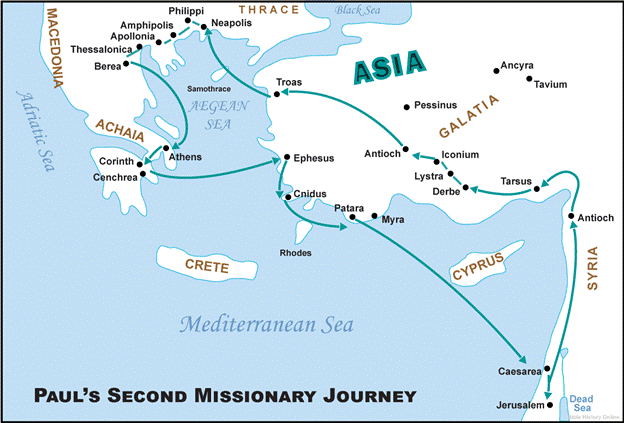

On his 2nd missionary journey, Paul and Silas departed Antioch of Syria, went through Cilicia and Southern Galatia. At Lystra, a city of Galatia, Timothy joined the team. These three then went to Troas and then onto Macedonia where churches were established in Philippi, Thessalonica and Berea. Silas and Timothy were left in Macedonia while Paul having to leave Berea hastily went to Athens. Timothy delivers a report about the Thessalonians to Paul in Athens. From Athens, Timothy is sent back to the Thessalonians to encourage them through his teaching. Paul having left Athens, goes onto Corinth. While in Corinth, Timothy and Silas arrived bringing some funds from the Philippian Church and a report regarding the Thessalonica Church. After hearing the report, Paul wrote 1st Thessalonians circa 52 AD, and 2nd Thessalonians a short while later. After spending about 18 months in Corinth, Paul set sail for Ephesus for a short stop before returning to Antioch, Syria as per Acts 18:18-22, “Paul having remained [in Corinth] many days longer [18 months], took leave of the brethren and put out to sea for [Antioch] Syria, and with him were Priscilla and Aquila. In Cenchrea [the eastern seaport of Corinth], he [Paul] had his hair cut for he was keeping a vow [the Nazarite Vow]. (19) They came to Ephesus, and he left them [Priscilla and Aquila] there. Now, he himself entered the synagogue and reasoned with the Jews. (20) When they asked him to stay for a longer time, he did not consent, (21) but taking leave of them, and saying, ‘I will return to you again if God wills,’ and he set sail from Ephesus. (22) When he had landed at Caesarea, he went up and greeted the church [in Jerusalem], and went down to Antioch [Syria].” This ended officially his 2nd Missionary Journey.”
After spending some time in Antioch, Syria, Paul began his third missionary journey.

Since Paul will spend up to three years in Ephesus on this journey [circa 54 to 58 A.D.], it behooves us to know something about Ephesus. Ephesus was at the crossroads of the Roman Empire for it linked the orient with the west. Between its harbor and the main city was a boulevard seventy feet wide with beautiful pillars along its sides. Also, the city was famous for an open-air theater carved out of the side of a mountain and seated 25,000 people. The Temple of Artemis with 120 pillars, one of the Seven Wonders of the World was also located in this city. (Each of these pillars, studded with gold, silver and various precious gems, was dedicated by a king or a famous prince and had been engraved with his famous deeds and accomplishments.) (This temple dedicated to Artemis was destroyed in 356 B.C. on the same day Alexander the Great was born.) Ephesus was also the Roman headquarters for the province of Asia. Thus, there was a Roman garrison, a governor and court there, and most importantly, it became the greatest church in the first few centuries of the Church Age.
Circa 1200 B.C. Ionians migrated to Ephesus so that by the time Paul had a ministry there, the people spoke primarily Ionic Greek, a very sophisticated form of Greek from which Attic Greek developed. So, an Ionian with a large vocabulary could communicate very well with this sophisticated language. This is just another reason why they became such a successful church. Ionic Greek became the most revolutionary, the most dynamic language of the ancient world.
Emotions are no substitute for thought. Some people will never truly orient to life because they have never done anything to increase their vocabulary. They do not realize that the greater the vocabulary, the greater is the potentiality for thought. And in the day in which we live, emotion has been substituted for increasing one’s vocabulary, and so many want only to feel good at all costs which becomes the basis for alcohol dependance, drug addiction even attendance at churches which emphasize emotions. When you have an entire generation of people who cannot think, then you have a generation of people who live by their feelings, by their emotions and will degenerate to the point of self-destruction.
When Paul arrived in Ephesus, he bumped into an unusual group of believers who had not yet received the assets of the Church Age, the 40 things which the person receives when he believes in the Lord Jesus Christ. (Three of which were specifically mentioned in the “Jewish Pentecost” namely the Indwelling and Filling of the Spirit and the distribution of a spiritual gift.) So, though living in the Church Age, they were operating under the assets of the Old Testament. This situation occurred because they had believed in Christ before the Church Age, and so, in order to receive the experiential spiritual life of the Church Age, they would need to have a Pentecostal experience equivalent to the Jewish Pentecost which occurred in Jerusalem around 30 A.D. and the gentile Pentecost which occurred under the authority of Peter as found in Acts 10:24, “The following day he [Peter] arrived in Caesarea. Cornelius was expecting them and had called together his relatives and close friends.” Then, Acts10:44-48 gives us the rest of the story, “While Peter was still speaking these words, the Holy Spirit came on all who heard the message. (45) The circumcised believers who had come with Peter were astonished that the gift of the Holy Spirit had been poured out even on Gentiles. (46) For they heard them speaking in tongues and praising God. Then Peter said, (47) “Surely no one can stand in the way of their being baptized with water. They have received the Holy Spirit just as we have.” (48) So, he ordered that they be baptized in the name of Jesus Christ. Then they asked Peter to stay with them for a few days.”
Now, for the story of the Pentecost which occurred under the authority of the Apostle Paul in Ephesus during his 3rd missionary journey is found in Acts 19:1-9 which we might call either the mixed Pentecost or the Johnny come late Pentecost, “And it came to pass that while Apollos was at Corinth, Paul [circa 54 AD] having passed through the upper coast [the highlands of northwest Asia Minor] came to Ephesus [from the northeast by following the valley of the Cayster River] and found certain disciples [Old Testament-believers who had believed in Christ under the ministry of John the Baptist]. (2) he [Paul] said to them, “Having believed did you receive the Holy Spirit [the Indwelling and the Filling of the Spirit]?” And they said to him, “We did not, so much as, hear whether there was [a ministry related to the] a Holy Spirit.” (3) And he said to them, “Therefore, on what basis did you receive [water] baptism?” And they said, “On the basis of John's baptism” [to be distinguished from the pre-canon-baptism of the early church]. (4) Then, Paul said, John baptized with a baptism characterized by a change of thinking [John only baptized those who had changed their mind about Christ and had believed], saying to the people that they should believe in the One coming after him [John, the Baptist], that is, in Jesus. (5) And having heard [what Paul had said], they were baptized [by God the Holy Spirit] into the person of the Lord Jesus [Spirit-Baptism: Positional Sanctification before Experiential Sanctification]. (6) And as Paul laid his hands on them, the Holy Spirit came on them [the Filling of the Spirit as the power of Experiential Sanctification], and they spoke with foreign languages [communicated the gospel in some foreign language] and prophesied [about the content of truth and material not yet put into book form: a communicational gift necessary since the Bible had not yet been completed and circulated]. (7) And there were in all about twelve men. (8) And going into the synagogue, he spoke with confidence for about three months, disputing [to argue from the reasonable standpoint of the Word] and persuading [influencing by presenting correct information] the doctrines concerning the kingdom of God [the kingdom of the regenerate]. (9) But when some [Jewish unbelievers in the synagogue] began to be hardened [by rejecting the gospel: the inceptive imperfect] and did not believe [in Christ], speaking evil of the Way [the Lord Jesus Christ as the way of salvation] before the multitude, he departed from them [those who had rejected the gospel] and separated the disciples [those who had accepted the gospel; must separate from apostasy], disputing daily in the school of Tyrannus [Tyrannus was a court physician in Rome who after his retirement founded a medical school in Ephesus].”
The Lord led Paul after leaving Corinth to Ephesus on his 2nd Missionary journey for a short stopover. During this brief stopover, Apollos had not yet arrived in Ephesus from Alexandria. However, Prisilla and Aquila companions of Paul from Corinth were left behind in Ephesus (Acts 18:19) and would meet Apollos who would need some help. The Lord would use Priscilla and Aquila to help him, not Paul (Acts 18:27-19:1). Priscilla and Aquila, after hearing Apollos communicate God’s Word, realized that he was not up to date on church age doctrines. So, they pulled him aside privately and gave him a briefing regarding these doctrines. What is the doctrinal point? It was not necessary for Apollos to meet Paul at this time, but it was very important for him to have met Priscilla and Aquila.
The Holy Spirit led Paul in such a way on his 3rd missionary journey as to avoid the cities of the Lycus Valley. You see, when Paul came back to Ephesus on his 3rd missionary journey, he did not travel on the main highway which ran from Galatia to Ephesus, the most direct route. (This would have taken him through the Lycus Valley in which were three cities: Colossi, Hierapolis and Laodicea. (It was God’s will that his ministry to those in these cities would not be face to face but would be handled through written epistles such as Colossians and Philemon.)) Rather, after departing Galatia he traveled northwest, apparently heading toward Troy, but was directed by the Lord to go to Ephesus instead. So, he merely came down the Cayster Valley from the northeast [likely the road from Sardis to Ephesus] which is described by the phrase in this verse as, “the upper coast.” (The Cayster River flowed southwest into the harbor at Ephesus.)


At the end of the 3rd Missionary Journey, Paul makes a short stop at Miletus where he met the pastors of Ephesus for a farewell speech before departing for Jerusalem [for his 5th and final trip to Jerusalem as per Acts 20:17-38].
13. Paul should have gone to the Roman Church at the end of his 3rd missionary journey as per Romans 15:19-24, “By the power of signs [to the Jews] and by miracles [to the Gentiles] in the power of the Holy Spirit, so that from Jerusalem, I Paul, on a circuit as far as Illyricum, have fulfilled the Gospel of the Christ. [Paul had finished his work in both Asia Minor and in Greece as far west as Illyricum.] (20) In fact, my standard operating procedure: I consider it a point of honor to proclaim the Gospel not where Christ has been mentioned [but he does when he decides to go to Jerusalem at the end of his 3rd missionary trip], in order that I might not build on a foundation belonging to another [but he attempted to do this when he decided emotionally to go to Jerusalem rather than to immediately sail for Rome]. (21) And not only this but just as it stands written [a quote from Isaiah 52:15], "They [the Gentiles] shall see, that is, those to whom it was not reported concerning Him [Jesus Christ], and they [gentiles who have not heard] shall understand." (22). For this reason, I also have been hindered many times from coming to you [because he was busy ministering to the gentiles in Asian Minor and Greece], (23) But now, no longer having a place of ministry in those regions [had established local churches with native pastor-teachers in Asian Minor and in Greece], and having a desire to come to you [in Rome] for many years, (24) Whenever I go to Spain for I expect to see you when passing through, and by you be assisted to that place [Spain], if first I am satisfied with you in part [Paul planned on ministering to the Romans before going on his 4th missionary journey to Spain],”

14. Paul makes a sentimentally emotional decision to go to Jerusalem for the Holy Week, Romans 15:25, 26, “But [a change of plans and contrary to what he has just stated in Romans 15:19-24] now I go to Jerusalem to minister to the saints [to bring them the funds collected; a flimsy excuse for violating God’s geographical will for his life], (26) For Macedonia and Achaia have decided with pleasure to make a special offering to the poor ones among the saints who are in Jerusalem.”
15. Paul is warned many times not to go to Jerusalem. As a consequence of his decision to go anyway, Paul will spend 2 years in house arrest in Caesarea, and 2 years in house arrest in Rome. Acts 20:16, 17, “For Paul had decided to sail past Ephesus [at the end of his 3rd missionary journey] so that he would not have to spend time in Asia; for he was hurrying to be in Jerusalem, if possible, on the day of Pentecost. [17] From Miletus he sent to Ephesus and called to him the pastors of the church [around Ephesus]. Acts 20:22, 23, “And now, behold, bound by the Spirit [forbidden: the Holy Spirit was making every effort to restrain Paul], I am on my way to Jerusalem, not knowing what will happen to me there [since Paul was now going contrary to the will of the Lord, he has lost his confidence], (23) except that the Holy Spirit solemnly testifies to me in every city, saying that bonds [chains, fetters] and afflictions [severe punishment] await me [Paul rationalizes away these warnings as if he needs to endure these sufferings for the Lord.].” Acts 21:1-4, “When we had parted from them and had set sail, we ran a straight course to Cos and the next day to Rhodes and from there to Patara; (2) and having found a ship crossing over to Phoenicia, we went aboard and set sail. (3) When we came in sight of Cyprus, leaving it on the left, we kept sailing to Syria and landed at Tyre, for there the ship was to unload its cargo. (4) After looking up the disciples, we stayed there seven days; and they kept telling Paul through the Spirit not to set foot in Jerusalem.” Acts 21:8-14, “On the next day we left and came to Caesarea, and entering the house of Philip the evangelist, who was one of the seven, we stayed with him. (9) Now this man had four virgin daughters who were prophetesses. (10) As we were staying there for some days, a prophet named Agabus came down from Judea. (11) And coming to us, he took Paul's belt and bound his [Agabus’s] own feet and hands, and said, "This is what the Holy Spirit says: `In this way the Jews at Jerusalem will bind the man who owns this belt and deliver him into the hands of the Gentiles [the Romans].' "(12) When we [Luke and others] had heard this, we as well as the local residents began begging him not to go up to Jerusalem. (13) Then Paul answered, "What are you doing, weeping and breaking my heart? For I am ready not only to be bound, but even to die at Jerusalem for the name of the Lord Jesus [but that was not the will of the Lord]." (14) And since he would not be persuaded, we fell silent, remarking, "The will of the Lord be done!"
16. In 58 A.D., Paul was at the peak of his ministry. He had a tremendous response to his evangelism for thousands were being saved. He was establishing with great success many churches in Asia Minor, Macedonia and Achaia. Paul, as a one-man seminary, was teaching and training many young men to be pastors. Paul’s writing ministry was phenomenal for he had already written six epistles which would be in the Canon forever. This entire ministry of Paul was removed during his first two years of incarceration in Caesarea except for the opportunity to evangelize a few elites like the governors of Judea namely Felix and Festus and, Herod Agrippa II and Bernice and a few others as well, but there was not one convert during that time. Then, after a rough voyage to Rome and under house arrest in Rome, the Lord permitted him to reestablish his writing ministry namely the Prison Epistles: Ephesians, Philippians, Colossians and Philemon.

17. Paul’s Fourth Missionary Journey:
Upon his acquittal and release in circa 63 A.D., Paul traveled east to Asia Minor by way of Macedonia before embarking on his 4th missionary journey which would take him to Spain. This was a change of plans due to his four years of incarceration for he stated in 58 A.D. that he was going to travel to Rome and then directly to Spain, but now upon his release from Roman house arrest, he first heads back east. Philippians 2:24, “and I trust in the Lord that I myself also will be coming shortly.” Philemon 22, “At the same time also prepare me a lodging, for I hope that through your prayers I will be given to you.”
He apparently went to Philippi first and then to Colossi and finally to Ephesus from where he apparently sailed to Spain and spent approximately two to three years there on his fourth missionary journey.
18. From Spain after completing his 4th missionary journey, he returned to Ephesus where he had left Timothy and then to Macedonia from where he wrote 1 Timothy. 1 Timothy 1:3, “As I urged you upon my departure for Macedonia, remain on at Ephesus so that you may instruct certain men not to teach strange doctrines,” and then onto Nicopolis of Epirus (a province on the western coast of Greece) where he spent the winter and from where he wrote Titus. In the spring of 68 A.D. in Nicopolis, the city of victory founded and named after the Emperor Octavian’s victory at the Battle of Actium, he was arrested and brought to Rome in chains. Then, waiting for his trial, he wrote his last letter to Timothy in the early summer of 68 A.D., and shortly after was executed.

19. The Pauline team of missionaries had been dispersed as Paul states after his 4th Missionary Journey.
Timothy was at Ephesus, 1 Timothy 1:3, “As I urged you upon my departure for Macedonia, remain on at Ephesus so that you may instruct certain men not to teach strange doctrines,”
Titus was at Crete, Titus 1:5, “For this reason I left you in Crete, that you would set in order what remains and appoint elders [pastor-teachers] in every city as I directed you,” After Titus had completed his work in Crete, Paul sent him to Dalmatia. 2 Timothy 4:10, “for Demas, having loved this present world, has deserted me and gone to Thessalonica; Crescens has gone to Galatia, Titus to Dalmatia.” At Nicopolis, a city along the Adriatic Sea, from where Paul writes to Titus and summons him to come to him just before winter. Titus 3:12, “When I send Artemas or Tychicus to you, make every effort to come to me at Nicopolis, for I have decided to spend the winter there.”
Trophimus was left at Miletus and Erastus at Corinth. 2 Timothy 4:20, “Erastus remained at Corinth, but Trophimus I left sick at Miletus.”
Tychicus was in Ephesus, 2 Timothy 4:11-13, “Luke is alone with me. Pick up Mark [a reference to John Mark] on route, bring him with yourself for he is useful with reference to the ministry. (12) For I have sent out Tychicus to Ephesus to replace you [so Timothy could come to Rome]. (13). When you [Timothy] come bring the heavy coat and the scrolls, and especially the parchments which I have left behind at Troy with Carpus.”
20. A brief account of Paul’s trial is given in 2 Timothy 4:6-8, 14-17, “For I am already being poured out as a drink offering, and the time of my departure has come [Paul knows that Nero will have him executed this time]. (7) I have fought the good fight, I have finished the course, I have kept the faith; (8) in the future there is laid up for me the crown of righteousness, which the Lord, the righteous Judge, will award to me on that day [at the Evaluation Platform of Christ]; and not only to me, but also to all who have loved His appearing. (14) Alexander the coppersmith [in Ephesus] did me much harm; the Lord will repay him according to his deeds [his evil deeds]. (15) Be on guard against him yourself, for he vigorously opposed our teaching. (16) At my first defense [before Nero the Emperor] no one [who could have been there at my trial] supported me, but all deserted me; may it not be counted against them [an expression of Impersonal Love]. (17) But the Lord stood with me [did not desert Paul as did all the others] and strengthened me [the empowering of Paul under pressure], so that through me the proclamation [The summary of all Paul’s writings and teachings] might be fully accomplished [Paul was given the time to complete his ministry], and that all the Gentiles might hear and understand [The constative aorist gathers into one entirety the ministry of the apostle Paul to the entire Roman world at that time.]; and I was rescued out of the lion's mouth [Right in the middle of his trial, Nero wanted to send Paul to the lions, but the Lord kept Paul alive to finish his ministry].” Between the trial and execution, Paul wrote 2 Timothy, completing his ministry. His execution took place on Via Ostia, a short way out from the city limits. Less than a year later, Nero was assassinated by the Praetorian Guard, thus ending the Claudio-Julian line. (One cannot murder the greatest Christian and get away with it!)
Jerusalem Trips by Paul:
1st. After being forced to leave Damascus, Syria, he went to Jerusalem circa 41 A.D. 2 Corinthians 11:32, 33, “In Damascus the ethnarch under Aretas, the king was guarding the city of the Damascenes in order to seize me, (33) and I was let down in a basket through a window in the wall, and so escaped his hands.” Galatians 1:18-19, “Then, three years later [after his conversion] I went up to Jerusalem to become acquainted with Cephas and stayed with him fifteen days. (19) But I did not see any other of the apostles except James, the Lord’s brother [spent a few days with James].”
2nd. In 45 A.D., Agabus came to Antioch announcing that a famine was about to occur all over the world as per Acts 11:28-30, “One of them named Agabus stood up and began to indicate [foretell] by the Spirit [as a prophet, the Holy Spirit provided this information to Agabus.] that there would certainly be a great famine [45 to 47 A.D.] all over the inhabited world. And this took place in the reign of Claudius [41-54 A.D.] (29) And in the proportion that any of the disciples had means, each of them determined to send a contribution for the relief of the brethren living in Judea. (30) And this they did, sending it in charge of Barnabas and Saul to the elders [in Jerusalem: Paul’s 2nd trip to Jerusalem].” Funds were collected from the Antioch Christians to be taken to needy Christians in Judea.
3rd. Paul goes to Jerusalem for the third time with Barnabas and Titus [possibly a native of Antioch, Syria] between his first and second missionary journeys to explain to the council in Jerusalem his work with the gentiles as per Galatians 2:1-10, “Then, after an interval of fourteen years [after Paul had left Jerusalem for Damascus in 36 A. D. I went up again to Jerusalem [Paul’s third trip in 50 A.D.] with Barnabas, taking Titus along also. (2) It was because of a revelation that I went up; and I submitted to them the gospel which I preach among the Gentiles, but I did so in private to those who were of reputation, for fear that I might be running, or had run in vain. (3) But not even Titus, who was with me, though he was a Greek, was compelled to be circumcised. (4) But it was because of the false brethren secretly brought in, who had sneaked in to spy out our liberty which we have in Christ Jesus, in order to bring us into bondage [through legalism]. (5) But we did not yield in subjection to them for even an hour, so that the truth of the gospel would remain with you. (6) But from those who were of high reputation (what they were makes no difference to me. God shows no partiality) well, those who were of reputation contributed nothing to me. (7) But on the contrary, seeing that I had been entrusted with the gospel to the uncircumcised, just as Peter had been to the circumcised (8) (for He who effectually worked for Peter in his apostleship to the circumcised effectually worked for me also to the Gentiles), (9) and recognizing the grace that had been given to me, James and Cephas and John, who were reputed to be pillars, gave to me and Barnabas the right hand of fellowship, so that we might go to the Gentiles and they to the circumcised. (10) They only asked us to remember the poor--the very thing I also was eager to do.” At which time, a council at Jerusalem was held in which Paul and Barnabas were given the right hand of fellowship by James, Peter and John. It was also understood at the council that Paul and Barnabas continue to go to the gentiles and the other apostles to the circumcised.
4th. Acts 18:22, “When he had landed at Caesarea [at the end of his 2nd missionary journey], he went up and greeted the church [in Jerusalem], and went down to Antioch [Syria].”
5th. Paul should have gone to the Roman Church at the end of his 3rd missionary journey as per Romans 15:19-24, “By the power of signs [to the Jews] and by miracles [to the Gentiles] in the power of the Holy Spirit, so that from Jerusalem, I Paul, on a circuit as far as Illyricum, have fulfilled the Gospel of the Christ. [Paul had finished his work in both Asia Minor and in Greece as far northwest as Illyricum.] (20) In fact, my standard operating procedure: I consider it a point of honor to proclaim the Gospel not where Christ has been mentioned [but he does when he decides to go to Jerusalem at the end of his 3rd missionary trip], in order that I might not build on a foundation belonging to another [but he attempted to do this when he decided emotionally to go to Jerusalem rather than to immediately sail for Rome]. (21) And not only this but just as it stands written [a quote from Isaiah 52:15], "They [the Gentiles] shall see, that is, those to whom it was not reported concerning Him [Jesus Christ], and they [gentiles who have not heard] shall understand." (22). For this reason, I also have been hindered many times from coming to you [because he was busy ministering to the gentiles in Asian Minor and Greece], (23) But now, no longer having a place of ministry in those regions [had established local churches with native pastor-teachers in Asian Minor and in Greece], and having a desire to come to you [in Rome] for many years, (24) Whenever I go to Spain for I expect to see you when passing through, and by you be assisted to that place [Spain], if first I am satisfied with you in part [Paul planned on ministering to the Romans before going on his 4th missionary journey to Spain],” Paul makes a sentimentally emotional decision to go to Jerusalem for the Holy Week, Romans 15:25-26, “But [a change of plans and contrary to what he has just stated in Romans 15:19-24] now [58 A.D.] I go to Jerusalem to minister to the saints [to bring them the funds collected; a flimsy excuse for violating God’s geographical will for his life], (26) For Macedonia and Achaia have decided with pleasure to make a special offering to the poor ones [apparently because of persecution] among the saints who are in Jerusalem.” [Earlier he and Barnabas made a trip to bring aid to those who were in need due to the great famine from 45 to 47 A.D.]
Paul’s Conscience:
1 Corinthians 4:4, “For I am conscious [aware] of nothing against myself [So, Paul had a clear conscience regarding his ministry], yet I am not by this [self-evaluation] justified [Paul knows that his ministry is not vindicated by his evaluation]; but the one who keeps evaluating me is the Lord [the periphrastic present: Paul is stating very strongly that only the Lord’s evaluation is meaningful to him].
οὐδὲν γὰρ ἐµαυτῷ σύνοιδα, ἀλλ’ οὐκ ἐν τούτῳ δεδικαίωµαι, ὁ δὲ ἀνακρίνων µε κύριός ἐστιν.
Paul had a pure conscience regarding his ministry.
Conscience is defined as the sense or the consciousness of moral uprightness or blameworthiness of one’s own conduct, intentions, or character together with a sense of obligation to do what is right. So, the conscience is that mental faculty by which one distinguishes between right and wrong, and urges the individual to do what he recognizes to be right and to restrain him from doing that which he recognizes to be wrong.
The conscience is a sense or consciousness in the right lobe related to either moral or spiritual goodness of one's thoughts, motives, decisions, and actions. Therefore, conscience is a faculty, a power, or a principle conceived in the right lobe to determine the quality of one's thoughts, intentions, decisions, and actions. The conscience must be built on a vocabulary that begins with one word: no, or don't. All consciences are started with negative words which forbid doing something. So, the conscience of man is first established by negatives, although eventually there are explanations in both positive and negative terms.
The fifth compartment of the Stream of Consciousness is the Conscience in which is stored norms and standards, and priorities related to the absolutes of Bible doctrine. The Greek word for conscience is suneidesis which means 'to know with an absolute standard.' The English word conscience comes from the Latin, consciari which means "to know with." Conscience is the mental faculty by which one distinguishes between right and wrong and motivates the believer under the Filling of the Spirit to do what is right and not to do what is wrong. Romans 2:15, "in that they show the work of the Law printed in their hearts, their conscience confirming the testimony, and their thoughts alternately accusing or else defending themselves." Accusing and defending oneself is the function of the norms and standards of the conscience of the believer. Acts 23:1, "And Paul, looking intently at the Sanhedrin, said, 'Brethren, I have conducted myself as a citizen with a good conscience before God up to this day." Acts 24:16, "In view of this, I [Paul] myself keep on doing my best to maintain always a blameless conscience both before God and before men." 1 Timothy 3:9, "but holding to the mystery doctrine with a clear conscience." We never have true happiness in our soul without a clear conscience. 1 Peter 2:19, "For this is grace, if for the sake of conscience toward God, a man bears-up under sorrows when suffering unjustly." 1 Peter 3:16, "and be having a good conscience, so that in the things in which you are slandered, those who malign your good in Christ will be put to shame." The believer in reversionism destroys his conscience through scar tissue of the soul, 1 Timothy 4:1-2, "But the Spirit explicitly says that in later periods of time [the Church Age, and Tribulation] some [believers] will become apostate from doctrine, paying attention to deceitful spirits [false teachers] and doctrines of demons by means of hypocrisy of liars seared in their own conscience with a branding iron [another word for the destruction of one’s conscience]." The branding iron is scar tissue in the soul from rejection of the truth. Precedence from the humanity of Christ in the dispensation of the hypostatic union is taught in Hebrews 9:14, "How much more will the blood of Christ [the work of the cross], who through the eternal Spirit [God the Holy Spirit] offered Himself [as a propitious sacrifice] without blemish to God, purify your conscience from dead works [false or legalistic standards in the conscience] to serve the living God [you must have a good conscience to serve God]." Metabolized doctrine circulating in the stream of consciousness and its application purifies the conscience from dead works.
2 Corinthians 1:12, "Now this is our boast [esprit de corps], the testimony of our conscience, that we have conducted ourselves in the world and especially in relationship to you, both in holiness [This Greek word is hagioteti based on manuscript evidence and is a reference to the Filling of the Holy Spirit] and honesty [motivation from Bible doctrine], not in fleshly wisdom [human wisdom], but in the grace of God [wisdom learned through God’s grace plan]."
Romans 9:1, “I am telling the truth in Christ [positive affirmation regarding academic integrity], I am not lying [negative affirmation regarding intellectual dishonesty], my conscience bearing me witness [a genitive absolute emphasizing the importance of this joint testimony: everything which Paul says is in agreement with his conscience] by agency of the Holy Spirit.”
1 Corinthians 15:11
Whether then it was I [Paul] or they [the other apostles who have seen the resurrected Christ], so we preach [regarding the resurrected Christ] and so you believed.
εἴτε οὖν ἐγὼ εἴτε ἐκεῖνοι, οὕτως κηρύσσοµεν καὶ οὕτως ἐπιστεύσατε.
Anticipating a Discussion on Resurrection:
Outline:
1. Resurrection must not be confused with resuscitation:
2. Details leading up to and including His Resurrection:
3. The Power involved in His Resurrection:
4. The Lord’s Resurrection guarantees our Resurrection:
5. Our Resurrection is the Lord's Victory:
6. There are two general resurrections namely the First and the Second:
7. Old Testament applications related to Resurrection:
8. Though the Resurrection of Christ is part of the Gospel-Message, it is not a necessary part:
9. The Importance of Resurrection as it relates to Salvation:
Resurrection must not be confused with resuscitation:
A resurrected body is an eternal body which cannot die naturally or be killed. Resuscitation defines a person who has died and then is brought to life in the body in which he died. For example, Lazarus was resuscitated by Jesus [brought back to life in his mortal body and subsequently died]; Paul resuscitated a boy [returned life to his mortal body] who fell out of a window as per Acts 20:7-12; two boys in the Old Testament were resuscitated [life was returned to their mortal bodies] as per 1 Kings 17:21-22; 2 Kings 4:32, and Elijah and Moses residing in their interim bodies in heaven will return to the earth in the last half of the Tribulation. After their ministries on the earth will have been completed, they will be murdered by Abaddon. However, they will be resuscitated and ascend into heaven with their interim bodies. Then, at the 2nd Advent, these interim bodies will be transformed into eternal resurrected bodies: corruption will become incorruption]. So, both the mortal body and the interim one which are bodies of corruption can die. On the other hand, resurrection means to be given an eternal body which does not corrupt or die.
Details leading up to and including His Resurrection:
First Fruits occurred on the first Sunday after the Passover as per Leviticus 23:9-12, “Then the Lord spoke to Moses, saying, (10) ‘Speak to the sons of Israel and say to them, 'When you enter the land which I am going to give to you and reap its harvest, then you shall bring in the sheaf of the first fruits of your harvest to the priest [Sunday, 18 Nissan]. (11) 'He shall wave the sheaf before the Lord for you to be accepted [based on resurrection]; on the day after the sabbath [Saturday 17 Nissan] the priest shall wave it. (12) 'Now on the day when you wave the sheaf, you shall offer a male lamb one year old without defect for a burnt offering to the Lord.” This feast portrayed the resurrection of our Lord who is the First Fruits, the first member of the human race to receive a resurrection-body.
After the physical death of Jesus, his body went into the grave, his human spirit went into the presence of God the Father and his soul went to Hades in the care of God the Holy Spirit, and this is why he said to the dying thief in Luke 23:43, "Today shalt you be with Me [the soul of the humanity of Jesus] in Paradise," and his human spirit went to God the Father in the 3rd heaven. 1 Peter 3:18-20, “For Christ also died for sins once and for all [paid the penalty for sins], the righteous one as a substitute for the unrighteous ones [we are all sinners], so that He might bring us to the God [the Father via reconciliation], having been put to death in the flesh [in his human body], but made alive by means of the Spirit [the omnipotence of the Holy Spirit participated in the resurrection of Christ]; (19) By means of whom [the Holy Spirit] also He [the Lord Jesus Christ possibly in an interim body] went and made a proclamation [a short well defined declaration] to the spirits in prison [the fallen angels in Tartarus as per Jude 6; 2 Peter 2:4]. (20) who [the fallen angels in Tartarus] once were disobedient [by cohabitating with human females and so producing [the Nephilim (half angel and half human as per Genesis 6:1-11)], when the patience of God kept waiting in the days of Noah [God waited 120 years for these half human, half angel to believe in Jesus Christ before the flood], during the construction of the ark, in which a few, that is, eight souls [because it is the soul that is saved], were brought safely through the water.”
When the work of salvation was finished, our Lord said to the Father, in Luke 23:46, "Father, into Your hands I dismiss My spirit," and so his human spirit traveled billions of light years of space into the presence of God the Father. After three days, the omnipotence of the Father sent our Lord's human spirit through billions and billions of light years of space back to His body in the tomb. Simultaneously, the omnipotence of the Holy Spirit returned His human soul from Hades to His body. Now rejoined in the resurrection body, our Lord walked through the stone. Later on, an angel rolled away the stone so that the world could see and verify the resurrection. The power that resurrected Christ was made possible by means of the omnipotence of God the Father and the omnipotence of the Holy Spirit.
Additional documentation: Acts 2:27, “Because you will not abandon my soul to Hades [the Holy Spirit will return his soul to his body in the grave], nor allow your holy one to undergo decay [the body of Jesus did not suffer decay in the tomb, a quote from Psalm 16:10].” Acts 2:31 clarifies this statement, "He [David] looking ahead spoke of the resurrection of Christ, that He was neither abandoned in Hades nor did His flesh see decay." Ephesians 4:8-10, “Therefore, it says [in Psalm 68:18] when He ascended into the third heaven up on high, He led a host of captives in a triumphal procession [to exhibit prisoners in a Roman style triumphal procession: in this context, it is not prisoners but the Old Testament saints who were transferred from Abraham’s Bosom to heaven] from a state of captivity [by analogy to Abraham’s Bosom in Hades] and He [Christ] gave spiritual gifts to men [to Church Age believers in celebration of his triumph as the Imperator or a triumphal general gave gifts to their soldiers]. (9) (Now, this doctrine that He ascended, what does it imply [mean] that He [His soul upon spiritual death] went down [descended] into the lower regions [Hades] of the earth. (10) Jesus who descended is the same one also that ascended up higher than all the heavens, that He might bring to completion all things.)”
Matthew 28:1-2, “Now, after the Sabbath [the normal Saturday Sabbath], as it began to dawn into the first day of the week [Sunday: the feast of the First Fruits also a Sabbath], Mary Magdalene and the other Mary [the wife of Clopas, the mother of Joseph and James the Lesser and others not mentioned here] came to see the sepulcher [they traveled at sunrise]. (2) And behold, a great earthquake occurred [to alert people that the resurrection had occurred]! For an angel from the Lord had descended from Heaven and came [after Jesus had passed through the boulder] and rolled back the stone [in order that others may look in] and sat on it [while waiting for the ladies].”

Matthew 28:3-8, “His countenance [the angel who rolled back the stone] was like lightning, and his clothing white as snow. [Angels possibly are constructed out of something similar to light, but can travel much faster than the speed of light.] (4) And the guards shook from fear of him [the angel] and became like dead [passed out]. (5) And the angel answered and said to the women [Mary Magdalene, Mary, the wife of Clopas and the other women], ‘You yourselves, stop fearing [stop looking confounded and astonished: a normal response since they were facing something beyond their frame of reference], for I know that you seek Jesus who was crucified. (6) He is not here, for He has risen, just as He said. Come, see the place where He was lying. (7) And go quickly and tell His disciples that He has risen from the dead. And, behold, He goes before you into Galilee. There you shall see Him. Lo, I have told you [The angel has followed his orders from God].’ (8) And having departed quickly from the tomb with awe [occupied with Christ] and with great joy [sharing the happiness of God], they [Mary Magdalene, the wife of Clopas, Joanna, and others] ran [in good condition] to announce [the resurrection] to His disciples [Luke 24:9].”
The first appearance of the resurrected Christ was to Mary Magdalene, John 20:1-18, “Now on the first day of the week Mary Magdalene [along with Mary, the wife of Clopas] came early to the tomb, while it was still dark [early Sunday morning], and saw the stone already taken away from the tomb. (2) So, she [Mary Magdalene is singled-out since she will be the first one to see the resurrected Jesus] ran and came to Simon Peter and to the other disciple whom Jesus loved [John], and said to them [these two were considered the two spiritual leaders], ‘They have taken away the Lord out of the tomb, and we [Mary Magdalene and Mary the wife of Clopas and other women] do not know where they have laid Him [his body].’ (3) So [after hearing this message from the ladies], Peter and the other disciple [John] went forth, and they were going to the tomb. (4) The two were running together [followed by Mary Magdalene who still desired to locate the body]; and the other disciple [John] ran ahead faster than Peter and came to the tomb first; (5) and stooping and looking in, he saw the linen wrappings lying there; but he did not go in. (6). And so, Simon Peter also came, following him [John], and entered the tomb; and he saw the linen wrappings lying there [but no angels], (7) and the face-cloth which had been on His head, not lying with the linen wrappings, but rolled up in a place by itself. (8) So, the other disciple [John] who had first come to the tomb then also entered, and he saw and believed [in the resurrection; the first one to do so]. (9) For as yet they did not understand the Scripture, that He must rise again from the dead. (10) So, the disciples [Peter and John] went away again to their own homes [but Mary Magdalene remained behind]. (11) And Mary [Magdalene] was standing outside the tomb weeping; and so, as she wept, she stooped and looked into the tomb; (12) and she saw two angels in white sitting, one at the head and one at the feet, where the body of Jesus had been lying. (13) And they [the two angels] said to her, “Woman, why are you weeping?” She said to them, “Because they have taken away my Lord, and I do not know where they have laid Him [His body]. (14) When she had said this, she turned around and saw Jesus standing there, and did not know that it was Jesus. (15) Jesus said to her, “Woman, why are you weeping? Whom are you seeking?” Supposing Him to be the gardener, she said to Him, “Sir, if you have carried Him away, tell me where you have laid Him, and I will take Him away [His body away for burial]. (16) Jesus said to her, “Mary!” She turned and said to Him in Hebrew, “Rabboni!” (which means Teacher). (17) Jesus said to her, “Stop clinging to Me, for I have not yet ascended to the Father; but go to My brethren [all the believers known to her] and say to them, ‘I ascend to My Father and your Father, and My God and your God.’” (18) Mary Magdalene came announcing to the disciples, “I have seen the resurrected Lord and that He had said these things to her.”
Matthew 28:9-10, “And behold, Jesus met them [the ladies minus Mary Magdalene; this would be His 2nd resurrection-appearance], saying, “Hail [greetings]! And they [Mary the wife of Clopas, Joanna etc.] came and held Him by the feet and worshiped Him. (10) Then, Jesus said to them, “Do not remain in this state of awe [don’t get so excited]; go tell My brethren [the eleven disciples that you have seen the resurrected Jesus and] that they should go into Galilee, and there, they will see Me [first these women along with Mary Magdalene reported to the disciples regarding the empty tomb; now these ladies minus Mary Magdalene are to report that they have seen the resurrected Christ and to repeat the instructions to meet the Lord in Galilee]. ”
Other passages telling this story:
Luke 24:1-12, “On the first day of the week [Sunday], very early in the morning, the women took the spices they had prepared and went to the tomb. (2) They found the stone rolled away from the tomb, (3) but when they entered, they did not find the body of the Lord Jesus. (4) While they were wondering about this, suddenly two men [two angels who reiterated the message of the angel who had rolled back the stone] in clothes that gleamed like lightning stood beside them. (5) In their fright the women bowed down with their faces to the ground, but the men [angels appearing as men] said to them, "Why do you look for the living among the dead? (6) He is not here; he has risen! Remember how he told you, while he was still with you in Galilee, (7) saying that the Son of Man must be delivered over to the hands of sinners, be crucified and on the third day be raised again. (8) Then, they remembered his words [the words of Jesus]. (9) When they [Mary Magdalene, Mary the wife of Clopas, Joanna and others] came back from the tomb, they told all these things to the Eleven and to all the others. (10) It was Mary Magdalene, Joanna, Mary the mother of James, and the others with them who told this to the apostles. (11) But they [a reference to “to all the others”] did not believe the women, because their words seemed to them like nonsense. (12) Peter, [and John] however, got up and ran to the tomb [followed by Mary Magdalene who desired to locate the body for burial]. He [Peter] bending over, saw the strips of linen lying by themselves, and he went away, wondering to himself what had happened [Peter still had not figured-out that Jesus had resurrected].”
Mark 16:1-8, “When the Sabbath was over [a reference to the Passover which occurred on Wednesday], Mary Magdalene, Mary the mother of James, and Salome bought spices [during Thursday and Friday] so that they might go to anoint Jesus' body [This intention was never fulfilled]. (2) Very early on the first day of the week [Sunday], just after sunrise, they were on their way to the tomb (3) and they asked each other, "Who will roll the stone away from the entrance of the tomb?" (4) However, when they looked up, they saw that the stone, which was very large, had been rolled away. (5) As they entered the tomb, they saw a young man dressed in a white robe sitting on the right side [apparently the angel who had rolled away the stone], and they were alarmed. (6) ‘Don't be alarmed,’ he said. ‘You are looking for Jesus the Nazarene, who was crucified. He has risen! He is not here. See the place where they laid him. (7) But go, tell his disciples and Peter, 'He is going ahead of you into Galilee. There you will see him, just as he told you.' (8) Trembling and bewildered, the women went out and fled from the tomb. They said nothing to anyone [other than His disciples], because they were afraid.”
The Power involved in His Resurrection:
Jesus had the authority to lay down his life and to take it up again as per John 10:18, “No one has taken it [his life] away from Me, but I lay it down on My own initiative [“Father, into your hands, I commit My spirit”]. I have authority to lay it down, and I have authority to take it up again. This commandment I received from My Father.” Although Jesus Christ Himself had the power to bring Himself back from the dead, he relied upon the omnipotence of God the Father and of God the Holy Spirit. Therefore, during the period of His physical death [the three days in the grave], Jesus Christ in conformity to the concept of Kenosis] did not exercise His omnipotence to benefit Himself, to provide for Himself, to raise Himself from the dead, or to glorify Himself in any way.
This authority or power came from the omnipotence of God the Father, who restored our Lord's human spirit to His body, and from the omnipotence of the Holy Spirit, who restored our Lord's human soul to His body. At that moment, the human spirit and soul of our Lord rejoined His body in the grave: mortal became immortal in resurrected body via the agency of both the omnipotence of God the Father and God the Holy Spirit. 1 Corinthians 6:14, "Now God [the Father] has not only resurrected our Lord, but He will raise us up through His power [He will provide resurrection bodies for all those Christians who will have died before the Rapture of the Church]." Romans 8:11, "Now if the Spirit from Him [God the Father] who raised Jesus from the dead indwells you [and He does], He [God the Father] who raised Jesus Christ from the dead will also give life to your mortal bodies through His Spirit who indwells you [God the Holy Spirit will provide resurrection bodies for all those who will be alive at the Rapture]." 1 Peter 3:18, “For Christ also died as a substitute for our sins once and for all, the righteous for the unrighteous so that He might bring us to God, having been put to death in the flesh [his physical death], but made alive [given a resurrection body] by the Spirit.”
The identical omnipotence of God the Father and omnipotence of the Holy Spirit that raised Christ from the dead is the same power that has been provided for us in our spiritual lives. The omnipotence of God the Father is available to you in the mechanics of the Protocol Plan of God and in the promises and guarantees in our Portfolio of Invisible Assets. The power of the Holy Spirit is understood through Common and Efficacious Grace, Baptism of the Spirit, Regeneration, Indwelling, the giving of spiritual gifts, Sealing and the phenomenal enabling power of the Filling of the Spirit. Furthermore, the omnipotence of Jesus Christ is available to you as well for He not only holds the universe together but at the same time controls and perpetuates human history one day at the time. Never before in history has so much divine omnipotence been available to so many believers for the glorification of God through the execution of His will, His plan, and His purpose.
1 Peter 1:3-8, "Worthy of praise and glorification [because of his character, plan and function] is the God even the Father of our Lord Jesus Christ, who on the basis of his mercy has caused us to be born again to a living confidence [based on our spiritual life taken directly from our Lord’s spiritual life and the confidence based upon resurrection] through the resurrection of Jesus Christ out from the dead [the power that raised Christ has been given to us], (4). resulting in an inheritance [a reference to Escrow Blessings] which is imperishable [eternal] and undefiled [not stained by the sin nature] and will not fade away, reserved in heaven for you. (5). who are guarded [in a garrison on this earth] by the power of God [wall of fire; guardian angels; spiritual life] through faith [we walk by faith and not by sight] resulting in deliverance [via the faith rest drill explained in the next verse] ready to be revealed [the bride is unveiled at the 2nd Advent] in the last time [at the 2nd Advent]. (6) In this [inheritance] you greatly rejoice, even though now for a little while, if necessary, you have distresses from various testing [undeserved sufferings]; (7) that [purpose clause] the testing [for approval] of your faith [faith rest drill], of greater value [the testing of faith under suffering] than gold which is perishable [spiritual assets do not perish], even though tested through fire [the tests associated with the levels of spiritual growth] may be found [having passed the tests] to result in commendation and glory and honor [rewards] at the revelation of Jesus Christ [the Rapture]; (8) and though you have not seen Him, you love [occupation with Christ], and though you do not see Him now, but believe [faith perception to maintain their love], you greatly rejoice with joy inexpressible having received glory [from the execution of the spiritual life].”
Philippians 3:10, “That I [Paul] may come to know Him, and the inherent power of His resurrection, and the fellowship of His suffering, being conformed to His death.” Paul wanted to understand the omnipotence of Christ as it relates to human history and to experience occupation with Christ; he wanted to understand the power that was involved in the resurrection of Jesus. Since both the Holy Spirit and the Father used their power in providing the resurrection-body for Christ, it was this power to which Paul was referring. He wanted to understand thoroughly the power of the Holy Spirit especially the enabling power; he wanted to understand the Father’s power as it relates to His plan. Paul wanted to experience undeserved suffering in his spiritual life just as Christ experienced undeserved suffering in his spiritual life, but of course not at the same degree. Christ was victorious in his death; Paul wanted to be victorious in his death.
The Lord’s Resurrection guarantees our Resurrection:
1 Thessalonians 4:13, “But we do not want you to be ignorant, brethren, about those who are asleep [the body sleeps as it were until the believer resurrects, gets up from his sleep], that you may not grieve as do the rest [the unbelievers] who have no confidence.” Ignorance is the greatest problem with Christianity today, and it is not an easy problem to solve especially since most Christian do not think that learning the Word of God is important.
1 Thessalonians 4:14-16, “For if we believe that Jesus died and rose again, and we do. So, in the same manner, the God [the omnipotence of God the Father] will bring with Him those [in interim bodies] who have fallen asleep [died] by [the will of] Jesus (15) for this we communicate to you by the word of the Lord, that we [Paul identifies himself with the Rapture generation] who are alive and remain until the coming of the Lord [at the Rapture], will not precede [in meeting the Lord in the air at the Rapture of the Church age believers] those who have fallen asleep [died]. [There will be one generation of believers who will be alive when the resurrection takes place.] 16) because the Lord Himself will descend from heaven with a command [will give a command through Gabriel], with the voice of the archangel [for mortality to receive immortality, a reference to those alive at the Rapture] and with the trumpet of God [the Father’s trumpet command for the corruption of the interim body to become the incorruption of an eternal body], in fact, the dead in Christ [those having died before the Rapture] will rise first [in their resurrection bodies].”
Notice that at the resurrection there are two commands. The voice command of the archangel is for the resurrection of Christians alive on the earth, mortal becoming immortal, from having a mortal body to having a resurrection body. There is also a trumpet command of God the Father which trumpet is blown for the resurrection of those believers who will have died before the Rapture: the corruption of the interim body will be transformed into the incorruption of the Resurrection Body.
Since both God the Father and God the Holy Spirit provided the humanity of Christ with his resurrection body so will they provide the resurrection bodies of Church Age believers at the Rapture of the Church. The Father will use his power in providing the resurrection bodies of those who have already died, whereas God the Holy Spirit will provide the resurrection bodies of those who will be alive at the Rapture.
1 Corinthians 15:50-54, “Now this I affirm, brethren, that flesh and blood [the mortal body] cannot inherit the kingdom of God [in the sense of the eternal state], nor does corruption [the interim body] inherit incorruption [everything in the eternal state]. (51) Behold, I teach you a mystery [the resurrection of Church Age-believers about which there is no prophecy in the Old Testament]: we shall not all sleep [die: In this analogy, sleep applies only to the physical body, not to the soul. At death, the body is said to sleep; at the Rapture of the Church, the body as it were gets up from that sleep.], but we shall be changed [receive a resurrection body], (52) in a moment, in the winking of an eye, at the last trumpet; for the trumpet will sound, and the dead [those in interim bodies] will be raised incorruptible, and we [Church Age believers alive at the Rapture] shall be changed [mortality becomes immortality]. (53) For this perishable [the interim body of those Christians who died before the Rapture] must put on imperishable [an eternal body], and this mortal [the mortal body of those alive at the Rapture] must put on immortality [an eternal body]. (54). But when this perishable [the believer in his interim body] shall have put on the imperishable [resurrection body], and this mortal [the believer alive at the Rapture] shall have put on immortality [a resurrection body], then will come about the saying that is written, “Death is swallowed up in [as a result of] victory [All Christians both the evil and the great will receive a resurrection body and live with God for all eternity]”
1 Thessalonians 4:17-18, “Then, we [Paul identifies himself with those who will be alive at the Rapture] who are alive and remain will be caught up together with them in the clouds to meet the Lord in the air, and so we shall always be with the Lord. (18) Therefore, comfort one another with these words.”
These doctrines are a source of comfort when you have lost Christian loved ones since the separation is only temporary. They are in heaven in their interim bodies waiting for the Rapture just as you. These doctrines are a source of blessing as you face the adversities of life and realize that there is something far greater beyond this life, and that God will provide for you an eternal body to be enjoyed in both the Millennium and in the eternal state, a permanent body that will never experience pain, or deterioration in any possible way.
The Promise of the Rapture: John 14:1-3, “Do not let your heart [the mentality of the soul] be troubled [addressing future Church age believers]; believe in God, believe also in Me. In My Father’s house are many mansions; if it were not so, I would have told you [the apostles but applies to future Church Age believers]; for I go to prepare a place for you [the groom prepares a home for his bride]. If I go [ascension] and prepare a place for you, I will come again [Rapture] and receive you [the Church, his bride] to myself [the ceremony: the bride is presented to the groom at the Rapture], that where I am, there you may be also.” 1 John 3:2-3, “Beloved, now we are the children of God, and it has not appeared as yet what we will be. We know that when He appears [at the Rapture], we will be like Him [a resurrection body similar to that of Jesus] because we will see Him just as He is [The Christian in resurrected body will see Jesus in resurrected body.]. And everyone [the believer with momentum] who keeps having this confidence in Him [from doctrine in the soul] purifies himself [by advancing in fellowship] just as that one is pure [the humanity of Christ remained in fellowship with God during the 1st Advent].”
James gives us an admonition in James 5:7-8, "Therefore, brethren, have patience until the coming of the Lord [Rapture]. The farmer waits with anticipation for the valuable production of the soil, constantly being patient until it has received the early and the latter rains. Have patience! Furthermore, all of you become stabilized in your stream of consciousnesses because the coming of the Lord [Rapture] has approached with the result that it is drawing nearer and nearer."
Titus 2:13, "Waiting with keen anticipation for that blessed hope [of receiving a resurrection-body at the Rapture], even the appearance of the glory of our great God and Savior, Christ Jesus."
Three times in Revelation is the phrase, "I am coming soon": Revelation 22:7, 12, 20. Remember that, to the Lord, a day is as a thousand years and a thousand years is as a day. This statement was made in A.D. 96, and this is now A.D. 2024. Therefore, "soon" connotes imminency, not immediacy. God the Father has not made known to us when the Rapture is to take place. If we should know when the Rapture would occur, we could also ascertain the date of the 2nd Advent by adding a mere seven years. If we should know when the 2nd Advent should occur, but we don’t, we could merely subtract seven years and so ascertain the date of the Rapture. Documentation: Matthew 24:36, “But concerning that day and hour [of the 2nd Advent] no one knows [if no one knows when the 2nd Advent will occur, then no one knows when the Rapture will take place], not even the [elect] angels of heaven nor the Son [speaking from his humanity], but the Father alone.
The Significance of Resurrection as the Lord's Victory:
In John 11:25, Jesus said to Martha, "I am the resurrection and the life. He who believes in Me shall live [in resurrection-bodies forever] even if He dies." So, why are you weeping and wailing about the death of Lazarus!
Just as the death of the believer is the Lord's victory, so the resurrection of the believer is the Lord's victory. The resurrection of the believer is the wise and sovereign decision of God. This means that the believer's volition, cognition, and individual merit are not factors in the resurrection of the Church. Winners and losers alike will receive a resurrection body equally. So, resurrection is strictly the Lord's victory. For just as we have no control over the manner or time of our death, so we have no control over the manner or time of our resurrection. This is completely a matter of the wisdom and sovereignty of God.
There are two general resurrections namely the First and the Second:
The Resurrection of Christ is the Pattern for the First Resurrection which is pictured as a battalion pass-in-review, and therefore, is divided into four echelons, Alpha Company, the resurrection of Christ at the end of the great power experiment of the Hypostatic Union. Secondly, Bravo Company, the resurrection of the royal family of God at the end of the great power experiment of the Church Age. Third, Charlie Company, the resurrection of the Old Testament believers and martyrs of the Tribulation at the Second Advent. Finally, Delta Company, the resurrection of the millennial saints at the end of the Millennium. The Second Resurrection is for unbelievers only. They will be resurrected to face the Great White Throne Judgment. After which, they will be cast into the Lake of Fire forever.
Old Testament applications related to Resurrection:
Though those in the Old Testament did not know about the Church Age and its culmination at the Rapture, the doctrine of resurrection was well known by the greats of the Old Testament. As examples, we will use Daniel, Job and Joseph although there are many others that we could have cited. Daniel 12:2, “And many of those who sleep [who have died] in the dust of the ground will awake [analogous to receiving a resurrection body], those to everlasting life [at the 2nd Advent], and that is the First Resurrection, but others to disgrace and everlasting shame [to those who reject the gospel message].”
Job made application to the doctrine of resurrection in the time of his suffering for comfort, Job 19:25-26, “And as for me, I know [prophetically] that my Redeemer lives [his redeemer would receive a resurrection-body], and at last, He will take His stand [in resurrected body] on the earth [2nd Advent]. (26) Even after my skin is destroyed [for that is all that is left], yet out from my flesh, I [in my resurrection body] shall see God.”
Joseph ordered, while he was dying, that his bones [his body] be taken to the land promised by the Lord. Hebrews 11:22, “By faith, Joseph, when he was dying, made mention of the exodus to the sons of Israel and gave orders concerning his bones.” Genesis 50:24-26, “And Joseph said to his brothers, “I am about to die, but God will surely take care of you, so that He will take you up from this land [Egypt] to the land which He promised on oath to Abraham, to Isaac and to Jacob. (25) Then, Joseph made the sons of Israel take an oath, saying, ‘God is going to deliver you. Therefore, you will carry my bones up from this place.’ (26) So, Joseph died at the age of one hundred and ten years; and he was embalmed and placed in a coffin in Egypt.” His coffin remained above ground for over four hundred years as a testimony that he knew he would be resurrected and so wanted to be resurrected from the Promised Land. In Exodus 13:19, we see that Joseph’s coffin went with the Jews as they left Egypt. For forty years, it marched through the desert as a testimony of the faithfulness of God and the certainty of resurrection. In Joshua 24:32, “Now they buried the bones of Joseph, which the sons of Israel brought up from Egypt, at Shechem, in the piece of ground which Jacob had bought from the sons of Hamor the father of Shechem for one hundred pieces of money [possibly silver], and they became the inheritance of Joseph’s sons.”
Though the Resurrection of Christ is part of the Gospel-Message, it is not a necessary part:
1 Corinthians 15:3-4, “For I delivered to you as of first importance what I also received, that Christ died [a substitutionary spiritual death] for our sins [propitiation, reconciliation and redemption] according to the Scriptures, (4) and that He was buried, and that He was raised on the third day according to the Scriptures [Even though the Corinthians had rejected the entire concept of resurrection, they were saved. So, after salvation as Christians, Paul had to teach them this important doctrine.],” Most unbelievers know very little about propitiation, reconciliation, redemption and in most cases nothing about the resurrection of Christ when they express faith in Christ. All the same, they are saved. Some unbelievers hear only the story about Nicodemus and believe in Christ and are eternally saved; others are told only that Jesus bore the punishment of their sins on the cross and so believe in Him. They do so and are eternally saved. So, although the unbeliever needs some information, it does not take much information for the Holy Spirit to convince the unbeliever to make a decision. Of course, the more information one gives to the unbeliever, the better. John 16:8, “And when that one comes, he will convince the world concerning sin [the sin of rejecting Christ as savior; sometimes understanding Christ’s resurrection will help to prevent this rejection] and concerning righteousness [the need for perfect righteousness] and concerning judgment [if you should not respond to the good news].” There are two major points in John 16 namely the need to believe in Christ and the need for God’s righteousness.]. James the half-brother of Christ obviously heard the gospel clearly presented, but it was not until he saw the resurrected Christ that he believed [faith alone in Christ alone].
The Importance of Resurrection as it relates to Salvation: Paul proves the existence of resurrection via logical arguments.
1 Corinthians 15:12
Now, if Christ is proclaimed that He has been raised from the dead, and He is proclaimed [indisputable evidence from His many resurrected appearances], then how can some among you say that there is no resurrection of the dead?
Εἰ δὲ Χριστὸς κηρύσσεται ὅτι ἐκ νεκρῶν ἐγήγερται, πῶς λέγουσιν ἐν ὑµῖν τινες ὅτι ἀνάστασις νεκρῶν οὐκ ἔστιν;
1 Corinthians 15:13
If there is no resurrection of the dead, and let’s assume there isn’t [debater’s first-class conditional sentence], then not even Christ has been raised [a logical conclusion];
εἰ δὲ ἀνάστασις νεκρῶν οὐκ ἔστιν, οὐδὲ Χριστὸς ἐγήγερται·
A debater’s first-class conditional sentence is assumed to be true for the sake of an argument when in fact it is not true. In this type of argument, a straw man is established. The straw man is named ‘no resurrection.’ The resurrected Christ becomes the prime witness against this fallacious argument of the Corinthians that there is no resurrection.
1 Corinthians 15:14
And if Christ has not been raised, and let’s assume that He hasn’t [debater’s first-class conditional sentence], then our communication [of the gospel of salvation] is in vain, your faith [in Jesus Christ] also is in vain [if Christ had not resurrected, there would have been no ascension, and session, and if no session, no Baptism of the Spirit].
εἰ δὲ Χριστὸς οὐκ ἐγήγερται, κενὸν ἄρα [καὶ] τὸ κήρυγµα ἡµῶν, κενὴ καὶ ἡ πίστις ὑµῶν,
1 Corinthians 15:15
More than that, we are then found to be false witnesses about God [if there is no resurrection] for we testified against God [the Father in effect] that He raised Christ, whom He did not raise, if in fact the dead [believers in Christ] are not raised.
εὑρισκόµεθα δὲ καὶ ψευδοµάρτυρες τοῦ θεοῦ, ὅτι ἐµαρτυρήσαµεν κατὰ τοῦ θεοῦ ὅτι ἤγειρεν τὸν Χριστόν, ὃν οὐκ ἤγειρεν εἴπερ ἄρα νεκροὶ οὐκ ἐγείρονται.
Paul and his team made it very clear that God the Father participated in providing a resurrection body for the humanity of Christ. Of course, if there is no such a thing as resurrection, then this testimony of the Pauline team was false. If the dead believers will not receive a resurrection body at the Rapture, then Christ did not receive His resurrection body on the Sunday after the Passover. In effect, this would make the teaching of Paul and his team false since they taught clearly that Jesus did in fact receive a resurrection body through the power of God the Father.
1 Corinthians 15:16-17
For if the dead [Christians] are not raised [given a resurrection body], and let’s assume that they will not be [debater’s first-class conditional sentence], not even Christ has been raised [very similar to verse 13]; (17) and if Christ has not been raised and let’s assume that He hasn’t been, your faith is worthless [since there cannot be eternal life without an eternal body for eternal life must reside in an eternal body]; you are still in your sins [the work of the cross is meaningless if there is no resurrection].
εἰ γὰρ νεκροὶ οὐκ ἐγείρονται, οὐδὲ Χριστὸς ἐγήγερται· (17) εἰ δὲ Χριστὸς οὐκ ἐγήγερται, µαταία ἡ πίστις ὑµῶν, ἔτι ἐστὲ ἐν ταῖς ἁµαρτίαις ὑµῶν.
1 Corinthians 15:18
Then, those also who have fallen asleep [died] in Christ [being in union with Christ would be meaningless if there was no resurrection, ascension and session of Christ Jesus] have perished [without resurrection, there is no salvation beyond the grave].
ἄρα καὶ οἱ κοιµηθέντες ἐν Χριστῷ ἀπώλοντο.
Without resurrection, there is no ascension; without ascension there is no session; without session, there is no Baptism of the Spirit; without the Baptism of the Spirit, there is no body of Christ; without the body of Christ, there are no members of the Royal Family of God.
1 Corinthians 15:19
If we have confidence in Christ in this life only [no eternal relationship with our Lord without a resurrection body], and let’s assume this to be true [a debater’s first-class conditional sentence] then we are of all men most to be pitied [since our faith in Christ would not have any eternal repercussions].
εἰ ἐν τῇ ζωῇ ταύτῃ ἐν Χριστῷ ἠλπικότες ἐσµὲν µόνον, ἐλεεινότεροι πάντων ἀνθρώπων ἐσµέν.
No hope means no future. When people do not have a future, there is no hope, no confidence. Because we know about all of the wonderful things in the future, we have confidence and stability in time. On the other hand, if death is the end of everything, then, “we are of all men most to be pitied.”
1 Corinthians 15:20
But now Christ has been raised from the dead, the first fruits [Jesus Christ was the first person to receive a resurrection body] of those who have fallen asleep [Christians in heaven with their interim bodies; awaking from sleep would be analogous to receiving resurrection bodies at the Rapture of the Church].
Νυνὶ δὲ Χριστὸς ἐγήγερται ἐκ νεκρῶν, ἀπαρχὴ τῶν κεκοιµηµένων.
Resurrection, First and Second:
The First Resurrection is analogous to a battalion with four companies:
1. Alpha Company: Jesus Christ received His resurrection body circa April 17, 30 A.D.
2. Bravo Company: Church Age believers will receive their resurrection bodies at the Rapture of the Church.
3. Charlie Company: Old Testament believers will receive their resurrection bodies at the 2nd Advent.
4. Delta Company: Millennial believers will receive their resurrection bodies at the end of the Millennium.
The Second Resurrection:
All unbelievers will receive their resurrection bodies just before the Great White Throne Judgment. After this judgment, they in their resurrection bodies will be cast into the Lake of Fire forever.
1 Corinthians 15:21-22
For since by a man [Adam] came death [real spiritual death], by a man [Jesus] also came the resurrection of the dead [of Church Age believers]. (22) For as in Adam all die [received real spiritual death], so also in Christ all will be made alive [through obtaining a resurrection body].
ἐπειδὴ γὰρ δι’ ἀνθρώπου θάνατος, καὶ δι’ ἀνθρώπου ἀνάστασις νεκρῶν· (22) ὥσπερ γὰρ ἐν τῷ Ἀδὰµ πάντες ἀποθνῄσκουσιν, οὕτως καὶ ἐν τῷ Χριστῷ πάντες ζῳοποιηθήσονται.
Mankind is born with a sin nature and without a human spirit.
When Adam committed the original sin of disobedience, he died spiritually namely he acquired a sin nature and lost his human spirit. Adam was warned that in the day that he ate from the fruit of the Tree of the Knowledge of Good and Evil, he would die spiritually. “But from the Tree of the Knowledge of Good and Evil you [Adam] shall not eat from it for in the day that you eat from it dying [the Hebrew infinitive: mot, a reference to spiritual death] you will die [the Hebrew imperfect: tamut, physical death]” (Genesis 2:17)
In most translations of Genesis 2:17, the Hebrew doubling of the verb (the infinitive followed by the imperfect) is translated as an intensive “you shall surely die.” However, this translation does not convey the true meaning of this verse. The Hebrew doubling of the verb “mot tamut” should be translated “dying you will die” as certain scholars have argued. In this case the infinitive “dying” refers to spiritual death, and “you will die” refers to physical death. Adam and his wife died spiritually immediately but did not die physically until many years later.
On the very day that Adam and his wife ate of the fruit, they died spiritually, that is, they acquired sin natures and lost their human spirits. They demonstrated possession of their sin natures when they put on fig leaves (Genesis 3:7). Man with a sin nature seeks to have a relationship with God through some method of human good or religion. Then, when the Lord came into the garden and called for them that he might judge them, they demonstrated the loss of their human spirits by hiding from the Lord (Genesis 3:8). No human spirit means no relationship with God; no relationship with God means judgment. If Jesus Christ were to announce that he was going to visit your city tomorrow to judge, most believers would welcome him, even those out of fellowship. However, most unbelievers would stay out of sight since they do not have a relationship with God via a human spirit. Also, since they, Adam and his wife no longer had a relationship with God, they easily succumbed to the temptation of fear from their newly acquired sin natures (Genesis 3:10).
Thus, Adam’s descendants at birth possess sin natures (Romans 5:12), and do not possess human spirits (1 Corinthians 2:14; Jude 19). The progeny of Adam are born like fallen Adam. Romans 5:12, “For this reason, just as through one man [Adam, not the woman], the sin nature entered the world and through the sin nature, death [God legally imputes Adam’s original sin to the sin nature of the individual at birth. This results in spiritual death], and in this way death [spiritual death] spread [through the male sperm] to all mankind because in him all have sinned [the human race was seminally in Adam who is the federal head of the human race].”
Paul calls the unbeliever ‘the soulish man’ because the unbeliever possesses a body and soul but not a human spirit. 1 Corinthians 2:14, “But the soulish man [psukikos anthropos] cannot receive the things [of the Word of God] from the Spirit of God for they are foolishness to him, and he is not able to understand because they are spiritually discerned [Since the unbeliever does not have a human spirit, he cannot discern spiritual matters.]”
Jude even defines the soulish man for us. Jude 19, “These are the ones [unbelievers] causing divisions, soulish ones [psuchikoi] not having a spirit” Jude very clearly states that the unbeliever does not possess a human spirit.
Adam, the Last:
1. As noted in the previous verse, Christ as the antitype to Adam’s type is
impeccable and perfect in His humanity.
2. Christ was not born with a sin nature and consequently did not receive the imputation of Adam’s Original sin, and furthermore, did not produce any personal sin, in contrast to the first Adam.
3. The typology of the two Adam’s, then, can only be carried a certain distance. It cannot be carried into their persons because as persons they were quite different. Adam was unique because he was created perfect and fell. Christ was unique because He is the God-Man and remained in His humanity impeccable.
4. The first Adam brought condemnation on the entire human race, while the last Adam brings salvation to the human race.
5. Because of the first Adam, the justice of God condemns man, but because of the last Adam the justice of God is free to provide blessing for man: beginning at salvation through imputed righteousness and justification.
6. Therefore, while the human race is born spiritually dead because of Adam, the human race is born again in Christ.
7. The believer in Christ through salvation adjustment to the integrity of God has been placed in a greater position than that which was lost by Adam in the garden. Hence, the believer is not restored to the status of Adam before the fall, he is restored to something far greater than Adam ever had. Adam possessed everlasting life given a day at a time and possessed perfect human righteousness. The Christian through Christ possesses eternal life and God’s perfect imputed righteousness.
8. Romans 5:16, “In fact, the grace-gift [refers to the Lord’s humanity being judged for the sins of the world] is not like that which came through one [Adam] who sinned [is not like the result of one man’s sin]. For on the one hand, judgment [of real spiritual death of Adam and his progeny] came from one transgression [Adam’s Original Sin] resulting in condemnation [to Adam at the time of his sin and to his progeny at birth]. But on the other hand, that gracious gift [substitutionary spiritual death of Jesus] was given because of many transgressions [many personal sins in the human race as a result of Adam’s sin] resulting in justification [the work of justification was accomplished on the cross for all humanity].”
9. The real spiritual death of Adam and his progeny created the problem; the substitutionary spiritual death of Jesus on the cross solved the problem. The 1st Adam through his sin brought about our condemnation at birth; the 2nd Adam removed our condemnation through his work of Justification on the cross to those who appropriate that work through faith alone in Christ alone. The first Adam committed one sin and the entire human race came under condemnation because of that one sin. The last Adam was judged for all sins and the entire human race is eligible for justification (declared righteous and qualified to live with God).
1 Corinthians 15:23
But each person in his own order: Christ the first fruits, after that those who are Christ's at His coming [the Rapture of the Church],
ἕκαστος δὲ ἐν τῷ ἰδίῳ τάγµατι· ἀπαρχὴ Χριστός, ἔπειτα οἱ τοῦ Χριστοῦ ἐν τῇ παρουσίᾳ αὐτοῦ·
The Rapture explained in 1 Thessalonians 4:13-18:
1 Thessalonians 4:13, "But we do not want you to be ignorant, brethren, about those who are asleep [the body sleeps as it were until the believer resurrects, gets up from his sleep], that you may not grieve as do the rest [the unbelievers] who have no confidence."
“But I would not have you to be ignorant, brethren.” Ignorance is the greatest problem with Christianity today, and it is not an easy problem to solve especially since most Christian do not think that learning the Word of God is important.
Being asleep is one of the ways of describing Christian death as it relates to the body only. We note that the soul leaves the body in death and the soul of the believer is absent from the body and face to face with the Lord, enjoying an interim body where there is no more pain, no more death etc.
1 Thessalonians 4:14-15, "For if we believe that Jesus died and rose again, and we do. So, in the same manner, the God [the omnipotence of God the Father] will bring with Him those [in interim body] who have fallen asleep [died] by [the will of] Jesus. (15) For this we communicate to you by the word of the Lord, that we [Paul identifies himself with the Rapture generation] who are alive and remain until the coming of the Lord [at the Rapture], will not precede [in meeting the Lord in the air at the Rapture of the Church age believers] those who have fallen asleep [died]."
There will be one generation of believers who will be alive when the resurrection takes place; their mortal bodies will become immortal; “shall not precede those who have fallen asleep.”
1 Thessalonians 4:16, "Because the Lord Himself will descend from heaven with a command [will give a command through Gabriel], with the voice of the archangel [for mortality to receive immortality] and with the trumpet of God [the Father’s trumpet command for corruption to become incorruption], in fact, the dead in Christ will rise first [in their resurrection bodies]."
Notice that at the resurrection of the Church, there are two commands. The voice command of the archangel is for the resurrection of living believers on the earth, mortal believers becoming immortal. They will be changed in a moment from having a mortal body to having a resurrection body. There is a trumpet command of God the Father. The trumpet command is for the resurrection of the dead believers, corruption of the interim body turned into the incorruption of the Resurrection body.
Since both God the Father and God the Holy Spirit provided the power in providing the humanity of Christ with his resurrection body so will they provide the power in creating the resurrection bodies of Church Age believers at the Rapture of the Church. The Father will use his power in providing the resurrection bodies of those who have already died, whereas God the Holy Spirit will provide the resurrection bodies of those who will be alive at the Rapture.
1 Thessalonians 4:17-18, "Then, we [Paul identifies himself with those who will be alive at the Rapture] who are alive and remain will be caught up together with them in the clouds to meet the Lord in the air, and so we shall always be with the Lord. (18) Therefore comfort one another with these words."
These doctrines are a source of comfort when you have lost Christian loved ones for the separation is only temporary. They are in heaven in their interim bodies waiting for the Rapture just as you. These doctrines are a source of blessing as you face the adversities of life and realize that there is something far beyond this life, and that God has given you an eternal state in a permanent body that will never experience pain or deterioration in any possible way.
Verses 24-28 presents Operation Footstool.
1 Corinthians 15:24
Then, comes the end [of the Tribulation at the Second Advent] when He delivers the kingdom of God, even the Father, [Jesus Christ supersedes Satan as ruler of the world, delivers the kingdom to the Father who, in turn, gives the rulership of the world to Jesus Christ for the last dispensation as His prize for the strategic victory of the angelic conflict] when He [Jesus Christ] has abolished all rule [of Satan and his demons] and all authority [dictatorships of the Tribulation] and all power. [This is the removal of demons, corrupting human power, and the influence of Satan's Cosmic System from the earth.]
εἶτα τὸ τέλος, ὅταν παραδιδῷ τὴν βασιλείαν τῷ θεῷ καὶ πατρί, ὅταν καταργήσῃ πᾶσαν ἀρχὴν καὶ πᾶσαν ἐξουσίαν καὶ δύναµιν.
Ephesians 1:22a, “And He [God the Father] has subordinated all things under His [Christ’s] feet [this will occur at the 2nd Advent].”
1 Corinthians 15:25
For He must rule [1000 years] until He [God the Father] has put all His enemies under His feet.”
δεῖ γὰρ αὐτὸν βασιλεύειν ἄχρι οὗ θῇ πάντας τοὺς ἐχθροὺς ὑπὸ τοὺς πόδας αὐτοῦ.
1 Corinthians 15:26
The last enemy that will be abolished is death.
ἔσχατος ἐχθρὸς καταργεῖται ὁ θάνατος·
Death is abolished for the unbeliever by being cast alive into the Lake of Fire, Revelation 20:10,14; Matthew 25:41, and for believers, Revelation 21:4, “There shall no longer be any death.”
1 Corinthians 15:27
For He [God the Father] has put all things in subjection under His feet [the humanity of Christ], but when He says, "All things are put in subjection," it is evident that He [God the Father] is excluded who [God the Father] put all things in subjection to Him [Christ].
πάντα γὰρ ὑπέταξεν ὑπὸ τοὺς πόδας αὐτοῦ. ὅταν δὲ εἴπῃ ὅτι πάντα ὑποτέτακται, δῆλον ὅτι ἐκτὸς τοῦ ὑποτάξαντος αὐτῷ τὰ πάντα.
Psalm 110:1, “The Lord [Yehovah, a reference to God the Father] says to My Lord [Adonai, a reference to Jesus Christ], ‘Sit down [Speaking to the humanity of Christ] at My right hand until I make Your enemies Your footstool.’”
1 Corinthians 15:28
When all things are subjected to Him, then the Son Himself also will be subjected to the One [God the Father] who subjected all things to Him [to the humanity of Christ], so that God [the Father] may be all in all.
ὅταν δὲ ὑποταγῇ αὐτῷ τὰ πάντα, τότε [καὶ] αὐτὸς ὁ υἱὸς ὑποταγήσεται τῷ ὑποτάξαντι αὐτῷ τὰ πάντα, ἵνα ᾖ ὁ θεὸς [τὰ] πάντα ἐν πᾶσιν.
Operation Footstool explained in ‘Thieme’s Bible Doctrine Dictionary’ pages 185, 186.
“Operation Footstool The series of future events that will crown Christ’s triumph in the angelic conflict.
When the victorious, resurrected Jesus Christ arrived in heaven, the Father ushered Him into His presence and said, “Sit at My right hand / Until I make Your enemies a footstool for Your feet” (Ps. 110:1; Luke 20:42–43; Acts 2:34–35; 1 Cor. 15:24–25; Heb. 10:12–13). The glorified King of kings, currently seated at the Father’s side, will return in the future—at the Second Advent—to reign over earth and forever remove His enemies. Satan, fallen angels, unbelievers, even death itself, will in effect lie prostrate at the Lord’s feet, and in victory He will stand upon them (Eph. 1:20–22a; Col. 2:15).
Phase I. At the height of the Armageddon campaign, when all of Israel’s enemies are gathered against her, Jesus Christ will descend from heaven and commence Operation Footstool. Christ alone will slay, with sword and flesh-eating plague, all those aligned against Israel, while His accompanying troops of elect angels and resurrected believers observe (Zech. 14:12; Rev. 19:11–19). In the wake of resounding conquest, total subjugation of His enemies will begin: all unbelievers will be cast into the fire of Torments to reside until their final judgment, the two tribulational beasts will be cast into the lake of fire (Rev. 19:20), and Satan, along with his fallen angels, will be bound in the Abyss (Rev. 20:1–3).
Phase II. Jesus Christ will establish the millennial kingdom and reign supreme over all the nations for one thousand years (Isa. 2:4; Zech. 14:9; Matt. 25:31; Heb. 1:8). At the end of the Millennium, Satan will be released from the Abyss only to reignite his conspiratorial tactics (Rev. 20:7). Fire from heaven will instantly suppress his futile revolution (Rev. 20:9). With Satan’s battle against God utterly lost, the sentence of condemnation will become a reality—the devil and his fallen legions will be cast into the lake of fire (Matt. 25:41; Rev. 20:10). Immediately, all unbelievers of human history will be judged before the great white throne and consigned to the fires of hell, eternally separated from God (Rev. 20:11–15). With all enemies crushed beneath His feet, Jesus Christ will hand the kingdom back to the Father (1 Cor. 15:24, 28). Complete destruction of the present universe will make way for the new heavens and new earth, which elect angels and regenerate man will enjoy with the Lord for eternity (2 Pet. 3:10; Rev. 21:1).”
1 Corinthians 15:29
Otherwise what will those who are being baptized [by God the Holy Spirit] beyond the dead [Every generation of believers is identified with Christ as He is seated at the right hand of God the Father] do? If the dead are not raised at all [if there is definitely no resurrection], why then are they being baptized [why is the Holy Spirit entering the believer into union with Christ at Salvation] beyond them [beyond the dead]?
Ἐπεὶ τί ποιήσουσιν οἱ βαπτιζόµενοι ὑπὲρ τῶν νεκρῶν; εἰ ὅλως νεκροὶ οὐκ ἐγείρονται, τί καὶ βαπτίζονται ὑπὲρ αὐτῶν;
If there is no resurrection, then the humanity of Christ would not have received a resurrection body, would not have ascended and would not be seated at the right hand of God the Father. Consequently, there would be no Christ seated at the right hand of the Father into whom the Christian could be identified. In other words, there would be no Spirit Baptism, no Current Positional Truth.
If there is no identification with Christ at salvation, then why were the Corinthians Christians placing so much emphasis on water baptism which portrayed not only Retroactive Positional Truth by going into the water, but Current Positional Truth when these Corinthians came out of the water. On the one hand the Corinthians were denying resurrection, but on the other hand they had participated in a ritual that portrayed identification with the resurrected Christ as He is seated at the right hand of God the Father. Furthermore, this identification with the resurrected Christ inferred, derived by reasoning that we would receive a resurrected body.
We have already seen that if there is resurrection for there is no salvation without it. This is also true of His Ascension and Session.
Ascension and Session:
Introduction.
1. There are two Christological dispensations. The great power experiment of the Hypostatic Union, 4 B.C. to 30 A. D. and the great power experiment of the Church Age, 30 A.D. to the Rapture, an indefinite period of time. The chart below was taken from ‘Thieme’s Bible Doctrine Dictionary’ page 64.

2.The resurrection, ascension and session of Jesus Christ divides the two Christocentric dispensations, namely the 1st Advent of Christ and the Church Age.
3. Both the ascension and session of Christ occurred in His resurrection body. Up to this time, Jesus Christ is the only one possessing a resurrected body.
Definition.
1. The ascension is the transfer of our Lord's true humanity from planet earth to the third heaven in a resurrection-body.
2. The session is the glorification of our Lord's humanity at the right hand of God the Father.
3. The Ascension and Session are closely related to and based on the resurrection of Jesus Christ from the dead. As a result of the Resurrection, He remained on earth for forty days before His ascension. During this period of time, Jesus Christ demonstrated and proved his resurrection and the capabilities of the Resurrection-Body.
4. The capabilities of the resurrection-body.
a. It can travel horizontally and vertically at unlimited speed, and is capable of unlimited space travel.
b. Our Lord traveled horizontally during His forty days on planet earth, as well as moving through closed doors.
c. The ascension of Christ demonstrates the vertical travel of the resurrection-body, moving with ease through the atmosphere of the earth, the galaxies of stellar universe, and the billions and billions of light years in an instant and entering into the third heaven, the abode of God.
5. Upon arrival in the Third Heaven, the humanity of Christ was seated at the right hand of God the Father known as His Session. Then, He received His third royal patent [privilege] and the title "King over kings [future rulers in the Millennium], Lord over lords [authority over angels], the Bright Morning Star." Because this third royal warrant [commission] had no accompanying royal family, the Church Age was inserted for the calling out of a royal family.
6. The ascension and session are the missing links between the resurrection of Christ and the Church Age. Something new had to be created to accompany this new third royalty of Jesus Christ. His first royalty was divine royalty, his title “the Son of God”. His second royalty was Davidic, his title, “the Son of David.” His third royalty is obtained by his strategic victory of the cross; the title, King over kings and Lord over lords, awarded to Him by God the Father at His session; His royal family are the believers of the Church Age.
7. The Age of Israel was interrupted and the Church Age was intercalated. The Day of Pentecost is the day the royal family began with the Baptism of the Holy Spirit, the first day of the Church Age.
8. These two namely His ascension and session combined with His defeat of Satan on the Cross form the climax of the strategic victory of Christ in the Angelic Conflict.
Historical Account, Acts 1:9-11.
"And after He had said these things [announcement of Church Age as per Acts 1:5, 8], He was lifted up before their very eyes, and a cloud hid Him out of their sight. (10) And as they were gazing intently up in the sky as He was going, behold two men [angels] dressed in white stood beside them. (11) And they also said, `Men of Galilee, why do you stand staring into the sky? This Jesus who has been taken from you into heaven [He arrived into the 3rd Heaven while these angels were talking to these disciples] will come in the same way as you have seen Him go into heaven.'"
Significance of the Session.
1. After His ascension, His session fulfilled the prophecy of Psalm 110:1, “The Lord [God the Father] said to my Lord [God the Son], `Sit down at My right hand until I make Your enemies a footstool for Your feet [This verse speaks of His humanity].'" Jesus Christ had to be seated to resolve the angelic conflict. Remember that His deity is omnipresent, everywhere, immanent [in space] and transcendent [beyond space]. Thus, only His humanity could be seated at the right hand of the Father.
2. This prophecy is quoted a number of times in the New Testament, Matthew 22:44, “the Lord [Jehovah: God the Father] said to my Lord [Adonai as revealed deity: The Lord Jesus Christ], Sit on My right until I make Your enemies, a footstool for Your feet? [a quote from Psalm 110:1]’” Hebrews 1:13, “But to which of the angels has He [God the Father] ever said, [Psalm 110:1] ‘Sit down at My right hand until I make Your enemies a footstool for Your feet.’” God could not say this to deity, and He never said this to an angel. He said this to the humanity of Christ, making the humanity of Christ superior to angels. We, being in union with Christ, are now positionally superior to angels. However, we cannot take advantage of our position now on earth unless we advance spiritually to spiritual adulthood. Other passages which quote from Psalm 110:1 are as follows: Mark 12:36; Luke 20:42-43; Acts 2:34-35; Hebrews 10:13. It is quoted often because it is so very important.
3. The strategic victory of the great power experiment of the Hypostatic Union is the key to the importance of the ascension and session of Jesus Christ. The resurrection, ascension, and session all deal with the true human nature of Jesus Christ though He is undiminished deity and true humanity in one person forever. Just as only the humanity of Christ could provide our salvation by receiving the judgment for our sins in His own body, so only the humanity of Christ could be resurrected, ascended, and seated at the right hand of God the Father.
4. The humanity of Jesus Christ in Hypostatic Union is now exalted and glorified at the right hand of the Father where His posture is one of being seated. Acts 2:33a, "Therefore, [Jesus Christ] having been exalted to the right hand of God." Acts 5:31a, "He is the one whom God has exalted at His right hand as prince and Savior." Philippians 2:9-10, "Therefore also, God has highly exalted Him and given Him a title which is above every title, (10) that in the presence of the person of Christ, every knee in heaven [at the Rapture] shall bow, both the ones on earth [believers alive] and the ones under the earth [dead believers], and every tongue should confess that Jesus is Lord to the glory of the Father."
The Ascension and Session and the Strategic Victory of the Angelic Conflict.
1. The ascension and session are not only related to the Hypostatic Union but also to the angelic conflict. The fact that the resurrection, ascension and session is based on the strategic victory of our Lord in the angelic conflict is the subject of Hebrews 1-2.
2. The ascension and session of Christ form the basis for the victory in the angelic conflict. The following passage demonstrates the superiority of Jesus Christ over angels. Hebrews 1:3-14. “In the past, God spoke to our forefathers [ancestors] through the prophets at many times and in various ways. (2) However, in these last days [1st Advent and Church Age] He has spoken to us by His Son, whom He has appointed heir of all things, and through whom He has designed the ages [dispensations]. (3) Who being the radiance [the flashing forth] of His glory [God the Father’s glory] and the exact image of His [God the Father's] essence, He [the deity of Christ] also sustains all things by the verbal expression of His power, having Himself [speaking of His humanity] accomplished purification for sins, He was caused to sit down at the right hand of the Majesty in highest places. [During the entire period of the Hypostatic Union on earth, from the baby in the cradle to the resurrection, ascension, and session, our Lord was still holding the universe together by the Word of His power.] (4) So, He [Jesus Christ in His humanity] became superior to angels, since He has inherited a superior title to theirs [third royal title]. (5) For to which of the angels did He [God the Father] ever say, [Psalm 2:7] ‘You are My Son [the eternal relationship between God the Father and God the Son; this is language of accommodation that we might understand their rolls as related to the human race]; this day [the Incarnation] I have given birth to You [humanity of Christ]?’ And again [2 Samuel 7:14], ‘I will be His Father and He will be My Son [the humanity of Christ will be obedient to the Father’s plan for the 1st Advent while the deity of Christ is co-equal with the Father and not subordinate].’ (6) And again [Second Advent], when He brings His first-born into the world he says, [Psalm 97:7], ‘Let all the angels of God worship Him.’ (7) And speaking to His angels He says, [we are not told what He says; a quote from Psalm 104:4] ‘Who makes His angels, spirits [God the Son created the angels as spirit-beings, a reference to their essence], and His angelic servants, a flame of fire [God the Son created their function: as a flame of fire the elect angels under the command of God administer judgement, and punishment].’ (8) But speaking of His Son, He [God the Father] says, [Psalm 45:6-7] ‘Your throne, O God [Jesus Christ], is forever and ever, and righteousness will be the scepter of Your kingdom [Second Advent, Millennium, and eternal kingdom; a ruler must have integrity].’(9) You loved righteousness and hated evil [impeccability of Jesus Christ]; therefore, God [Father], Your God, has anointed You above your associates with the ceremonial oil of optimum happiness [In the ancient world, one was commissioned with anointing of oil. This is a reference to ceremonial oil used for the appointment of a king. Because Christ is both perfect and unique, righteous and just, and superior to angels, he will supersede Satan as the ruler of this world].’(10) And, [Psalm 102:25-27] ‘In the beginning, O Lord [the deity of Christ], You laid the foundations of the earth, and the heavens are the work of Your hands.’ (11) They [the galaxies] will perish, but You will remain; they all will wear out like clothing. (12) And You will roll them up like a robe [at the end of the Millennium]; like a garment they will be changed [new heavens and earth], but You will remain the same, and Your years will never end.’ (13) But to which of the angels has He [God the Father] ever said, [Psalm 110:1] ‘Sit down at My right hand until I make Your enemies a footstool for Your feet [in the ancient world, a conqueror would put his feet on his conquered enemies; Jesus Christ will defeat Satan and his angels at the 2nd Advent].’ (14) Are they not all ministering spirits [elect angels that serve you] sent out to render service to those who will inherit salvation?”
3. Hebrews 2:5-9, For not to the angels has He put under the authority the coming civilization [the Millennium] concerning which we communicate. (6) Moreover, someone [David in Psalm 8:4-8] in a certain place has testified saying, what is mankind that You yourself should remember him, or the son of man, [the progeny of Adam namely the spiritually dead] that You yourself should come to his aid [the Cross and other grace provisions] (7) For a brief time You [the Father] have made him [the humanity of Christ] a little lower than the angels; You crowned him with glory and honor which belongs to You; (8) You, Father, you have put all things in subjection under his feet, [the end of the quote from Psalm 8:4-8] for in subjecting all things to Him [Jesus Christ], He [God the Father] left nothing that is not subject to him. But now [at the present time] we do not yet see all things subjected to Him [under his command as it will be in the eternal state], (9) but, we see Jesus who for a little while was made lower than the angels, now having been crowned with glory and honor [result of his resurrection, ascension and session] because of the suffering of death [substitutionary spiritual death] that by the grace of God, He might taste death [the bitter taste of His substitutionary spiritual death on the cross] as a substitute for all [human beings].”
4. 1 Peter 3:22, "Who [Jesus Christ] is at the right hand of God, having gone into heaven after which angels and authorities and powers had been subordinated to Him." With the resurrection of Jesus Christ, all angelic creatures including fallen angels, are subordinated to Him in His humanity! That fact is very important. Some day in our resurrection bodies, we will share that same privilege experientially. Being in union with Christ, we are already positionally higher than angels. But in resurrection bodies, we will be experientially and physically higher than angels.
5. Ephesians 1:22, "And He [God the Father] has subordinated all [angelic creatures] under His feet [under Jesus Christ]. Furthermore, He appointed Him [Jesus Christ] ruler over all things to the Church."
This establishes another link between the two Christological dispensations. When our Lord received His third royal patent, He did not have a royal family. Therefore, the Church Age was inserted into history. Furthermore, Israel had rejected Jesus Christ as their Messiah and King. Consequently, the Messianic Kingdom was postponed until the Second Advent of Christ. In the meantime, the great power experiment of the Hypostatic Union has been parlayed into the great power experiment of the Church Age.
The Session and the Efficacy of Christ's Sacrifice on the Cross.
1. Hebrews 10:12, "But this One [Jesus Christ in contrast to the Old Testament sacrifices], when He had offered one unique sacrifice as a substitute for our sins for all time, sat down at the right hand of God."
In physical death, our Lord's work was completed. Hence, just before His death He said, "tetelestai," which means it is finished in the past with the result that it stands finished forever. The work of Jesus Christ on the cross is efficacious which settled the sin issue once and for all time. To indicate the efficacy of His sacrifice, our Lord sat down at the right hand of God. So, the resurrection, ascension, and session are the verification of the efficacy of our Lord's saving work on the cross.
2. Furthermore, this efficacious saving work occurred while our Lord was physically alive. He did not die for our sins in physical death; He died as a substitute for us in a substitutionary spiritual death, wherein each and every sin of the human race was imputed to Christ and judged.
3. Therefore, Christ died twice on the cross. He died a substitutionary spiritual death for the sins of the world, which provided our salvation and He died a unique physical death in which there was the separation of His soul, spirit, and body.
4. Hebrews 9:23-24, “Of necessity, therefore, on the one hand that the copies, the models of the things in the heavens be cleansed with these shadows, but on the other hand the heavenly realities themselves with better sacrifices than these (shadow of animal blood). (24) For Christ had not entered into a Holy of Holies [at His session] made with human hands, a copy of the reality, but into heaven itself, now to appear in the presence of the God (Father) on behalf of us.”
The Session Related to the Importance of the Church Age:
Ephesians 1:18-22, "That the eyes of your right lobe may be enlightened [through advance via the Two Power Options] so that you may know what is the hope [confident expectation that you will accomplish your two strategic objectives] of His calling [divine call], what are the riches [divine capitalization of every Church Age believer in eternity past through the provision of our portfolio of invisible assets] of His inheritance in the saints. (19) And what is the surpassing greatness of His power to us [maximum availability of divine power to every Church Age believer as a result of the extension of the Hypostatic Union into the Church Age] who have believed, for the working of His superior power [execution of the protocol plan] (20) which [superior power] He put into operation by means of Christ when He raised Him from the dead and seated Him at His right hand in heavenly places. (21) Superior to every authority, both human power and authority as well as angelic power and authority, and superior to every title that can be named, not only in this age [Church Age], but in the one destined to come [Millennium]. (22) And He [God the Father] has subordinated both angelic and human creatures under His feet [operation footstool]; furthermore He [God the Father] has appointed Him ruler over all things to the Church.”
The Session and the Royal Priesthood.
1. Hebrews 8:1, “Now the main point on what is being communicated is this: we have such a high priest who has taken His seat at the right hand of the throne of the majesty in the heavens.”
2. Our Lord was not qualified by birth to be a Levitical priest in Israel. His priesthood, however, supersedes the priesthood of Israel because He is both a king and a priest.
3. Our Lord's priesthood is patterned after a royal priesthood, that of Melchizedek. Melchizedek was both a king and a priest who lived during the time of Abraham. Our Lord is the king-priest as a result of His resurrection, ascension, and session. Because we are in union with Christ, we belong to this priesthood.
4. Therefore, we pray to God the Father through our high priest, Jesus Christ, and in the power of the Holy Spirit.
The Session and glorification of Christ should provide motivation.
Hebrews 12:2-3, “Be concentrating on Jesus, the pioneer [the one who established the precedence for our spiritual life] and perfector [He perfected the use of the Prototype Spiritual Life] of our doctrine who because of his exhibited happiness [Sharing the happiness of God provided the strongest possible motivation], he endured the cross [the greatest pressure ever] disregarding the shame [He did not react to the sins for which he was being punished] and sat down [his humanity] at right hand throne of God [His Session]. (3) For begin thinking about such a Person as Jesus Christ, having endured such opposition by sinners against Himself, in order that you do not become discouraged, fainting in your souls.”
1 Corinthians 15:30
Why are we also in danger every hour?
τί καὶ ἡµεῖς κινδυνεύοµεν πᾶσαν ὥραν;
It doesn’t mean that Paul is necessarily in danger every hour, it means some believer is. The life of Paul illustrates that believers do face danger and run risks in this life. Why run risks if there is no resurrection?
1 Corinthians 15:31
I affirm, brethren [they are fellow believers by their position in the resurrected Christ], by the boasting in you [who are in union with the resurrected Christ] which boasting [boasting is the antecedent] I have in Christ Jesus our Lord [Paul is in union with Christ; they are in union with Christ], I die daily.
Καθ’ ἡµέραν ἀποθνῄσκω, νὴ [with the accusative to denote a solemn oath] τὴν ὑµετέραν καύχησιν, [ἀδελφοί,] ἣν ἔχω ἐν Χριστῷ Ἰησοῦ τῷ κυρίῳ ἡµῶν.
To die daily simply means to face the peril of death. This is a present active indicative. If he actually died daily, and came alive the next day, it would be in the aorist tense. This is present tense which means that he is actually in danger of death daily. Paul is willing to face these perils since he has an eternal future guaranteed by his being in Christ Jesus.
In Positional Sanctification, Jesus Christ is the Lord of all believers including the Corinthians. Paul can boast that all the Corinthian believers are in union with the resurrected Christ seated at the right hand of God the Father though most of the Corinthians are boasting that there is no resurrection.
1 Corinthians 15:32
If from human motives [not based upon the divine understanding of an eternal future] I fought with wild beasts at Ephesus, and let’s assume I had [a debaters first class conditional sentence: to assume something true for the sake of an argument] what does it profit me [there would be no profit]? If the dead [Christians who have died] are not raised [in resurrection bodies], let us eat and drink [let us consider only the moment] for tomorrow we die [with no eternal future].
εἰ κατὰ ἄνθρωπον ἐθηριοµάχησα ἐν Ἐφέσῳ, τί µοι τὸ ὄφελος; εἰ νεκροὶ οὐκ ἐγείρονται, Φάγωµεν καὶ πίωµεν, αὔριον γὰρ ἀποθνῄσκοµεν.
Paul pictures himself in the arena at Ephesus to illustrate the point of danger for though he is writing from Ephesus he is not in the arena at Ephesus. This is an illustration because whenever they threw a Christian into the arena it meant he was in constant danger. He was in danger until he came out alive or until he went to be with the Lord. The resurrection provides motivation for facing the vicissitudes of the Christian life. Neither Paul nor any other normal believer would go into the arena with a relaxed mental attitude apart from complete confidence in the doctrine of resurrection.
Eat and drink here is an idiom for living it up. In other words, he is saying that if there was no resurrection he would be living it up: let’s have our fun now because tomorrow when we die there will be no more fun. So, without resurrection the human viewpoint of hopelessness would prevail.
1 Corinthians 15:33
Stop being deceived: "Evil companions [close friends, a husband, a wife: those who generally pull you away from doctrine] corrupt good morals [virtue and integrity developed from the spiritual life]."
µὴ πλανᾶσθε· Φθείρουσιν ἤθη χρηστὰ ὁµιλίαι κακαί.
Many Corinthian believers were influenced by their Hellenistic culture. Therefore, they ridiculed and rejected resurrection. Rejection of resurrection leads to the philosophy of eat, drink and be merry for afterwards the fun is over. Rejection of resurrection causes the believer to imitate the unbeliever in seeking to derive happiness from life under the philosophy of eat, drink and be merry. These Corinthians influenced by Hellenistic culture did not make good friends.
When not to Socialize with Christians:
1 Corinthians 5:11, “But now, I wrote to you [to clarify his previous instructions] not to associate with any man who is called a brother if he should be a fornicator [including adultery and incest] or covetous or an idolater [religious activity like the devil’s communion table] or a railer [a person who is verbally abusive of others: maligner, gossiper, judger, criticizer, nitpicker etc.] or a drunkard or extortioner [swindler, a believer involved in dishonest business practice], not even to eat [have social intercourse] with such a one.”
Two reasons not to socialize with these Christians from this passage: First, these six categories of sins tend to influence a person. Also, these believers need to experience the sting of being ostracized. Thus, for two reasons, one must not socialize with Christians continually involved in these sins.
The Christian is not to socialize with any Christian who is not executing the spiritual life. 2 Timothy 3:1-7, “But know this that in the last days [periods of apostasy in the Church Age and the entire seven years of the Tribulation] difficult times are imminent. (2) For persons will be lovers of self, lovers of money, boastful, arrogant, slanderers, disobedient to parents, ungrateful ones and anti-establishment [totally irresponsible]. (3) Unloving [no capacity for love], implacable, malicious gossips, without self-control, violent and brutal [unreasonable in thinking and action], not lovers of intrinsic good [no spiritual values and skills] (4) treacherous [disloyal], thoughtless types [insensitive], having become pumped up with arrogance, lovers of pleasure rather than lovers of God [false priorities]. (5) Holding to a superficial form [outward appearance] of the spiritual life, but they themselves have disregarded its power; avoid such ones as these. (6) For among them are those [immoral Christian men] who creep into homes [slyly enter the homes] and seduce [captivate] silly women [morally weak women because there is no doctrine in their souls] who are overwhelmed by their sins and are carried away by various lusts. (7) Always learning [these women], but they are never able to come to a metabolized knowledge of the truth.”
1 Corinthians 15:34
Come to your senses [sober up] righteously [obtain capacity-righteousness through the execution of God’s plan], and stop sinning [this does not imply sinless perfection, rather a command to use the Recovery Procedure to continue your advance]; for some [believers] have no knowledge of God [without knowledge of God and His plan, the Christian will fail spiritually and ultimately experience shame at their Evaluation by Christ]. I speak this to your shame [It is shameful to reject learning about the essence of God and His plan which shame will become evident at the Evaluation Platform of Christ following the Rapture of the Church].
ἐκνήψατε δικαίως καὶ µὴ ἁµαρτάνετε, ἀγνωσίαν γὰρ θεοῦ τινες ἔχουσιν· πρὸς ἐντροπὴν ὑµῖν λαλῶ.
The Greek word eknepho means to sober up. In this case, the intoxication of inebriation is ignorance or rejection of doctrine such as resurrection and substituting the philosophies of hedonism. To sober up means to use the Recovery Procedure and to separate yourself from the wrong crowd namely those who reject doctrine and this case the doctrine of resurrection. The idea of a resurrection body of any kind was totally repugnant to the Greek mind. They had been influenced by Plato and other philosophers into thinking that the body was essentially evil, and so it was an easy move into hedonism.
Shame is a painful feeling originating from the conscience of a person regarding something dishonorable, wrong, and sinful, and which shame will ultimately cause regret. Hence the disgrace of having failed to fulfill God’s plan for his life.
Without the Filling of the Holy Spirit and the concept of spirituality, there can be no contentment, no tranquility in life, no personal sense of destiny, no true happiness, and no occupation with Christ.
Contentment and Capacity for Life:
1. If you are not content with what you have now, you will never be content with what you may have in the future.
2. Contentment is based on the Filling of the Holy Spirit and the inculcation of Bible doctrine. You cannot have one without the other.
3. Contentment is based on capacity for life from Bible doctrine and the Filling of the Holy Spirit. Contentment is not based on human intelligence, attractiveness, prosperity, wealth, or success.
4. Discontent becomes malcontent. If every wish, dream, and desire of your soul were given to you without the Filling of the Spirit and Bible doctrine, you would be miserable.
5. The only true happiness in life comes from capacity for life. Capacity for life and happiness depends on the Christian functioning under the Two Power Options and his advance spiritually. “The fruit of the Spirit is happiness.”
6. God provides capacity for life and happiness at each stage of spiritual advance and growth through the Filling of the Spirit and metabolized doctrine in your soul.
7. Progress in the Protocol Plan of God means that the Filling of the Holy Spirit balances the capacity for what you have with the enjoyment of what you have. In other words, God does not provide blessings without the capacity for those blessings.
The Spiritually Rich and the Spiritually Poor.
1. The spiritually rich are those winners in the Protocol Plan of God who receive the transfer of their blessings from Escrow deposited in eternity past.
2. The spiritually poor are losers in the Cosmic System who are still supported by God’s logistical grace and although they have equal privilege and equal opportunity, they will never receive their Escrow Blessings simply because they’re negative, through either ignorance or cognizance (failure to apply the metabolized truth in their stream of consciousness).
3. The spiritually poor cannot lose their salvation and will receive their resurrection bodies at the Rapture, but they will not receive Escrow Blessings at the Judgment Seat of Christ (the Evaluation Platform of Christ).
4. Cosmic believers are double losers and the poorer for it. Their first loss is in time. Though they had equal privilege and opportunity at salvation, they failed to fulfill the Protocol Plan of God. Hence, their Escrow Blessings for time remain on deposit forever as a memorial to their failure. They are a double loser because, as a result of not obtaining their Escrow Blessings in time, they also won’t receive their eternal Escrow Blessings.
5. Although their names are still recorded in the Lamb’s Book of Life, they are omitted from the honor’s list in eternity.
6. Logistical grace extends equal opportunity to every believer, beginning on the day of his salvation, to receive his Escrow Blessings. Every believer is kept alive by logistical grace long enough so that he could become a winner.
7. Therefore, every loser is a loser by his own decisions. Though he may not take responsibility for being a loser in time, he will take the responsibility for his own decisions in eternity future.
8. Some believers exploit the equal opportunity of election and predestination and fulfill the Protocol Plan of God in time. Time provides the opportunity for the grantee to attain God’s highest and best under election.
The Evaluation Platform of Christ after the Rapture, the only evaluation that counts:
Romans 14:10, “You there, why do you [the weak believer] judge your fellow believer? Or you also, why do you [the strong believer] regard your fellow believer with contempt? For we shall all stand before the Evaluation Platform of God [the Judgment Seat of the Lord Jesus Christ].”
1 Corinthians 4:5, “Therefore do not go on passing judgment before the time [the Rapture of the Church followed by the Evaluation Platform of Christ], but wait until the Lord comes [the Rapture of the Church] who will both bring to light the things hidden in the darkness and disclose the motives of men's hearts; and then each man's praise will come to him from God.”
A few points regarding our future Evaluation:
1. Every believer is a royal priest and represents himself before God. After the Rapture of the Church, he will have to give an account to the Lord Jesus Christ.
2. Each one of us must stand before the Judgment Seat [Evaluation Platform] of Christ alone. Just as we have to learn how to live our own lives and how to die alone, so we will stand alone in resurrection body before the Lord Jesus Christ and give an account of ourselves to Him.
3. You are responsible for your own decisions whether they are made in cognizance or in ignorance. You must give an account for your own thoughts, motives, actions, and decisions. You cannot blame anyone else at the Judgment Seat of Christ for you yourself will be evaluated by Jesus Christ whose evaluation of the believer will be perfect. So, why should any believer judge another when that judgment is imperfect.
4. Do not try to evaluate the work or life or function of another believer. This is the prerogative of Jesus Christ both now and at the Evaluation Platform of Christ which will take place after the Rapture.
5. Each believer must live his own life as to the Lord and avoid meddling in the affairs of another believer.
6. The life of every believer will be evaluated by the Lord Jesus Christ for the purpose of destroying human good and rewarding the advance to maturity.
7. The Judgment Seat (Evaluation Platform) of Christ never implies loss of salvation but only evaluation of your life after salvation.
Revelation 22:12, “Behold, I am coming soon, and My reward is with Me to decorate each winner according to his accomplishments.” This verse says that the winners will receive their escrow blessings for eternity at the Judgment Seat of Christ [the Evaluation Platform of Christ].
1. The main purpose of this evaluation is to decorate the mature believers “My reward is with Me”.
2. Sin is neither mentioned at the Great White Throne Judgment for unbelievers nor at the Evaluation Platform of Christ for believers. The issue at the Evaluation Platform of Christ will be whether you will receive your Escrow Blessings or not.
3. The issue at the Evaluation Platform of Christ will be the quality of your production. Will you have gold, silver and precious gems or will it be wood, hay and stubble!
1 Corinthians 15:35
But some [Corinthian believers] will say, "How are the dead raised-up? And by what body do they come?"
Ἀλλὰ ἐρεῖ τις, Πῶς ἐγείρονται οἱ νεκροί; ποίῳ δὲ σώµατι ἔρχονται;
“How are the dead raised up?” The first question is a question regarding the mechanics of resurrection or manner of resurrection. This question will be answered in verse 36. The second question dealt with the type of body which one would receive. This particular question will be answered in verses 37-49.
1 Corinthians 15:36
You are non-thinking [You are stupid]! That which you sow does not come to life unless it dies; [First one has to die to receive a resurrection body.]
ἄφρων, σὺ ὃ σπείρεις οὐ ζῳοποιεῖται ἐὰν µὴ ἀποθάνῃ·
Paul immediately takes up an illustration from agricultural life, for you must remember that while industry was developing, at this time throughout the ancient world, the basis of all economy was essentially agriculture, “that which you sow,” the seed which you put into the ground, “does not come to life unless it dies.” This was apparently very well known. The seed has to die before anything grows. From the death comes whatever is going to come up from the ground.
1 Corinthians 15:37
And that which you sow, you do not sow the body which is to be [by analogy the eternal body], but a naked seed [of grain; by analogy the mortal body], perhaps of wheat or of something else [just as the plant looks very different from the seed so also the resurrection body will be quite different from our present body.].
καὶ ὃ σπείρεις, οὐ τὸ σῶµα τὸ γενησόµενον σπείρεις ἀλλὰ γυµνὸν κόκκον εἰ τύχοι σίτου ἤ τινος τῶν λοιπῶν·
This is why Christ had to die physically before he could receive a resurrection body. Matthew 27:50 explains how he died, “And Jesus after shouting again with a loud voice, He dismissed His human spirit [into the hand of God the Father].” What a farmer sows dies and what comes out of the ground is different from that which he has sown. Christ in his mortal body, the seed as it were died, and it rose in a resurrection body.
The comparison is this. When you look at the seed of a rose bush, you don’t see a rose bush; when you look at the seed of a tulip, you don’t see a tulip. However, there is a relationship between that seed and the rose bush, and between the seed of a tulip and the tulip that comes from that seed. That seed has to die first, and then it will become some type of plant. When you drop that seed into the ground, the plant which emerges will be much greater than the seed.
Our physical bodies must die just as a seed dies. After the death of the mortal body of the Church Age believer, there will emerge at the Rapture a glorious resurrection body. Though there is a relationship between the two, the body we have now is not going to look like the body which we will have in the future. The body we will have in the future is going to be infinitely greater than the body we have presently.
1 Corinthians 15:38
But God gives it [the naked seed], a body [a certain kind of plant] just as He willed [the same he will do regarding our resurrection bodies] and to each of the seeds, its very own body [some will be wheat; some will become corn etc.; by analogy each resurrection body will be unique].
ὁ δὲ θεὸς δίδωσιν αὐτῷ σῶµα καθὼς ἠθέλησεν, καὶ ἑκάστῳ τῶν σπερµάτων ἴδιον σῶµα.
We are going to have a resurrected body like the resurrected body of Christ but we are all going to be different, just as a hollyhock is different from a sunflower. Every seed produces a different plant. So, we will be different in a way as to be recognizable and to complement the spiritual life the believer had in his mortal body. In other words, a beautiful soul in the mortal body may produce as it were a more attractive resurrection body.
1 Corinthians 15:39
All flesh is not the same flesh, but there is one flesh of men, and another flesh of animals, and another flesh of birds, and another of fish.
οὐ πᾶσα σὰρξ ἡ αὐτὴ σάρξ, ἀλλὰ ἄλλη µὲν ἀνθρώπων, ἄλλη δὲ σὰρξ κτηνῶν, ἄλλη δὲ σὰρξ πτηνῶν, ἄλλη δὲ ἰχθύων.
They are all flesh but they are different. Since we have the flesh of men, our resurrection bodies will reflect that we belong to the species, mankind.
In other words, in resurrection bodies, none of us will look like horses or cows, but like humans.
1 Corinthians 15:40
There are also heavenly bodies [bodies designed to live in heaven] and earthly bodies [bodies designed to live on planet earth], but the glory of the heavenly is of a different kind, and the glory of the earthly is of a different kind.
καὶ σώµατα ἐπουράνια, καὶ σώµατα ἐπίγεια· ἀλλὰ ἑτέρα µὲν ἡ τῶν ἐπουρανίων δόξα, ἑτέρα δὲ ἡ τῶν ἐπιγείων.
This mortal body we have is gloriously made. Our heavenly resurrection body will be gloriously made. However, there will be a vast difference. Our mortal body is designed to live on this planet for a relatively short time whereas our heavenly bodies will be designed to live in the eternal state forever with tremendous capacity for blessing.
1 Corinthians 15:41
There is one glory [splendor] of the sun, and another glory [splendor] of the moon, and another glory [splendor] of the stars; for star differs from star in glory [splendor].
ἄλλη δόξα ἡλίου, καὶ ἄλλη δόξα σελήνης, καὶ ἄλλη δόξα ἀστέρων· ἀστὴρ γὰρ ἀστέρος διαφέρει ἐν δόξῃ.
We can draw a number of conclusions from this verse. Each person will retain his own identification based upon his soul in resurrection body just as the sun, moon and stars retain their own identity, and just as the stars differ in splendor and glory so also will each believer have a different glory and glamour in his resurrection body depending upon his decorations and rewards.
1 Corinthians 15:42
So also is the resurrection of the dead. It is sown a perishable body [so it can last just so long]; it is raised an imperishable body [the resurrection body will be an eternal body];
Οὕτως καὶ ἡ ἀνάστασις τῶν νεκρῶν. σπείρεται ἐν φθορᾷ, ἐγείρεται ἐν ἀφθαρσίᾳ·
1 Corinthians 15:43
It is sown in dishonor [disgrace, and shame due to the possession of the sin nature], it is raised in glory [in resurrection body, there is no sin nature and no sinning]; it is sown in weakness [due to the lust of the sin nature, and physical weaknesses and perishability] it is raised in power [divine power and sustained by that same power for all eternity];
σπείρεται ἐν ἀτιµίᾳ, ἐγείρεται ἐν δόξῃ· σπείρεται ἐν ἀσθενείᾳ, ἐγείρεται ἐν δυνάµει·
The sin nature resides in the cell structure of the body which explains the dishonor and weakness of this mortal body.
When the sin nature controls the soul, the person is described as having a “desperately wicked heart.” “The heart [soul] of man is deceitful above all things and desperately wicked” (Jeremiah 17:9). In other words, the sin nature residing in the cell structure of the body presents a temptation which enters the soul and is defined in words and thought. So, although the sin nature does not reside in the soul, it can entice the volition of the soul with a well-defined temptation. Once this temptation is defined, the volition makes a decision for or against. If the person consents to the temptation, the sin nature takes control of the soul and in this way the soul becomes desperately wicked.
Let no one say when he is being tempted, I am being tempted from God, for God is not capable of being tempted from the source of evil, neither does he [God] tempt any man, (14) but each one [analogy to a man being tempted to fornicate] is tempted when he is lured away [enticed] and entrapped by his own lust [analogy to a female seductress]. (15) Then, when lust has conceived [becomes pregnant when the believer makes the decision to sin], it gives birth to sin [the believer commits the sin], and when the sin has become fully grown [the believer continues to involve himself in some sin and subsequently fails in the spiritual life], it brings forth death [the sin unto death]. (James 1:13-15)
The sin nature is not part of the soul. Since the sin-nature is material and mortal, it cannot be an intrinsic part of the immaterial and immortal soul. Rather the sin nature is part of the mortal body. Paul called the sin nature “flesh” and the “body of sin” since the sin nature resides in the cells of the body. He called it the “old man” since it is as old as the garden. Since the garden, the sin nature has resided in the body. Paul writes, in Romans 7:14, “For we know that the Law is spiritual, but I am of the flesh [sin nature resides in the body] sold in bondage to the sin nature.”
All members of the human race who are born, inherit their sin nature (inherent sin) from their genetic father at the time of conception, as per Romans 5:12, “Therefore, just as through one man [Adam], sin [the sin nature] entered into the world [because the seed was corrupted], and [spiritual] death through the sin nature [Adam’s Original Sin is imputed to the Sin Nature producing spiritual death], so [spiritual] death spread to the entire human race because in him [the entire human race with the exception of Jesus was genetically in Adam] all sinned [when Adam sinned: he made the decision for the entire human race]” At the moment of birth, God creates a soul which he imputes to this new biological life resulting in human life. Simultaneously, God imputes Adam’s Original Sin to this newborn, Romans 3:23. Psalm 51:5, “Behold, I [David] was born in iniquity [Adam’s Original Sin imputed at birth], and in sin [a reference to the sin nature] I was conceived [because his father’s seed, sperm was corrupted with the sin nature].” Thus, the newborn receives human life and spiritual death simultaneously. At some point after human birth, the child begins to use his volition, and with that volition begins to commit personal sin. (1 John 1:10).
1 Corinthians 15:44
It is sown a natural body [a mortal body from the minerals of the ground]; it is raised a spiritual body [a resurrection body which will last forever]. If there is a natural body [the mortal body], there is also a spiritual body [a resurrection body].
σπείρεται σῶµα ψυχικόν, ἐγείρεται σῶµα πνευµατικόν. εἰ ἔστιν σῶµα ψυχικόν, ἔστιν καὶ πνευµατικόν.
1 Corinthians 15:45
So, also it is written, “The first man, Adam became a living soul.” The Last Adam [the Lord Jesus Christ] resulting in a person providing life [eternal life].
οὕτως καὶ γέγραπται, Ἐγένετο ὁ πρῶτος ἄνθρωπος Ἀδὰµ εἰς ψυχὴν ζῶσαν· ὁ ἔσχατος Ἀδὰµ εἰς πνεῦµα ζῳοποιοῦν.
To explain the difference between the Hebrew words namely bara, asah and yatsar, I have quoted from pages 8 and 9 of the booklet “Creation, Chaos, and Restoration” by R.B. Thieme Jr.
“Old Testament Hebrew employs four words to depict the work of God in creation. The first, bara, is used exclusively with God as the subject. Generally, this word means “to create or to bring into existence by divine command.” Twice in Genesis 1 the context indicates bara has the more specific meaning, “to create from nothing.” God created both the universe (Gen. 1:1) and the human soul (Gen. 1:27) from nothing. Theologians call this creatio ex nihilo.
נַעֲשֶׂה (asah), the second term, generally means “to make.” In some contexts, it has the more precise meaning “to create something according to a pattern.” When used of the creation of the atmosphere (Gen. 1:7), sun, moon, stars (Gen. 1:16), and animals (Gen. 1:25), asah describes God’s restoration of the planet after the chaos of Genesis 1:2. More specifically, asah describes the origin of the human soul to emphasize its creation based on the pattern of God’s invisible essence (Gen. 1:26–27). The Holy Spirit employed both bara and asah in the passage below to emphasize the uniqueness of the human soul created in God’s image.
Then God said, “Let Us make [asah] man in Our image, according to Our likeness.” (Gen. 1:26a) And God created [bara] man in His own image, in the image of God He created [bara] him; male and female He created [bara] them. (Gen. 1:27)
The third Hebrew word, וַיִּיצֶר (yatsar), is used for forming something as a potter molds clay. Isaiah 45:18 uses yatsar to describe the restoration of the earth after the chaos of Genesis 1:2. Yatsar also describes the forming of Adam’s physical body from the “dust” or chemicals of the soil, while the creation of his soul life is depicted by bara and asah.
Then the LORD God formed [yatsar] man of dust from the ground, and breathed into his nostrils the breath of life [soul life]; and man became a living being. (Gen. 2:7)”
Adam, the Last:
1. As noted in the previous verse, Christ as the antitype to Adam’s type is
impeccable and perfect in His humanity.
2. Christ was not born with a sin nature and consequently did not receive the imputation of Adam’s Original sin, and furthermore, did not produce any personal sin, in contrast to the first Adam.
3. The typology of the two Adam’s, then, can only be carried a certain distance. It cannot be carried into their persons because as persons they were quite different. Adam was unique because he was created perfect and fell. Christ was unique because He is the God-Man and in his humanity was born perfect and remained in His humanity impeccable.
4. The first Adam brought condemnation on the entire human race, while the last Adam brings salvation to the human race.
5. Because of the first Adam, the justice of God condemns man; because of the last Adam, the justice of God is free to provide blessing for man: beginning at salvation through imputed righteousness and justification.
6. Therefore, while the human race is born spiritually dead because of Adam, the human race is born again by faith in Christ.
7. The believer in Christ through salvation adjustment to the integrity of God has been placed in a greater position than that which was lost by Adam in the garden. Hence, the believer is not restored to the status of Adam before the fall, rather he is restored to something far greater than Adam ever had. Adam possessed everlasting life given a day at a time and possessed perfect human righteousness. The Christian through Christ possesses eternal life and God’s perfect imputed righteousness.
8. Romans 5:16, “In fact, the grace-gift [refers to the Lord’s humanity being judged for the sins of the world] is not like that which came through one [Adam] who sinned [is not like the result of one man’s sin]. For on the one hand, judgment [of real spiritual death of Adam and his progeny] came from one transgression [Adam’s Original Sin] resulting in condemnation [to Adam at the time of his sin and to his progeny at birth], but on the other hand, that gracious gift [substitutionary spiritual death of Jesus] was given because of many transgressions [many personal sins in the human race as a result of Adam’s sin] resulting in justification [the work of justification was accomplished on the cross for all humanity].”
9. The real spiritual death of Adam and his progeny created the problem; the substitutionary spiritual death of Jesus on the cross solved the problem. The 1st Adam through his sin brought about our condemnation at birth; the 2nd Adam removed our condemnation through his work of Justification on the cross to those who appropriate that work through faith alone in Christ alone. The first Adam committed one sin and the entire human race came under condemnation because of that one sin. The last Adam was judged for all sins and the entire human race is eligible for justification (being declared righteous and qualified to live with God).
1 Corinthians 15:46
However, the spiritual [the eternal body] is not first, but the natural [the mortal body]; then the spiritual. [Paul presents the order of our bodies starting with our first body and ending with our last one]
ἀλλí οὐ πρῶτον τὸ πνευµατικὸν ἀλλὰ τὸ ψυχικόν, ἔπειτα τὸ πνευµατικόν.
1 Corinthians 15:47
The first man [a reference to Adam] is out from the minerals of the earth [regarding his biological life]; the second man [the God-Man] is from heaven [the throne room of God the Son is in heaven].
ὁ πρῶτος ἄνθρωπος ἐκ γῆς χοϊκός, ὁ δεύτερος ἄνθρωπος ἐξ οὐρανοῦ.
Genesis 2:7, “Then the Lord God formed [yatsar] man of dust [minerals] from the ground [to form biological life], and breathed into his nostrils the spark of life [neshamat chayyim, ‘soul life’]; and man became a living being [a soul having life, a soul with human life].
The incarnation of the 2nd Adam: In the person of the incarnate Christ are two natures, divine and human, inseparably united without mixture or loss of separate identity, without loss or transfer of properties or attributes, the union being personal and eternal. The two natures of Christ maintain their complete identity though being joined in personal union forever. The attributes of His human and divine nature belong to their corresponding natures though the attributes of either nature belong to the one person of Christ. Each nature has its own attributes that adhere to that nature. There is no mixture of the two natures to form a third substance or hypostasis. The human nature always remains the human nature and the divine nature always remains the divine nature.
Further elaboration: It is impossible to transfer an attribute of one nature to the other nature without destroying that nature. The essence is composed of the sum total of its attributes. A change of attributes involves a change of essence. Therefore, there is no change in the essence of deity or the essence of humanity. The focus of the doctrine concerns the union of two natures, divine and human into one hypostatic union, one person. The word “nature” comes from the Greek word ousia, the present participle of eimi, which means “that which is one’s own.” It means essence and it means being. It is the persona of the unique person of the universe.
Beginning with the incarnation of Jesus Christ, a human nature was inseparably united forever with the divine nature of Jesus Christ. Since the incarnation, Jesus Christ is true humanity and undiminished deity in one unique person forever. Since the first advent, it is no longer the divine nature alone which is expressed in His person, but the human nature as well. Therefore, from the time of the virgin birth, our Lord Jesus Christ will always be undiminished deity and true humanity in one person forever. Whatever the Bible says about either the divine or human nature of Christ must be attributed to the entire person. Whatever is true of either nature is true of the entire person of Christ in hypostatic union. Jesus Christ is not two persons, but one person with two natures. Jesus Christ is the God-man, undiminished deity and true humanity in one person forever.
1 Corinthians 15:48
As is the one made of minerals [a reference to the mortal body of the first Adam], so also are those made of minerals [all the descendants of Adam]; and as is the heavenly [a reference to the humanity of Christ in a resurrection body which is able to function in heaven], so also are those who are heavenly [all believers will have a soul and human spirit which will function in an eternal resurrected body in the eternal state].
οἷος ὁ χοϊκός, τοιοῦτοι καὶ οἱ χοϊκοί, καὶ οἷος ὁ ἐπουράνιος, τοιοῦτοι καὶ οἱ ἐπουράνιοι·
1 Corinthians 15:49
Just as we [all believers] have borne the image of the one made from minerals [the body of Adam], we [all believers] will also bear the image of the heavenly [of the resurrection body of Christ].
καὶ καθὼς ἐφορέσαµεν τὴν εἰκόνα τοῦ χοϊκοῦ, φορέσοµεν καὶ τὴν εἰκόνα τοῦ ἐπουρανίου.
Physical Death as a Prerequisite for Resurrection, 1 Corinthians 15:50-52.
1 Corinthians 15:50
"Now this I confirm, brethren, that flesh and blood [the mortal body] cannot inherit the kingdom of God [the eternal state for believers], nor does corruption [neither the mortal nor the interim body] inherit incorruption [the eternal state requires an incorruptible body]."
Τοῦτο δέ φηµι, ἀδελφοί, ὅτι σὰρξ καὶ αἷµα βασιλείαν θεοῦ κληρονοµῆσαι οὐ δύναται, οὐδὲ ἡ φθορὰ τὴν ἀφθαρσίαν κληρονοµεῖ.
Paul uses the phrase "the Kingdom of God" in the sense of the eternal state of the Church. He says we cannot live in eternity in the body we now possess for it is a body of flesh and blood which body is designed for planet earth only. The physical body is not capable of living off planet earth as angelic creatures can. So, eternal life of the believer can only function in the eternal state with a resurrection-body.
1 Corinthians 15:51
“Behold, I teach you a mystery: [the resurrection of Church Age-believers about which there is no prophecy in the Old Testament] we shall not all sleep [die; In this analogy, sleep applies only to the physical body, not to the soul. The body “sleeps” because the soul and spirit are absent from that body in an interim body waiting for the resurrection. Resurrection is analogous to awakening from a sleep], but we shall be changed [receive a resurrection body at the Rapture],
ἰδοὺ µυστήριον ὑµῖν λέγω· πάντες οὐ κοιµηθησόµεθα, πάντες δὲ ἀλλαγησόµεθα,
The Mystery-Doctrines:
Vocabulary based on the Ancient Cults:
The Greek word musterion is a reference to the secrets of the ancient cults. Only those who were initiated into the fraternities and sororities of these cults knew the mystery doctrines or their secrets. The mystery cults of the ancient world were all demonic. Some of the famous mystery cults included: The mystery cult of Eleusis related to the goddess Demeter (Ceres) adopted by Athens, the mystery cult of Isis, the cult of Egypt, the mystery sorority of Dionysus for women whose rites included heavy drinking, drugs, ritual shouting, ecstasies, wild frenzied dancing, lesbian homosexual perversions, and human sacrifice, also there was the mystery cult of Mithras which was for men only, worshippers of Cybele who often castrated themselves in the madness of the rites, and the Orphic mystery cult centered around the singer Orpheus. Though these cults were said to be famous, infamous would be a better word to use.
Therefore, a vocabulary was developed in the Attic Greek for these cultic functions. The Greek word museo means to be initiated into the mysteries of the fraternity or sorority. This initiation was comprised of learning through inculcation, the secrets and doctrines of the fraternity (sorority) which secret doctrines were never to be revealed to outsiders. The Greek word muste referred to those who were initiated, to those who persevered until they actually learned all the fraternity (sorority) doctrines which doctrines were called mystery (musterion in the Greek).
Paul borrows the Greek word, musterion of the ancient cults to explain the Church Age and its unique doctrines:
The word musterion came down into the Koine of the New Testament. Musterion referred to the content of the doctrine, the actual principles and points that had to be learned to understand the spiritual life of the Church Age. The apostle Paul who used this word twenty-three times in the New Testament, took this noun away from the Greek fraternities (sororities) and gave it, under the ministry of the Holy Spirit, a Biblical definition which stands in the Word of God forever.
The meaning of Mystery (musterion in the Greek) in the Church Age:
The word “mystery” (musterion in the Greek) refers to Church Age doctrines that were never revealed in Old Testament times. In the Old Testament, the Church Age with its unique spiritual assets was completely blacked-out. None of the following unique doctrines were known to the Old Testament writers of Scripture such as:
1. The assets provided by the Holy Spirit at salvation namely the Baptism of the Spirit, Indwelling of the Spirit, a spiritual gift, Sealing of the Spirit, and the Filling of the Holy Spirit Though Regeneration and Efficacious Grace are provided as well, they are not unique to the Church Age.
2. The new spiritual species of the royal family of God,
3. The unique Protocol Plan of God with its precisely correct procedure,
4. The equal privilege and equal opportunity of every Church Age believer to execute the protocol plan of God,
5. The Portfolio of Invisible Assets,
6. The unique royal commissions of the royal priesthood and the royal ambassadorship,
7. The indwelling of each member of the Trinity in the body of every Church Age believer,
8. The 100% availability of divine power (the omnipotence of the Father, Son, and Spirit),
9. The dispensation of invisible heroes having personal, national, international, and angelic impact.
10. Marriage in the Church Age which may need a little elaboration is also part of the Mystery doctrine. No unbeliever could fulfill the phrase “as unto the Lord” as found in Ephesians 5:22 and the clause, “just as the Lord loved the Church and gave himself as a substitute for her” Ephesians 5:25. As a matter of fact, only mature believers have the ability to obey these commands; growing believers should be challenged to advance to spiritual maturity in order to fulfill these mandates. Furthermore, these commands found only in Ephesians were never given to any Old Testament believer. Moses, for example was never given the command found in Ephesians 5:25 since to execute these commands requires the power of the ‘mystery doctrines’ as found in the New Testament Epistles and the power of the Filling of the Holy Spirit. So, this passage was designed for Church Age believers only. In the Old Testament both unbeliever-marriage and believer-marriage were under the Laws of Establishment whereas in the Church Age, the Christian marriage is not only under the Laws of Establishment, but is related to the spiritual life as well. Thus, the standard of believer-marriage in the Church Age was raised to the highest possible level. This makes Christian marriage in the Church Age unique and a part of the mystery doctrines. Ephesians 5:32, “This mystery [Christian marriage as related to the spiritual life of the Church Age with the highest possible mandates in order to defeat Satan’s argument against marriage] is great; I am speaking with reference to Christ [Christian marriage is related to one’s relationship with Christ] and with reference to the Church [Christian marriage as part of the mystery doctrines only occurs in the Church Age].” The divine institution of marriage during the Church Age is far more important and has greater repercussions than any other period of human history.
The Church Age and the Mystery Doctrines are not mentioned in the Old Testament; the Church Age and these doctrines are skipped-over:
There are a number of Old Testament passages which could have mentioned the Church Age but passed over it. Between the following passages, the Church Age occurred and so could have been revealed, but it was passed over in silence: Daniel 2:40-41, “Then there will be a fourth kingdom as strong as iron [the Roman Empire]; inasmuch as iron crushes and shatters all things, so like iron that breaks in pieces, it [the Roman Empire] will crush and break all these in pieces. [between verse 40 and 41 we have the Church Age] (41) And in that you saw the feet and toes, partly of potter’s clay and partly of iron, it will be a divided kingdom; but it will have in it the toughness of iron, inasmuch as you saw the iron mixed with common clay [the consolidation of the Revived Roman Empire in the Tribulation].” Daniel 7:23-24, “Therefore, he said [the interpretation from the angel], ‘The fourth beast shall be a fourth empire upon earth [the Roman Empire], which shall be diverse from all the kingdoms, and shall devour the whole earth, and shall tread it down, and crush it. [After speaking about the Roman Empire, Daniel skips over the Church Age and proceeds to the Tribulation.] (24) And as for the ten horns [the Revived Roman Empire], out of this kingdom shall ten kings arise: and another [a little horn, the dictator of the Revived Roman Empire] shall arise after them; and he shall be different from the previous ones [the ten in that he is Satan’s chosen servant] and he shall conquer three kings.” Hosea 5:15-6:1, “I will go away and return to My place [Jesus Christ departs Israel and ascends into heaven; ten days later, the Church Age begins, but is not mentioned in this passage], until they [historical Israel in the Old Testament] acknowledge their national guilt [of the 5th Cycle of Discipline] and seek My face; In their affliction [a reference to the Tribulation] they will earnestly seek Me. (6:1) Come, let us return to the Lord. For He has torn us [under the 5th Cycle of Discipline], but He will heal us; He has wounded us [under the 5th Cycle of Discipline], but He will bandage us [restore Israel at the 2nd Advent].”
Jesus prophesized in part regarding the Mystery-Doctrines:
John 14:20, “In that day [Pentecost] you will know [they did not understand it when Jesus taught it] that I am in My Father [identification of Jesus Christ with the essence of God], and you in Me [Baptism of the Spirit], and I in you [Indwelling of Christ in every Church Age believer].” Acts 1:5-8, “For John truly baptized with water, but you shall be baptized by the Holy Spirit [identification with Christ in heaven] not many days from now. (6) Then, indeed, these coming together, they asked Him, saying, “Lord, are You at this time going to restore the kingdom to Israel [His millennial kingdom]? (7) And He said to them, ‘It is not for you to know the times or the seasons, which the Father has put under His own authority. (8) But you shall receive power, the Holy Spirit coming upon you [the Filling of the Holy Spirit]. And you shall be witnesses [both to unbelievers of the human race and to angels with regard to the angelic appeal trial] to Me both in Jerusalem and in all Judea, and in Samaria, and to the end of the earth.’”
The Mystery-doctrines for the Church Age as taught by Paul:
These mystery doctrines are now revealed, Romans 16:25-26, “Now to Him who is able to establish [stabilize] you [through the spiritual life] according to my good news and the preaching of Jesus Christ, on the basis of the revelation of the mystery which has been kept secret [concealed] for long ages past [past dispensations]. (26) But now [in the Church Age] has been revealed through the prophetic Scriptures [of the New Testament] by the decree of the eternal God, having been made known to all the Gentiles, for the purpose of obedience [to the plan of God] from doctrine.” Ephesians 3:2-6, “Inasmuch as you have heard about the dispensation of the grace of God which was given to me for your benefit, (3) that through revelation, the mystery doctrine was made known to me just as I have already written briefly. (4) By reading this, you ought to be able to understand my technical knowledge about the mystery of Christ (5) which was not made known to mankind in other ages [other dispensations], so that it has now been revealed to His holy apostles, even the prophets, by the Spirit; (6) that Gentiles are fellow-heirs and members together of the same body and sharers together of the same promises in Christ Jesus through the Gospel.” Never before in human history has the grace policy of God promised so much for the ordinary believer, no matter how insignificant his life may be.
Pastors are mandated to teach the Mystery-doctrines:
1 Corinthians 4:1, “Let a person regard us [communicators of God’s Word] as servants of Christ and stewards of the mysteries of God.” 1 Corinthians 2:7, “But we communicate God’s wisdom in a mystery, the hidden assets which God predestined before the ages for the purpose of our glory.” These doctrines of the Church Age will manufacture invisible heroes when Christians are willing to learn them from having correct Biblical priorities. 1 Timothy 3:9, “With a pure conscience, keep holding the mystery, even the Church Age doctrine.” Colossians 1:25-26, “Concerning which [body which is the Church] I have become a minister with reference to the dispensation from God having been given to me for my benefit [it is to the advantage of the communicator to be oriented to dispensations] for the purpose of [communicating it to] you to fulfill [every time the communicator teaches] the Word of God [Bible doctrine must be taught to the congregation in the framework of dispensations.] (26) That is, the mystery which has been hidden from past dispensations and generations [within those dispensations], but now has been revealed to the saints [the Royal Family of God].” Since this mystery is now revealed, there is no excuse for ignorance.
So, it is the pastor’s job to inculcate the mystery-doctrines, to inculcate through repetition. Ephesians 3:9, “And to make perspicuous what is the dispensation of the mystery.”
There is a link between the great power experiment of the Hypostatic Union and the great power experiment of the Church Age.
Colossians 2:2, “That their right lobes may be encouraged, having been held together by means of love [meaning all the components of love], and resulting in all the riches from the full assurance of technical knowledge [providing insight] resulting in metabolized knowledge of the mystery of the God, that is, Christ [who utilized the Prototype Spiritual Life].” Note the linkage between the great power experiment of the Hypostatic Union and the great power experiment of the Church Age. The humanity of Christ pioneered maximum utilization of divine omnipotence inside the prototype spiritual life. We have the operational type spiritual life for the utilization of that same power. 1 Timothy 3:16, “And by consent of all, great is the mystery of the spiritual life: the unique One [Jesus Christ] who appeared in a human body was vindicated by means of the Holy Spirit; He was observed by angels; He was proclaimed among the nations; He was the object of faith in the world; He was taken up into glory [ascension and session].” Our Lord’s humanity resided inside the prototype spiritual life where He depended entirely upon the omnipotence of the Holy Spirit and metabolized doctrine. Today we have exactly what the humanity of Christ had. He functioned in the prototype; we have the operational-type. The strategic victory of our Lord during the great power experiment of the Hypostatic Union resulted in a second Christocentric dispensation: the great power experiment of the Church Age [the first time so much was given]. The great power experiment of the Church Age derives its precedence from the great power experiment of the Hypostatic Union. So, the dispensation of the Hypostatic Union has two applications. First, it serves as a permanent line of demarcation between the dispensation of Israel in the Old Testament and the dispensation of the Church in the New Testament. Secondly, it also serves as a precedence for the unique spiritual life of the Church Age with its mystery doctrines.
Distinguishing between the Age of Israel and the Church:
The modus operandi of Israel is based on being a new racial species. The modus operandi of the Church is based on being a new spiritual species. Therefore, Israel did not have the 100% availability of divine power as we have nor did Israel have the indwelling of all three persons of the Trinity, the baptism of the Holy Spirit, the universal priesthood of the believer, the universal royal family of God composed of all believers, the equal privilege and equal opportunity of both Jews and Gentiles, the modus operandi of the protocol plan of God, and the extremely high mandates required in Christian marriage.
Using the Mosaic Law for the spiritual life of the Church Age instead of the Mystery-Doctrines:
Throughout the Church Age, there has been the prevalence of using the Mosaic Law for the Christian way of life. The Mosaic Law became the center of attention for explaining the Christian way of life, and self-determined morality became the order of the day instead of Spirit-filled virtue. The result of morality combined with arrogance related to Sabbath observance, tithing, ritual muttering of the alleged Lord’s Prayer. All these things are not the Christian way of life. For the protocol plan of God for the Church Age, derives its precedence from the great power experiment of the Hypostatic Union, not from the Old Testament and not from the Mosaic Law.
In conclusion, the dispensation of Israel provides no precedence for the Church Age. All precedence for the protocol plan of God is taken from the great power experiment of the Hypostatic Union.
1 Corinthians 15:52
"In a moment, in the winking of an eye, at the last trumpet; for the trumpet will sound, and the dead [the Christians who have died before the Rapture] will be raised incorruptible [the corruptible interim body becomes an eternal body], and we [Church Age believers alive at Rapture] shall be changed [mortality becomes immortality]."
ἐν ἀτόµῳ, ἐν ῥιπῇ ὀφθαλµοῦ, ἐν τῇ ἐσχάτῃ σάλπιγγι· σαλπίσει γάρ, καὶ οἱ νεκροὶ ἐγερθήσονται ἄφθαρτοι, καὶ ἡµεῖς ἀλλαγησόµεθα.
This resurrection occurs instantly. It is not a prolonged process! (Evolution is 100% wrong!) When God does something with regard to life, it is done instantly. Man was created instantly. The universe was created instantly. God imputed life to your soul at physical birth instantly! God provides resurrection bodies faster than you can wink or blink your eye! This is God's definition of a moment.
There is the trumpet command of God the Father. The trumpet command is for the resurrection of the dead believers in interim bodies: the corruption of the interim body turned into incorruption of the Resurrection body. The Father will use his power in providing the resurrection bodies of those who have already died whereas God the Holy Spirit will provide the resurrection bodies of those who will be alive at the Rapture that is mortality will become immortality.
1 Corinthians 15:53
For this corruption [the perishable interim body of those Christians who died before the Rapture] must put on incorruption [an imperishable eternal body], and this mortal [the mortal body of those alive at the Rapture] must put on immortality [an eternal body].
δεῖ γὰρ τὸ φθαρτὸν τοῦτο ἐνδύσασθαι ἀφθαρσίαν καὶ τὸ θνητὸν τοῦτο ἐνδύσασθαι ἀθανασίαν.
1 Corinthians 15:54
Now, when this corruption [the believer in his perishable interim body] shall have put on incorruption [imperishable resurrection body], and this mortal [the believer alive at the Rapture] shall have put on immortality [resurrection body], then the saying that is written will occur, “Death has been swallowed-up because of victory” [Because of the Lord Jesus Christ’s victory and his receiving a resurrection body, all Christians both the evil and the great will receive a resurrection body and live with God for all eternity; a quote from Isaiah 25:8 a reference to Jewish believers at the 2nd Advent, but quoted to illustrate the doctrinal principle that death is God’s victory].
ὅταν δὲ τὸ φθαρτὸν τοῦτο ἐνδύσηται ἀφθαρσίαν καὶ τὸ θνητὸν τοῦτο ἐνδύσηται ἀθανασίαν, τότε γενήσεται ὁ λόγος ὁ γεγραµµένος, Κατεπόθη ὁ θάνατος εἰς νῖκος.
At the Rapture of the Church no matter whether the Christian died the sin unto death or died as a victorious believer, every Christian will receive a resurrection body. There are certain times when God treats every believer the same. This is the grace of God! “Death is swallowed up in victory.”
1 Corinthians 15:55
“O Death, where is your victory? O Death, where is your sting?” (a quote from Hosea 13:14 in the Septuagint)
ποῦ σου, θάνατε, τὸ νῖκος; ποῦ σου, θάνατε, τὸ κέντρον;
The only victory is God's victory of resurrection. Physical death as the result of Real Spiritual Death has no victory! The sting of death is explained in verse 56.
One must distinguish between dying and death. Dying precedes death. Dying varies in length; death takes about one second. There are many manners of dying; there is only one manner of death. One may die of cancer, gunshot wounds, heart attack etc. Death is the soul leaving the body. Dying emphasizes (is talking about) the body; death emphasizes the soul.
In dying, the Christian will have one of two experiences. If the Christian develops a love for God during the living stage of his life, he will enjoy victory in dying. On the other hand, if the Christian does not develop a love for God during his living stage, as he approaches death, he will encounter regret and fear.
Dying Grace:
God provides blessing and happiness to the mature believer in dying. This divine provision is called dying grace. Dying grace is stronger than any pain or suffering in dying. Even in the greatest pain there is maximum soul stimulation through loving God and the happiness related to it. This is why Paul was able to say, “As far as I am concerned [ethical dative], living is Christ [maximum love for Christ]; dying is gain” (Philippians 1:21).
For I am already being poured out as a drink offering, and the time of my departure has come [Paul has entered the dying stage]. I have fought the good fight; I have finished the course [completed the spiritual life]; I have kept the doctrine. In the future there is laid up for me the crown of righteousness which the Lord, the righteous judge will award me on that day [the period of evaluation following the Rapture]; and not only to me, but also to all who have loved his appearing [at the Rapture] (2 Timothy 4:6-8).
Paul is happy in his dying stage for he knows that he has reached his objective of occupation with Christ [“living is Christ”; “all who love his appearing”]. He has finished the spiritual life that God has assigned to him. David also reached occupation with the Lord, so he was able to enter into dying with great happiness.
Also, when I [David as a mature believer] walk through the valley of the shadow of death [expression for dying], I cannot fear evil [adversity] since you are with me [reciprocal love (Psalm 23:4a).
Each believer will enter his own valley of death. In eternity past God designed a different valley for each believer. For some believers, the valley is very short, but for others the valley is very long with many turns (not straight). If the believer learns the Word of God and develops a wonderful relationship with the members of the trinity, he will have the greatest possible happiness as he goes through the valley that God has designed for him.
Dying is merely the conclusion of one’s life. If a believer has great happiness in life, he will have even greater happiness in dying. If the believer has the capacity to enjoy (be happy in) life, he will also have the capacity to enjoy dying. On the other hand, if one’s life is full of regret, anxiety and fear, then his sins will be magnified as he moves toward and enters his dying stage. David said that he did not fear the adversity of dying. The Hebrew word ‘ra’ has a number of meanings such as violence, disease, harm, and other categories of adversity involved in death. David did not fear these things, but you will if you do not develop a love for God. David did not fear the pressure and suffering that sometimes comes with dying because of his love for the Lord “since you are with me.” David knew that God’s love never fails in time of adversity.
Dying the Sin unto Death:
Paul wept privately when he realized that most of the thousands of Christians whom he had led to the Lord, were distracted from executing the spiritual life and would die the sin unto death.
For many [the majority] keep walking concerning whom I have told you many times, and now even weeping I tell you that they [Christians] are the enemies of the Cross of Christ whose end [of his life] is destruction [the sin unto death] whose god is their emotion, and whose glory is their shame, who keep thinking about earthly things [emphasis on social life, education, family, money etc.] (Philippians 3:18, 19).
Walking is a metaphor for the believer’s lifestyle. When we walk, we take one step at a time. So, it is with the believer. The spiritual life is moment by moment, step by step way of life. These Christians had forsaken the spiritual life and were constantly walking out of fellowship.
Paul warned these Christians many times not to be distracted from the spiritual life. He warned them not to be distracted by emotion, by false values and priorities, by lust related to the things of this world. Since Paul realized how great the spiritual life was, it made him terribly sad to see large numbers of his converts leave the spiritual life. Occasionally, in private, he would weep when he thought of this great tragedy.
The Christian who does not obtain a love for the Lord will die the sin “leading to death.” He will die in terrible disgrace, and if he has time to think about it, he will experience terrible regret.
“If anyone sees his brother committing a sin not leading to death, he shall ask [in prayer] and He will give to him life [extend his life] to the one not committing a sin not leading to death [sin unto death]. There is a sin leading to death [the believer is dying]. I do not say that you should ask [pray] for that one” (1 John 5:16).
What can you do for a reversionistic believer who is dying the sin leading to death? Neither gossip nor pray for that person. However, if the dying person comes to you for help, explain to him that he needs to get into fellowship and learn the Word of God. If he does so, God may permit him to live.
Though the Christian may die in disgrace, death is the same for all:
Dying is different for believers, but death is the same. At the death of the believer, the soul leaves his mortal body and enters an interim body. Paul mentions being face to face with the Lord at death. “Face to face” implies a body.
We are of good courage I say, and would prefer to be absent from the body and to be at home face to face with [the Greek preposition “pros” has this connotation] the Lord (2 Corinthians 5:8).
Once the believer dies, he will never experience death, pain, or sorrow again.
And He will wipe away every tear from their eyes [much of this comes from divine discipline]; and there will no longer be any death; there will no longer be any mourning, or crying [much from self-pity] or pain; the first things have passed away (Revelation 21:4).
Whether the Christian experienced victory in dying or disgrace in dying, he will be treated the same at death. He will be absent from this mortal body, face to face with his loved ones in heaven.
We have seen that there is a great difference during dying. However, in heaven initially there will be no differences among believers for the differences do not take place until after the Rapture of the Church. At which time, each believer will be evaluated by the Lord and be given or denied rewards.
1 Corinthians 15:56
The sting of death is sin [Adam’s Original Sin imputed to the Sin Nature at physical birth ultimately results in physical death], and the power over sin is the Law;
τὸ δὲ κέντρον τοῦ θανάτου ἡ ἁµαρτία, ἡ δὲ δύναµις τῆς ἁµαρτίας ὁ νόµος·
1. "Sin" the imputation of Adam's sin at physical birth has two results: real spiritual death and subsequent physical death. This is in compliance with Genesis 2:17, in which God warned Adam, "The day you eat from this tree, dying [from Real Spiritual Death] you shalt die [physical death]."
2. If the Mosaic Law has power over sin and it does, it must be defined. The Mosaic Law defines and reveals personal sin: 1 Timothy 1:8-10, “But, we know that the Law is good [excellent, blameless] if anyone uses it lawfully. (9). Knowing this that to the righteous one, the Law does not apply, but to the lawless ones [anti-establishment types], and undisciplined ones, rejecters of authority, to ungodly ones, those influenced by evil, and sinning ones, those being influenced by sin, to unholy ones [reversionistic believers with no integrity], and profane ones [the reversionistic unbeliever], to parricides, and to matricides, to homosexual types. (9) Know this that the Law was not made for the righteous man, but for those who are lawless and rebellious [a rebellion against a lawful government] ungodly [believers out of fellowship and unbelievers] and the sinners; for the unholy and profane [believers and unbelievers], for those who murder their fathers and mothers, (10) For murders and fornicators, for homosexuals, kidnappers, liars, perjurers, and whatever else is contrary to sound doctrine [indicating that this also applies to believers], but the use of the law is a knowledge of sin.” The Mosaic Law assigns punishment to sins and so has a power over sin. When these punishments are administered, sin is hindered. Many times, the punishment for sin motivates the believer to get back into fellowship and to continue his advance to spiritual maturity.
1 Corinthians 15:57
But thanks [literally: grace belongs to God, but as an idiom should be translated as thanks] to God who gives [with no strings attached; resurrection is not earned] us [all believers] the victory [at resurrection] through our Lord Jesus Christ.
τῷ δὲ θεῷ χάρις τῷ διδόντι ἡµῖν τὸ νῖκος διὰ τοῦ κυρίου ἡµῶν Ἰησοῦ Χριστοῦ.
1. There could be no greater monument to the grace of God than resurrection. Notice that this is a victory which God gives to us. It's not a victory we earn! You can earn a victory by becoming a mature believer, executing the protocol plan of God, but there's one victory you cannot earn namely God's victory in providing every believer with a resurrection body.
2. For until our Lord went to the cross and achieved the strategic victory of the great power experiment of the Hypostatic Union, no one could be resurrected. In other words, God could not give a victory that had not yet been attained. Now, that Christ has received his resurrected body, he can also give that body to all believers.
3. In the great power experiment of the Hypostatic Union, Jesus Christ died physically on the cross, was resurrected by the omnipotence of God the Father and the omnipotence of the Holy Spirit, ascended, and sat at the Father's right hand. At that point, the victory was completed. That was the strategic victory of the angelic conflict, the termination of the great power experiment of the Hypostatic Union. Now, he has the victory of resurrection to give not only to us, but also to all the Old Testament saints at the Second Advent.
4. The believer who grows spiritually and executes God’s plan, can have control over his life as a function of his own volition, but this control through his positive volition ends at the point of his physical death. No believer has any control over the time or manner of his physical death, nor over the time or manner of his resurrection. These are dependent upon the wisdom, omniscience, and sovereignty of God.
5. The victory is the resurrection of the Church Age believer at the Rapture. It is patterned after the resurrection of the humanity of Jesus Christ at the end of the great power experiment of the Hypostatic Union. The victory is given to every believer, regardless of his spiritual status or any failure on his part. No failure can eliminate you from resurrection.
Thanksgiving:
Thanksgiving toward God and his plan is based upon receiving something from God without having to earn it. Even the Greek verb for thanksgiving Εὐχαριστέω takes its root from the Greek word for grace χαρις, the basic root for all the Greek words for thanksgiving. The more you understand grace, the greater is your appreciation of God’s plan. Thanksgiving, then, is simply grace orientation expressing itself toward God.
1 Thessalonians 5:18, “In everything give thanks, for this is the will of God in Christ Jesus concerning you.” Be thankful for the blessings of life; be thankful for the adversities of life for both blessings and adversities can be used in God’s plan to advance you spiritually. Environment should not weaken you, enslave you or destroy you. When the Christian has the ability to apply and does apply the Ten Problems Solving Devices successfully to any type of environment, he will be consistently thankful.
Ephesians 5:20, "Always be thankful [gnomic present: gratitude is a permanent status of the soul where there is spiritual advance] with reference to all things [testing, blessing, discipline, disaster etc.] to God even the Father through the person our Lord Jesus Christ (Colossians 1:12, 2:7)."
Thanksgiving requires power and is that form of worship in which the Church Age believer acknowledges the gracious benefits received from the three members of the Trinity. The power for worship is found in John 4:24, “God is a spirit, and those who worship Him, must worship by means of the Spirit [the Filling of the Spirit] and by means of truth [doctrine metabolized in the soul].” The enabling power of the Holy Spirit with the power of metabolized doctrine, these two applying the Problem-Solving Devices equals true thanksgiving. Thanksgiving has no meaning, even for the believer, until he is consistently functioning under God’s empowered plan.
Thanksgiving is a part of the daily function of the Ten Problem-Solving Devices deployed on the FLOT line (forward line of troops in a defensive position) of the soul. Thanksgiving is not some shallow, fleeting system of gratitude for something. Thanksgiving is a moment-by-moment mental attitude produced by metabolized doctrine in the stream of consciousness. Thanksgiving is the mental attitude forged from cognition and inculcation of Bible doctrine plus subsequent capacity for life, love and happiness. Colossians 2:7, “Having been rooted and having been edified in Him, and being stabilized by means of doctrine as you have been taught, overflowing with thanksgiving.” There is a relationship between your consistent perception of Bible doctrine and your attitude of thanksgiving toward God. Ephesians 5:20, “always be thankful with reference to all things toward God, even the Father, through the person of our Lord Jesus Christ.” Thanksgiving is an index of the spiritual status of the believer. The greater the content of metabolized doctrine in the believer’s right lobe, the greater the capacity for mental attitude thanksgiving in the life.
Capacity for blessing means thanksgiving potential. Thanksgiving potential depends on the amount of Bible doctrine in the soul of the believer, so that the believer who is blessed is occupied with the Giver as well as the gift. True happiness is loving the Giver more than the gift. Capacity for life is to enjoy the Giver more than the gift.
Thanksgiving is that form of worship in which the Church Age believer acknowledges the benefits related to the divine initiative of antecedent grace in eternity past and in time. The divine initiative of antecedent grace in eternity past is the provision of our very own Portfolio of Invisible Assets. The divine initiative of antecedent grace in time is the function of the four spiritual skills.
All true worship in the Church Age is based on the two power options: the Filling of the Holy Spirit and the metabolization of doctrine. There is a relationship between your consistent perception of Bible doctrine and your attitude of thanksgiving toward God. Bible doctrine gives capacity for gratitude. Colossians 1:12, "Giving thanks to the Father who has qualified us for a share in the endowment of the saints in the light." Thanksgiving is an act of giving thanks, grateful acknowledgement of the benefits of the grace of God. Hence, it is an expression of gratitude toward God based on your doctrinal capacity to appreciate who and what He is. Only winner-believers have capacity for true thanksgiving. Thanksgiving is more than an expression of gratitude, more than appreciation in a human sense. It is appreciation for God. Thanksgiving is first of all directed toward God, and as an overflow it is capacity and appreciation for life.
1 Corinthians 15:58
Therefore, my beloved brethren, become stabilized, not distracted, and excel in association with the work of the Lord [great power experiment of the Hypostatic Union carried into the great power experiment of the Church Age] at all times, because your labor for the Lord is not in vain.
Ὥστε, ἀδελφοί µου ἀγαπητοί, ἑδραῖοι γίνεσθε, ἀµετακίνητοι, περισσεύοντες ἐν τῷ ἔργῳ τοῦ κυρίου πάντοτε, εἰδότες ὅτι ὁ κόπος ὑµῶν οὐκ ἔστιν κενὸς ἐν κυρίῳ.
Your Challenge in Application of Resurrection.
1. The Greek word ginomai means to become something you were not before. We have the opportunity to use our free will to execute the protocol plan of God for God has provided unlimited divine assets, the portfolio of invisible assets, by which we can execute the protocol plan of God.
2. To "become stabilized" means you have the right to use your own volition to execute and fulfill the plan of God. You have the right to learn Bible doctrine, to utilize your portfolio of invisible assets, to use the omnipotence of God, all to the glory of God. When you do this, you will become a stabilized person.
3. The apposition, "not distracted," more clearly defines what it means to become stabilized. Distractions are anything you put before Bible doctrine and will destabilize.
4. To "excel" means to be outstanding, to become an invisible hero. This means you have personal impact, national impact, international impact, and angelic impact.
5. It is called "your labor" because you use your volition during this time on earth. Your volition determines your control or lack of control over your life. "Your labor for the Lord" are the decisions you make; not your Christian service. It is your positive decisions daily, your evaluation of what is important in your life, the importance of Bible doctrine, the daily perception of Bible doctrine, your spiritual growth. The lives of mature believers are not in vain from the standpoint of eternal rewards.